Taxonomy & naming
The southern oscar was described by the Austrian ichthyologist Johann Jakob Heckel in 1840 as Acara crassipinnis, in the second volume of the Annalen des Wiener Museums der Naturgeschichte, where it was figured on Plate 29. Heckel based the name on syntypes still held at the Naturhistorisches Museum in Vienna (NMW 58776, 24261 and a dried specimen 92455), with one specimen (SMF 2926) passed to the Senckenberg museum in Frankfurt in 1844. The original series was a composite drawn from several drainages — the type locality is given as the Río Paraguay at Cáceres (the former Villa María) and Caiçara, the Río Guaporé near Mato Grosso, and the Rio Negro and Rio Branco — and of that mixed series only the two Guaporé specimens are now considered to genuinely represent the species, so a worker examining the genus in 2012 flagged that a lectotype from the Guaporé still needs to be formally designated. The genus Astronotus had been erected earlier, by William Swainson in 1839, for the common oscar. For much of the twentieth century crassipinnis was treated as nothing more than a synonym of the wide-ranging Astronotus ocellatus; Sven Kullander's 1986 study of Peruvian cichlids redescribed ocellatus and revalidated crassipinnis as a distinct species. Even now the boundaries within the genus are unsettled. A mitochondrial-DNA survey by Colatreli and colleagues (2012) found deep genetic divergence and several lineages that do not map cleanly onto the named species, and in 2023 a further Astronotus was described from the Orinoco — a reminder that the genus's true species count is still being worked out rather than settled. In the trade the fish is sold, rarely, as the "fat oscar"; the name is a literal rendering of the Latin epithet rather than a description of any obesity.
Morphology
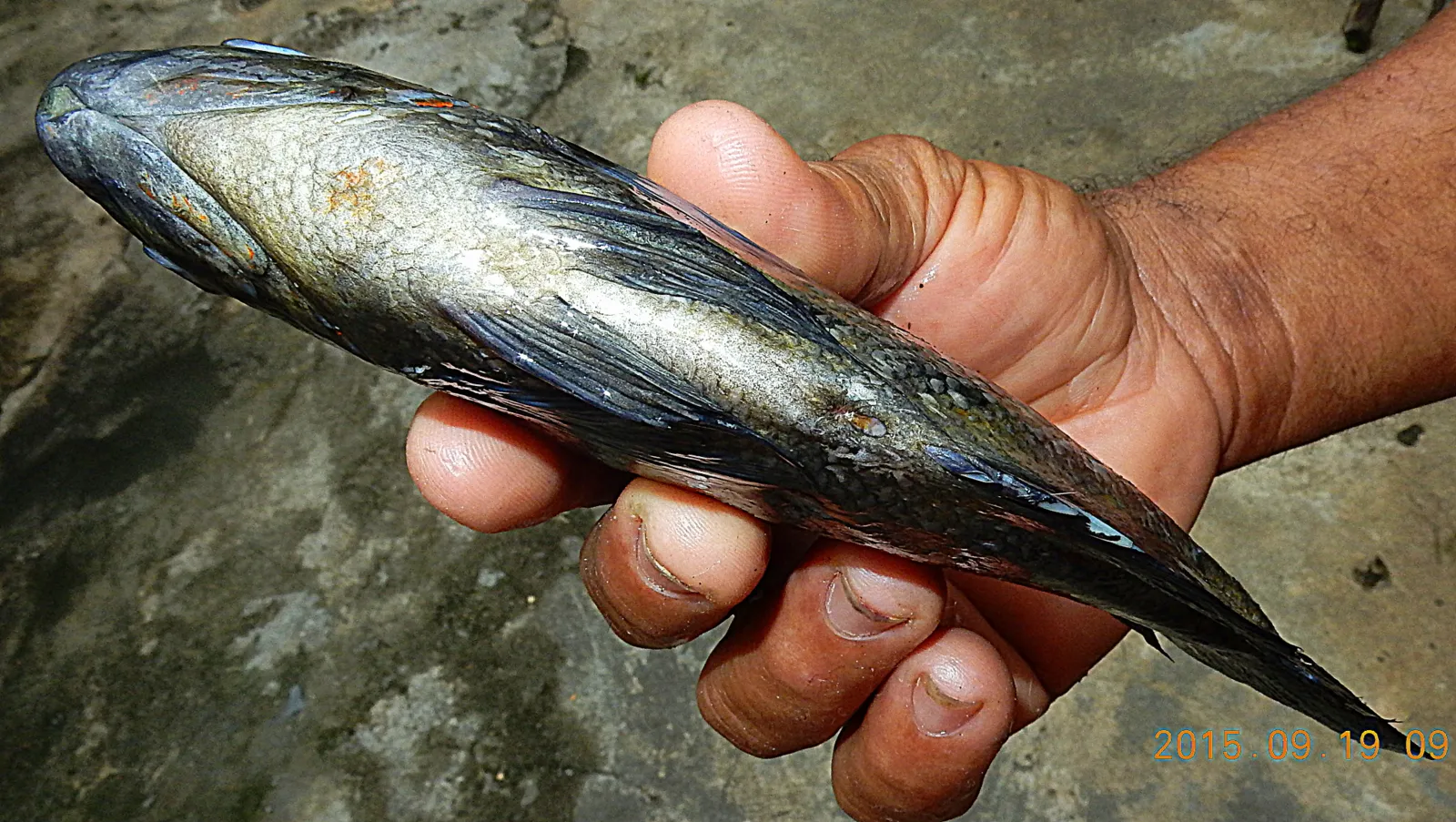
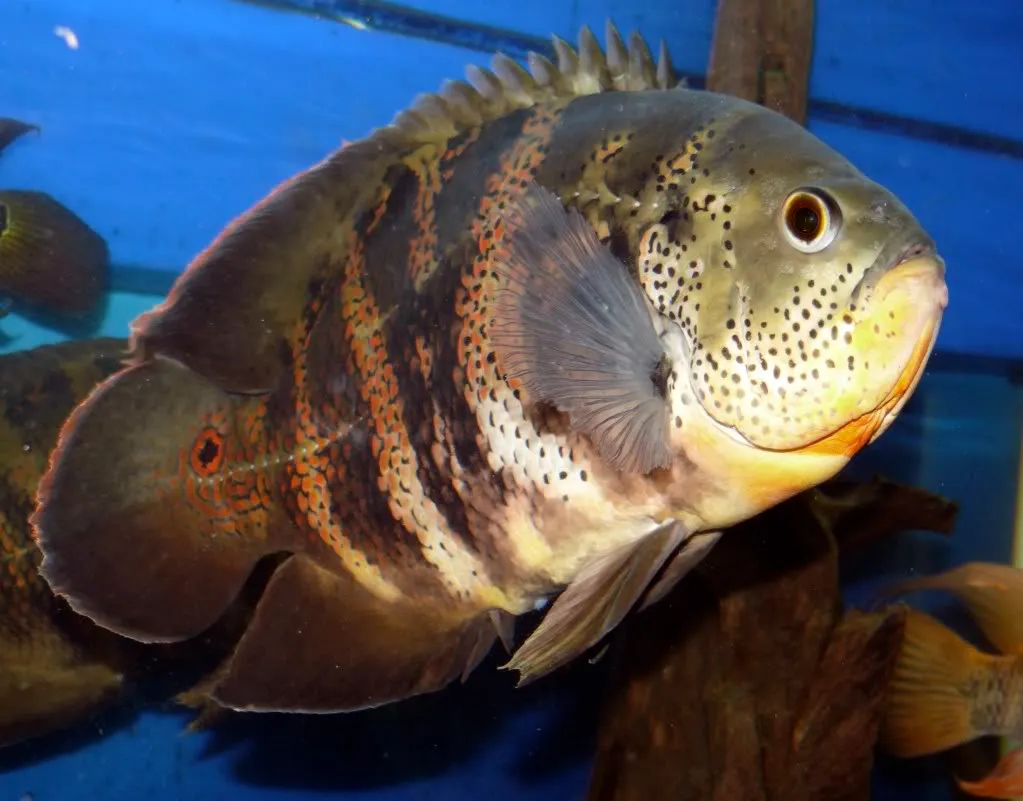
Astronotus crassipinnis has the classic oscar build — a tall, deep, laterally compressed body with a large head, big eye and a wide, protrusible mouth — but it runs slightly smaller and noticeably darker than its famous relative. FishBase lists a maximum of about 9.5 in standard length (roughly 10 in total length); imported wild fish are typically half-grown at 5.5–7 in. The single most useful field mark separates it from the common oscar: Astronotus ocellatus carries a group of two to twelve bright, dark-ringed eye-spots (ocelli) along the base of the dorsal fin, and in crassipinnis those dorsal ocelli are simply absent. The two species also differ in the arrangement of the dark bars down the flanks and in fin-ray counts. The ground colour is a very dark olive to near-black, often broken by irregular blotching and lighter marbling that varies a great deal between individuals; like all oscars it retains the species-defining ocellus — a black, light-ringed eyespot — on the upper caudal peduncle at the base of the tail, a marking thought to deflect the strikes of fin-nipping predators away from the head. The epithet crassipinnis ("thick-finned") refers to a subtler trait Heckel noticed: the bases of the spiny fin rays are sheathed in thick, fleshy, finely scaled skin. Sexual dimorphism is weak — as in other oscars the sexes are hard to tell apart outside breeding condition, when ripe females become visibly deeper and fuller in the belly; there is no reliable external colour or finnage difference, and vent shape at spawning is the usual recourse.
Habitat
This is a fish of two great river systems on the southern flank of tropical South America. Its native range spans the southern Amazon — specifically the upper Madeira drainage, taking in the Guaporé, Mamoré and Madre de Dios rivers of Bolivia, western Brazil and southeastern Peru — and the upper Paraguay basin, the river network that feeds the vast Pantanal wetland of Brazil, Paraguay and Bolivia. It does not naturally occur in the upper Paraná: populations now found there are introductions, most plausibly aquarium releases, and the species is treated as non-native and invasive in that basin. Ecologically it is a benthopelagic freshwater cichlid of warm, slow lowland waters — floodplain lakes, lagoons, flooded forest and the sluggish margins of large rivers — the seasonally inundated, structurally complex habitats that the Pantanal and the Amazonian várzea provide in abundance. In-situ water chemistry for crassipinnis specifically is not well documented in the literature; the fish tracks the warm, soft-to-moderate, near-neutral conditions typical of these lowland floodplains rather than any narrow chemical niche, and keepers report it thriving across roughly pH 6 to 7.5. Published depth figures for this species are scarce, but as a shallow floodplain inhabitant it lives in the upper few metres of the water column; the value below is given as a habitat estimate, not a measured range, and is flagged as such.
Feeding
Like the rest of its genus, the southern oscar is a robust generalist predator that sits fairly high on the food web — FishBase places it at a trophic level near 3.0. The clearest dietary data come from the introduced upper-Paraná population studied by Lopes and colleagues (2022), who described an omnivorous habit with a strong tendency to carnivory and a marked shift with age. Juveniles took mostly aquatic-insect larvae (chironomids, mayflies) and microcrustaceans such as ostracods, while adults moved onto larger, more rewarding prey — chiefly fish and molluscs. That ontogenetic switch from a broad invertebrate diet to vertebrate-and-mollusc predation, and the broader trophic opportunism it implies, is exactly the flexibility that lets the species establish itself where it has been introduced. The big mouth and the capacity to engulf any tankmate small enough to fit are the same traits hobbyists know from the common oscar. In its native floodplains it functions as a mid-level predator of the leaf-litter, vegetation and soft-sediment zones, eating what the season makes abundant.
Mating
Detailed field observations of courtship in Astronotus crassipinnis are thin, and most of what can be said responsibly is drawn from the genus's well-known behaviour and from aquarium experience with this species. Oscars are monogamous substrate spawners that form lasting pair bonds, and the reliable route to a pair is the same one keepers use for the common oscar: raise a group of six or more youngsters together and let them sort themselves into pairs as they mature, then remove the surplus. As a pair comes into condition the two fish select and meticulously clean a flat, firm surface — a rock, a slab of wood, the aquarium glass — and defend the area around it. Like all oscars these are powerful, territorial fish prone to bouts of intraspecific aggression, and a mismatched or crowded pairing can turn lethal; a tank large enough for the loser to escape is part of getting a pair to settle. Once bonded, the pair holds and defends the spawning territory together through the breeding cycle.
Breeding
Astronotus crassipinnis is a biparental substrate spawner: the female lays adhesive eggs in neat rows on the cleaned surface and both parents tend and guard the brood. The eggs are white and opaque when first laid; in a viable clutch they change colour over the first day or so as development proceeds, a cue keepers use to judge fertility. Species-specific fecundity has not been formally published, but the genus is highly productive — in the closely related and well-studied common oscar, smaller females lay on the order of a few hundred eggs and large females several thousand, so a clutch in the hundreds-to-low-thousands is the genus-typical expectation here (this figure is inferred from Astronotus ocellatus, not measured in Astronotus crassipinnis, and should be read as such). Parental care is extended: both parents guard the eggs and then shepherd the free-swimming fry, which can be left with the pair until they are independent. Breeding has been achieved in aquaria but the species remains uncommon in the hobby, so documented spawnings are comparatively few; the practical triggers are the usual cichlid ones — stable warmth, generous feeding on meaty foods, and large water changes.
In the aquarium
The southern oscar is a fish for the dedicated keeper, and the first decision is tank size. A single adult at 9.5–10 in requires a minimum of around 120 US gal (approximately 120 US gallons) of floor space, and a pair needs more — 160 US gal or above. The temptation to house a small juvenile in a modest setup and upgrade later is the most common keeper mistake with oscars of any species; the fish grow quickly and the upgrade almost never keeps pace. Filtration must be generous and robust. Like the common oscar, Astronotus crassipinnis is a messy, high-waste predator and biological filtration must be sized well above the tank volume; external canister filters rated for double the actual volume, or a combination of canister and sump, are the practical solution. The water changes the aquarium requires are large and frequent — 30–40% weekly is a reasonable baseline. Water chemistry should match the fish's floodplain origin: soft to moderately hard (general hardness ideally below about 12–15°dH), pH 6.0–7.5, temperature 75–82 °F. Slightly acidic, warm, and soft is ideal; the species is tolerant of a broader range, but hard alkaline water typical of a rift-lake setup is inappropriate. Decor should be minimal and anchored. A sand or fine-gravel substrate suits the fish and allows the natural bottom-rooting behaviour these cichlids display; a flat smooth stone or unglazed ceramic slate provides a ready spawning site. Any rockwork must be stable — oscars shove objects with purpose. Live plants are generally impractical with large adults, which uproot and damage vegetation; artificial plants or none at all is the realistic choice. Lighting has no special requirement beyond what suits the keeper.
Tankmates require careful thought. Astronotus crassipinnis is a predatory cichlid that will eat any fish small enough to be swallowed, and fish that fit in the mouth will be eaten regardless of how long they have been cohabiting. Suitable companions are limited to fish of similar or greater body size: large catfish such as Pseudoplatystoma or well-grown Pterygoplichthys species make reasonable dither fish and serve the added function of cleaning up food scraps. Large robust characins — pacu and silver dollar relatives (Metynnis, Colossoma) — are occasionally kept with oscars, and because they are comparably sized and fast-moving, they survive better than most. Mixing with other large cichlids is possible but carries aggression risk; if attempted, the tank must be large enough for a subordinate fish to escape and for territories to form without constant contact. Any fish under about 6 in is at risk. This species is less frequently encountered in the trade than Astronotus ocellatus and there is consequently less accumulated keeper experience with it specifically; where oscar husbandry notes cite Astronotus ocellatus, they transfer reliably to crassipinnis, which is noted here as a generalisation from the closely related species.
Breeding in captivity has been achieved, though documented spawnings are comparatively few given the species' scarcity in the hobby. The practical approach follows oscar-standard method: raise six or more juveniles together, allow them to pair naturally, remove surplus fish once a pair has formed and begun to show territorial behaviour. Sexing outside of spawning condition is not possible from external appearance. Once settled, the pair cleans a flat surface and spawns on it; the female lays adhesive, white, opaque eggs in rows and both adults stand guard, fanning the clutch and removing infertile eggs. Fertility can be assessed within a day by colour change in viable eggs. Both parents shepherd the free-swimming fry, and the family group can remain intact until the fry are independent. The main threats to a breeding attempt are aggression between the pair — ensure the tank is large enough for a reluctant partner to retreat — and water quality lapses, which are the fastest route to fungusing eggs. Triggers for spawning are consistent with the genus: stable warm temperature, generous feeding on meaty foods such as prawns, earthworms or quality cichlid pellets, and a series of large water changes to simulate the onset of the wet season.
Overall difficulty is intermediate to advanced. The species is tractable in the sense that it is hardy, adaptable and tolerant of the keeper's learning curve, but the volume of water it demands and the waste load it produces make it unsuitable as a casual purchase. Buying small and upgrading is the common error. A keeper who can commit to a large, well-filtered tank with regular heavy water changes, who sources appropriately large tankmates and accepts that smaller companions will eventually disappear, will find Astronotus crassipinnis a rewarding and personality-rich fish — intelligent, interactive and long-lived, in the manner for which oscars as a group are well known.
Conservation
The IUCN Red List assesses Astronotus crassipinnis as Least Concern, assessed on 4 November 2020 by Renata Guimarães Frederico. The rationale is the familiar one for a wide-ranging, adaptable lowland fish: a large native distribution across the southern Amazon and the Paraguay basin, no evidence of a significant decline, and only minor commercial value, which keeps targeted fishing pressure low. It carries no CITES listing, and its rarity in the aquarium trade means collection is not a population-level concern. If anything, the species is more often discussed as an agent of harm than a victim of it — its establishment as a non-native predator in the upper Paraná basin is documented as a biological-invasion problem, the flip side of the same hardiness and trophic flexibility that make it secure in its home range. The broader backdrop is the mounting pressure on lowland South American freshwaters: the Pantanal and the Amazonian floodplains that this fish depends on face dam construction, altered flood pulses, deforestation, agricultural expansion and, in the Pantanal, intensifying drought and fire. None of these is documented as a present threat to crassipinnis specifically, but they are the basin-scale forces against which its long-term status should be read.