Taxonomy & naming
Louis Agassiz described the oscar in 1831, in the Spix and Agassiz survey of Brazilian fishes (Selecta genera et species piscium), as Lobotes ocellatus. Lobotes is a strictly marine genus — the tripletails — so the placement was a famous early blunder: the type material was published with its locality given as the 'Atlantic Ocean,' almost certainly an error introduced when specimens reached Europe with little reliable collection data, and the oscar's deep, tripletail-like body did the rest. The fish now sits in the South American cichlid genus Astronotus, a name attributed to Swainson (1839), and it later gathered a string of synonyms as different authors re-described the same animal — among them Acara compressus Cope 1872, Acara hyposticta (Cope 1878), Astronotus ocellatus zebra Pellegrin 1904, and Astronotus orbiculatus Haseman 1911.
Astronotus belongs to the subfamily Cichlinae, the great radiation of Neotropical cichlids, though its exact branch has been argued over: Kullander (1998) once grouped it with Chaetobranchus and Chaetobranchopsis, while later molecular work (Smith et al. 2008; Lopez-Fernandez et al. 2010) places it near the base of the Cichlinae instead. For most of the twentieth century the genus was treated as effectively monotypic, but it is not — Astronotus crassipinnis (Heckel 1840) is a well-established second species, and Astronotus mikoljii was described from Venezuela and Colombia as recently as 2022. More unsettling for the familiar name, genetic work by Colatreli et al. (2012) found deep, geographically structured divergence within 'Astronotus ocellatus' with no clean match to current taxonomy, strong evidence that several morphologically cryptic species hide under the one label. Kullander's 1986 redescription, based on Peruvian material, remains the standard modern reference, and FishBase flags outright that names in the synonymy may prove to be valid species. The English name 'oscar' is of uncertain aquarium-trade origin; across its native range the fish carries many local names, among them acará-açú and apaiari in Brazilian Portuguese and carahuazú in Spanish.
Morphology
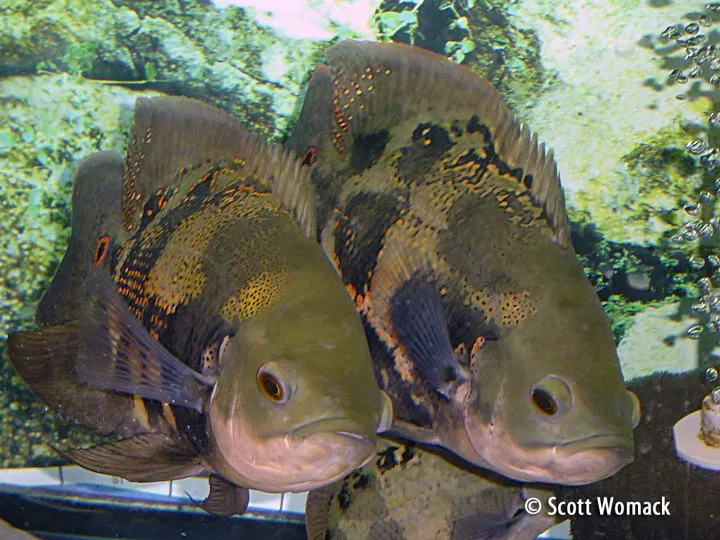
The oscar is a large, deep-bodied, oval cichlid with a big head, large eyes, and a wide, thick-lipped mouth built for engulfing prey rather than nibbling it. Its dorsal and anal fins are spiny in front and soft-rayed behind, with rounded trailing edges and densely scaled bases; the counts run to roughly 12–14 dorsal spines and 17–21 soft rays, with 3 anal spines and 16–20 anal soft rays. Wild fish are muted and cryptic — olive-green, gray, or chocolate-brown marbled with irregular blotches and stripes, often with a bright orange wash along the lower flanks and gill-cover margin. Juveniles look like a different animal: dark bodies crossed by wavy white and orange bars and peppered with small white spots on the head.
The defining mark is the ocellus — a black spot ringed in orange on each side of the upper caudal-fin base, with some fish carrying more than one. This eyespot gives the species its name and sits at the centre of its biology, not just its looks. Sexual dimorphism is weak: males run a little larger and more colourful, but there is no reliable external difference outside breeding condition, when a ripe female's ovipositor shows. In practice oscars are notoriously hard to sex by eye, and breeders confirm sex by venting — examining the genital papilla — rather than by appearance. Reported maximum size is commonly around 12–14 in and often rounded up to a foot or more; FishBase lists a maximum near 18 in total length and 1.6 kg, while field and aquarium fish more often top out at 12–15.5 in. The hobby has bred the wild animal into a parade of colour and finnage forms — red, tiger, albino, lutino, and long-finned 'lemon' oscars among them — none of which occur in nature. Astronotus ocellatus is told from its congener Astronotus crassipinnis by the ocellated spots at the dorsal-fin base, the position of the first light body bar, and small differences in fin-ray counts; Astronotus crassipinnis is darker overall and shows two dark bars where Astronotus ocellatus shows the first pale one.
Habitat
The oscar is above all a fish of the Amazon Basin, with its range reaching north into the Orinoco. Within the Amazon it has been collected from a long list of tributaries and mainstem reaches — the Ucayali, Solimões, Amazonas, Negro, Madeira, Tapajós, and Tocantins among them — and its records span Brazil, Peru, Colombia, Venezuela, Ecuador, Bolivia, the Guianas, and beyond. That breadth is exactly what the genetics calls into question: the wide-ranging 'Astronotus ocellatus' almost certainly bundles several species, and Kullander's redescription restricts the name in its strict sense to the western Amazon, around the Ucayali and upper Amazon of Peru and Brazil, where the diagnostic dorsal ocelli have mainly been documented.
This is a lowland, warmwater fish of slow and still places rather than fast channels. It lives mainly in lentic (still-water) settings — the shallow margins of sluggish or standing water in forested floodplains, including silt-laden whitewater, backwaters, lagoons, lakes, and flooded forest — where it hangs close to submerged roots, sunken branches, and overhanging marginal plants. Much of its day is spent 'resting' under cover, the sit-and-wait posture of an ambush predator. FishBase lists no specific depth range; consistent with its documented life in shallow floodplain margins, it is best read as a fish of the upper few metres of these structure-rich, slow waters rather than deep or open channels. In-situ conditions run to pH about 6.0–8.0, moderate hardness (dH 5–19), and tropical temperatures of roughly 73–82 °F; it tolerates a wide thermal band but is killed by cold, with a lower lethal temperature measured near 55 °F. One striking adaptation to its low-oxygen home is exceptional hypoxia tolerance — the oscar performs aquatic surface respiration, skimming the oxygen-rich film at the surface, and downregulates its metabolism to ride out the oxygen crashes of warm, stagnant, decomposition-rich water. That same hardiness has helped it establish feral populations well outside its native basin.
Feeding
Despite its sluggish look, the oscar is a carnivore-leaning generalist that makes its living as an ambush predator. The natural diet is dominated by smaller fishes, crustaceans (crayfish and shrimp among them), gastropods, and aquatic insects and their larvae, rounded out opportunistically with terrestrial and aquatic plant matter, fruit, and seeds when prey is scarce. FishBase places it at a trophic level near 2.8 — a predator, but a flexible one. A diet study by Winemiller (1990) found that the fish oscars ate were largely benthic catfishes (Bunocephalus, Rineloricaria, Ochmacanthus), fitting a bottom-oriented, cover-hugging hunter that lunges over short distances rather than running prey down. Some populations reportedly use thanatosis — 'playing dead' to draw scavengers within striking range — the same trick made famous by the African Nimbochromis of Lake Malawi.
The caudal eyespot is the most interesting thread in the oscar's ecology, and it has drawn more than one explanation over the years. Reviewing the debate, the Cichlids Yearbook recounts T. M. Zaret's 1977 study of the related peacock bass, Cichla ocellaris, which proposed that a caudal ocellus functions as a species-recognition signal that discourages cannibalism among similar-looking juveniles, and further suggested that the oscar — along with other large Neotropical cichlids such as Crenicichla — evolved a comparable mimic spot specifically to deflect predation from Cichla itself. Winemiller's 1990 work in the Venezuelan llanos (published in Copeia), drawing on five years of field data, offered a different and better-supported reading: oscars living alongside fin-nipping piranhas of the genera Serrasalmus and Pristobrycon suffered less fin damage than similar-sized sympatric cichlids that lack eyespots. The leading interpretation today is that the tail ocellus mimics the head end, deflecting a piranha's snapping bite away from the real eyes and toward the more expendable tail — a deflection mark rather than plain camouflage or an anti-cannibalism signal. And the oscar is prey as well as predator: all its life stages are taken by larger fish, wading birds, caimans, and other reptiles, placing it on a solid middle rung of the floodplain food web.
Mating
Oscars are monogamous cichlids that form lasting pair bonds — the foundation of the open-spawning strategy that makes them so engaging to keep. Pairs usually form by slow sorting: a group of juveniles raised together will pair off as they mature, after which the pair shuts everyone else out. A 20-year captive study of 189 pairs (Paiva 1989, reviewed in Buntbarsche Bulletin 140) compared 'natural' pairs that chose one another in a communal grow-out pond against randomly assigned 'sexed' pairs created by venting adults — a measure both of how firmly these bonds hold and of how hard the fish are to sex any other way.
A courting pair is unmistakable. The partners darken, deepen their orange flush, flare their fins, and display their caudal eyespots at one another, and rival males may lock jaws in trials of strength over territory or a mate. Once a pair has settled, both fish choose and meticulously clean a spawning surface — a flat rock, a submerged log, or a pit dug in the substrate — scrubbing away algae and debris before the female will lay. That deliberate, shared site preparation is the hallmark of the substrate-spawning cichlids, and it sets the stage for the spawning and brood care that follow.
Breeding
The oscar is a biparental substrate spawner — an open brooder, not a mouthbrooder. Once the pair has cleaned its chosen flat surface, the female lays her adhesive eggs in neat rows and the male follows to fertilize them. Clutches are large, commonly running from several hundred to one or two thousand eggs in a single spawning; the eggs are opaque white when laid, and a viable batch typically changes colour over the first day as development proceeds.
Both parents then guard and fan the clutch — driving oxygenated water over the eggs and picking off any that fungus — and a bonded pair defending a spawn becomes formidable, far more aggressive than at any other time. The eggs hatch in about three to four days; the parents move the wrigglers to a shallow pit and continue to shepherd the free-swimming fry, a stretch of extended biparental care that can run a week or more until the young disperse. In the wild, spawning happens year-round but peaks with the rainy season (Paiva 1989), and South Florida's feral oscars likewise breed mainly through the summer. In aquaria the triggers are simple: maturity, stable warm water, a clean flat surface, and the security of an established pair.
In the aquarium
The oscar is one of the most popular large cichlids in the hobby, kept for its bold, almost dog-like manner — it learns its keeper, begs at the glass, and will take food from the hand. None of that softens the fact most buyers overlook: this is a big, messy, long-lived fish that outgrows nearly every tank sold for it. A single adult reaches roughly 12–15.5 in, lives 10–20 years, and needs real floor space, so it is a decade-plus commitment rather than an impulse buy.
Tank: Seriously Fish recommends a footprint of at least 150 × 23.5 in for one fish, and experienced large-cichlid keepers broadly agree — a 75-gallon tank is the bare minimum for a single oscar, a 6-foot, 125-gallon-plus tank is far better, and a pair or any tankmates need more again. Substrate and decor: because the oscar is a notoriously messy feeder, a fine substrate that lets uneaten food sit on the surface for easy siphoning works better than coarse gravel that traps waste. Any rockwork must be too heavy for the fish to move and should rest directly on the tank bottom rather than on substrate it can undermine by digging; heaters and other equipment are safer sited behind a perforated corner divider or otherwise firmly secured, both to stop the fish cracking them and to keep water circulating behind the barrier. Lighting is best kept subdued rather than bright. Water: they are heavy eaters and heavy waste producers, so filtration must be generously oversized (several turnovers an hour) and backed by disciplined weekly water changes of 30–50%; captive-bred stock, which is almost the entire trade, is forgiving at roughly pH 6.0–7.5, moderate hardness, and about 72–82 °F (with 77–79 °F a good normal-maintenance target), while wild fish ask for more. Even so, Ad Konings recommends staying at or below pH 6.5 where possible, closer to the soft, acidic water of its native floodplains, despite the fish's evident tolerance for harder, more alkaline conditions. Because oscars dig, rearrange the decor, and have a reputation for cracking in-tank heaters, an external or guarded heater is wise. Diet: a quality cichlid pellet supplemented with live or frozen meaty foods such as earthworms, prawns, and shrimp. Tankmates: nothing small or delicate — companions must be too large to swallow and able to hold their own, so think larger characins, other robust South American cichlids, and big plecos or doradid catfish. Central American cichlids are a common but poor pairing: despite the superficial match in size and attitude, their preferred water chemistry runs harder and more alkaline than the oscar's native soft water, and in practice it is often the oscar that ends up bullied in that combination rather than the aggressor keepers expect. Common mistakes: overfeeding (they will always beg); feeding mammalian or avian meat like beef heart, or live 'feeder' goldfish, which carry disease risk and poor nutrition; and letting water quality slip, which — together with poor diet — is tied to the head-and-lateral-line erosion ('hole-in-the-head') oscars are famously prone to. The honest verdict: a rewarding, characterful fish for anyone with the room, the filtration, and the patience — and, precisely because so many buyers have none of those, one of the most commonly surrendered fish at shops and public aquaria.
Conservation
The IUCN Red List assesses Astronotus ocellatus as Least Concern (assessed 4 November 2020 by R. G. Frederico; published 2023), reflecting its enormous range across the Amazon and Orinoco basins, its broad habitat tolerance, and the absence of any documented decline. CITES and CMS list it as Not Evaluated. A wide-ranging, fast-maturing, hardy fish, it is not a conservation concern in the way a narrow-range endemic would be — FishBase rates its fishing vulnerability only moderate — and although it is harvested as a food fish across much of its native range and produced on an industrial scale by ornamental breeders, collection pressure on wild populations stays light.
The more interesting caveat is taxonomic rather than demographic. A 'Least Concern' rating is only as meaningful as the species it is attached to, and the evidence that 'Astronotus ocellatus' is a complex of several cryptic species (Colatreli et al. 2012; the 2022 description of Astronotus mikoljii) means a basin-wide rating could be masking narrower, less secure lineages not yet formally recognized. The wider backdrop is the Amazon Basin itself — the largest river system on Earth and a biodiversity stronghold under accelerating pressure from deforestation, hydroelectric dams that fragment and alter floodplain habitats, mercury contamination from gold mining, and a changing climate. A floodplain generalist like the oscar is better buffered against these stresses than many specialists, but it still depends on the seasonal flood pulse and the shallow, structure-rich backwaters that dams and land-use change disrupt. There is a flip side to that hardiness, too: its success as an invader. Established feral populations in South Florida, Hawaii, Puerto Rico, and Southeast Asia stem almost entirely from aquarium releases — stockings in the Everglades date to the late 1950s — and there the oscar is a recognized non-native that may compete with native sunfishes, a reminder that 'Least Concern' at home and 'problem' abroad can describe the very same fish.