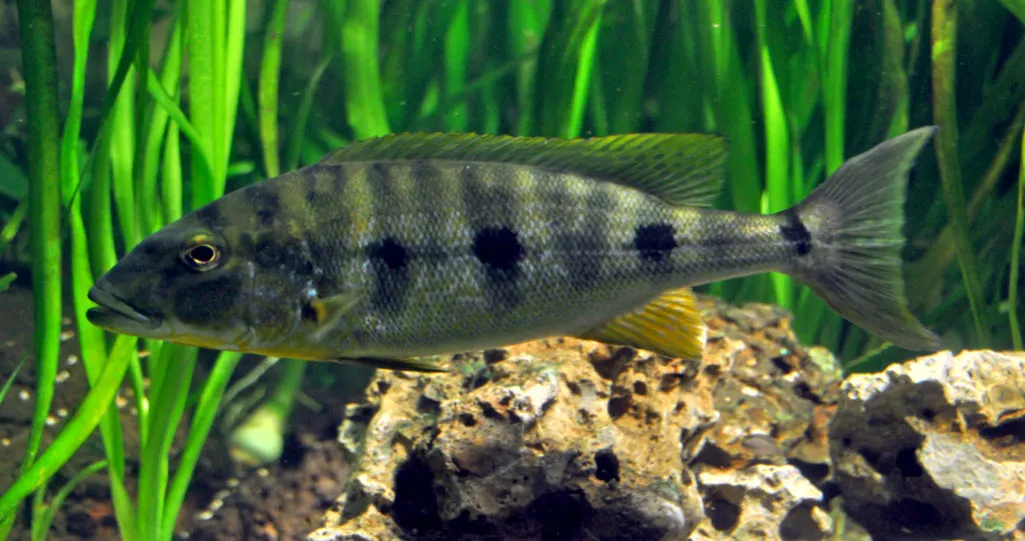
Taxonomy & naming
George Albert Boulenger described this fish in 1899 as Tilapia microlepis, from a specimen taken at Moliro on the southern shore of Lake Tanganyika in what is now the Democratic Republic of the Congo. It was later moved to its own genus, and the Catalog of Fishes today lists it as the valid Boulengerochromis microlepis (Boulenger 1899), with the original syntypes still held in London and Tervuren. The genus name honors Boulenger himself, the prolific Belgian-British zoologist who named a large share of Africa's cichlids; the species epithet, from the Greek for 'small-scaled,' points to the fine scales covering its great flanks.
What makes the fish remarkable taxonomically is its isolation. Boulengerochromis is monotypic — one genus, one species — and it sits alone in its own tribe, the Boulengerochromini, with no close living relatives in the lake's celebrated cichlid flock. Molecular work by Koblmüller and colleagues places its lineage among the earliest offshoots of the Tanganyika radiation, diverging more than eight million years ago, yet the species itself shows strikingly little genetic structure across the lake, consistent with a highly mobile, wide-ranging predator.
A parallel argument for that same 'early and isolated' status came, decades earlier, from reproductive biology rather than molecules — though it needs a caveat. Balon (1991), comparing the egg-brooding strategies of the coelacanth Latimeria to those of Tanganyika cichlids, treated Boulengerochromis's simple, high-fecundity sand-nest spawning as close to what the ancestral condition for the lake's cichlids might have looked like, with the lake's various forms of mouthbrooding as later, more derived innovations. His broader argument rested on treating Boulengerochromis, Haplotaxodon microlepis, Tanganicodus irsacae, and Cyphotilapia frontosa as a single evolving lineage — an assumption that does not hold up, since the Tanganyika cichlid flock is now understood to be polyphyletic, assembled from several independent lineages rather than one common ancestor (a conclusion Nishida (1991) confirmed not long after Balon wrote, and one consistent with Boulengerochromis's own deeply separate, monotypic placement noted above). The underlying natural-history observation still stands on its own, though: Boulengerochromis lays vast numbers of small eggs, in sharp contrast to the few, large eggs Cyphotilapia frontosa broods in her mouth for months — a genuinely simple, unspecialized reproductive style even if it is not literally the lake's ancestral one.
Hobbyists and anglers know it by several names: emperor or giant cichlid in English, and locally as kuhe, nkupi, or 'yellow belly' for its breeding color. Note that an unrelated fish, Haplotaxodon microlepis, shares the species epithet — a common point of confusion in catalogs.
Morphology
This is a big, deep-bodied, fusiform predator built for pursuit rather than ambush. Reports of maximum size vary, and the variation is worth stating plainly: FishBase and the Koblmüller study give a maximum of about 32 inches (31.5 in) total length, with Matthes's mid-century measurements and later observers describing fish 'exceeding 31.5 in,' while the Cichlid Room Companion cites roughly 28 inches (27.5 in) as a practical maximum. Maximum published weight is about 10 pounds (4.5 kg), though most adults are smaller — the specialist Ad Konings gives average adults of around 16 inches (15.5 in) for females and 20 inches (19.5 in) for males. The widely repeated hobbyist figure of 35.5 in appears to be an exaggeration; the defensible claim is simply that no other cichlid reliably grows larger.
Outside the breeding season the fish is silvery-green, marked with three dark blotches along the flank and a fourth on the caudal peduncle. Come breeding, both sexes transform into a vivid golden yellow — the source of the 'yellow belly' name — with the female often developing a darker, tiger-like patterning and the male showing blue spangling on the cheeks and gill covers. Sexual dimorphism is mostly a matter of size: males run larger, and in a settled pair the female is recognizable chiefly as the smaller of the two.
Habitat
Boulengerochromis microlepis is endemic to Lake Tanganyika and occurs lake-wide, in all four riparian nations — Burundi, the Democratic Republic of the Congo, Tanzania, and Zambia. Unlike the many rock-dwelling cichlids whose ranges fragment shore by shore, the emperor cichlid is a generalist of open and intermediate water, recorded from the surface down to considerable depth; sources differ on how deep, with FishBase listing a range to about 279 ft and Koblmüller and colleagues reporting captures to roughly 492 ft. It is found over most substrates but only infrequently over rock.
The waters it moves through are the hard, alkaline, remarkably stable conditions typical of Tanganyika: a pH around 8.5–9, moderate hardness, and surface temperatures generally in the range of about 75–79°F (75–79 °F). Adults favor deeper sandy and intermediate zones, where they hunt; they move into shallow water mainly to breed or, as Konings notes, to fatten in preparation for spawning. This tie to open and sandy habitat, rather than to a particular reef, is exactly why the species shows so little geographic genetic differentiation.
Feeding
The emperor cichlid is one of the lake's few true top predators among the cichlids, with a trophic level estimated around 4.5 — about as high as a freshwater fish gets. Adults are primarily piscivorous, running down prey rather than ambushing it. In the open water they pursue the lake's pelagic clupeids — the herring-like Stolothrissa and Limnothrissa that also anchor the human fishery — and over sand they take schooling cichlids such as Xenotilapia and Grammatotria. The diet is not strictly fish: published gut studies record crabs, shrimps, molluscs, and insect larvae, and juveniles up to about 8 inches (8 in) lean more heavily on larger invertebrates such as crabs before shifting fully to fish as they grow.
Growth is fast — by hobbyist and field accounts the fastest of any cichlid — with males reaching adult size in under three years. That rapid growth, large adult size, and high feeding rate make the emperor cichlid an ecologically expensive animal to be, and it helps explain a life history organized around one decisive reproductive event rather than a long career of repeated spawnings.
Mating
Boulengerochromis microlepis is a biparental substrate spawner — unusual in a lake whose cichlid fame rests largely on mouthbrooding — and forms monogamous pairs that defend a nest together. Pairs form the hard way: in nature and in captivity alike, young fish grow up in loose groups and turn on each other as they mature, the survivors whittling down through fighting until a single bonded male and female remain. Once settled, that pair is the social unit, and it becomes intensely territorial as breeding approaches.
A few days before spawning the pair moves into shallow intermediate habitat and selects and clears a site, driving off other fish from a wide area around it. The female may excavate a broad crater in sand, though eggs are also laid on flat stones, clusters of small stones, or shells, always near rock. The male and female cooperate closely in preparing and defending the chosen ground, and it is this coordinated territorial defense — boisterous, relentless, and aimed at anything that approaches — that sets the stage for the enormous spawning to follow.
Breeding
When the pair spawns, the female lays in long rows that the male fertilizes in turn, a process that can take close to two hours. Fecundity is extraordinary: counts run from about 5,000 to 12,000 eggs in a single spawn, among the highest of any cichlid. After the eggs hatch in roughly three days, the parents shuttle the wrigglers between shallow pits, sometimes moving them several times a day over distances of up to 30 feet (33 ft) — a tactic thought to confuse scent-hunting predators such as nocturnal catfishes. The fry begin feeding on their own remarkably early for so large-bodied a fish — independent, exogenous feeding starts at around 0.5 in in length (Balon, 1991) — well before they resemble anything but easy prey for the very predators the parents are chasing off. The pair guards a dense cloud of fry that can number in the thousands, leading them toward deeper, rock-free water as they grow.
The most striking claim about this fish is its reproductive fate. Poll, dissecting ripe adults in 1956, found their digestive tracts resorbed and concluded the species breeds only once in a lifetime; Kuwamura's 1986 fieldwork and Konings's observations of emaciated parents still tending nine-month-old young support a semelparous, 'big-bang' strategy in which adults effectively starve while guarding the brood, then die. This is almost unique among cichlids, a family otherwise known for repeated, iterative spawning. But the picture is genuinely debated. Koblmüller and colleagues describe the species only as 'probably semelparous,' and a captive female that had her eggs removed soon after spawning went on to lay three clutches in a month — implying that the resorption Poll observed may be a consequence of prolonged parental care rather than an obligatory, one-and-done physiology. The honest summary is that the emperor cichlid normally breeds once and dies in the attempt, but whether that is truly unavoidable remains an open question.
In the aquarium
This is emphatically not a community fish, and almost no private aquarist can house it properly. It is occasionally offered as a handsome golden juvenile a few inches long, and it grows astonishingly fast into a powerful predator that will eat any tankmate small enough to swallow. Konings, in Enjoying Cichlids, puts a hard floor on this at over 260 US gallons even for a small growing-out group of juveniles; a mature, near-meter-long adult pair needs meaningfully more room than that, and other guidance aimed at full adults points toward something on the order of 1,100 US gallons (roughly 1,055–1,320 US gal) as a realistic minimum. Either way, the fish is best regarded as public-aquarium material. The hard, alkaline water it needs is easy to provide; the space, filtration, and feeding load are not.
Keepers who have raised groups consistently report the same arc: juveniles grow rapidly and turn on each other, and a batch will whittle itself down through fighting until a pair forms. The best-documented case, first published by Fohrman in The Cichlids Yearbook (1994) and later reproduced at Cichlid Room Companion, involved the Swedish aquarists Rasmus Plomin and Kenneth Bengtsson: in summer 1991 they bought eight wild-caught, Zambian-collected juveniles of 2.5–3 in and grew them on in a 250-litre tank, where they thrived for eight to nine months before reaching about 6 in and turning on each other — five were killed in short order, leaving three survivors that were moved to larger quarters, with aggression flaring again at each subsequent size increase until a single pair remained. Forum reports from experienced large-fish keepers echo this arc: a settled pair can be relatively calm in a big Tanganyikan setup, but the species is territorial, boisterous, and quick to clear a spawning area of anything in its way. As community evidence rather than fact, these accounts agree that the emperor cichlid is a specialist's animal demanding heavy feeding (preferably fish-based foods), frequent large water changes to control nitrate, and far more room than its cute juvenile form — or its modest starter tank — ever suggests. For nearly everyone, the right place to appreciate this fish is in the lake.
Conservation
In March 2025 the IUCN reassessed Boulengerochromis microlepis as Near Threatened (criterion A2d), a notable downgrade from the Least Concern status it held in 2006. The species remains widespread and still 'quite abundant' across Lake Tanganyika, and it is not range-restricted, but the assessment records a decreasing population and suspects a decline of roughly 20–29% over the past decade — more than three generations for this fast-living fish — driven chiefly by fishing pressure, including illegal ring-net use in near-shore waters. The emperor cichlid is itself a prized food and sport fish: its firm flesh commands a high price, one of its local names, 'English fish,' reflects its standing as a premium catch, and it has long figured in beach-seine and commercial landings. A large, slow-to-mature, single-spawning predator is exactly the kind of fish that fisheries deplete first.
That species-level concern sits inside a lake under broad strain. Tanganyika supports millions of people, and its pelagic fishery has historically supplied an estimated 25–40% of the animal protein in surrounding countries (O'Reilly et al. 2003). The same study found that twentieth-century warming has increased the stability of the water column and reduced the wind-driven mixing that brings deep nutrients to the surface, cutting primary productivity by about 20% and implying roughly a 30% drop in fish yields — an effect the authors judged larger than that of local overfishing alone. A 2023 multi-author status review of the lake (Phiri, Mushagalusa, Sibomana and colleagues — several of them also authors of the emperor cichlid's IUCN assessment) catalogs the wider pressures: sedimentation and nutrient loading from deforested catchments, pollution, habitat loss, and the governance challenge of managing a shared resource across four countries. For the emperor cichlid the two threads converge: as a benthopelagic predator dependent on the lake's open-water clupeids, it is exposed both to direct overfishing and to the warming-driven productivity decline thinning the prey base beneath it. None of this makes the species endangered today — it is not — but the trend lines, and the lake it depends on, both point the wrong way.