Taxonomy & naming
The species was described by Paul Gervais in 1848 as Acerina zillii, the name honoring a "Monsieur Zill" whom Gervais credited as the naturalist who collected the type and sent it to the Paris museum. For most of the twentieth century it was universally called Tilapia zillii, and that name still dominates the older fisheries and aquarium literature. The current placement in the genus Coptodon follows the molecular phylogeny of Dunz and Schliewen (2013), who broke up the catch-all genus "Tilapia" into several distinct lineages; their conclusive molecular work moved zillii, rendalli and their relatives into Coptodon, the biparental substrate-spawning "tilapiines." The IUCN assessment notes the transfer explicitly: the species "was long time known as Tilapia zillii but had been transferred to the genus Coptodon by conclusive molecular studies by Dunz and Schliewen (2013)."
The synonymy is long and tangled, reflecting a fish that was repeatedly re-described across a huge range — Chromis andreae, Tilapia melanopleura, Tilapia tristrami, Tilapia shariensis and more all collapse into Coptodon zillii. That history matters for identification: the name Tilapia melanopleura was historically applied to both this species and the closely similar Coptodon rendalli, and a documented Yangambi pond mix-up in the mid-twentieth century muddied which fish was actually being moved around Africa. Common names track its enormous range, from "redbelly," "banded tilapia" and "Zill's tilapia" in English to ngege and sato in Swahili and bulti akhdar in Arabic. It sits in the tribe Coptodonini, well outside the haplochromine and lamprologine flocks that built the great lakes' endemic diversity.
Morphology
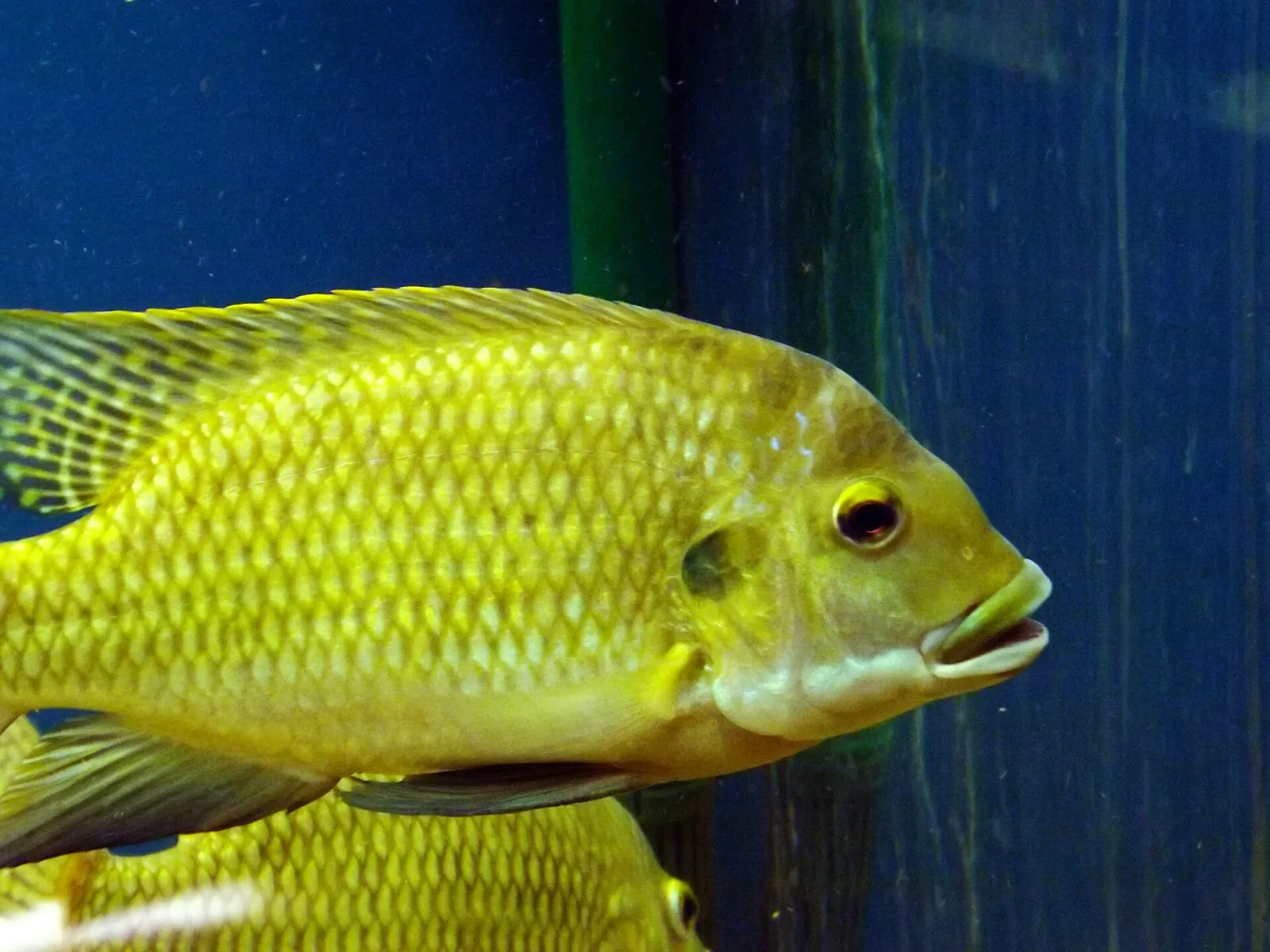
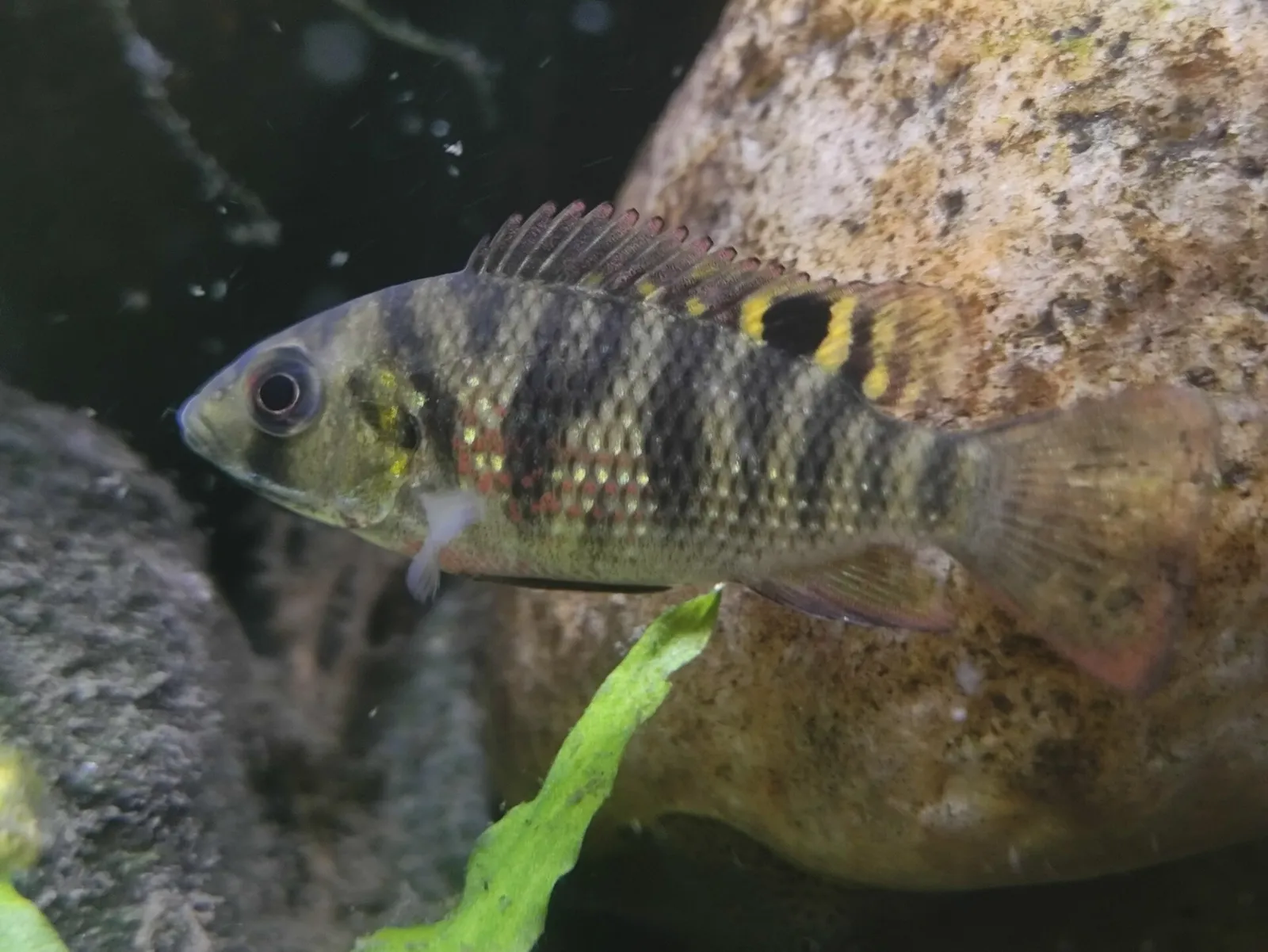
Redbelly tilapia is a robust, laterally compressed cichlid with a fairly narrow head and small, strong jaws set with bicuspid, vegetation-shearing teeth. FishBase gives a maximum of about 16 in (15.5 in) standard length with a common length near 12 in (12 in) and a maximum published weight around 0.66 lb (300 g) — a mid-sized tilapia, not a giant. The fin counts are diagnostic within the group: 13–16 dorsal spines and 10–14 soft rays, with three anal spines and 8–10 anal soft rays.
The body is typically brownish-olive with an iridescent blue sheen, often crossed by prominent dark vertical bars and, in breeding or excited fish, the bright red to pinkish belly and chest that give the species its name. The lips can be a vivid green, and a dark "tilapian" blotch sits on the rear of the soft dorsal, characteristically ringed by a yellow band. The sexes look much alike; in a settled pair the male is usually the larger fish. The real identification headache is its near-twin, Coptodon rendalli: the two overlap broadly, but Coptodon zillii tends to show a less-steep head profile and bolder vertical barring, and in East Africa Coptodon rendalli often has a tail split into a darker upper and reddish lower half, whereas the tail of Coptodon zillii is more uniform. Misidentification between the two — and with introduced look-alikes elsewhere — is common enough that some literature records should be read with caution.
Habitat
This is a fish of the northern half of the continent, not the rift lakes. Its natural range runs from southern Morocco and the Saharan oases across the Senegal, Niger–Benue, Volta, Ogun and Chad basins, into the middle Congo tributaries (the Ubangui–Uélé–Ituri), and east through Lakes Albert and Turkana, the Nile, and the Jordan system of Israel, Jordan and Palestine. The IUCN assessment (Lalèyè 2020) maps it as native to roughly thirty countries spanning West, North and Northeast Africa and the Near East, and as introduced in many more — from Cameroon and Madagascar to Iran, Iraq and Turkey, where it is highly invasive in the Tigris–Euphrates.
Across its range it is a demersal, potamodromous fish of shallow water, generally 0–33 ft and occasionally down to about 98 ft, favoring waterlily zones, inlets, drowned forest and vegetated sandy margins rather than open or deep water; fry shelter in marginal vegetation and juveniles in the seasonal floodplain. It is strikingly tolerant: FishBase records a pH range of 6.0–9.0 and a natural temperature span around 50–97 °F (51–97 °F), and the IUCN notes it is the most salt-tolerant of all tilapias, surviving salinities as high as 40‰ — at or beyond full seawater. That plasticity is exactly why it has been moved so widely — and why it so often escapes and establishes.
Feeding
Ecologically, Coptodon zillii is a macrophyte specialist turned generalist. It is fundamentally herbivorous, with a low trophic level around 2.5; adults shear and graze the leaves and stems of submerged plants and supplement that with filamentous algae, epiphyton, periphyton, diatoms and vegetative detritus, taking some aquatic invertebrates as well. Dietary studies summarized by the USGS report that aquatic macrophytes, algae and diatoms typically make up more than 80% of the diet, with the animal fraction — aquatic insects, small crustaceans, fish eggs — rising as the fish grows larger.
That plant-shredding habit defines its ecological footprint. In its native floodplains it is one of several grazers cropping marginal vegetation. Where it has been introduced, the same appetite becomes a wrecking ball: in a North Carolina cooling reservoir, introduced redbelly tilapia eliminated essentially all aquatic macrophytes within about two years, then persisted by switching to other foods even after the plants were gone. That very capacity is why the species has been deliberately stocked elsewhere as a biological control agent for nuisance aquatic weeds — a use the IUCN records directly, and one that has repeatedly backfired into invasion.
Mating
Unlike the mouthbrooders that dominate so much of East Africa's cichlid story, Coptodon zillii is a biparental substrate spawner — and that single fact shapes its whole social life. Pairs form monogamous bonds and become strongly territorial around a nest, usually a saucer-shaped pit excavated in mud, sand or pebbly lake bottom among abundant vegetation. Pairing precedes spawning: a male and female establish and defend a shared territory, clearing and cleaning a hard surface within the nest pit before eggs are laid.
Outside the nesting window the fish are comparatively unremarkable — diurnal, demersal, sometimes loosely schooling — but pairs in spawning condition are bold and pugnacious, patrolling and clearing intruders from the nest area. Breeding timing tracks climate: in warm, thermally stable equatorial waters the species can spawn year-round, with a bump during the rains; in more seasonal settings it concentrates spawning in the warmer months. That combination of monogamous pairing, broad tolerance and aggressive territoriality is the front end of a reproductive strategy built for colonizing new water.
Breeding
Coptodon zillii is emphatically not a mouthbrooder. Adhesive eggs — up to roughly a thousand per spawn from a large female — are laid on the cleaned hard surface of the nest pit and guarded by both parents (Eyeson 1983). Hatching follows in a few days, and the larvae develop in close association with the substrate, remaining near the nest before becoming free-swimming. Both fish defend eggs and larvae thoroughly; the IUCN summary records that the species "deposits and guards eggs in a shallow nest" and that "adhesive eggs are laid on the substratum which are guarded by both parents."
This biparental nest defense, paired with high fecundity and the species' enormous physiological tolerance, is precisely the recipe that makes redbelly tilapia so successful — and so disruptive — when it reaches new water. A monogamous pair can convert a patch of weedy margin into a defended nursery and turn out large broods repeatedly through a long warm season, which is exactly the demographic profile of a runaway invader.
In the aquarium
Let's be plain: redbelly tilapia is not an aquarium showpiece, and it's not a beginner's African cichlid in the way the Tanganyikan shell-dwellers or Malawi mbuna are. It is kept — mostly by tilapia and food-fish enthusiasts, by aquaponics growers, and by the occasional big-cichlid keeper — rather than collected for its looks. A fish that reaches a foot or more, digs, and grazes plants needs real space: think a long tank measured in the 75-gallon-plus range for adults, with the footprint mattering more than the height, and expect it to rearrange the substrate and demolish live plants. Water chemistry is genuinely the easy part, given a species that shrugs off a pH from 6 to 9, a wide temperature band, and even brackish or marine salinities; clean water and adequate filtration for a messy, plant-eating fish matter far more than chasing precise parameters.
The honest cautions are temperament and legality. Spawning pairs are territorial and will harass tankmates, so this is a fish for a species setup or robust, similarly sized company, not a planted community. Sexes are hard to tell apart outside of breeding behavior. Most importantly, because Coptodon zillii is one of the most widely introduced fishes on Earth and a proven invasive — it tolerates cold better than many tropicals and breeds prolifically — it is regulated or outright prohibited in parts of the United States, Australia and elsewhere. Never release one, and check local rules before acquiring it. Treat it as a hardy biology and food-fish project rather than a decorative centerpiece, and it rewards you; treat it casually, and it will outgrow, out-dig and out-breed your plans.
Conservation
On its own account, Coptodon zillii is in no trouble. The IUCN Red List assesses it as Least Concern (assessed 21 April 2019, published 2020; assessor Lalèyè), citing a very wide distribution with no known major widespread threats; the global population trend is simply listed as unknown, with no population data available. Localized pressures exist — destruction of macrophyte beds by drag and seine nets, and in North Africa dams, water pollution, groundwater extraction and drought — but for a tolerant, fast-breeding, commercially fished species these don't add up to extinction risk. The assessment concludes that no conservation actions are needed for this common and tolerant fish.
If anything, the conservation literature worries about Coptodon zillii as a threat to other ecosystems. It is one of the most widely introduced freshwater fishes in the world: stocked for food and for aquatic-weed control, it has established far beyond its native range — invasive in the Tigris–Euphrates, in inland waters of the southwestern United States and elsewhere — where its appetite for macrophytes, its salt and cold tolerance, and its prolific biparental breeding let it strip vegetation and displace native fishes. The honest summary is a split verdict: as a species it is secure to the point of being a global colonizer, and the real conservation concern is not its survival but its impact on the waters it invades.