Taxonomy & naming
Chromidotilapia kingsleyae was described by the prolific Belgian-British ichthyologist George Albert Boulenger in 1898, in the Proceedings of the Zoological Society of London, from material collected on the Ogowe River in Gabon. Boulenger made it the type species of his new genus Chromidotilapia, so the name anchors the entire genus by monotypy. The name-bearing type series is held at the Natural History Museum in London; Anton Lamboj selected a lectotype (BMNH 1896.5.5.30) in 1998, with paralectotypes in London and a specimen at the Muséum national d'Histoire naturelle in Paris. The species has had a slightly unsettled history: at one point Lamboj (2000) treated kingsleyae as a valid subspecies of the wide-ranging Chromidotilapia guntheri rather than a full species, but later work — including his own Gabon revisions — restored it as a distinct, valid species, the consensus today. Chromidotilapia is a small genus of around eleven species spread across West and West-Central Africa, and Lamboj's studies of its varied mouthbrooding styles suggest the group is more phylogenetically heterogeneous than its tidy generic boundary implies. Chromidotilapia kingsleyae sits within the African cichlid subfamily Pseudocrenilabrinae. Identification in the wild and the trade has long been muddied by confusion with close relatives: FishBase notes that specimens labelled Chromidotilapia kingsleyae from outside the Ogowe basin are almost always misidentifications, most often of Chromidotilapia mamonekenei or Chromidotilapia melaniae, two species Lamboj distinguished only in the late 1990s and early 2000s.
Field workers have long split Chromidotilapia into two informal groups. The guntheri–kingsleyae group unites C. guntheri (with its subspecies loennbergi and bosumtwensis) and C. kingsleyae alongside roughly half a dozen still-undescribed species from the Ogowe drainage in Gabon and two more from the Republic of the Congo. A second, smaller-bodied batesii–finleyi group — C. batesii, C. finleyi, C. linkei, and an undescribed species from the Korup region — is distinct in size and, per aquarium breeding reports, in mouthbrooding reliability (Konings, Cichlids Yearbook Vol. 1).
Morphology
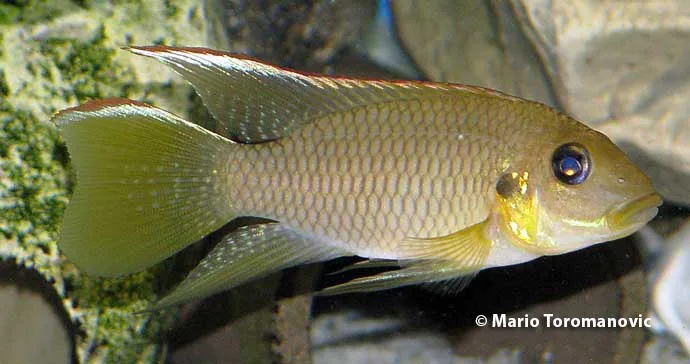
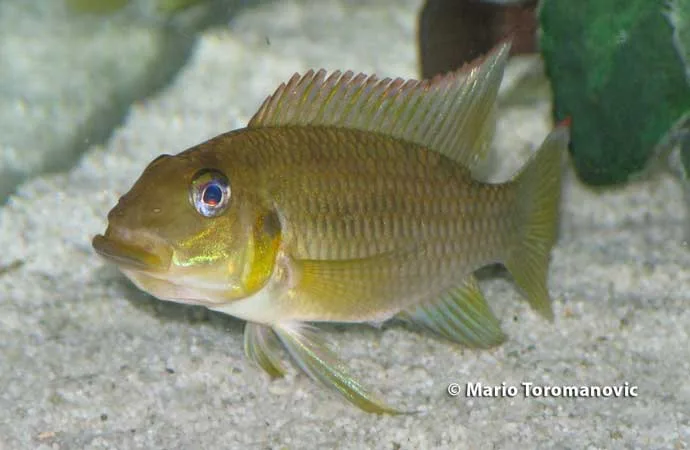
This is the bulkiest Chromidotilapia. FishBase records a maximum standard length of about 5 in with a maximum total length of 6.5 in, while aquarium and trade sources put well-grown adults at 6–7 in total length, comfortably the largest in the genus. Field data complicate that ceiling: Ad Konings, reporting on a 1988 collecting expedition to Gabon, recorded fully mature wild females reaching about 8 in — larger than either the FishBase or trade figures (Cichlids Yearbook Vol. 1). We flag rather than resolve that gap; it may reflect wild fish simply outgrowing what aquarium and museum material captures, but it sits uneasily with dimorphism reports that make males, not females, the larger sex. The body is fusiform and moderately deep (body depth roughly 26–40% of standard length, averaging about 35%), with the solid, slightly elongate build typical of a substrate-oriented river cichlid rather than a slab-sided lake form. Base coloration is a warm light brown to ochre, often with a metallic sheen across the gill cover and a subtle iridescence to the flanks and unpaired fins; unlike some congeners it lacks large bold flank spots. When stressed or displaying, four to six dark vertical bands — or two rows of dark blotches and short horizontal lines — emerge on the sides. Fin counts run to 14–15 dorsal spines, 10–12 dorsal soft rays, three anal spines and six to eight anal soft rays, with 15–19 gill rakers on the first arch. The mouth is pointed and angled downward, the same build seen across the guntheri–kingsleyae group and functionally similar to the South American eartheaters Geophagus and Satanoperca (see Feeding). Sexual dimorphism is clear and useful to keepers: males grow roughly a third larger than females and develop a more elongate caudal fin, truncate or drawn out into trailing rays in the upper lobe (sometimes also the lower), whereas females keep a rounded to slightly truncate tail and, in breeding condition, a brighter, more contrasting belly and throat. Males are the showier, larger sex overall.
Habitat
Chromidotilapia kingsleyae is a Lower Guinea endemic, restricted to the Ogowe (Ogooué) river system of Gabon — the dominant drainage of that country and one of the richest fish faunas in Central Africa. The IUCN treats it as confined to the Ogowe basin; Eschmeyer's Catalog of Fishes lists its distribution as Gabon and the Republic of the Congo, but the more recent ichthyological and conservation literature regards records outside the Ogowe as misidentifications of similar congeners, so the secure native range is Gabonese. These are warm equatorial forest waters: FishBase gives a preferred temperature band of roughly 73–79 °F, consistent with the lowland and mid-altitude rivers, side channels and inundated margins of the Ogowe and its tributaries. Like most soft-water Lower Guinea cichlids the species occupies tea-stained to clear forest waters that tend to be soft and mildly acidic to near-neutral, over sand, leaf litter and submerged wood, where it forages along the bottom and among structure. Precise in-situ chemistry for this species is sparsely published, but the habitat is the classic warm, soft, slow-to-moderate blackwater and clearwater of the Gabonese rainforest; it is a benthopelagic fish of shallow inshore and channel-margin water rather than open deep river. It is not a lake fish and has no deep-water phase. Field surveys place it specifically in the Ngounié, the Ogowe's major southern tributary, where it was the only Chromidotilapia found in the main channel between the Du Chaillu Massif and the coast; smaller, still-undescribed relatives instead occupy the tributary streams and coastal forest creeks of the neighbouring Nyanga drainage (Konings, Cichlids Yearbook Vol. 1).
Feeding
Chromidotilapia kingsleyae is an omnivore with a preference for small particles. Dietary work cited by FishBase describes it taking a range of small food items and, only rarely, small fish — so while it is capable of the occasional predatory snap, it is not a specialised piscivore. Its assigned trophic level (around 3.4 by FishBase's estimate) places it as a mid-level generalist that works the substrate and lower water column, picking through sand, detritus and leaf litter for invertebrates, larvae, small crustaceans and plant and organic matter. In its forest-river community it fills the role of a robust benthic forager, large and bold enough to dominate a feeding patch but not built as a hunter of larger prey. Mechanically, members of the guntheri–kingsleyae group feed by taking a mouthful of sand and sediment, working — 'chewing' — it against the substrate, and passing the material back out through the gills while edible matter is retained, a downward-mouth sifting mode Konings likens functionally to the South American eartheaters Geophagus and Satanoperca (Cichlids Yearbook Vol. 1). This broad, opportunistic diet is part of why the species adapts so readily to aquarium foods.
Mating
Here Chromidotilapia kingsleyae departs sharply from the genus stereotype. Most Chromidotilapia are monogamous, pair-bonding biparental mouthbrooders in which a male and female stay together and share — or in which the male does much of — the brood-carrying. Chromidotilapia kingsleyae instead is polygamous and does not form lasting pair bonds: a dominant male, given the room and the females, holds a loose harem and spawns with several females in succession, living as Frank Schäfer of Aquarium Glaser put it 'as if in a harem.' Although both sexes can in principle participate in brood care, in practice the male contributes little once spawning is done and the females take over entirely. Courtship and spawning are tied to a male's defended area; ripe females approach, spawn, and then withdraw to brood. This social structure — one large male, multiple smaller brooding females — shapes everything about how the fish should be kept, since a single male will harass lone or unreceptive females and a balanced group is needed to spread that pressure.
Breeding
Chromidotilapia kingsleyae is an ovophilic, female (maternal) mouthbrooder. The female takes the fertilised eggs into her mouth and incubates them there through hatching and the early free-swimming stage, releasing the fry to forage and gathering them back into her mouth at any sign of danger. This is a different reproductive mode from the biparental and male-dominant mouthbrooding seen elsewhere in the genus, and it is one of the behavioural clues Lamboj used in arguing that Chromidotilapia is more heterogeneous than it looks. Published clutch figures specific to this species are scarce; congeneric Chromidotilapia mouthbrooders typically carry on the order of dozens to a couple of hundred eggs and fry, a sensible expectation here given the female's mouth-incubation limit and the species' larger size, though the exact number for kingsleyae is not well documented and should be treated as genus-typical rather than measured. Parental care is essentially all maternal: the female broods, then guards and re-mouths the released young; the male defends territory but invests little in the brood. Spawnings in captivity are reported but the fish is not a common aquarium subject, and most modern stock traces back to specimens collected in Gabon in the 1990s rather than ongoing wild imports.
In the aquarium
Chromidotilapia kingsleyae is an uncommon but rewarding aquarium fish for keepers interested in West African cichlids and in mouthbrooding behaviour. It is not a tank-buster in the Oscar mould, but at a potential 6–7 in it is the largest of its genus and needs space accordingly: a single male with two or three females is best housed in a tank of around 59 in / roughly 120 US gal or more, both to absorb the male's polygamous pressure and to let subordinate females retreat. A skewed sex ratio favouring females over a single dominant male is the standard recommendation; a lone pair risks the female being harassed.
Replicate the warm, soft Gabonese forest water it comes from. A temperature of about 75–81 °F suits it (FishBase's preferred band runs 73–79 °F), with soft to moderately soft water and a pH on the acidic-to-neutral side — broadly pH 6.0–7.5, leaning toward 6.0–6.8 for breeding. Fine sand is the right substrate, since this is a bottom-forager that sifts and digs; furnish the tank with driftwood, leaf litter, roots and caves or flowerpots to break up sightlines and give females and lower-ranking fish refuges. Subdued lighting and tannin-stained water bring out its understated colours and keep it confident. Good filtration and regular water changes matter, as with any larger cichlid, but it is not especially demanding chemically and adapts to a range of conditions once acclimated.
Feeding is straightforward: a varied diet of quality sinking pellets or flake supplemented with frozen and live foods — bloodworm, brine shrimp, small crustaceans — keeps it in condition, matching its small-particle omnivory in the wild. Tankmates should be robust enough not to be bullied during spawning but not so boisterous as to outcompete it; medium-sized West African characins, other peaceful-to-firm river fish, and similarly sized non-territorial cichlids work, while small timid species and other males of its own kind in a confined tank do not. The chief husbandry mistakes are keeping a lone pair (where the male's harem instinct turns into relentless harassment), under-sizing the tank for a species that gets larger than its slim trade reputation suggests, and confusing it with the more common, more pH-tolerant Chromidotilapia guntheri.
Conservation
The IUCN Red List assesses Chromidotilapia kingsleyae as Least Concern (assessed 16 February 2009 by T. Moelants, published 2010). The assessment describes it as a Lower Guinea endemic of the Ogowe system in Gabon, occurring in inland wetlands, with an unknown population trend and no information available on specific threats; it is not recorded from a protected area in the assessment. It carries no CITES or CMS listing and is harmless to humans. As a Gabon-restricted, single-basin endemic it is inherently more exposed than a wide-ranging species, so its status depends heavily on the health of the Ogowe drainage — a system facing the broad regional pressures of deforestation, expanding agriculture, artisanal and industrial activity, and habitat alteration that affect Central African forest rivers generally. None of these is documented as a present, species-specific danger to kingsleyae, and the Least Concern listing reflects a fish that appears reasonably secure within its restricted range; but the narrow endemism is the reason that range bears watching. The species is essentially absent from the modern wild aquarium trade, with captive stock descending from 1990s Gabon collections, so collection pressure is not a current concern.