Taxonomy & naming
Congochromis sabinae was described by the Austrian cichlid specialist Anton Lamboj in 2005, originally as Nanochromis sabinae, in a short paper in the journal Zootaxa (No. 827, pages 1–11). The holotype, a male held at the Naturhistorisches Museum Wien (NMW 94839), came from the Loubi River — a small tributary of the Likouala River in the central Congo system, southwest of the town of Makoua near the village of Lengui, in the Republic of the Congo — with paratypes distributed among the American Museum of Natural History, the Muséum national d'Histoire naturelle in Paris, and the Royal Museum for Central Africa at Tervuren. Two years later Melanie Stiassny and Ulrich Schliewen erected the genus Congochromis (American Museum Novitates 3576, 2007) to receive the so-called 'squamiceps group' of dwarfs that had been awkwardly lodged within Nanochromis, and sabinae was transferred into the new genus as Congochromis sabinae (Lamboj, 2005). The split rested on a suite of anatomical features — the cephalic laterosensory pore system, a single tubular infraorbital bone, scaled nape and opercle, a fully scaled belly, and widely spaced, robust, single-pointed jaw teeth — that separate Congochromis from the finer-toothed true Nanochromis. The genus is one of the informally recognised chromidotilapiine cichlids of West and Central Africa; molecular hints reported by Stiassny and Schliewen pointed, unexpectedly, toward Chromidotilapia schoutedeni and Limbochromis robertsi as near relatives, and the internal phylogeny of the group is still being worked out. The species epithet honours the describer's daughter, Sabina Lamboj.
Morphology
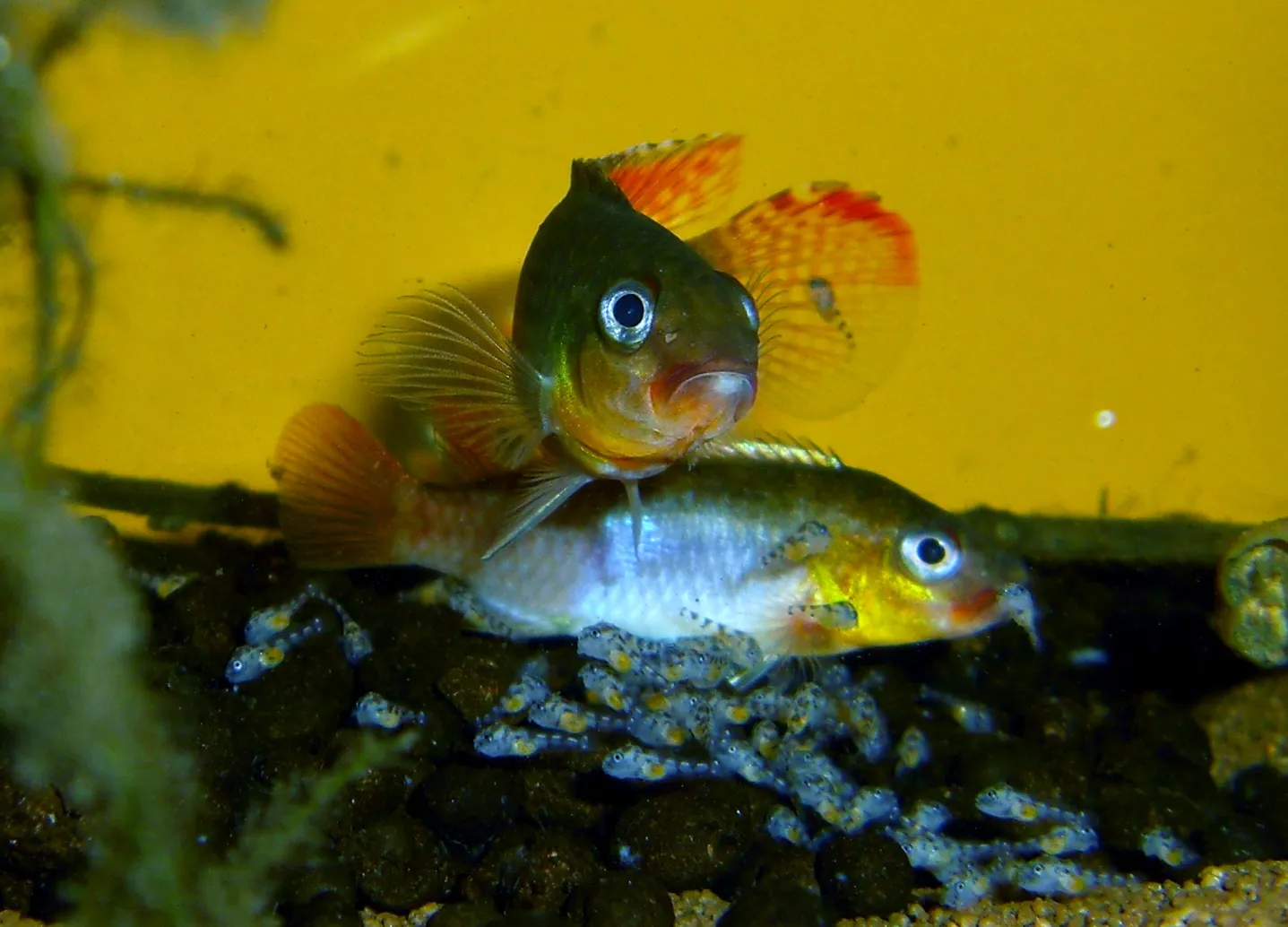
This is a true dwarf: males reach roughly 2.5–3 in in length (about 2 in standard length in preserved type material), with females noticeably smaller at around 2 in. The body is moderately elongate with a relatively abrupt, rounded head profile and a blunt snout — a more robust, rounded forehead than its congeners — and a rounded caudal fin. A clean diagnostic set distinguishes it: one tubular infraorbital bone; a scaled nape and opercle; one or two scale rows on the rear of the cheek; and, in females, a small patch of two or three silvery scales flanking the genital papilla on each side. A dark longitudinal stripe runs along the midline of the flank but, unlike in Congochromis dimidiatus and Congochromis squamiceps, it does not continue into the tail. Colour is where the species earns its keep, and the sexes diverge sharply. Males carry the brighter, more structured finnage: the posterior dorsal fin is edged white, sometimes with a fine red submarginal line, the soft dorsal and tail are dusted with small red and pale-blue spots, the anal fin is bluish-violet with a dark margin, and the throat, cheeks, chest and lower flanks flush reddish-orange, intensifying when the fish is in condition. Females are rounder-bodied and, when ripe, develop a pinkish to wine-red belly and a darker, contrasting band that they flash during courtship. Counts run to 16–18 dorsal spines, 6–9 dorsal soft rays, three anal spines and 5–7 anal soft rays, with 24–25 vertebrae.
Habitat
Congochromis sabinae is a fish of small, shaded rainforest streams across western-central Africa. FishBase records it from the Sangha, Alima and Likouala drainages of the middle Congo basin in the Republic of the Congo, the Sangha drainage in the Central African Republic, the Lukenie basin in the Democratic Republic of the Congo, and — notably outside the Congo system — the upper Ogooué of Gabon and Congo. It is the only member of its genus not confined to the central Congo basin, a quirk reflected in the genus name. The type stream, the Loubi, was just 7–10 ft wide and shallow, with a maximum depth of about 4 ft, running through closed forest with thick marginal vegetation overhanging and shading the water. The water there was the soft, acidic blackwater typical of the region: stained reddish-brown with tannins from decaying leaf litter, a conductivity of only about 40 microsiemens, a pH near 4.0, and a temperature of 75–77 °F. Other recorded localities are broadly similar, the species consistently favouring tannin-stained forest brooks and tributaries over open or fast water. Fish reaching the trade often carry locality labels — 'Tschuapa', and the older 'Gemena', 'Makoua', 'Bamanja' tags — but these are frequently unreliable and are best treated with caution.
Feeding
Like its congeners, Congochromis sabinae is a benthic micro-forager — a small, bottom-oriented omnivore that works the leaf litter and soft sediment of its home streams. The genus is generally characterised as detritivorous, taking organic detritus and plant matter along with the small aquatic invertebrates, insect larvae and micro-crustaceans that live among submerged leaves and roots. FishBase places it at a trophic level of roughly 3.2, consistent with a diet that mixes vegetable and animal material rather than dedicated predation. In a forest stream this is a fish of the margins and the bottom, sifting and picking through accumulated litter rather than hunting in open water. In the community it functions as one of the small, secretive substrate feeders that exploit the rich microfauna fostered by the continuous rain of leaf litter from the surrounding canopy.
Mating
Reproduction in Congochromis sabinae follows the distinctive chromidotilapiine pattern in which the female is the active, soliciting partner. As a female comes into condition she adopts brood colouration — a flushed, darkened belly — and displays to a chosen male by bending her body into a pronounced 'U' shape, presenting the intense violet-to-wine flank toward him while quivering rapidly. Receptive males respond by deepening the red-orange pigment across the lower forebody, and in both fish the overall colour pales while the dark lateral stripe fades. The pair is monogamous and bonds around a concealed site, usually a small cave or crevice into which they often excavate their own entrance. Outside of breeding the species is not especially aggressive by the standards of related dwarfs, but it is non-gregarious: males hold territory, and the practical rule for keepers is a single pair per tank unless the aquarium is large enough for several to partition space. Pairing is typically straightforward — placing a conditioned male and female together is often enough, with early chasing that rarely escalates to injury.
Breeding
Congochromis sabinae is a monogamous, biparental cave spawner that breeds readily in aquaria once its needs are met, though with an unusual division of labour. After a concealed spawning site is chosen and the eggs are laid and fertilised, the female stays inside the cave and takes sole charge of tending the clutch, while the male is driven out to patrol and defend the surrounding territory. A genus-typical dwarf clutch numbers on the order of a few dozen eggs. Incubation is temperature-dependent but runs to roughly three days; the larvae are then hung from the cave roof until they become free-swimming around eight to nine days after spawning. Free-swimming fry are large enough to take Artemia nauplii immediately, along with micro- and banana worms, Cyclops and Daphnia. Parental care is well developed and prolonged — typically five to six weeks of brood-guarding — although in younger or poorly matched pairs the male may eventually turn on the female, at which point she may need to be separated. One critical constraint sets breeding apart from mere maintenance: while adults tolerate moderately hard water, viable egg and embryo development occurs only in water with little to no measurable hardness, so very soft (often reverse-osmosis) water is essential to get fry.
In the aquarium
Congochromis sabinae is an attractive but only sporadically available aquarium fish, and it is best regarded as a project for a keeper who can supply soft, acidic, blackwater conditions and a mature, stable tank. A footprint of about 60 × 12 in (roughly 15 US gal) is the practical minimum for a single pair, with appreciably larger quarters needed if more than one pair is to be kept. The biotope is the whole point: a soft sandy substrate suits this largely benthic fish, and the tank should be furnished with shade and spawning caves — driftwood roots and branches arranged to throw shadow, clay flowerpots, halved coconut shells, or short lengths of pipe. A layer of dried leaf litter (beech, oak, or Indian almond/Ketapang) deepens the blackwater feel, releases beneficial tannins, and cultivates the microfauna that feed fry. Lighting should be dim, and shade-tolerant plants such as Anubias, Microsorum, Taxiphyllum or potted Cryptocoryne, plus a little floating cover, complete the look. Gentle filtration with modest surface movement is ample; high flow is unnecessary and unwelcome.
Water conditions should mirror the wild streams: a temperature of about 75–81 °F and a low pH, with the literature giving a maintenance range of roughly 4.0–6.0 and very soft water. The species needs genuinely stable parameters and should never be added to an immature aquarium — Congochromis are sensitive to swings and to dissolved-waste accumulation. As noted, breeding specifically demands near-zero hardness, so anyone aiming to raise fry will likely need reverse-osmosis or rainwater. Diet is undemanding: a varied menu of quality fine-grade prepared foods with a good vegetable/Spirulina component, supplemented with live or frozen bloodworm, Daphnia, Artemia and similar, keeps the fish in colour and condition.
For company, Congochromis sabinae does best with small, peaceful, upper-water dither fish that draw it out without competing for the bottom — West African characins such as Ladigesia or Lepidarchus, small 'Barbus', and Aplocheilichthys-type killifish are natural matches, and peaceful South American tetras, small Corydoras, Otocinclus, or Southeast Asian Boraras and Trigonostigma also work. Other cichlids and larger substrate-dwellers are best avoided unless the tank is very large, to prevent competition for territory and food. For breeding, the species is best kept as a lone pair with at most a few small, non-predatory dithers such as pencilfish.
Conservation
The IUCN Red List assesses Congochromis sabinae as Least Concern (assessed 16 February 2009 by T. Moelants; published 2010), with the population trend listed as unknown. The assessment reflects a relatively broad distribution across forest streams of the central Congo basin and the upper Ogooué, spanning several countries, with no evidence of a major range-wide threat. It carries no CITES or CMS listing. The fish is harmless and of negligible commercial fishing interest, taken only incidentally and in small numbers for the specialist aquarium trade — it most often reaches importers as a bycatch among other Congo fishes rather than as a targeted export. As with the rest of the Congo basin's forest-stream fauna, the broader long-term concerns are habitat-level: deforestation, agricultural expansion and changes to the small, shaded streams these dwarfs depend on. None of these is documented as a present danger to this particular species, but they are the backdrop against which a forest-stream endemic's status should be read.