Taxonomy & naming
Coptodon snyderae was described in 1992 by Melanie L. J. Stiassny, Ulrich K. Schliewen and Wallace J. Dominey, in a landmark paper in Ichthyological Exploration of Freshwaters that introduced the entire Lake Bermin radiation and erected eight new species of 'Tilapia' in one stroke. The species was placed in Tilapia as Tilapia snyderae; its holotype (AMNH 98259) and paratype series (further specimens in the American Museum of Natural History and the Zoologische Staatssammlung München) were collected at the type locality, Lake Bermin itself, in the Nguti subdivision of what was then South West Province, Cameroon, at roughly 5°09′N, 9°38′E. From the outset the authors flagged snyderae as the dwarf of the flock — and, indeed, the smallest tilapiine cichlid then known. For decades the genus 'Tilapia' was a sprawling, admittedly artificial dustbin for substrate-spawning African cichlids, and molecular work steadily showed it to be polyphyletic. Anton Lamboj's 2004 treatment already noted that the Bermin fish belonged to the subgenus Coptodon and would likely be elevated; the revision came with Andreas R. Dunz and Ulrich Schliewen's 2013 phylogenetic study, which formally transferred the species to the resurrected genus Coptodon Gervais, 1853. The current valid name is therefore Coptodon snyderae (Stiassny, Schliewen & Dominey, 1992), one of nine Coptodon endemic to the lake alongside relatives such as Coptodon bythobates, Coptodon bemini, Coptodon gutturosa, Coptodon spongotroktis and Coptodon bakossiorum.
Morphology
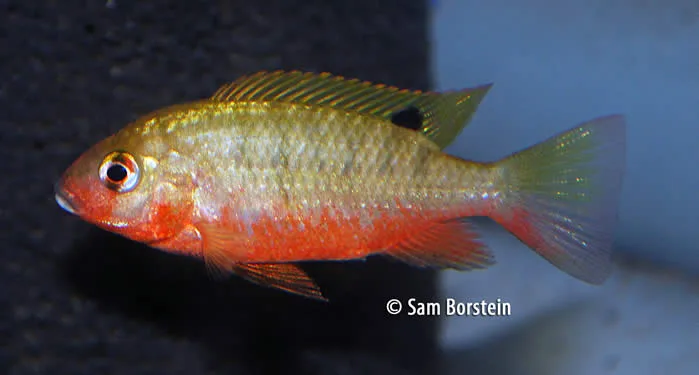
This is a genuinely tiny cichlid. FishBase records a maximum standard length of about 2 in, and field workers find wild fish rarely exceed 2–2.5 in total length; females reach sexual maturity at a standard length of just 1 in, which is what earns snyderae its title as the smallest known tilapiine. Aquarium specimens, well fed and unstressed, grow noticeably larger — keepers report males of 3 in and occasionally up to roughly 4.5 in, with females staying smaller. The body is the fusiform, moderately deep tilapiine shape, carrying 15–16 dorsal spines and 10–11 soft rays, three anal spines and 7–8 anal soft rays. Diagnostically, Stiassny and colleagues described a robust lower pharyngeal jaw bearing a large, triangular (not heart-shaped) toothplate of stout, sparsely set teeth; coarse oral dentition with stout bicuspid teeth in the outer row, one to two inner rows on each jaw; an acute snout; and 10–12 slender gill rakers. Colour is variable and mood-dependent rather than fixed: the original description noted green, pale and red colour states, and both Lamboj and aquarium observers confirm a single fish can shift rapidly between them with its emotional state. In good condition males show an olive-green to reddish-brown back over a bright red belly, while females run silvery to olive, flushing red when courted. Both sexes carry the classic 'tilapia spot' — a dark ocellus on the rear of the dorsal fin — which is typically most obvious in females. Sexual dimorphism is modest but real: males grow longer, stockier and more colourful, while ripe females develop a swollen, intensely red belly and chest and a prominent genital papilla before spawning.
Habitat
Coptodon snyderae is endemic to Lake Bermin (sometimes spelled Bemin), a small crater lake set in the chain of extinct volcanoes that runs through the Southwest Region of Cameroon, part of the freshwater ecoregion known as the Western Equatorial Crater Lakes. The lake is minute and isolated: roughly 2,297 ft across, about 60 hectares in surface area, and only some 48–49 ft deep at its deepest point. It sits in a forested caldera whose rim rises tens of metres above the water; there are no inflowing streams and only a single small outflow, and the surrounding jungle keeps it largely undisturbed — it is a long uphill walk from the nearest town. Because the lake is shallow, it is not prone to the catastrophic limnic gas overturns that have killed the deeper Cameroonian crater lakes. The water is warm and only weakly mineralised: in-situ studies report a temperature around 75 °F, a slightly alkaline pH near 7.5, and very low conductivity (on the order of 80 microsiemens), with a soft, low-alkalinity chemistry. The bottom and margins are strewn with the debris of the forest — fallen leaves, branches, logs and bogwood — over which a film of algae, aufwuchs and detritus develops, and the lake also supports freshwater sponges that one congener (Coptodon spongotroktis) has specialised on. Within this single small basin the nine Coptodon species partition themselves subtly; snyderae favours the shallows, where it grazes the algal film and shelters among wood and rock.
Feeding
Coptodon snyderae is fundamentally a grazing herbivore-omnivore, sitting low on the food web at a trophic level near 2.8. FishBase, drawing on the original ecological work, records it as feeding primarily on vegetative matter — preferably algae — but also taking detritus, aquatic insects, diatoms and small amounts of sponge material. In the wild its diet is dominated by the algae, aufwuchs and detritus that coat the lake's submerged wood and rock; animal prey is a minor supplement rather than a staple. This trophic profile is shared by most of the Bermin flock, which is part of what makes their explosive speciation so puzzling, since the species largely overlap in what they eat. In the aquarium the herbivorous bent is unmistakable and even inconvenient: keepers describe snyderae as an efficient hair-algae eater capable of clearing a heavily fouled tank in days, and warn that it will strip live plants — including tough Anubias, Java fern and Java moss — back to the stems. It is well served by vegetable-based foods (spirulina flakes, mbuna-type pellets, blanched greens) with only occasional meaty offerings, mirroring its natural role as a grazer of the lake's algal turf.
Mating
Like its Bermin relatives, Coptodon snyderae forms monogamous pairs and reproduces by biparental substrate spawning rather than mouthbrooding — the ancestral tilapiine pattern. Courtship is vigorous and visually dramatic for so small a fish: observers describe extended circling, body-shaking, tail-slapping and jaw-locking between the prospective partners, during which both fish flush red and the female's genital tassel becomes conspicuous. As the pair bond hardens, both sexes darken — the belly turning black in the hours before spawning. The species is socially feisty out of all proportion to its size; even outside breeding it can be pugnacious and will dominate larger tankmates, and during reproduction a pair becomes strongly territorial around its chosen site. A notable behaviour reported from the wild is colonial nesting: large aggregations of many pairs spawning in close proximity in the shallows, each defending a small patch. The pair bond is strong but can also be dangerous in confinement — in cramped quarters a male may turn lethally on his mate, so the pre-spawning relationship is best played out with room to retreat and, often, the buffering presence of other fish to absorb the male's aggression.
Breeding
Coptodon snyderae is an open, biparental substratum brooder. In the wild the female deposits her eggs on an exposed surface in shallow water — rock, wood or firm substrate — and both parents guard and tend the clutch and the resulting fry. True to its dwarf stature, its fecundity is the lowest in the tilapiine world: wild clutches typically number only about 10–20 eggs, the small brood that a fish maturing at 1 in can produce. In aquaria the species is far more productive, with broods commonly around 100 eggs and occasionally more, and captive fish will readily adopt the shelter of caves, flowerpots or bogwood crevices rather than spawning fully in the open. Development is quick: eggs hatch in roughly two days and the larvae are free-swimming a further two to three days later, after which the fry take finely crushed flake, microworm or newly hatched brine shrimp immediately. Parental care is unusually protracted for a cichlid of this size — pairs may defend a brood for well over three months, until the young are several centimetres long, with the parents moving the shoal around the tank and mouthing strays back to safety. Fry grow fast, develop the red-tinged dorsal and the tilapia spot at around 1 in, and can themselves spawn within a few months. The genus's reputation as easy to breed — 'the Convict cichlid of West Africa' — holds, with the major caveat that pairs must be given space, lest the male kill the female once fry appear.
In the aquarium
Coptodon snyderae has a small but devoted following among West African cichlid keepers, who prize it as a hardy, characterful dwarf — and as a CARES Preservation Program species worth keeping alive in the hobby against the day its single lake is degraded. It is undemanding chemically: although the lake runs near pH 7.5 and very soft, captive fish are tolerant and thrive across a broad range of moderately hard, near-neutral tap water, asking little more than dechlorination and stability. A temperature in the low-to-mid 20s °C (around 75–79 °F) matches the lake. The real husbandry challenge is behavioural, not chemical. Despite measuring only a couple of inches, snyderae is scrappy and can bully far larger tankmates, and a spawning pair becomes fiercely territorial. The consensus minimum is a tank of about 35.5 in (a 40-gallon 'breeder' footprint), and most keepers do best starting with a group of six to eight juveniles rather than a single pair, letting a pair form naturally. The tank should be broken up with driftwood, rockpiles, ceramic caves and inverted flowerpots so that subordinate fish can break the line of sight and escape squabbles; this hardscape doubles as spawning sites. Live plants are food, not décor — they will be grazed to nothing, so plan accordingly. A common and costly mistake is to leave the colony together when a pair spawns: the spawning male's aggression can be fatal to both tankmates and his own partner, so a second tank or a ready tank divider is essential. The species is an excellent algae control animal and tolerant of larger, non-aggressive dither species — mid-sized African or South American tetras, larger barbs, rainbowfish — that can withstand its temper and are too big to be eaten. Feeding is simple given its herbivorous diet: a quality vegetable-rich or mbuna pellet, spirulina, and blanched greens, with meaty foods only as an occasional treat. Note that snyderae has historically been hard to find in the trade and is often confused with other near-identical members of the Bermin flock, so provenance matters to anyone keeping it for conservation.
Conservation
The IUCN Red List assesses Coptodon snyderae as Critically Endangered (criteria B1ab(iii)+2ab(iii)), in an assessment by T. Moelants dated 16 February 2009 and published in 2010. The category turns almost entirely on geography: the species exists in one lake of roughly 60 hectares and nowhere else, so its entire extent of occurrence and area of occupancy fall below the thresholds for Critical Endangerment, and any single catastrophe at Lake Bermin could in principle extinguish the species outright. The documented and potential threats are those reaching the lake from its watershed and beyond — oil-palm plantation expansion, slash-and-burn agriculture, deforestation of the surrounding forest, and consequent pollution and sedimentation of the lake. Lake Bermin's relative remoteness has so far spared it the worst, and because the lake is shallow it is at low risk of the lethal limnic overturns that menace deeper Cameroonian crater lakes, but the narrowness of its range leaves no margin for error. The species carries no CITES or CMS listing. As one of nine reproductively isolated cichlids that evolved within a single tiny crater lake, Coptodon snyderae is also a scientifically irreplaceable example of rapid, possibly sympatric speciation; its loss would erase not just a species but a natural experiment in evolution. Captive populations maintained by hobbyist conservation networks such as the CARES program are, for now, a meaningful insurance policy.