Taxonomy & naming
The green chromide was described by the German physician and naturalist Marcus Elieser Bloch in 1790 as Chaetodon suratensis, in the fourth volume of his great work on foreign fishes — a placement in the butterflyfishes that reflects how unfamiliar these deep-bodied Asian fish were to European science at the time. The species epithet preserves its type locality: 'Suratte', the port city of Surat on the lower Tapti River in Gujarat, western India (roughly 21°12′N, 72°55′E). The genus Etroplus was later erected by Cuvier (1830), and the fish has accumulated several synonyms now folded into Etroplus suratensis, among them Chaetodon caris Hamilton, 1822 (described from 'Paligaut', India) and Etroplus meleagris Cuvier, 1830. Within the cichlid family, Etroplus belongs to the small subfamily Etroplinae alongside one other Indian genus and the Madagascan genus Paretroplus. The comprehensive phylogeny of the group by John Sparks (2008), building on Sparks & Smith (2004), recovered the Etroplinae as the sister group to all other cichlids — the deepest branch of the family — and confirmed Etroplus of southern India and Sri Lanka as the sister of the endemic Madagascan Paretroplus, a split that mirrors the breakup of the southern supercontinent Gondwana. Of the three living Etroplus species, Etroplus suratensis is by far the largest and one of two euryhaline forms; the spotted Etroplus maculatus shares much of its range, while the orange chromide's small freshwater relative Etroplus canarensis is restricted to a few rivers in Karnataka. Konings notes that canarensis was long feared extinct before its rediscovery in the 1990s; it has since entered the aquarium trade, though — being so recently rediscovered — detailed behavioural and husbandry data for it were still unavailable at the time of his writing (Enjoying Cichlids).
Morphology
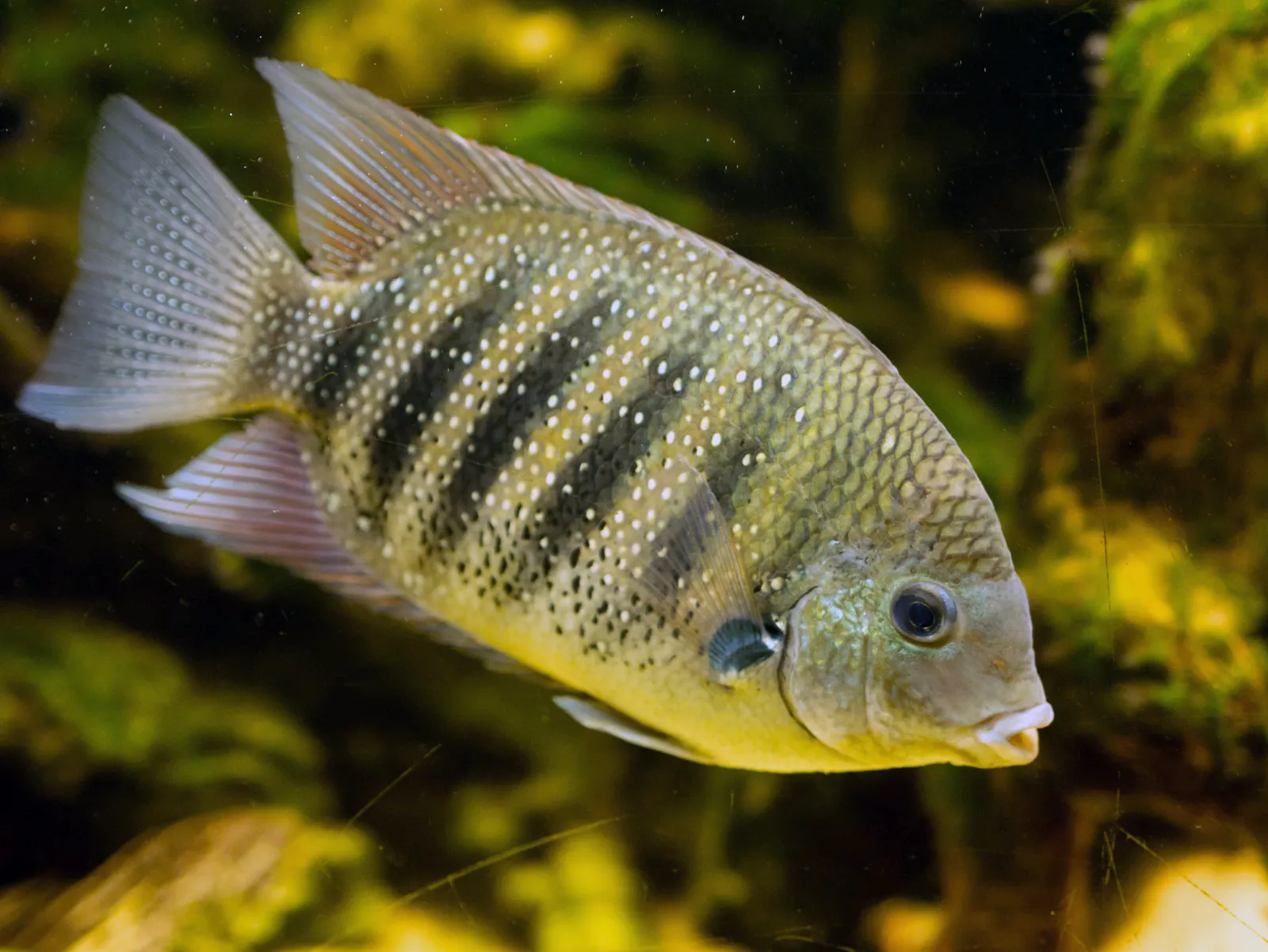
Etroplus suratensis is a tall, strongly compressed, disc-shaped cichlid — built more like a deep oval than the elongate profile of most New-World or Rift-lake cichlids. It is the giant of its genus: FishBase records a maximum of about 15.5 in total length, and reliable accounts note specimens exceeding 12 in standard length, though common market and aquarium fish are nearer 8 in. The ground colour is a greenish-brown to olive, paler below, and the flanks are crossed by a series of about six dark vertical bars (excluding any markings on the head and tail base) that remain solid throughout life — a feature distinguishing it from the related Etroplus canarensis, in which the front bars split with age. Those bars are more than decoration: Konings describes the coloration of both larger Etroplus species as cryptic, with the striped pattern of E. suratensis helping it disappear among aquatic vegetation much as E. maculatus's pattern camouflages it against open sand (Enjoying Cichlids). The species' best-known ornament is the scattering of pearly, iridescent blue-white spots centred on many of the body scales, which give the 'pearlspot' its name and shimmer against the darker background. The dorsal and anal fins carry numerous stiff spines; the genus is in fact named for the prominent spinous anal fin. Sexual dimorphism is subtle and largely confined to the breeding season: males average slightly larger, and nuptial males intensify in colour and develop dark stripes running between the eye and the gill cover. The clearest difference is in the genital papilla — pointed and elongate in the male, broader and rounder in the female, where it swells, reddens, and becomes a functional ovipositor when she is ripe.
Habitat
The green chromide is a fish of the brackish margin. It is euryhaline and benthopelagic, most at home in coastal lagoons, riverine estuaries, and the tidal lower reaches of rivers, where it tolerates a remarkable sweep of salinity — field studies in Sri Lanka's lagoons record it across salinities from nearly fresh (about 0.02) to seawater strength (around 28), with pH values measured anywhere from 5.0 to 9.6. It also lives in genuine freshwater, including inland lakes and reservoirs, though some inland populations were established by deliberate stocking for aquaculture. Its native range runs along the western coast of peninsular India from Gujarat south through Maharashtra, Goa, Karnataka, and Kerala to Tamil Nadu, and around much of Sri Lanka, chiefly the western seaboard; east-coast Indian records (Andhra Pradesh, Odisha, West Bengal) are largely introductions, and feral populations now thrive in Singapore and Peninsular Malaysia. The heartland of the fishery is Kerala's Vembanad Lake, a vast estuarine backwater long considered the species' home. FishBase notes a depth range beginning around 33 ft, but as an estuarine and lagoon fish it spends most of its life in shallow, warm, often turbid water; preferred temperatures run roughly 73–79 °F in the literature, though the fish endures the wider 68–86 °F span of its tropical coastal habitats. There is observational evidence that it can gulp atmospheric air, an adaptation to the low-oxygen conditions of stagnant backwaters. Sea-grass beds are a particularly important nursery habitat: juveniles use them for shelter, and Konings describes shoals of juvenile E. suratensis appearing to 'vanish' from view by each fish orienting head-up alongside a single blade of grass, disappearing into the vertical lines of the vegetation (Enjoying Cichlids).
Feeding
Etroplus suratensis is an omnivore with a strong vegetarian and grazing streak, sitting low on the food web at a trophic level near 2.9. In the wild it works solid surfaces, rasping aufwuchs and filamentous algae from rocks, roots, submerged timber, and even the sides of sluice gates and pillars; gut analyses of feral fish in Singapore turned up detritus, several groups of algae, crustacean larvae, plant and animal organic matter, and ingested sand. This grazing habit makes it a tidy fish to keep in enclosures — in Kerala cage culture, pearlspot are valued for scrubbing the mesh clean of attached algae and periphyton, which both maintains water flow through the cage and supplies the fish with a steady natural food. Its broad, opportunistic diet and tolerance of variable conditions are a large part of why the species adapts so readily to pond and cage farming.
Mating
The green chromide is a loosely gregarious, generally peaceful fish that lives in groups and forms a clear dominance hierarchy as it matures; in the wild it is monogamous only for the duration of a breeding cycle, forming temporary pair bonds when reproductively active. In Sri Lanka, observations record two breeding periods a year, tied to the dry pre-monsoon (roughly December to April) and the local monsoon-season dry spell (around June to September), when rising salinity and falling turbidity improve the clear-water visibility that lets parents keep contact with their fry. A pair selects and defends a spawning site — a rock, a submerged root or branch, or in captivity even the aquarium glass — and holds the surrounding territory against intruders. The scale of that territory dwarfs the smaller Etroplus maculatus's: Konings records E. maculatus holding a territory only about 17.5 in across, packed so densely along the shore that adjacent territories cover large stretches of vegetated bottom, against which E. suratensis's much larger pair territory and nest stand out (Enjoying Cichlids). A striking feature of this species' social life is its sympatry with the smaller Etroplus maculatus, with which it appears to have a near-symbiotic relationship in Sri Lanka's Negombo Lagoon: the orange chromide acts as a cleaner, grazing parasites from the green chromide's body, while also preying on its eggs and fry — a relationship with a generous helping of cheating on the smaller fish's part, and one Konings confirms independently: E. maculatus, he notes, is an opportunistic carnivore that preys on the eggs and fry of both Etroplus species while maintaining a cleaning relationship with its larger relative. Remarkably, unrelated adult Etroplus suratensis have been seen helping to defend a pair's territory, an apparently altruistic behaviour against this shared predator.
Breeding
Etroplus suratensis is a biparental substrate spawner with elaborate, prolonged parental care — the reproductive style that has made it both a research subject and an aquaculture candidate. Timing tracks water clarity and salinity rather than a fixed calendar: Konings describes breeding activity concentrated in the dry season, when monsoon-driven silt has settled out and the water is at its clearest, and salinity is at its highest — around 30 ppt at the site he documents (Enjoying Cichlids). Seasonal swings there are considerable: roughly 81 °F and 5 ppt salinity in the wetter part of the year, rising to about 91 °F and 30 ppt in the dry season, with pH tracking from about 8.5 up to 9.0 over the same span — all well above the milder ranges typically quoted for aquarium keeping, a reminder that this is an estuarine fish built to ride out real chemical extremes in the wild, not a figure to replicate in a tank. After courtship the female deposits her eggs one by one on a cleaned solid surface (a rock, brick, root, coconut husk, or similar stationary object), attaching each by a short filament, and the male fertilizes them immediately; a single brood typically holds a few hundred to over a thousand eggs (field reports give roughly 250–1,573 per brood, with 400–2,000 recorded in raceway systems), and total fecundity ranges from about 500 to over 7,000. Spawning is completed within an hour, after which both parents fan the eggs continuously with their fins to oxygenate them. The eggs hatch in roughly 70–72 hours (a little faster, 48–72 hours, at warmer aquarium temperatures), and the parents then move the wriggling hatchlings into shallow nursery pits they have excavated in the substrate, shuttling the larvae between pits until the yolk is absorbed around the sixth day. The free-swimming fry shoal tightly around their parents and, in their first days, graze on the adults' body mucus. Parental care is unusually extended — the pair guard the young until they reach about 1–1.5 in — and throughout this period the adults barely feed, which is why mature wild and pond fish grow slowly while breeding. The fish has an 'asynchronous' ovary holding eggs at all stages, allowing repeated spawnings through a long season, so captive breeding is induced by simulating the right environment (clear water, gentle flow, ample spawning substrate and breeding pits) rather than by hormones.
In the aquarium
The green chromide is far better known on the dinner plate than in the hobby, and for good reason: it is a large, gregarious, group-living cichlid that needs a great deal of space. A single fish can approach 12 in or more, and because the species is loosely schooling and unsettled when kept in small numbers, the sensible minimum is a group of eight or more — which in practice restricts proper long-term care to very large home aquaria or public installations. Kept singly or in pairs, weaker individuals are bullied and the group never relaxes.
Water is the make-or-break factor. Etroplus suratensis can be maintained in fresh or brackish water provided acidic conditions are avoided — it does best around pH 7.0–8.5 and in moderately hard, mineral-rich water; many keepers run it in light brackish conditions, which suit its physiology and head off disease. Temperature is best held in the mid-20s °C (a 73–82 °F window is comfortable). The single most common mistake is neglecting water quality: this fish is intolerant of accumulated organic pollutants and demands near-spotless conditions, so generous, routine water changes (25–50% weekly) and strong filtration are essential. A sandy substrate with some rounded rocks and driftwood branches mimics its natural habitat; flat stones double as spawning sites.
Feeding is easy given the fish's grazing nature. It takes good prepared foods readily but should get a strong vegetable component — spirulina- or algae-based dried foods, blanched greens, chopped peas — alongside live or frozen bloodworm, brine shrimp, mosquito larvae, and Tubifex for condition. Temperament is undemanding: outside of breeding it is relatively peaceful and will not trouble anything larger than a mouthful, so it suits other robust, non-aggressive fish that share its taste for hard, neutral-to-alkaline or brackish water. In freshwater, schooling cyprinids such as Devario or larger Rasbora make good dither fish; in brackish setups, salt-tolerant livebearers work well. Avoid soft-water, acid-loving species and pugnacious cichlids. The chief difficulty is simply scale — this is a food fish first, and giving it the room and water quality it needs is beyond most general community tanks.
Conservation
The IUCN Red List assesses Etroplus suratensis as Least Concern, in an assessment published in 2019 (assessed 29 July 2019 by Abraham, de Alwis Goonatilake, Fernado, and Kotagama). The category reflects a wide distribution across India and Sri Lanka and continued abundance as a cultured and wild-caught food fish, but the assessment flags the population trend as decreasing, and lists residential and commercial development, natural-system modification, pollution, and problematic species among the pressures on it. Those pressures are sharply visible in the species' heartland. In Kerala's Vembanad Lake, annual landings of karimeen fell from over 1,200 tonnes in the 1960s to a few hundred tonnes by the early 2000s, driven by over-exploitation and by damage to the very habitat the fish needs to breed: indiscriminate dredging of the lake bottom for lime-shell deposits destroys its spawning substrates, while mangrove clearance for backwater tourism, salinity barrages built for rice farming, and broader estuarine degradation have all eroded recruitment. The species carries no CITES listing. Conservation responses have leaned on its biology — establishing engineered fish sanctuaries with artificial nesting substrates and protected depths in the open lake, and developing pond, raceway, and cage breeding to supply seed and relieve pressure on wild stocks. As a hardy, euryhaline generalist the green chromide is in no danger of disappearing, but its local fisheries are a clear case of a common species depleted where it matters most.