Taxonomy & naming
George Albert Boulenger described this fish in 1899 as Lamprologus hecqui, working from a specimen collected at Albertville (modern Kalemie) on the Congolese shore of Lake Tanganyika; the unique holotype, taken from a stomach's contents, sits in the Royal Museum for Central Africa in Tervuren. The species epithet honors Captain Celestin Hecq (1859-1910), a Belgian officer stationed in the Congo during the campaigns against the slave trade.
The generic placement has been anything but settled. Maréchal and Poll moved the fish to Neolamprologus in the 1991 CLOFFA checklist, where it stayed through Schelly and colleagues' early-2000s morphological work, and most aquarium and older scientific literature still calls it Neolamprologus hecqui. Konings then reassigned it to Lepidiolamprologus in 2015 and again in 2019, and Eschmeyer's Catalog of Fishes today lists Lepidiolamprologus hecqui (Boulenger, 1899) as the valid name. The trouble is that Lepidiolamprologus as currently constituted is almost certainly not a natural group: molecular phylogenies of the tribe Lamprologini show its roughly dozen member species are often only distant relatives, and the genus lumps together fish ranging from a few centimeters to over a foot long. Further upheaval is widely expected, and an honest writer should treat the genus name as provisional. The IUCN assessment adds a second layer of doubt, noting that what passes under the name "hecqui" may include populations referable to boulengeri and meeli.
Morphology
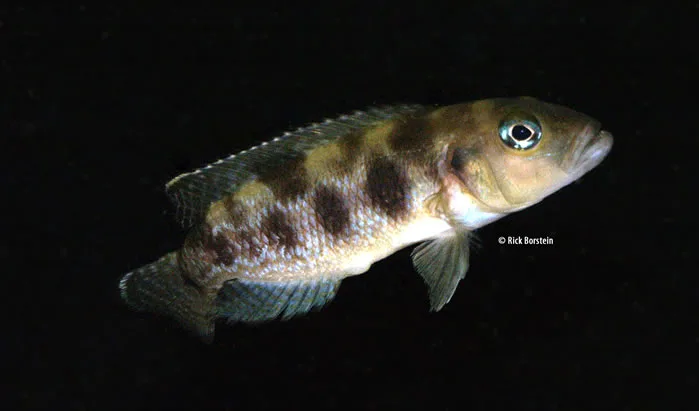
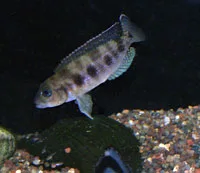
Hecq's shelldweller is a compact, torpedo-shaped lamprologine with a pale tan-to-grey body, often washed with soft blue iridescence on the flanks and a scatter of darker markings; fin edges can pick up pale blue or white. It is one of the larger "shellies" rather than one of the true miniatures. FishBase gives a maximum total length of about 3.1 in (3 in) for males, with females considerably smaller at around 1.6 in (1.5 in), and the IUCN likewise caps the species near 3 in.
Reported sizes vary, and the disagreement is worth flagging. Hobby sources and breeders consistently describe wild-type males topping out at just over 3 in (3 in) and "beefy" in build, while females mature small, frequently spawning at only 1.5-2 in (1.5–2 in); some care sheets push the female figure higher, to roughly 2–2.5 in, which likely reflects well-fed aquarium stock rather than wild proportions. Males are the larger, bolder sex with slightly extended fins. There is no dramatic nuptial color change, so size, fin length, and behavior near the shells remain the most reliable way to sex them.
Habitat
Lepidiolamprologus hecqui is endemic to Lake Tanganyika, the ancient rift lake shared by Tanzania, the Democratic Republic of the Congo, Zambia, and Burundi. Sources differ on how far it ranges: FishBase calls it widely distributed around the lake, whereas the 2025 IUCN assessment restricts confirmed records to the Tanzanian coast between Kigoma and Mahale. That gap is partly a taxonomy problem, since lookalike populations elsewhere may belong to other species in the boulengeri-meeli complex.
This is a fish of the sand and shell beds rather than the rocky reef. It lives over open sandy and muddy bottoms, often near rocky margins, in the shallow-to-moderate depth band the IUCN gives as roughly 16–164 ft. Its whole way of life is bound to the empty shells of Neothauma tanganyicense, a large endemic snail whose accumulated shells carpet parts of the lake floor and give dozens of small cichlids a place to shelter and breed. Tanganyika's water suits hard-water specialists: in-situ measurements put the pH around 7.4-8.4 with high carbonate hardness, and surface temperatures in the species' range sit near 73-81 °F.
Feeding
Hecq's shelldweller is a small benthic carnivore, assigned an estimated trophic level near 3.7. In the wild it works the sand surface for small invertebrates and zooplankton, and the IUCN notes that outside of breeding it roams the open sand in loose schools rather than staying glued to a single shell. In the aquarium it takes the same micro-predator diet readily: small frozen and live foods such as cyclops, baby brine shrimp, daphnia, and finely chopped mysis, alongside quality micro-pellets and flake.
Ecologically it is one member of a remarkable guild of "shell cichlids" that have independently converged on the Neothauma resource. That single snail's discarded shells support a crowd of unrelated lamprologines, and competition for them is intense, which goes a long way toward explaining why these fish are built to fight above their weight. As a small, abundant sand-dweller, Lepidiolamprologus hecqui is itself prey and forage for the lake's larger predatory cichlids and represents one strand in the dense benthic food web of Tanganyika's littoral.
Mating
For its size, this is an exceptionally pugnacious fish. Quality Marine relays the breeders' nickname "pitbull of shellies" and the reputation as one of "the bravest fish in the world," eagerly charging far larger intruders, including divers and aquarists' hands. That is not just retailer color: independent keepers on cichlid forums rate Lepidiolamprologus hecqui as the meanest and best territory-holder among the pair-forming shelldwellers they have kept, with one reporting a pair holding their own in a tank alongside 10-inch predatory cichlids.
Unlike the colonial, harem-forming shellies such as Neolamprologus multifasciatus, hecqui tends to settle as a pair (or one male to a few females) defending a tight shell cluster. Territory defense is vigorous and constant, and the male in particular patrols the perimeter of the shell colony with conspicuous boldness. There is no dramatic nuptial coloration; pair formation is signaled primarily through behavior, positioning, and the male's larger size.
Breeding
Lepidiolamprologus hecqui is a substrate spawner of the shell-brooding kind: the female deposits adhesive eggs deep inside a Neothauma shell while the male guards the perimeter. Eggs hatch in roughly three days at 77–79 °F, with fry free-swimming several days later. Honesty demands a caveat here, since the IUCN flatly states that the species' breeding behavior in the wild is essentially unknown; the timeline above comes from aquarium observation, and one supplier even reports wild fish tunneling in muddy bottoms, a claim that has not been broadly corroborated and should be treated as a lead rather than fact.
In the aquarium
Hecq's shelldweller is a rewarding but genuinely feisty Tanganyikan, better suited to a keeper who wants to watch behavior than to someone after a peaceful community. A breeding pair or small group does well in a tank with a generous footprint rather than height; a 30 in (29.5 in) or larger base with a deep bed of fine sand and several Neothauma or escargot shells per fish gives them room to dig, rearrange, and stake out territory. Water should be hard and alkaline, pH roughly 7.8-9.0 with high carbonate hardness and temperatures around 75-81 °F (75–81 °F), with good oxygenation and low nitrate.
The common mistake is underestimating the aggression. At a mid-size for a shellie, a dominant hecqui can bully subordinate males and harass unrelated tankmates, and breeding only sharpens it. Workable companions are fish that use different water layers and ignore the shell bed, such as midwater Cyprichromis, with rock-dwellers like Julidochromis or Altolamprologus possible only in a large tank where their rockwork is kept well away from the shells. Avoid large predators and boisterous bottom-foragers. The fish is relatively uncommon in the hobby, so wild-type stock can be worth seeking out, and there is little point keeping it without shells, since the shell-centered antics are the whole appeal.
Conservation
The IUCN Red List assessed Lepidiolamprologus hecqui as Least Concern on 25 February 2025 (Haambiya 2025), the same category it has held since 2006. Within its range the species is described as common and abundant, its population trend unknown, with no major widespread threats; the assessment singles out sedimentation from soil erosion and agricultural runoff as the one notable pressure, and flags taxonomy, ecology, and population monitoring as research priorities. It carries no CITES listing. The fish is collected for the international aquarium trade and taken locally for food, but neither appears to threaten it at present. In short, the species itself looks secure even though the lake around it is not.
That lake-wide strain is the real story for any Tanganyika endemic. Lake Tanganyika is warming, and the warming is suppressing the seasonal mixing that lifts nutrients from the depths: O'Reilly and colleagues (2003, Nature) linked that change to a roughly 20% decline in primary productivity and an estimated 30% drop in fish yields since the mid-20th century. Cohen and colleagues (2016, PNAS) used sediment cores to show that reduced mixing has shrunk the oxygenated benthic habitat in their study areas by about 38%, depressing both fish and endemic mollusc production. Layered on top are shoreline sedimentation that smothers the littoral (Cohen et al. 1993) and the heavy pelagic clupeid and Lates fishery that feeds four nations, all overseen, imperfectly, through the four-country Lake Tanganyika Authority. For a shallow sand-and-shell dweller like hecqui, the most direct hazard is that sedimentation: silt loading degrades the open sand beds and can bury the Neothauma shells the species depends on, while warming-driven habitat loss erodes the productive littoral it feeds in. Least Concern is an accurate verdict for the fish today; it is not a statement that its habitat is safe.