Taxonomy & naming
The American ichthyologist John Diederich Haseman described this fish in 1911 as Crenicara altispinosa, working from specimens the Carnegie Museum's expedition to central South America (1907–1910) collected in Bolivia. The original type locality is a sand-bank in the Río Mamoré, just below the mouth of the Río Guaporé, near San Joaquin, Bolivia, with part of the type series also taken from a large lake nearby. The holotype is held at the Field Museum of Natural History as FMNH 54090 (ex Carnegie Museum 2639a), with paratypes catalogued as FMNH 54091–92; this is the same primary material the Catalog of Fishes and the museum collections still cite today.
The genus name has a famously tangled history that is worth getting right, because the spelling itself is a point of confusion. The fish was shuffled across several names over the twentieth century — Apistogramma, then the aquarium-coined Microgeophagus (used informally from at least 1957 by Hans Frey, but as a nomen nudum lacking a diagnosis and type species), then Papiliochromis Kullander 1977. Sven Kullander ultimately settled the question, concluding that the oldest available name was Mikrogeophagus — spelled with a k — attributable to Jens Meulengracht-Madsen, who used it as a valid name in a 1968 Danish aquarium book. Kullander adopted Mikrogeophagus in 1998 and defended it in detail in a 2011 Zootaxa paper after the issue was briefly reopened. The upshot: the correct modern spelling is Mikrogeophagus (not Microgeophagus), and older literature listing this fish as Crenicara altispinosa, Microgeophagus altispinosus, or Papiliochromis altispinosus all refers to the same species — indeed an early American Cichlid Association import-permit list (Buntbarsche Bulletin 156) still names it Papiliochromis altispinosus. The masculine ending altispinosus is the grammatically corrected form of Haseman's original altispinosa.
The genus was erected to hold the two "ram" cichlids — Mikrogeophagus altispinosus and Mikrogeophagus ramirezi — separating them from Apistogramma, and it sits within the subfamily Cichlinae in the species-rich Neotropical assemblage often treated as the geophagine cichlids, a clade that underwent rapid adaptive radiation across South America. For decades Mikrogeophagus held just those two species; in 2022 Staeck, Ottoni & Schindler described a third, Mikrogeophagus maculicauda, from the eastern tributaries of the upper Río Guaporé in Brazil — long known in the hobby as the "two-spot" or "Zweifleck" ram and distinguished by a dark blotch on the caudal peduncle.
Morphology
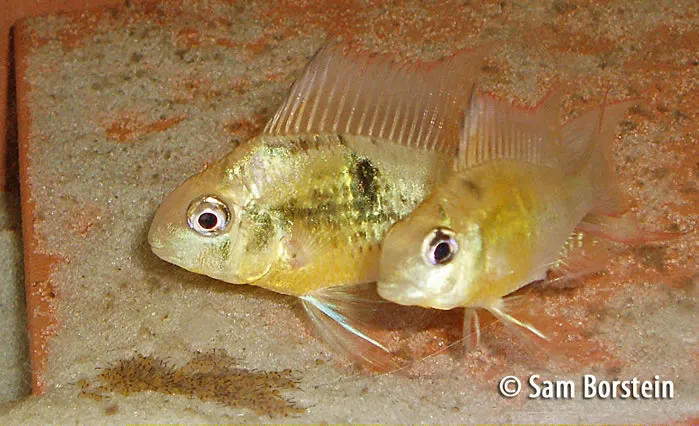
The Bolivian ram is a deep-bodied, laterally compressed little cichlid in the same mold as its celebrated cousin, but painted in a quieter palette. The body is a soft silvery-tan to grey washed with iridescence, crossed by a dark vertical bar that runs down through the eye, with a bold dark blotch in the centre of the flank. The unpaired fins — dorsal, anal, and the tail — carry warm red to orange edging, which is the feature that brightens dramatically when the fish is settled, breeding, or displaying; shop fish kept in bare tanks often look washed-out and plain, which is part of why the species is chronically underrated. The defining structural feature, and the source of the name, is the dorsal fin: the anterior spines are notably elongate — the fin standing roughly half the height of the body — giving the "hi-fin" profile that also lends the trade name hi-fin ram.
Reports of maximum size cluster in a narrow band. FishBase lists about 2.2 in standard length; hobby and aquarium-literature sources typically give 3–3.5 in total length, with large males reaching the upper end. Either way it is a genuinely small fish, though noticeably larger and stockier than Mikrogeophagus ramirezi. Sexual dimorphism is subtle and a recurring frustration for breeders: males average a little larger, with slightly more extended finnage and somewhat more intense colour, but the differences are unreliable. The only sure sign is the female's blunt ovipositor, which descends from the belly only when she is in spawning condition (versus the male's narrow, pointed genital papilla). Compared to Mikrogeophagus ramirezi, the Bolivian ram is larger, less vivid, and lacks the blue iridescent spangling on the body and fins.
Habitat
This is a fish of the upper Amazon — specifically the upper Río Madeira system, the great southern tributary of the Amazon. It is essentially endemic to the Guaporé (known in Bolivia as the Iténez) and Mamoré drainages of Bolivia and western Brazil, with records also from the upper Río Orthon system (the Tahuamanu and Manuripi rivers). Because this site treats the water body first, the key point is that the Bolivian ram is a creature of the rivers themselves and their seasonal floodplain, not of any single lake: it inhabits tributaries, marginal shallows, oxbow lakes, and quiet pools across the lowland Llanos de Moxos wetlands and the upper Guaporé. The IUCN maps its range across the Guaporé, Mamoré, and Madeira basins in Bolivia and the Brazilian states of Amazonas, Mato Grosso, Rondônia, and Acre, with an estimated extent of occurrence of roughly 2.16 million square kilometres.
In-situ habitat notes are sparse but consistent. Collectors describe smooth-bottomed waters over sand, mud, and clay-like substrates — the soft, siftable bottom this fish depends on — often without much aquatic vegetation but sometimes fringed by dense shoreline growth. Horst Linke and Wolfgang Staeck, who first imported the species in 1985, recorded one capture in a sun-exposed murky pool at about 81 °F, pH 7.6, and around 4 °dGH. The broader picture from FishBase and hobby measurements is of warm tropical water, roughly 72–82 °F, ranging from very soft and slightly acidic to neutral or modestly hard and alkaline — a wider tolerance than most blackwater dwarf cichlids. The upper Madeira as a whole is spectacularly diverse, with well over 400 freshwater fish species, and the Bolivian ram shares its waters with characins, hatchetfish, pencilfish, Corydoras and other small catfishes, and a cast of other geophagine and Apistogramma cichlids.
Feeding
The genus name says it plainly: a Mikrogeophagus is a "small eartheater," and the Bolivian ram feeds like a miniature geophagine. It is benthophagous, taking mouthfuls of sand from the bottom and sifting them for edible items — small invertebrates, insect larvae, micro-crustaceans, and other meiofauna — then expelling the cleaned grit back out through the mouth and gill openings. This sand-sifting is the fish's signature behaviour, performed more or less continuously through the day; much of what it actually swallows is far smaller than the foods a keeper might assume it is targeting, so a Bolivian ram can appear to mouth and reject food while in fact feeding steadily on fine particles. It will also browse hard surfaces and snatch the occasional item from the water column. FishBase places it at a trophic level of about 3.1 — an omnivore with a carnivorous lean — and rates its fishing vulnerability as low.
Within the floodplain community this small fish is both a consumer of bottom invertebrates and, at three inches, potential prey for larger fishes, kingfishers, and other shallow-water hunters. Its quiet, near-bottom habits and quick generation time give it high resilience — FishBase estimates a minimum population doubling time under 15 months — which fits a fish adapted to the boom-and-bust seasonality of an Amazonian flood-pulse system, where habitats expand and contract dramatically with the annual rise and fall of the water.
Mating
By dwarf-cichlid standards the Bolivian ram is mild-mannered. Outside of breeding it is relatively gregarious and can be kept as a group, and in the wild it appears to live largely solitarily except when reproducing. It is not a harem-forming polygynist like many Apistogramma; instead it forms monogamous pairs and is a biparental substrate spawner — and this is the trait most worth dwelling on, because it inverts the parenting model of the African mouthbrooders featured elsewhere on this site. Where a Lake Malawi or Tanganyika mbuna female carries fertilised eggs and fry in her mouth and does the parenting alone, a pair of Bolivian rams lays its eggs in the open, on a substrate, and the male and female share guard duty more or less equally. Pairing is built on courtship and joint site selection rather than a dominant male's harem, and once a pair forms it tends to be stable and cooperative through the breeding cycle.
Breeding
Spawning follows the classic open-substrate sequence. The female cleans a flat surface — a rock, a piece of wood, a broad leaf, or the aquarium glass — and lays rows of small translucent eggs (a large female can produce several hundred), with the male moving in behind her to fertilise each batch; the whole process can take more than an hour. The eggs hatch in about two to three days, after which the non-swimming larvae ("wrigglers") are moved to a pit excavated in the substrate, and are frequently shifted among several such pits over the following days — a behaviour that frustrates predators and, presumably, parasites. One charming detail recorded in the wild and the literature is that a parent will sometimes spit a fine layer of sand over the eggs, apparently as camouflage. The fry become free-swimming roughly five to nine days after hatching, at which point they are large enough to take newly hatched brine shrimp. Both parents continue to herd and defend the school. Spawning has no single dramatic trigger beyond good condition and clean water; the species is reported to be a seasonal spawner in nature, a hint of its subtropical-edge origins south of the equator, and captive pairs may simply take their time. Inexperienced pairs commonly eat their first few clutches before getting it right.
In the aquarium
This is the honest pitch a good shop should make: if you want the look and behaviour of a ram but without the fragility, buy the Bolivian. Mikrogeophagus altispinosus is widely regarded as one of the hardier, more forgiving dwarf cichlids, and a far better community fish than Mikrogeophagus ramirezi, which demands very warm, soft, acidic water and is notoriously delicate. The Bolivian ram tolerates a broad range of chemistry — soft to moderately hard, pH from about 6.0 to 7.5 — and ordinary tropical-aquarium parameters suit it. A practical target is roughly 75–82 °F, with cooler-end temperatures often recommended for everyday keeping; soft sand is the single most important furnishing, because gravel inhibits the fish's natural sifting and coarse grit can damage gills.
A bonded pair does well in a tank with a footprint of around 24–36 in length; a group of six or more is genuinely better behaved than a lone pair, but needs more floor space (a tank of 4 ft or larger) and broken sightlines from wood, flat rocks, and planting so that males can hold territories without constant friction. The species is peaceful toward dissimilar tankmates — small tetras, pencilfish, hatchetfish, rasboras, Corydoras, Otocinclus, and the like all work, and a shoal of upper-water dither fish visibly settles these naturally shy cichlids. The standard cautions: aggression is real but localized and seasonal — a spawning pair will defend the bottom vigorously and may bully other substrate-dwellers — so avoid other territorial cichlids and boisterous feeders that out-compete a deliberate sand-sifter. The one place the "hardy" label needs an asterisk is water quality: like its cousin, the Bolivian ram is sensitive to poor maintenance, should never go into an immature tank, and is prone to head-and-lateral-line erosion ("hole-in-the-head") when conditions slip; small, regular water changes serve it better than infrequent large ones. Feed a varied diet of small sinking foods — quality pellets, frozen and live bloodworm, Daphnia, and brine shrimp — and expect a lifespan of around four years. It is reportedly easy to breed and will often raise a brood in a community tank without devastating its tankmates, making it an unusually rewarding first "real" cichlid. A peaceful, beginner-friendly dwarf cichlid in every practical sense.
Conservation
The IUCN Red List assesses Mikrogeophagus altispinosus as Least Concern (criteria version 3.1), last assessed on 20 November 2020 by R. G. Frederico and published in 2023. The rating rests on a very wide mapped range — an extent of occurrence of about 2.16 million km² across the Guaporé, Mamoré, and Madeira basins — and the species' apparent abundance: it is described as common and widespread with no direct threats currently identified, though its population trend is formally listed as unknown for want of data. CITES and CMS list it as Not Evaluated, and FishBase rates its fishing vulnerability as low. The only documented human use is the aquarium trade, in which it is exported nationally and internationally; collection for the trade is something to monitor rather than a demonstrated pressure, and as a fast-maturing, high-resilience fish it is well placed to withstand modest harvest.
The wider context is the upper Madeira basin itself, which is far from untroubled even if this particular fish is not. The Madeira is one of the most heavily dammed of the major Amazon tributaries — the Santo Antônio and Jirau hydroelectric projects on the Brazilian reach transformed the river's flow, sediment transport, and fish migration — and the broader basin faces deforestation in its headwaters, mercury contamination from artisanal gold mining, and the seasonal disruption that dams impose on flood-pulse habitats. A small, sedentary floodplain cichlid like the Bolivian ram depends on exactly the marginal pools, oxbows, and sandy shallows that altered hydrology and sedimentation can degrade. None of that has been shown to be reducing this species, and the measured conclusion is the right one: Mikrogeophagus altispinosus is genuinely common and not in decline as currently understood, but it lives in a basin under mounting pressure, and its "Least Concern" status is a snapshot of a poorly studied fish rather than a guarantee about the future of its waters.