Taxonomy & naming
Megalamphodus megalopterus was originally described by Carl H. Eigenmann in 1915, based on material from the upper Paraguay basin; the type locality is Cáceres in Mato Grosso, Brazil. The original description placed it in what was then a broadly drawn Hyphessobrycon, and it has remained there, though the generic boundaries of this large assemblage within the family Characidae have been revised repeatedly. The valid name per Eschmeyer's Catalog of Fishes is Megalamphodus megalopterus (Eigenmann, 1915), with the parenthetical authority indicating the genus assignment has changed since the original description.
For several decades the species circulated in the hobby under the trade name Megalamphodus megalopterus, a genus erected for the phantom tetras on the basis of their fin development and body shape. Most contemporary ichthyological opinion places Megalamphodus within Hyphessobrycon as a junior synonym, so the correct current name is the Eigenmann original. The species epithet megalopterus derives from the Greek megas (great or large) and pteron (wing or fin), a direct reference to the enlarged fins of the male — an apt name if ever there was one.
This fish was long listed as Hyphessobrycon megalopterus; Eschmeyer's Catalog of Fishes places the species in Megalamphodus, and the current combination Megalamphodus megalopterus is followed here.
Morphology
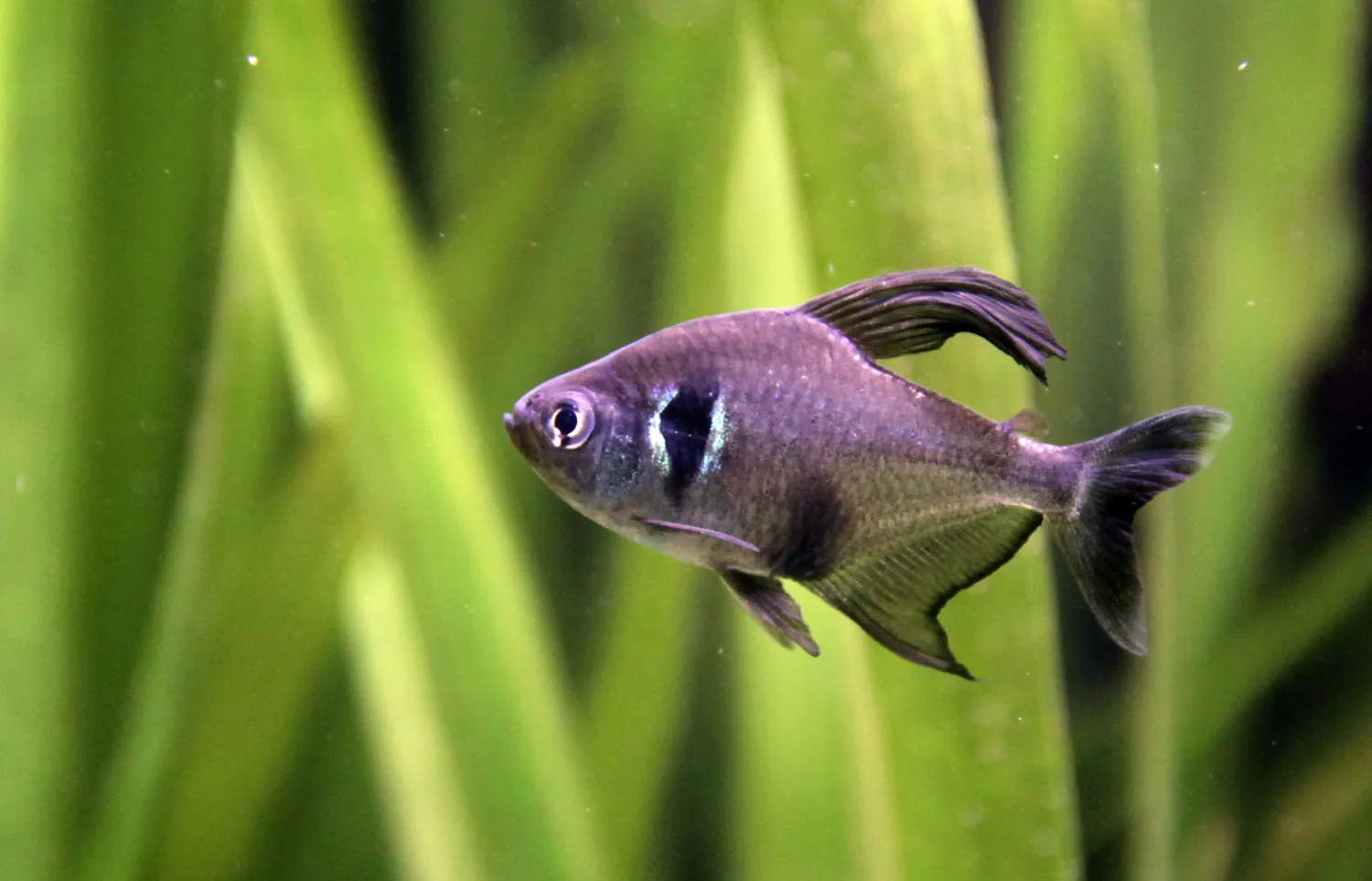
The black phantom tetra reaches a standard length of roughly 1.2–1.4 in, making it a small but not tiny characid. The body is moderately deep and laterally compressed in the classic tetra form, and in good condition the flanks show a faint silver to rose iridescence. The most diagnostic feature is a prominent oval black blotch on the shoulder, just behind the gill cover, typically edged in a pale silvery or bluish margin that catches the light and gives the blotch a three-dimensional quality.
Sexual dimorphism is strong and visible from an early age. Males develop substantially enlarged dorsal, pelvic, and anal fins that are held erect during display; all these fins are deep black. Females are smaller-bodied and deeper in profile — particularly when ripe — and their fins carry a reddish to orange tint rather than solid black, a reversal of the usual pattern of drab females that makes the species immediately recognisable. Both sexes have the characteristic humeral blotch, but it is typically bolder and more extensively outlined in the male.
Habitat
In the wild, the black phantom tetra is found in the upper río Paraguay drainage (including Bolivia and the Brazilian Pantanal) and in the upper rio Madeira system, specifically tributaries such as the rios Beni and Mamoré that drain the Bolivian highlands eastward. The type locality, Cáceres in Mato Grosso, sits on the edge of the Pantanal — the world's largest tropical freshwater wetland, which supports more than 280 species of aquatic macrophytes and creates an extraordinary diversity of lentic and lotic microhabitats.
The species favours still or sluggish water: backwaters, marginal bays, oxbow lakes, ponds, and slow-moving small streams with dense marginal and emergent vegetation. The water in these habitats tends to be soft and mildly acidic to neutral. Seriously Fish records water parameters from the natural range of 68–82 °F, pH 5.0–7.0, and hardness of 18–215 ppm, the broad ranges reflecting the seasonal variation across the Pantanal floodplain as well as local differences between clear blackwaters and more turbid whitewater-influenced channels.
Feeding
Megalamphodus megalopterus is an omnivorous micro-predator in the wild, taking small invertebrates including worms, insect larvae, small crustaceans, and plant matter. Its small mouth constrains it to fine-particle food sources, and it forages actively in the middle and lower water column as well as near the surface among floating vegetation.
In the aquarium the species accepts most small prepared foods readily — micro-pellets and quality flake form a practical staple — but shows best colour and condition with regular additions of live or frozen invertebrates: daphnia, brine shrimp, mosquito larvae, micro-worms, and cyclops are all taken with enthusiasm. Bloodworms are nutritious but should be offered in moderation. Multiple small feedings through the day suit the species' natural foraging rhythm better than one large daily meal.
Mating
The black phantom tetra is an egg-scattering open spawner with no parental care. Males are notably combative among themselves, performing extended fin-flaring tournaments in which rivals face off with dorsal fins fully erect and body colour intensified; these displays can last many minutes and rarely escalate to physical contact, making them entertaining to observe. Multiple males kept together form a loose dominance hierarchy and display more persistently than solitary individuals.
Courting males direct the same fin-flaring display toward females, swimming alongside a receptive female and orienting so that the enlarged dorsal and anal fins are shown to maximum effect. The female's reddish fins are thought to function as a signal of reproductive readiness, and pairs may engage in extended parallel swimming before moving into vegetation to spawn. Spawning activity in the aquarium tends to peak in the morning hours under natural or simulated dawn lighting.
Breeding
Breeding the black phantom tetra is straightforward and well within the reach of any hobbyist, which accounts for the near-universal availability of tank-bred stock. A conditioned pair or small group will spawn over fine-leaved plants such as Java moss, water sprite, or spawning mops, scattering small, semi-adhesive eggs among the plant fronds. Water on the soft, acidic side — pH around 6.0–6.5 and low hardness — encourages spawning, though many breeders report success across a wider range. Temperatures in the lower part of the natural range, around 75–79 °F, suit breeding efforts.
Adults will eat their own eggs and fry without hesitation, so the standard approach is to either remove the spawning medium to a separate container after spawning, or to move the adults out of the breeding tank once eggs are seen. The eggs hatch within 24–36 hours at typical breeding temperatures, and the fry become free-swimming within a few more days. First foods must be very fine: infusoria, commercial liquid fry food, or rotifers initially, with newly hatched brine shrimp introduced as the fry grow. The species is short-generation: juveniles develop quickly and show the characteristic humeral blotch within weeks; adult fin development in males takes several more months.
In the aquarium
The black phantom tetra is an excellent community fish — peaceful, hardy, tolerant of a range of water conditions, and striking enough to anchor an aquascape. A group of six or more is the minimum for the fish to behave naturally; with more males present the fin-flaring displays become more frequent and the fish more active and visible. A species tank with a dark substrate, tannin-stained water, and dense planting reflects its Pantanal origins and shows the silver-and-black colour scheme to best advantage, but the species adapts well to a wide variety of planted community layouts.
Water conditions should lean soft and slightly acidic for best colour, breeding condition, and long-term health: pH 6.0–7.2, hardness around 2–10 °dH (roughly 36–180 ppm), and temperature 72–82 °F cover the practical aquarium range. The species is not demanding and tolerates moderate deviation from ideal parameters, but extremes of hardness or high pH dull colour and suppress spawning. Good filtration with gentle flow — the fish hails from sluggish backwaters — completes the setup. Tankmates should be similarly sized and peaceful; other small South American tetras, pencilfish, hatchetfish, corydoras, and dwarf cichlids such as Apistogramma species all make compatible companions. Lifespan in captivity is typically three to five years.
Conservation
Megalamphodus megalopterus is assessed as Least Concern (LC) on the IUCN Red List, with the assessment published in 2023 (Lima and Reis). The evaluation notes a large distribution across the upper Paraguay and upper Madeira basins, a stable population trend, and the absence of major widespread threats. The IUCN notes that while the species is harvested for the ornamental fish trade, the level of collection is small relative to total population size, and most fish in the hobby are captive-bred rather than wild-caught.
The Pantanal, which forms a large part of this tetra's range, faces ongoing pressures from agricultural expansion, upstream damming, deforestation, and water-quality changes that affect seasonal flood pulses — the ecological engine of the wetland. These threats are addressed at the ecosystem level rather than as species-specific concerns for M. megalopterus at present. Hobbyists purchasing tank-bred specimens, which are widely available, have no impact on wild populations.