Taxonomy & naming
George Albert Boulenger described this fish in 1901 as Paratilapia nigripinnis, working from syntypes collected at Msambu on Lake Tanganyika (now housed at the Natural History Museum, London). The species name nigripinnis means "black-finned," a nod to the dark dorsal and anal fins of preserved specimens rather than the iridescence the living fish shows in good light. Eschmeyer's Catalog of Fishes lists it as valid under its current combination, Paracyprichromis nigripinnis (Boulenger 1901), in the cichlid subfamily Pseudocrenilabrinae.
The genus Paracyprichromis was erected by Max Poll in 1986 to separate two rock-associated species from the more pelagic Cyprichromis within the tribe Cyprichromini, on the strength of differences in vertebral number and arrangement as well as other morphological characters. That split was not universally accepted, and Tetsumi Takahashi re-examined it in a 2004 morphological study (Ichthyological Research 51:1–4). He found several of the original diagnostic traits unconvincing — the non-elongated swim bladder, for instance, is a primitive condition, not a derived one — but still upheld the genus on the strength of a unique configuration of the infraorbital bones. So the name stands, on different evidence than it was first justified by. Writing in the 1990s, Konings went further and argued the two Paracyprichromis species are probably not close relatives of Cyprichromis at all, but a case of parallel evolution between lineages of separate ancestry that converged on a similar body plan and habit; that impression has since been superseded by the molecular work above, but the underlying observation — that Paracyprichromis and Cyprichromis look far more alike than they are related — still holds. The most reliable behavioural distinction between the two genera is in how the eggs are fertilised: in Cyprichromis fertilisation happens inside the female's mouth, while in Paracyprichromis, including this species, it does not (see Breeding).
In the hobby the fish is sold almost universally as the "blue neon," sometimes with a collection locality appended ("Chituta Bay," "Kigoma"). Its only congener is Paracyprichromis brieni, with which it is occasionally confused.
Morphology
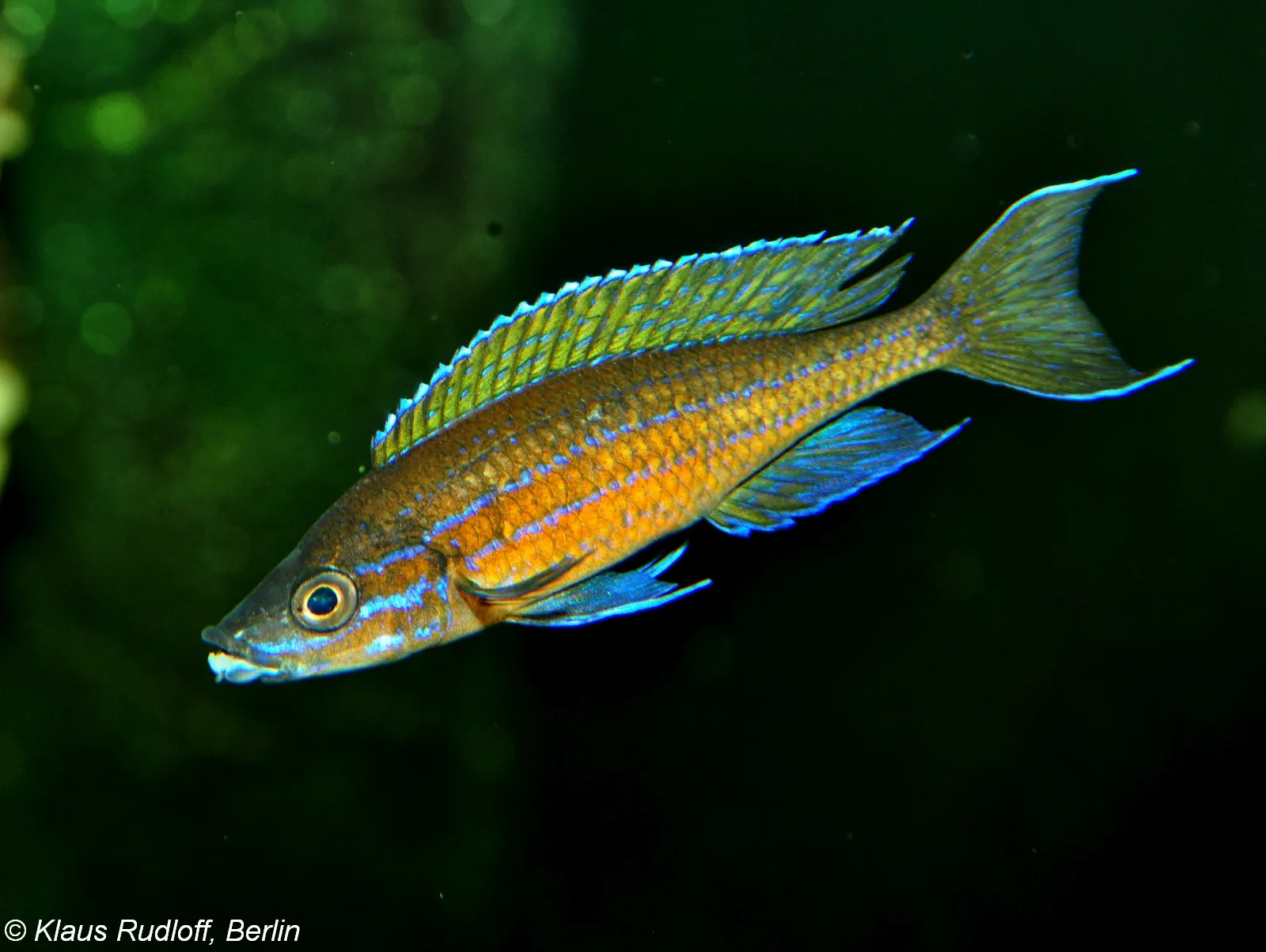
This is a slender, elongate cichlid with a small mouth and large eyes. FishBase gives a maximum length of about 4.3 in (4.5 in) total length; the Cichlid Room Companion cites adults of 4–5.5 in, so figures in the upper range are plausible for well-grown males, and Konings' Enjoying Cichlids lists a similar 4.5 in maximum. Seriously Fish lists 4.4 in (4.5 in) standard length, the larger figure being measured to the tail base.
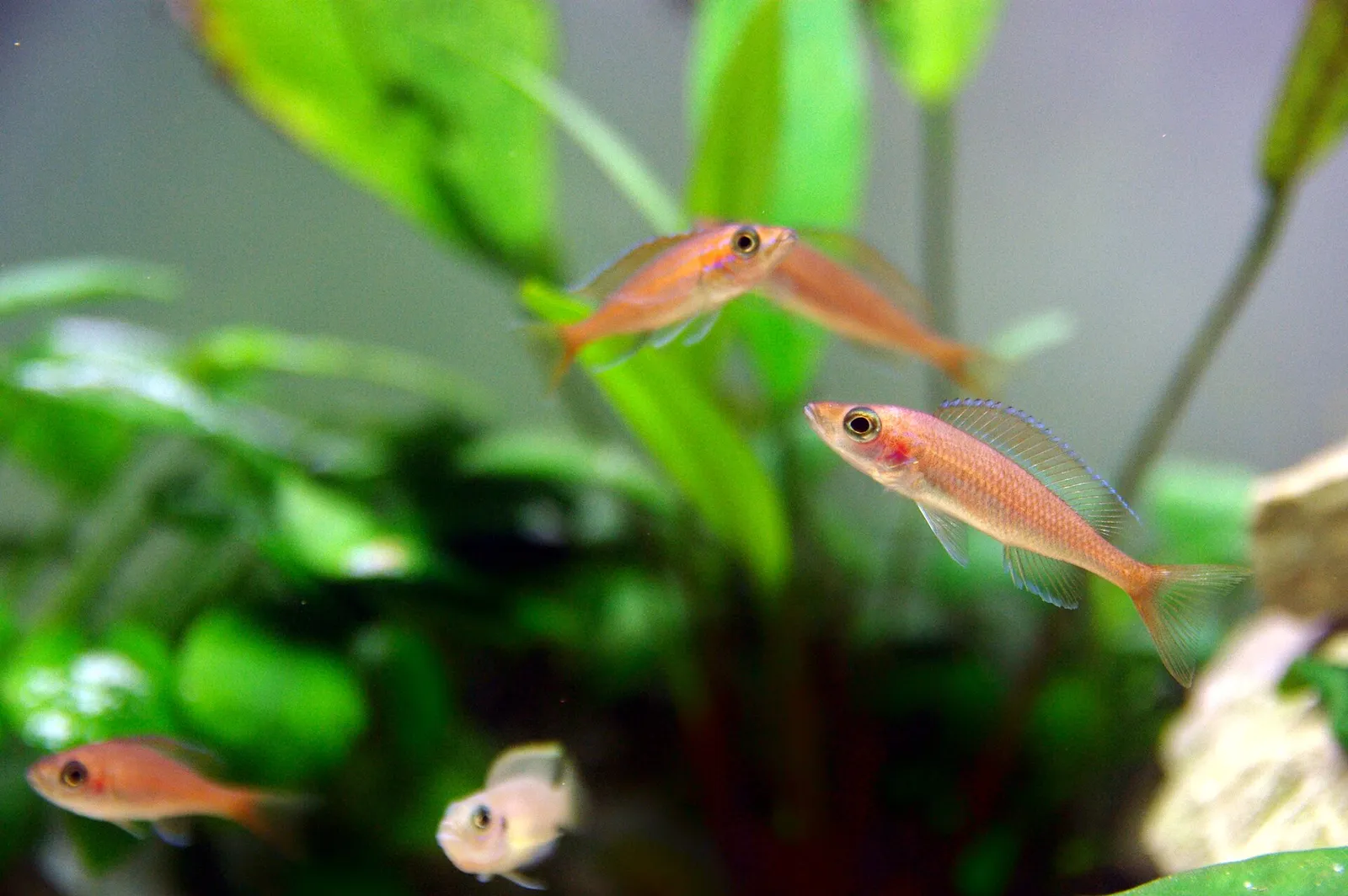
The colour is the draw. Against a dark body the flanks carry rows of luminous blue-to-violet neon stripes that run onto the unpaired fins; the effect is most intense in mature, territorial males and famously fickle, fading fast under bright light, in bare tanks, or when the fish is stressed. Males grow larger and more saturated than females and develop elongated extensions on the caudal fin. Females are plainer, often a soft grey-tan, but show the same pinstriping more subtly.
The lookalike is its only congener, Paracyprichromis brieni. Seriously Fish separates the two by Paracyprichromis nigripinnis having proportionally larger eyes and a slightly rounder, stockier build; field observers add that it also holds to noticeably deeper water than brieni, which stays in the top 33 ft. Several geographic colour morphs of Paracyprichromis nigripinnis exist and are traded on locality: at least two distinct populations have been documented within Chituta Bay itself, differing chiefly in how much red tints the dorsal fin, while a population from Kigoma Bay lacks the "neon" striping altogether. An aquarium-bred albino sport also circulates that cannot be tied to any wild population.
Habitat
Paracyprichromis nigripinnis is endemic to Lake Tanganyika — found nowhere else on Earth — and the lake is the whole story of this fish. Its distribution is essentially lake-wide; the IUCN assessment notes records spanning Burundi, the Democratic Republic of the Congo, Tanzania, and Zambia, with familiar collection points including Chituta Bay in Zambia and Kigoma and Msambu (Nkove) in Tanzania. Older literature emphasised the northern basin, but the species is now treated as broadly distributed around the lake's rocky coast. It is frequently found in the company of one or more Cyprichromis species sharing the same rocky ground — at Chituta Bay, for example, field observers have recorded it alongside as many as four Cyprichromis forms in a single small area.
Habitat is the diagnostic part. Rather than roaming open water like Cyprichromis, Paracyprichromis nigripinnis stays bound to the rocky littoral, concentrating in and around the large caves and crevices formed by tumbled boulders — in Chituta Bay specifically it favours large caves or the immediate vicinity of large boulders. Typical collection depth runs 66–98 ft, distinctly deeper than P. brieni's upper 33 ft, and the IUCN account describes it as occurring down to about 130 ft (131 ft), and possibly deeper, largely restricted to these big rock caves. In-situ temperatures sit around 73–77°F (73–77 °F). Like all of Tanganyika's rock cichlids it lives in hard, alkaline water — the lake runs to a pH near 8.5–9.0 — which sets the template for keeping it.
Feeding
Despite hugging the rocks, Paracyprichromis nigripinnis is a planktivore. It feeds on zooplankton drifting in the water column above and around the rocky substrate, picking individual prey with its small, protrusible mouth; FishBase places it at a trophic level of about 3.4. This is the ecological compromise that defines the genus — a Cyprichromini that exploits the open-water plankton supply without abandoning the shelter of the reef.
Feeding behaviour is split by sex and status. Females and non-territorial fish forage a meter or two out from the rock face, gleaning plankton much as their relatives do. Territorial males, by contrast, stay deep in the caves and under ledges, and in those dark recesses they routinely swim and feed upside-down, backs oriented toward the dim light reflecting off the bottom (a behaviour documented by Konings). It is an arresting adaptation to a low-light, overhead-cover niche, and it is also why the fish so often looks washed-out in a brightly lit aquarium: you are seeing it out of the lighting context its colours evolved for.
Mating
Socially, Paracyprichromis nigripinnis is famously mild. Field and aquarium accounts agree it forms loose aggregations rather than the tight shoals of Cyprichromis, and it shows little of the territorial violence common among rock cichlids — a milder temperament than its genus-mate P. brieni as well. Males defend small spawning sites alongside a rock face or inside a cave but rarely inflict real damage on each other or on tankmates.
Courtship departs from the fin-flaring displays typical of many Tanganyikan cichlids: rather than being drawn to the male's territory by a display, a ripe female is essentially sequestered away from the school and led by the male to his site, after which spawning follows (see Breeding).
Breeding
Reproduction is polygamous maternal mouthbrooding, but the mechanics of fertilisation are the genus's most distinctive trait and worth stating precisely: unlike Cyprichromis, where the eggs are fertilised inside the female's mouth, Paracyprichromis fertilises its eggs externally, before the female ever picks them up. A ripe female, led to the male's territory rather than courted there by display, swims head-down close to the substrate and discharges her eggs; as they leave her and fall, the male — stationed above or beside her — releases milt continuously, visible at times as small clouds, and fans it toward the falling eggs so that fertilisation happens in the open water or on the rock before the female collects them into her mouth. Clutches are small — the IUCN account gives roughly 8–15 eggs per spawn, Seriously Fish a wider 5–25 — and a single brood may be fathered by several males. The female broods for about three weeks (Kuwamura's 1986 Lake Tanganyika field survey reports larvae up to 0.5 in carried by females of 3.5–4 in standard length), then releases the free-swimming fry and provides no further care; the young join schools of similar-sized juveniles. One worthwhile caveat from keepers: while females are widely said to fast while holding, at least one detailed aquarium account reports a holding female slipping out to feed without dropping her brood, so the "never eats" rule is not absolute.
In the aquarium
The blue neon is a specialist's fish that is genuinely easy on water chemistry but easy to disappoint on everything else. Keepers consistently report it as undemanding about parameters — hard, alkaline Tanganyikan water (pH roughly 7.5–9.0, hardness 8–25 °dH, 75–81°F / 75–81 °F) with routine 20–30% water changes suits it, and the old folklore that it cannot tolerate water changes is not borne out in practice. What it does demand is structure and restraint: tall vertical rockwork forming caves and overhangs and, specifically, a dark tank floor and dark back/side walls rather than merely dim overhead lighting — Konings notes the fish prefers this outright. Under bright light, in a pale tank, or with pushy tankmates it sulks and loses the colour that is the entire point of keeping it; a milder temperament than Cyprichromis also means it will not show its full range of behaviour if housed alongside that more robust genus.
Keep it in groups — eight is the usual floor, more is better, with several females per male; Konings suggests keeping more than three males together specifically to spread their mutual aggression, with a stable group achievable at around five males to five or more females. A 48 in (47 in), roughly 50-gallon (50 US gal) tank suits a modest group; serious Tanganyikan keepers often run larger. It is best in a species tank or with calm, non-competing Tanganyikans: shell-dwellers, Julidochromis, calvus-type Altolamprologus, and small Neolamprologus all coexist well in keepers' reports. Avoid boisterous or faster-feeding fish — Tropheus, large Cyphotilapia, mbuna — which outcompete this slow, small-mouthed feeder at the surface and bully it off station; even mixing with the superficially similar Cyprichromis can leave the paracyps second in line. Note too that the various colour morphs interbreed freely, so mixing them muddies the line. Despite its reputation as peaceful, one experienced aquarist documented breeding males harassing bottom-dwelling tankmates over territory and food once spawning began — "peaceful" is relative, not absolute. Captive breeding happens but is described as occasional rather than reliable; many hobbyists strip and artificially raise the small clutches. The large, well-formed fry take newly hatched brine shrimp from release.
Conservation
The IUCN Red List assessed Paracyprichromis nigripinnis as Least Concern in its 2025 assessment (Haambiya 2025), reaffirming a status it has held since 2006. The reasoning is straightforward: it is widespread around Lake Tanganyika with no known major widespread threats, and its cave-bound habit appears to shield it from the artisanal food fishery that targets more accessible species. The population trend is listed as unknown. The assessment does flag two species-specific pressures — soil erosion and sedimentation degrading the rocky habitat, and over-collection for the ornamental trade, since this is a popular and commercially exported aquarium fish — but neither is judged severe enough to move the category. Sourcing captive-bred stock, which dominates the hobby supply, keeps that second pressure low.
The honest framing is that the species is secure while the lake it lives in is not. Lake Tanganyika is warming and stratifying more strongly, which suppresses the deep mixing that lifts nutrients to the surface: O'Reilly et al. (2003, Nature, doi:10.1038/nature01833) linked that warming to a roughly 20% decline in primary productivity and a comparable drop in fish yields over the second half of the 20th century. Cohen et al. (2016, PNAS, doi:10.1073/pnas.1603237113) found that warming has reduced the lake's oxygenated, habitable benthic zone, with an estimated loss of about 38% of viable habitat for many lake animals. Along the shore, deforestation-driven sedimentation (Cohen et al. 1993) smothers exactly the rocky, cave-rich substrate this fish depends on, and the pelagic clupeid-and-Lates fishery that feeds four nations shows how heavily the basin is leaned on. Governance is shared across Burundi, the DRC, Tanzania, and Zambia under the Lake Tanganyika Authority. For a shallow-to-mid-depth rocky-cave planktivore, the warming and sedimentation threads matter most: a productivity decline trims the plankton it eats, and sediment fouls the reef it shelters in. None of that has yet changed its Red List status — but it is the reason a "Least Concern" fish still belongs in any honest conversation about the lake's future.