Taxonomy & naming
George Albert Boulenger described this fish in 1901 as Pelmatochromis taeniatus, from a single male collected by W.J. Ansorge near Sapele in the Niger Delta, Nigeria — the holotype, BMNH 1901.1.28.21 (2.5 in SL), remains the unique name-bearing specimen, its type locality given as the mouth of the Ethiop River where it meets the Jamieson. The species sat in Pelmatochromis for decades until Thys van den Audenaerde's 1968 revision split that catch-all genus into subgenera; one of these, Pelvicachromis, was raised to full genus rank by Ethelwynn Trewavas in 1974. Greenwood (1987) later placed Pelvicachromis within the tribe Chromidotilapiini (the chromidotilapiine cichlids), defined by the absence of microbranchiospines, alongside genera such as Chromidotilapia, Benitochromis and Parananochromis. For much of the twentieth century the name Pelvicachromis taeniatus was applied very broadly — Thys van den Audenaerde had folded the Cameroonian taxa kribensis (Boulenger, 1911) and its form calliptera (Pellegrin, 1929) into it on rather thin grounds, chiefly caudal-fin colour and the faded pigment of the old types. Hobbyists who collected in Nigeria and Cameroon long argued the two were distinct, but their case rested on the colours of live fish and never appeared as a formal revision. The matter was finally settled by Lamboj, Bartel & Dell'Ampio (2014), who combined molecular, morphological and colour-pattern data across sixty-six specimens. They restricted Pelvicachromis taeniatus to its original compass — the populations of Benin and Nigeria — revalidated Pelvicachromis kribensis for most Cameroonian fish, and described the Wouri River form as a new species, Pelvicachromis drachenfelsi. As a practical consequence, several beloved "taeniatus" aquarium morphs of Cameroonian origin ("Moliwe", "Kienke", "Nyete", "Lobe", "Dehane") technically belong to Pelvicachromis kribensis, while the true Pelvicachromis taeniatus comprises the Nigerian and Beninese forms such as "Warri", "Calabar", "Nigeria Red" and the various yellow- and green-cheeked strains.
Morphology
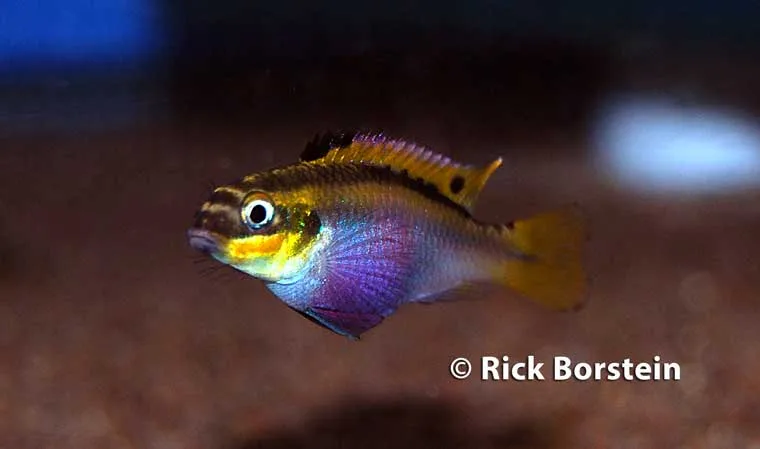
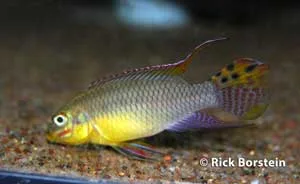
This is a small, moderately slender cichlid with a rounded head and a fusiform body. FishBase records a maximum of 3 in standard length; in the hobby, males commonly reach about 3 in total length and females stay smaller, around 2.5 in. Lamboj et al. give a body depth of 29.9–36.4% of standard length, a shorter, deeper caudal peduncle, and seventeen to eighteen dorsal spines with seven to nine soft rays — among the higher spine counts in the genus. Unlike most Pelvicachromis, in which the female is the gaudier sex, Pelvicachromis taeniatus males rival or exceed females in colour, which is exactly what makes the species a textbook case of mutual ornamentation. Diagnostically, the male carries a striking caudal-fin pattern: the upper half is whitish to yellow with a scatter of three to a dozen black dots and no margin, the lower half bears a black margin with a white-to-pale-bluish submargin, and the central field is reddish with four to eight rows of iridescent blue spots. The flanks show outlined scales, a dark midlateral stripe (the taenia of the name), and a frequently bright yellow upper lip; the caudal fin is rounded rather than spade-shaped. Females are deeper-bodied and, in condition, develop an unmistakable rounded belly that flushes from rose to a deep violet-purple. The female's dorsal fin is iridescent yellow with a black margin and a pale submargin, and her caudal carries one to three horizontal dark bars — a feature that separates her from the otherwise similar Pelvicachromis drachenfelsi (no bars) and Pelvicachromis kribensis (usually one).
Habitat
Pelvicachromis taeniatus is restricted to the freshwater reaches of the coastal lowlands from eastern Benin across southern Nigeria, including the Niger Delta itself and the rivers of the Bight drainages around Lagos and east toward Calabar and the Cross River. Records from Cameroon and Bioko that once carried this name are now referred to Pelvicachromis kribensis, so the true taeniatus is a narrowly coastal, West African endemic. It is a fish of still and slow-moving forest streams and small rivers, typically shaded, tannin-stained and often densely vegetated or littered with leaf and wood debris that provide the crevices it spawns in. These are warm, soft, mildly acidic waters; FishBase brackets the species at pH 6.0–8.0 and 5–12 °dH with temperatures around 72–77 °F, while aquarium and field sources extend the tolerated band down to about pH 5.0 in the blackwater habitats it favours. As a small, secretive bottom-oriented cichlid it lives at shallow depth in these streams — typically the upper metre or two of water over sand and litter — rather than in deep open river channels. The closely related Wouri-system congener Pelvicachromis drachenfelsi was measured in situ at 81 °F, very low conductivity (around 25 µS) and 15.5–51 in depth, a fair proxy for the kind of small, clear-to-blackwater coastal stream the whole group inhabits.
Feeding
Like its congeners, the striped krib is a benthic micro-omnivore that works the bottom and the surfaces of submerged wood, roots and leaf litter, taking small invertebrates, insect larvae, crustaceans and the associated organic detritus and aufwuchs. FishBase places it at a trophic level near 3.3, consistent with a diet weighted toward small animal prey but broadened by browsing on detritus and algae — newly free-swimming fry, indeed, browse algae and detritus alongside taking tiny live foods. In the wild community of these shaded coastal streams it is a low-level forager rather than a predator of any consequence, and its small size and retiring habits keep it well down the food web. The species is unfussy in practice: it accepts effectively any food offered, which is part of why it adapts so readily to captivity.
Mating
The reproductive biology of Pelvicachromis taeniatus is the reason it has become a model organism. It forms monogamous, biparental pairs, and crucially both sexes choose — a system of mutual mate choice that is rare and unusually well documented here. Work from the Bonn group (Baldauf, Thünken, Bakker and colleagues) showed that females prefer males with brighter yellow nuptial colour, while males in turn prefer females showing a larger and more intensely violet belly ornament; that female ornament is not mere decoration but an honest signal, since the extent and intensity of the violet predicts a female's fecundity. Pair formation is best understood as a negotiated, two-sided affair, with the female typically the active courter — she dances before the male and flashes her purpled belly to solicit spawning. More surprising still, experiments revealed a preference to mate with kin: given a choice, Pelvicachromis taeniatus associate with and breed with related rather than unrelated partners, an example of active inbreeding thought to be favoured here because related pairs cooperate more evenly in raising the brood. These behaviours make the species both a jewel for the aquarist and a recurring subject in the sexual-selection literature.
Breeding
Pelvicachromis taeniatus is a biparental cave spawner. A pair selects or excavates a sheltered cavity — a rock crevice, a hollow under a root or piece of bark, the underside of a large leaf, or in aquaria an upturned flowerpot — and the female fastens her eggs to its roof or wall. Clutches are modest, on the order of several dozen to roughly a hundred eggs, in keeping with the small body size and the heavy investment in care that follows. The two parents divide labour: the female tends, cleans and fans the eggs inside the cave while the male patrols and defends the surrounding territory, though both will guard, and the contribution of the sexes is most evenly shared between related pairs. Eggs hatch in about two to three days and the larvae become free-swimming roughly seven to eight days after spawning; the female then leads the shoal of fry about the territory while the male holds the borders. Parental defence continues for some weeks until the approach of the next spawning cycle, at which point the fry are best separated, since a female can turn on her mate once brood care winds down. Fry are large enough to take brine-shrimp nauplii or microworm from the outset and also browse algae and detritus.
In the aquarium
The striped krib is one of the more rewarding and manageable West African dwarf cichlids, and it has become far more widely available than it once was. A single pair is comfortable in a tank of roughly 23.5–31.5 in length (around 20 US gal); a larger footprint is needed if more than one pair is to be kept, as breeding fish become territorial. The key to success is the same as with most Pelvicachromis: rather than buying a random adult "pair," acquire a group of six or more juveniles and let them pair off naturally, because an arbitrarily matched male and female may simply refuse one another — and a rejected partner can be harassed to death in a confined space. Décor should provide a sand or fine-gravel substrate (the fish dig spawning pits) and an abundance of caves and broken sightlines: clay pots with a notch chipped in the rim, coconut shells, roots and driftwood, and plants that the fish appreciate as cover even though they do not strictly require them.
Water should be soft to moderately hard, slightly acidic to neutral, and warm. Maintenance values of about 72–79 °F with pH between 5.0 and 7.5 suit the species; for breeding, aim for the warmer, gentler end — roughly 75–81 °F and pH 6.0–7.0 — and keep filtration calm, ideally an air-driven sponge filter so that fry are not drawn into the intake. These are shy, retiring fish and should not be housed with boisterous or large tankmates. They make excellent residents of a peaceful community: small characins, barbs, danios, rasboras, Corydoras and similar are good company, and a school of upper-water dither fish actively helps a nervous pair settle and breed. Other small West African dwarf cichlids can work given enough room for separate territories. The chief caution is intraspecific: pairs that fail to bond, and aggression that can flare when brood care ends. Note also that the trade offers more than a dozen named geographic strains — "Nigeria Red," "Warri," "Calabar," the yellow- and green-cheeked forms — and morphs should not be cross-bred if line purity is to be preserved (and bear in mind that several morphs long sold as taeniatus are, post-2014, properly Pelvicachromis kribensis or Pelvicachromis drachenfelsi).
Conservation
The IUCN Red List assesses Pelvicachromis taeniatus as Least Concern (assessed 22 April 2019, published 2020, by P. Lalèyè), reflecting a relatively wide distribution across the coastal freshwaters of Benin and Nigeria and no evidence of a population-level decline; the population trend is listed as unknown. It carries no CITES listing. The species is collected for the ornamental trade and appears in local subsistence fisheries, but neither is flagged as a threat at the scale of the whole range. The real long-term pressures are environmental and concentrated in the Niger Delta, one of the most heavily impacted freshwater regions in Africa: oil-industry pollution, deforestation, urban and agricultural runoff, and the clearing of the marginal vegetation and leaf litter on which these small stream cichlids depend. None of these is documented as endangering the species at present, but they are the backdrop against which its coastal, habitat-specialised populations should be watched.