Taxonomy & naming
Pelvicachromis drachenfelsi was described in 2014 by the Austrian cichlid specialist Anton Lamboj together with Daniel Bartel and Elisabeth Dell'Ampio, in a paper in the journal Cybium that revised the whole Pelvicachromis taeniatus species-group, revalidated Pelvicachromis kribensis (Boulenger, 1911), and erected this new species. The holotype (Naturhistorisches Museum Wien, NMW 95237) and its paratypes (housed at the AMNH in New York, the NMW in Vienna, the MRAC in Tervuren and the ZSM in Munich) came from a tributary of the Wouri River on the Douala-Yabassi road in Cameroon, at roughly 4°18'N, 10°03'E. The fish itself was no newcomer to aquarists: it was first collected by Otto Gartner in 1984 and was imported and bred worldwide for thirty years under the provisional trade label 'Pelvicachromis taeniatus Wouri', appearing under that name in the standard West-African cichlid books long before it had a binomial. Lamboj and co-authors' revision used colour-pattern characters, corroborated by genetic data, to separate the long-confused members of the taeniatus complex; within that complex drachenfelsi sits closest to Pelvicachromis taeniatus and Pelvicachromis kribensis. Pelvicachromis belongs to the African cichlid subfamily Pseudocrenilabrinae and to the broad assemblage of West-African dwarf cichlids that also contains Pelmatochromis and Wallaceochromis. The specific epithet honours the German biologist, businessman and lifelong aquarist Ernst-Otto von Drachenfels, described by the authors as a friend and promoter of their research.
Morphology
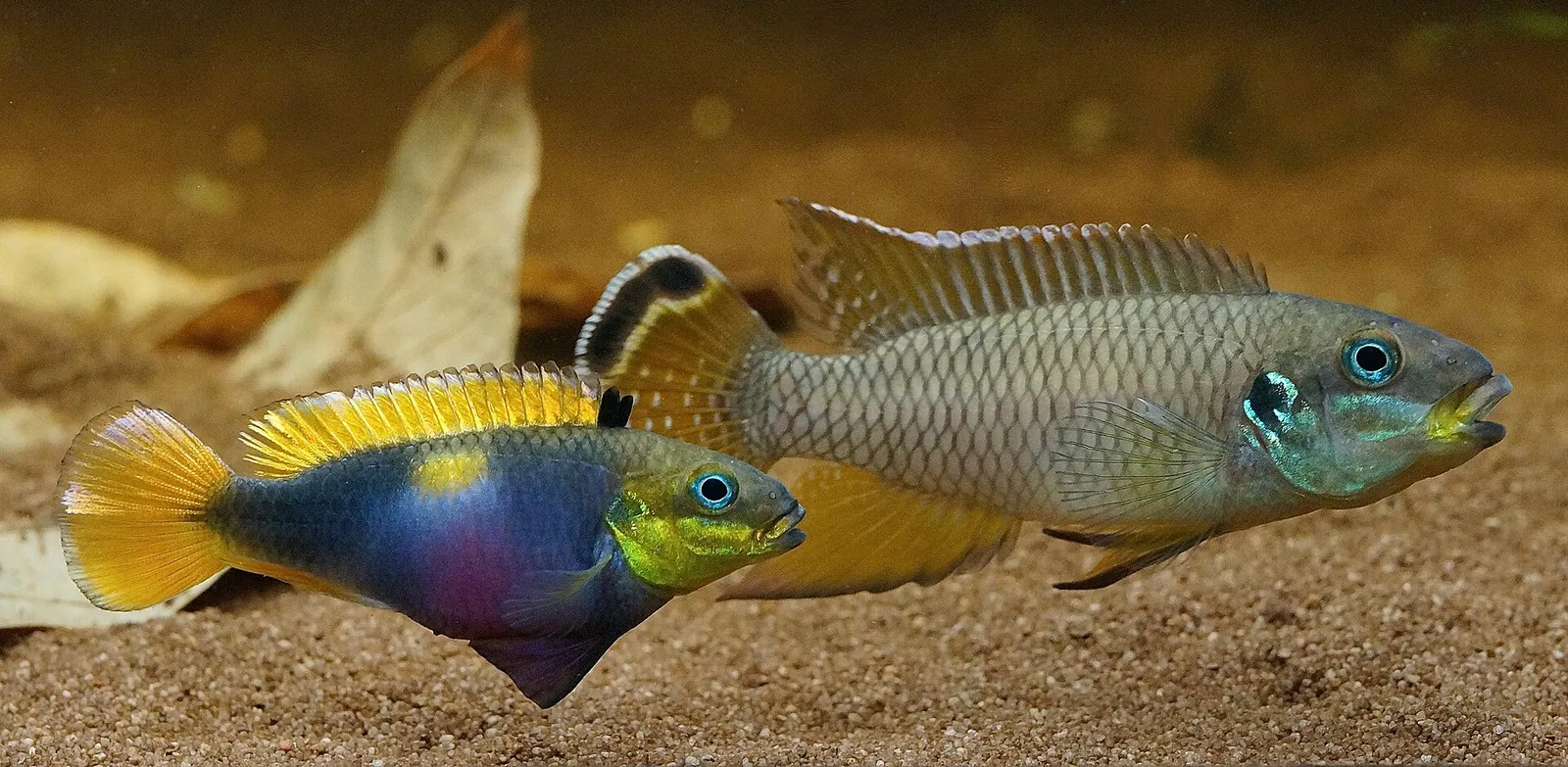
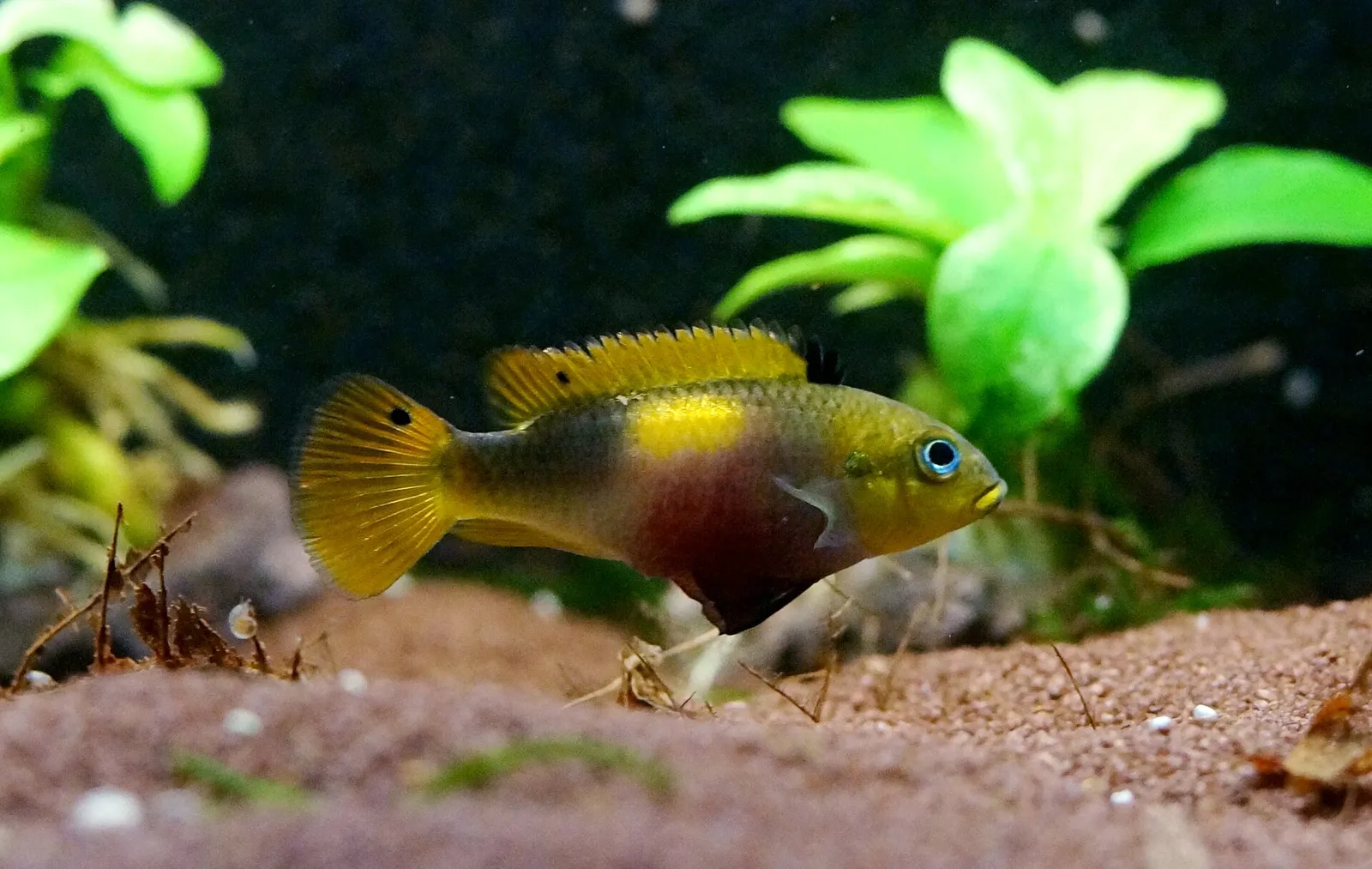
This is a very small cichlid: FishBase gives a maximum of about 2.5 in standard length, and in the aquarium males reach a little under 4 in total length while females stay an inch or so shorter. The species is strongly dimorphic and dichromatic. Males are moderately elongate and gracile with a rounded head; females are markedly stouter, becoming blocky or 'football'-shaped and almost circular in the belly when ripe. Lamboj's diagnosis rests largely on the male caudal fin: the lower half carries a black margin with a white-to-pale-bluish submargin, while the upper half shows a white margin with a black submargin — a combination found in no other Pelvicachromis (it shares the lower-fin margin only with Pelvicachromis taeniatus). The dark upper band is sometimes broken into a row of dots rather than a solid stripe, and the central caudal field carries rows of small dots. Females are the showier sex: a yellow-to-golden head, light flanks fore and aft of a vivid pink-to-wine-red midbody patch that intensifies dramatically in courtship, and a caudal fin with a dusky blackish margin but, unlike Pelvicachromis taeniatus and Pelvicachromis kribensis, without horizontal dark bars. Meristics include 17-18 dorsal spines and 8-9 soft rays, three anal spines, and 27-29 pored lateral-line scales; the caudal peduncle is usually longer than deep, one of several proportional features separating it from close relatives. Like other kribs the genus name records the sexually dimorphic pelvic fins — pointed in males, rounded in females.
Habitat
Pelvicachromis drachenfelsi is endemic to the Wouri River system in southwestern Cameroon, where it lives not in the main river but in the smaller forest tributaries draining into the Wouri basin in the region of Yabassi. It is known from only a couple of localities and falls within the Southern Gulf of Guinea Drainages freshwater ecoregion. The type locality, as described by Lamboj, is a stream 13–26 ft wide that in the dry season runs 15.5–51 in deep with water visibility around 4–5 ft; the bed is fine sand carpeted with leaf litter, detritus and mud, broken by larger rocks and fallen, waterlogged trees. Beds of the aquatic plants Crinum natans and Bolbitis heudelotii grow in places, with large stands of Anubias barteri along the banks, and much of the channel is shaded by dense rainforest. Other collectors describe the same character: blackwater darkly stained with tannins, sometimes fast-flowing and rocky with sand pockets between the stones, fringed by grass-like dwarf bamboo overhanging the surface. The water is consistently very soft and low in conductivity; reported field measurements run warm (around 79–81 °F) and near-neutral, with collectors logging pH values from the low 7s down toward genuinely acidic blackwater. The fish shares these streams with small killifishes, tetras and barbs, and is reported locally in high densities.
Feeding
Like its congeners, Pelvicachromis drachenfelsi is a small benthic omnivore that leans toward animal prey — Cichlid Room Companion classes it as detritivorous and omnivorous, and FishBase places it at a trophic level near 3.2. In its tannin-stained forest streams it forages over the sand-and-leaf-litter bottom, taking small invertebrates, insect larvae and other tiny prey along with the organic detritus and biofilm that accumulate among the leaves. Its modest size and rounded, blunt head suit a fish that picks and grazes through soft sediment and submerged litter rather than one that excavates or crushes hard food. In the stream community it is a minor benthic forager occupying the shaded, slow-margin and leaf-pack microhabitats alongside other small characins and killifishes.
Mating
Pelvicachromis drachenfelsi is monogamous and forms pair bonds, with the brilliantly coloured female taking the lead in courtship — the typical pattern for the genus, in which the female is the more ornamented sex and uses her swollen, reddened belly as a signal. Courting females shimmy and shake, bending the body almost into a circle to display the wine-red midsection while the front and rear of the flanks darken from top to bottom, often setting off a golden patch on the nape. This drachenfelsi display closely resembles that of Pelvicachromis subocellatus, though it is somewhat less intense. Keepers report the species as comparatively peaceful for a Pelvicachromis: forced pairings are usually accepted without much trouble, and its tendency to occur in high densities in the wild hints at a relatively tolerant social temperament. A pair may court for a long while before spawning, the female intensifying her colours as the bond firms; once spawning is imminent she selects and prepares a cave, and the male shifts to defending a surrounding territory.
Breeding
Breeding follows the classic Pelvicachromis cave-spawning pattern. Given a choice the female selects a cave with a very small entrance, then lays her eggs in neat rows on the ceiling or walls of the chamber while the male attends from just outside, entering periodically to fertilise. After laying, the female assumes sole care of the interior — fanning and guarding the clutch — while the male patrols an outer territory; during the brood-care period she typically wears a dark mid-lateral band across her body. The fry become free-swimming after roughly 8-10 days, after which both parents jointly shepherd the school for another four to eight weeks. Clutch sizes are not separately published for this species but, as with congeners of similar size, run to a few dozen up to roughly a hundred eggs. As in several Pelvicachromis, water chemistry can skew the sex ratio of the brood, with more acidic, softer water tending to produce more males — a reason breeders pay close attention to pH. Rearing the fry is generally straightforward given good food and frequent water changes.
In the aquarium
Pelvicachromis drachenfelsi is an undemanding, rewarding dwarf cichlid, though it is a specialist-hobby fish rather than a pet-store staple — it is rarely if ever offered in general shops and is most often found through dwarf-cichlid specialists, sometimes still listed under the old name 'Pelvicachromis taeniatus Wouri'. A pair can be housed in a tank from about 24 inches upward, with more length always better if other fish are present. The aquarium should echo the native stream: very soft water (under about 2 °dGH), pH around 6.5-7.0, and a temperature near 78 °F; a fine sand substrate, subdued lighting, leaf litter or tannin-stained water, and some rock and bog-wood structure all suit it well. Live plants tolerant of soft, shaded water — Anubias, Bolbitis, Crinum, as found over the wild beds — are both natural and useful for breaking sightlines.
The single most important furnishing for breeding is a spawning cave with a small entrance: an inverted flowerpot with a chipped rim, a coconut shell, or a purpose-made ceramic cave, which the female will choose and defend. The species is on the peaceful end of the genus, and forced pairings are usually accepted, but as with all kribs a mismatched or cramped pair can quarrel, so give subordinate or unsettled fish room and cover to retreat. Diet is no obstacle: a varied menu of small live and frozen foods — bloodworm, daphnia, brine shrimp, cyclops — alongside good-quality micro-pellets and flake keeps the fish in colour and brings females into spawning condition. Suitable tankmates are the small, soft-water fishes that share its range or its conditions: West-African tetras, small barbs, killifishes, and other peaceful nano species; avoid boisterous, hard-water, or fin-nipping companions. The two husbandry points keepers most often get wrong are water chemistry — these are genuine soft, low-conductivity blackwater fish that do poorly in hard, alkaline tap water — and skewed brood sex ratios from breeding at the wrong pH.
Conservation
Pelvicachromis drachenfelsi has not been evaluated by the IUCN Red List; it carries no Red List category, no CITES listing and no CMS listing (FishBase, version 2025-2, likewise records it as Not Evaluated). That absence of a formal assessment is not the same as security. Anton Lamboj, who has watched the type region for close to two decades, notes that while the habitat has appeared stable over that time, the species is known from only two localities, so its total range and population are inherently small — and he explicitly suggests that maintaining captive (aquarium-conservation) stocks is worthwhile as a hedge. The broader backdrop is the southwestern Cameroon lowlands, where rainforest clearance, expanding agriculture and development pressure around the Douala-Yabassi corridor threaten the small, shaded forest streams that narrow-range fishes like this one depend on. As a soft-water blackwater specialist tied to a handful of tributaries, Pelvicachromis drachenfelsi is exactly the sort of micro-endemic whose status could change quickly and quietly, and its continued presence in the hobby is a genuine conservation asset.