Taxonomy & naming
The Belgian ichthyologist Max Poll described this fish in 1948 as Plecodus straeleni, working from a single specimen (the holotype, MRAC 112724) collected south of Cape Tembwe on the Congolese shore of Lake Tanganyika during the 1946-1947 Belgian hydrobiological expedition. The genus name Plecodus comes from the Greek plekein, 'to fold,' and odous, 'tooth' - a nod to the unusual, loosely set teeth the scale-eaters carry. The species epithet honors Victor Van Straelen, the Belgian naturalist who directed that expedition's institutional backing.
Nomenclature is the one place this fish genuinely divides its sources, and it is worth being precise. FishBase and older checklists list it as Plecodus straeleni. Eschmeyer's Catalog of Fishes - the standard authority for fish names - now records its current status as valid as Perissodus straeleni (Poll 1948), following Ad Konings' 2015 and 2019 treatments, which subsumed Plecodus into the older genus Perissodus. Both names point to the same fish; Plecodus straeleni remains the more familiar label in the trade, but the atlas follows the Catalog of Fishes in using Perissodus straeleni. Either way it sits in the tribe Perissodini, the small clade of Tanganyikan lepidophages (scale-eaters) that also contains the better-studied Perissodus microlepis. In Tanzania it carries the local name Kalilakumkumi.
Morphology
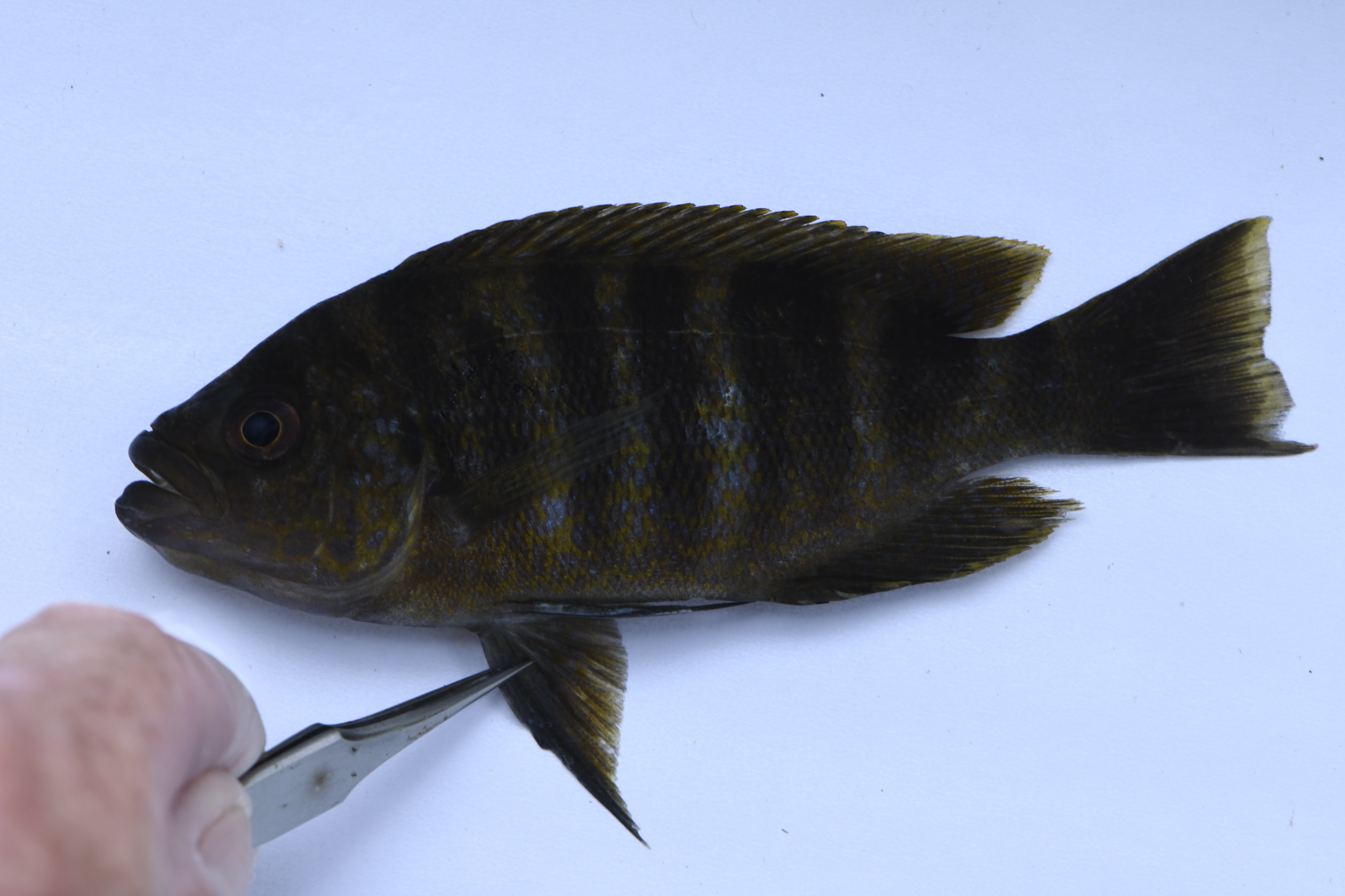
This is a modest-sized cichlid, reaching about 5 in standard length, with a deep, laterally compressed body and a slightly upturned, fleshy-lipped mouth set with the splayed, almost comb-like teeth that define the scale-eaters. The most-repeated thing about it concerns color, and here it is strongly sexually dichromatic - the sexes look like different fish. Males wear a bright white-to-bluish ground crossed by about five dark vertical bars, a pattern that reads as a smaller, slimmer echo of the big humphead Cyphotilapia frontosa. Females (and non-displaying males) are a plain gray to dark brown with the bars only faintly showing.
That barred livery is the visual basis of the 'aggressive mimicry' story attached to this fish: a displaying male, at a glance, can be mistaken for a small, harmless frontosa, and the classic reading holds that this disguise lets the scale-eater approach unsuspecting prey before it strikes. The mouth and dentition are the real specialist hardware, twisted slightly to one side so the comb of teeth can rake a victim's flank in a single rasping bite. Geographic variation is slight for such a wide-ranging fish. Populations in the southern half of the lake, particularly along the southern Congolese coast, have been reported to show males with a more intense blue than fish from Magara in Burundi to the north - a difference hobbyists track by collection-site labels like 'Kasanga,' 'Magara' and 'Lyamembe.' The feature that separates straeleni from its lake-mates is less the bars than the company it imitates: once a barred male moves, its smaller size, different mouth and predatory behavior give it away.
Habitat
Perissodus straeleni is a Lake Tanganyika endemic, found around the lake with very little geographic break - a genuinely lake-wide distribution shared across all four riparian nations (the Democratic Republic of the Congo, Burundi, Tanzania and Zambia). The type locality is Cape Tembwe on the Congolese side.
It is a fish of the rocky and intermediate (rock-meets-sand) shoreline rather than open water, and it ranges through a broad depth band, from roughly 10 ft down to about 130 ft or deeper. Because it lives by attacking other fish, its habitat is effectively wherever its prey congregate: the boulder-strewn littoral where Tanganyika's dense cichlid communities pack in. Its native water is the lake's signature hard, alkaline, thermally stable medium - a high pH (around 8.6 to 9.3) and warm (about 75-81°F in the surface layers it frequents). It is never abundant; one careful estimate puts it at only about 0.1 to 1 percent of the fish at any given rocky site, which is exactly what theory predicts for a parasite-like specialist that must stay rare relative to the prey it exploits.
Feeding
Scale-eating - lepidophagy - is the whole story of this fish's ecology, and it is one of the strangest feeding strategies in freshwater. An adult Perissodus straeleni rushes a larger fish, twists, and rasps a mouthful of scales (and often skin) off its flank, then leaves the victim alive to regrow them. Because the prey survives, scale-eaters can crop the same population repeatedly, which is part of why they persist at very low density. FishBase places the species at a high trophic level (around 4.3), reflecting that it feeds on other fish even though it rarely kills them.
The blue-and-black bars that make a displaying male resemble a harmless Cyphotilapia have long been read as 'aggressive mimicry' - camouflage that lets the predator close on prey that fail to recognize the threat until it has already bitten. Field science has mapped the hunting in detail. Following 69 individuals one hour each with SCUBA, Nshombo (1994) catalogued five techniques - pursuing (chasing 'flying' prey at speed, used by adult males, often against the spiny eel Mastacembelus), waiting (lying motionless for a known target), mingling (subadults mixing into schools of plankton-feeders to bite from within), aiming, and stealthy approach from behind. Attacks landed on 38 cichlid species plus seven non-cichlids, and remarkably, individuals specialized: a given fish would work just one or a few prey species in an hour, a skill attributed to learning the habits of particular victims. The most striking diet study is molecular: Boileau and colleagues (2015) sequenced DNA from 469 ingested scales in 38 stomachs and identified 43 prey species spanning 10 of Tanganyika's 12 cichlid tribes, plus the endemic spiny eel - with up to nine species inside a single gut. That breadth is what complicated the mimicry story: a fish raiding dozens of species across the whole community is plainly not relying on resembling any one of them. Females also dabble in a second trick: some lie in wait near the bowers of the mouthbrooder Cyathopharynx furcifer and, the instant a pair spawns, dash in to snatch the freshly laid eggs (Nshombo 1991).
Ad Konings' own field notes both support and complicate the mimicry picture. Diving off Burundi and the southern Congolese coast, he found the population at Kapampa runs noticeably bluer than the one at Rutunga in Burundi, tracking the locally bluer Congolese frontosa population there rather than any fixed, lake-wide pattern - hard to explain unless the resemblance is doing real work. Yet in years of diving among Burundi's frontosa schools he never once witnessed straeleni strike a frontosa, despite routinely seeing it swim among them; the direct attacks he documented targeted other species, including the sand-dweller Cyathopharynx furcifer and even the far smaller Neolamprologus brichardi. He also pointed out that Burundi waters lack the fish sometimes proposed as alternative models, Neolamprologus sexfasciatus and N. tretocephalus, yet the frontosa-like pattern holds there regardless - an argument against a multi-species mimicry reading. Set against Perissodus microlepis, the lake's other abundant scale-eater, which shows no comparable resemblance to any of its own targets (chiefly the algae-grazers Tropheus and Petrochromis, plus female Ophthalmotilapia ventralis), straeleni's preferred targets skew toward other large, silvery cichlids - especially female C. furcifer and the bigger sand-dwelling species - a split distinct enough to suggest the two scale-eaters have partitioned prey as well as depth.
Mating
The famous behavioral hook for the scale-eaters is 'handedness.' Their close relative Perissodus microlepis comes in two mirror-image forms - a left-twisted mouth that bites scales from the prey's right flank, and a right-twisted mouth that takes the left - and Michio Hori's celebrated 1993 field study in Science showed the two morphs are held near a 50:50 balance by frequency-dependent selection: whichever form is momentarily rarer enjoys better hunting success, because prey learn to guard the side they are bitten from most often. A 2018 enclosure experiment by a Basel team confirmed it, finding scale-eaters fed best in mixed left/right groups. Perissodus straeleni belongs to the same lepidophagous guild, and this is the headline trait of its lineage, though the cleanest experimental work has been done on its cousin rather than on straeleni itself.
At pairing, the fish's strong sexual dichromatism comes to the fore: the bright, barred males that read as frontosa-like are the displaying sex, while females stay drab gray-brown. The pair forms the bond that carries through to the unusually committed brood care described below.
Breeding
Reproduction is mouthbrooding with unusually committed parental care. The female takes the eggs - clutches reported up to roughly 100 - into her mouth, and after the larvae are first released the fry continue to be guarded by both parents for an extended stretch, ducking back inside a parent's mouth for shelter for more than a month after first emergence. In one record, a 4.5 in female was still brooding 1 in young. During this parental phase, breeding males darken markedly, becoming so similar to the drab females that size becomes the main way to tell the pair apart - a behavior that complicates any simple 'males mimic frontosa' reading of the color pattern. The biparental defense of free-swimming young is striking for a Tanganyikan mouthbrooder, most of which abandon the fry soon after release, and it underlines that the scale-eaters invest heavily in each small clutch.
In the aquarium
Perissodus straeleni turns up only occasionally in the trade, and it is a specialist's fish rather than a beginner's, for a reason that is obvious once stated: it eats the scales of its tankmates. Keepers who run it successfully treat the scale-eating as the central design problem. A common approach is to keep it as a pair or small group with robust, fast, similarly sized Tanganyikan cichlids that can shrug off the occasional raid, in a tank with the lake's hard, alkaline water (pH ~8.6-9.3) and warm temperatures, plenty of rockwork, and enough length - a 4-to-6-foot footprint is sensible for a fish this active - to let bitten tankmates put distance between themselves and the hunter. Slow, long-finned, or much smaller fish make poor companions, since they become easy and repeated targets.
The practical surprise, reported since the earliest aquarium observations (Marlier & Leleup, 1954, found captives that refused worms, fish powder and insects and would take only scales of live fish), is that wild-collected adults can be reluctant to switch to prepared foods. Most modern keepers report that captive-raised or acclimated fish will eventually accept frozen and pellet diets, but a fresh import may need patience and live or scale-rich feeding to transition - one of the genuine challenges of the species. None of this is folklore worth repeating uncritically; the honest summary is that straeleni is rewarding for its behavior but demands a keeper willing to plan the whole tank around a fish that bites its neighbors for a living.
Conservation
Perissodus straeleni is listed by the IUCN Red List as Least Concern, in an assessment published in 2025 by Lwabanya Mabo for the Lake Tanganyika fishes group. It is naturally uncommon but lake-wide in distribution, is not a meaningful target of fisheries, and faces no species-specific collection pressure beyond light, incidental capture in the ornamental trade; specialists note it is not threatened by overfishing. That is the honest headline: the fish itself is not in trouble.
The larger context is the lake it cannot leave. Lake Tanganyika is under documented, basin-scale strain. O'Reilly and colleagues (2003, Nature) showed that a warming climate has strengthened the lake's thermal stratification and weakened the seasonal mixing that lifts nutrients to the surface, driving an estimated ~20 percent decline in primary productivity and, by their reckoning, roughly 30 percent lower fish yields - a loss that rivals the effect of fishing itself. Cohen and colleagues (2016, PNAS) found that warming since roughly 1946 has cut the oxygenated benthic habitat available to lake animals by something on the order of 38 percent, squeezing the bottom-associated community from below. Closer to this fish's home, shoreline deforestation and erosion push sediment onto the rocky littoral (Cohen et al. 1993), the very boulder habitat where straeleni hunts. As a rocky-shore specialist tied to dense, shallow cichlid communities, Perissodus straeleni is exposed to that sedimentation and to anything that thins the prey assemblage its whole lifestyle depends on - it sits near the top of a food web that warming and habitat loss are reshaping from the base up. Governance is shared by the four lake nations through the Lake Tanganyika Authority. So the accurate framing is the careful one: this scale-eater is Least Concern today, but its security rests entirely on a lake whose productivity, oxygenated depths and littoral habitat are all measurably under pressure.