Taxonomy & naming
The bay snook was described by Albert Günther in 1862 in his catalogue of the acanthopterygian fishes of the British Museum, on material from Lake Petén in the Guatemalan lowlands — the lake that gives the genus its name. Günther erected the genus Petenia for it at the same time, and it has remained monotypic ever since: Petenia splendida is the only valid species the genus contains. Earlier names that fall into synonymy include Petenia myersi Schmidt, 1936. Within the Central American cichlid radiation (tribe Heroini of the subfamily Cichlasomatinae) the genus is one of a cluster of distinctive Mesoamerican lineages — Petenia, Caquetaia and Parachromis among them — that converged on a piscivorous body plan with enlarged, protrusible jaws. Molecular phylogenies (Říčan et al. 2016 and earlier work by Concheiro Pérez and colleagues) place Petenia firmly within the Middle American heroines rather than with the superficially similar South American Caquetaia, making the shared 'telescoping jaw' a case of convergence. The species was long left in or near the catch-all genus Cichlasoma by aquarists, but the genus Petenia has priority and is universally accepted today.
Aquarium-hobby identification of the fish was not always so clean. Collectors recall that as El Salvadoran cichlids first reached hobbyists in the early 1980s, an undescribed, superficially similar Guapote was for a time mistakenly sold and discussed under the name Petenia splendida, before the true species became available for direct comparison and the mix-up was resolved — that other fish was eventually formally described as a species of its own. It is a useful reminder that, in a genus this distinctive, misapplied trade names were still common only a few decades ago.
Morphology
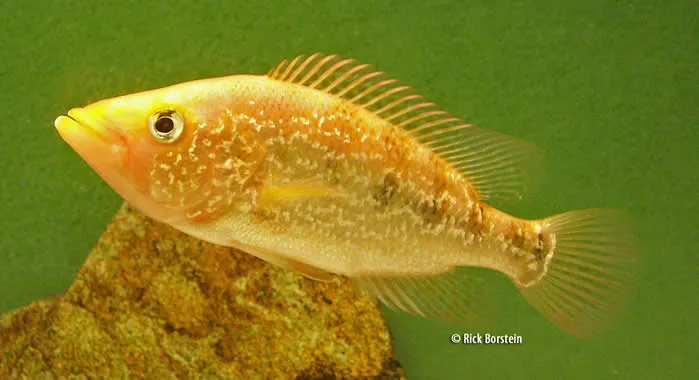
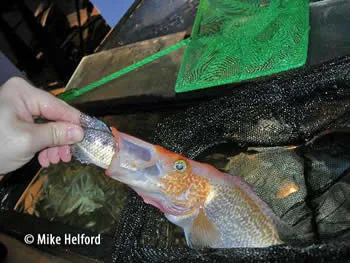
Petenia splendida is among the larger Central American cichlids: FishBase gives a maximum of 19.5 in SL, and wild fish of 12–15.5 in are routine, though aquarium specimens usually settle smaller. The body is elongate and only moderately compressed — a streamlined predator's outline rather than the deep disc of a Heros or Vieja. The defining feature is the mouth: the premaxilla and lower jaw are mounted on long ascending processes so that, when the fish strikes, the entire jaw apparatus shoots forward into a protruding tube, dramatically increasing reach and creating suction to inhale prey. Two colour forms occur. The common 'wild type' is silvery to greyish-olive, marked with a broken midlateral stripe of dark blotches and fine dark speckling, the fins faintly reddish. The celebrated red or 'rojo' form is a leucistic morph — orange-red to pink overall, with reduced melanin — that occurs naturally in some populations and has been line-bred in the hobby; intermediate marbled fish are also seen. The eye is large and often red-rimmed. Sexual dimorphism is modest: mature males grow larger and develop more produced, pointed dorsal and anal fin tips, while ripe females are deeper-bodied through the belly; both sexes intensify in colour when breeding.
Habitat
The bay snook inhabits the Atlantic (Caribbean) slope of Central America, from the Grijalva–Usumacinta system of Tabasco and Chiapas in Mexico through the Petén lakes and rivers of Guatemala into Belize — and, on the evidence of field collecting along the Caribbean coast between La Ceiba and Trujillo, into Honduras as well. Both the plain silvery-grey 'wild' form and the red morph have been taken well east of the Usumacinta-Petén core of the range, on expeditions into Belize and onward into Honduras, indicating this species' true distribution runs the length of the northern Caribbean slope rather than stopping at any one national border. It is a fish of lowland lakes, lagoons, oxbows and the slower, deeper reaches of rivers, favouring clear to slightly turbid warm water over soft substrates with submerged wood, rock and marginal vegetation that give an ambush predator cover. In the karstic lakes of the Petén — including the large Lake Petén Itzá — it is a characteristic open- and mid-water predator. It also turns up in far humbler water: around Villahermosa, Tabasco, it has been collected from shallow (about 3 ft), muddy-bottomed, murky ponds fringed with water lilies that dry out in the dry season and are restocked from overflowing neighbours when the rains return, in the company of Amphilophus robertsoni, several Nandopsis/'Cichlasoma' species, Paratheraps, Thorichthys and a wide range of livebearers, catfish and characins — waters running warm, 82–90 °F. Recorded water is warm and hard-leaning alkaline, in keeping with the limestone geology of much of its range: FishBase cites roughly 79–86 °F and pH 7.0–7.5, while a Honduran Caribbean-coast site holding the species alongside Thorichthys and several Nandopsis/Paratheraps cichlids read pH 7.5–8.0 with a moderate hardness around 8 °dH and temperatures of 77–82 °F. It tolerates a fair range of conditions across its distribution but is not a fish of cool headwaters; it belongs to the warm, well-vegetated lowland waters where prey fish are abundant.
Feeding
Petenia splendida is a specialised piscivore — FishBase places it at a trophic level near 4.5, among the highest of any Mesoamerican cichlid. It hunts by lie-in-wait ambush and short pursuit, then strikes with the telescoping jaw to engulf small fish whole; the protrusible mouth lets it take prey relatively large for its gape and to capture fast, evasive quarry by suction. Smaller fishes make up the bulk of the adult diet, supplemented by larger aquatic invertebrates such as shrimp and insect larvae, especially in younger fish. In the lake and river communities it occupies it functions as a mid-sized apex predator on the smaller fish fauna — livebearers, tetras, juvenile cichlids and the like — a role reflected in its sleek build and oversized mouth.
Mating
Like most Central American heroine cichlids the bay snook forms monogamous pairs that hold and defend a breeding territory. Pair formation is preceded by the usual cichlid repertoire of lateral displays, jaw-locking and substrate cleaning, and a bonded pair becomes markedly more colourful and considerably more aggressive toward intruders as spawning approaches. Outside the breeding season the species is comparatively retiring for so large a predator, often hanging quietly in cover; it is the onset of reproduction that brings out strong territoriality. Pairs select and clean a hard surface — a flat stone, a sloping rock face or a sheltered patch of substrate — in advance of spawning.
Breeding
Petenia splendida is a biparental, open substrate (sometimes cave-associated) spawner with extended parental care typical of the heroine cichlids. The female lays a clutch of adhesive eggs — several hundred to over a thousand in a large female — on the cleaned surface, and both parents share the brood: the female tends and fans the eggs while the male patrols the territory, the roles overlapping as the brood develops. Eggs hatch in a few days at warm temperatures and the wrigglers are moved to pits in the substrate; once free-swimming the fry are guarded as a dense school by both parents, who lead them through cover and defend them vigorously against all comers. As with related large predators the young grow quickly on a high-protein diet. In aquaria the species has been bred but demands a large tank and a well-matched pair; pair aggression and the predatory disposition of the adults make management more involved than for smaller cichlids.
In the aquarium
The bay snook is a long-established and prized aquarium fish, especially the red form, but it is a large, predatory cichlid that needs space and planning — not a community fish. A single adult should be considered the minimum tenant of a tank around 120–150 US gallons, and a breeding pair or any attempt at a mixed 'wet-pet' display needs more — a 6 ft or larger tank is realistic for adults. The species is an accomplished predator: anything small enough to fit in that telescoping mouth will eventually be eaten, so tankmates must be robust and of comparable size — other large Central American cichlids (Parachromis, large Vieja, Mayan cichlids), big plecos or other heavy-bodied catfish. Even then, individual temperament varies and breeding pairs turn sharply territorial.
Water should be warm and hard-leaning: 79–86 °F, pH around 7.0–8.0, with moderate to hard, alkaline water suiting it well given its limestone-lake origins. Powerful, well-maintained filtration and generous water changes are essential because a fish of this size on a meaty diet produces a heavy bioload. Décor should provide line-of-sight breaks and secure cover — sizeable driftwood, rock structures and a fine sand or smooth gravel bottom; the fish will rearrange loose material. Robust or floating plants can be used but delicate planting is usually uprooted.
Feeding is straightforward once the fish is settled: it readily takes good-quality sinking carnivore pellets, plus frozen and fresh meaty foods — whole fish (smelt, silversides), prawns, mussel, earthworms — offered in variety. Feeder fish are best avoided as a staple for disease and nutrition reasons; quality prepared and frozen foods give better long-term health. Wild-type fish are sometimes shy and slow to feed at first and appreciate dither fish and cover to draw them out. The chief mistakes keepers make are undersizing the tank, mixing the bay snook with fish small enough to become prey, and underestimating how aggressive a settled pair becomes at breeding time.
Conservation
The IUCN Red List assesses Petenia splendida as Least Concern (assessed 2018), reflecting a wide distribution across the Grijalva–Usumacinta and Petén drainages and Belize, and populations not considered to be in overall decline. It is an important food fish through much of its range — netted and angled for local consumption — and is also harvested for the ornamental trade, but neither is presently regarded as a population-level threat. The broader pressures on its lowland habitats are the familiar ones for Mesoamerican freshwaters: deforestation and agricultural runoff, water extraction, pollution of the karstic Petén lakes, and the spread of introduced fishes; these are watch-points for the future rather than documented threats to the species at present. It carries no CITES listing.