Taxonomy & naming
The redhead cichlid was described by the German-born British ichthyologist Albert Günther in 1862 as Heros melanurus, in the fourth volume of his Catalogue of the Fishes in the British Museum, on material from Lake Petén in Guatemala; a lectotype (BMNH 1864.1.26.82) was later designated from his syntypes by McMahan and colleagues in 2011. Like nearly all the Middle American 'Cichlasoma' of the nineteenth and twentieth centuries, it passed many decades in that catch-all genus before the modern dismantling of the group. It has since been shuttled through Paraneetroplus and into Vieja, a genus erected by Fernández-Yépez in 1969; the most recent comprehensive revision of the Middle American herichthyin cichlids (McMahan, Matamoros, Piller & Chakrabarty 2015, Zootaxa) retained the species in Vieja, where the Catalog of Fishes continues to list it as valid. The name most hobbyists know it by — synspilum — belongs to Cichlasoma synspilum Hubbs, 1935, described from the San Pedro de Mártir, a Usumacinta tributary in Petén, Guatemala; the Catalog of Fishes now treats synspilum as a junior synonym of Vieja melanurus, and a careful comparison found the supposed differences between the two to be invalid. The species sits in the Neotropical subfamily Cichlinae among the heroine cichlids, and within Vieja it is the largest and most vividly coloured member.
Morphology
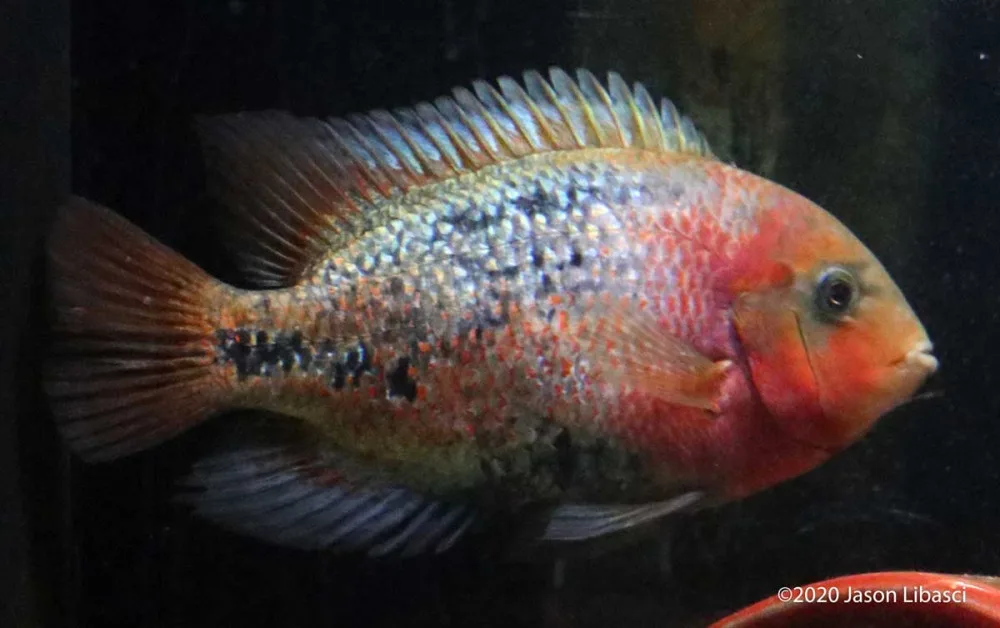
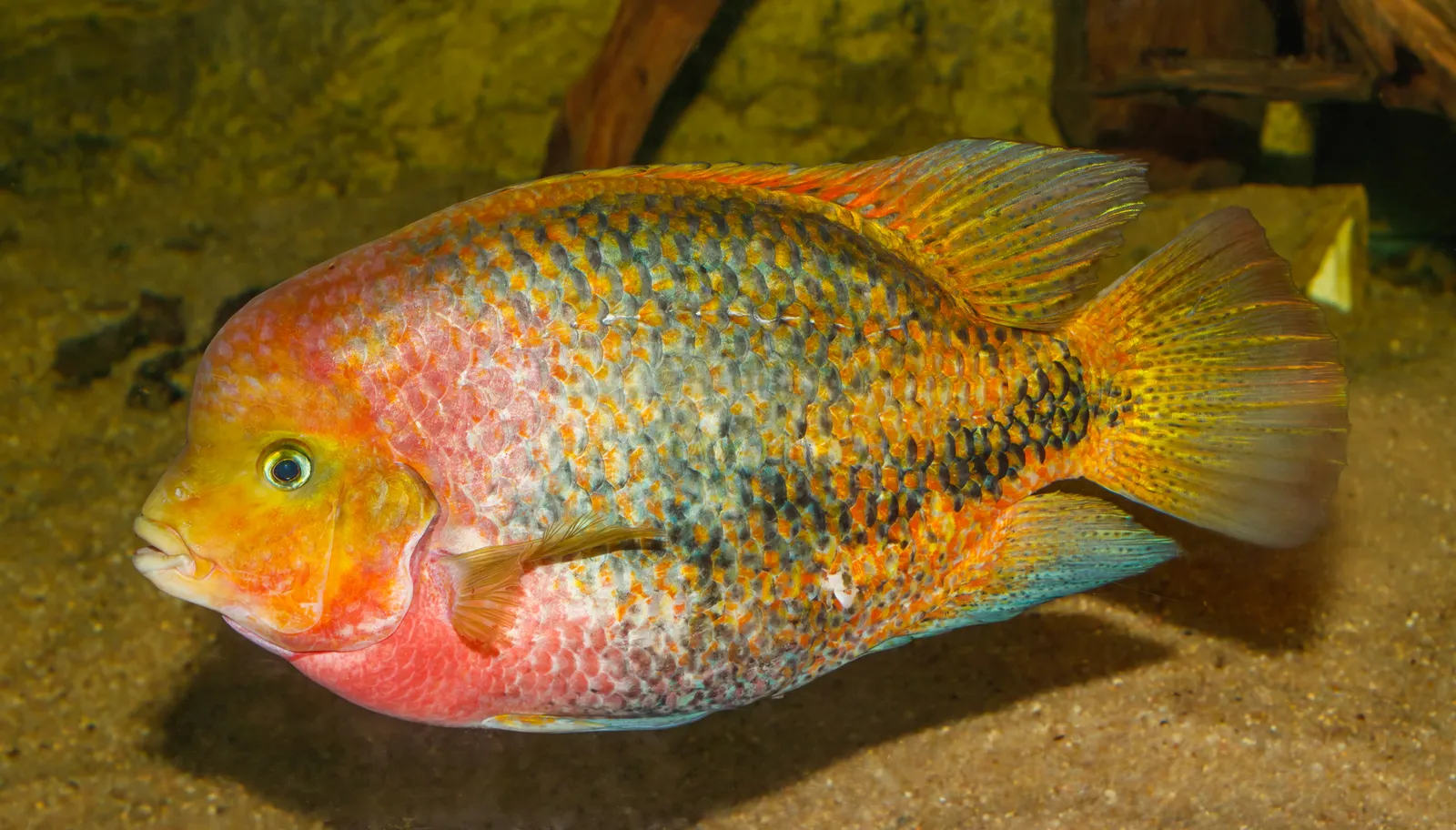
Vieja melanurus is a tall, robust, strongly compressed cichlid; FishBase gives a maximum of about 14 in total length, making it the largest species in the genus, and big aquarium males develop a very steep forehead and a heavy nuchal hump. The fish is named for two contrasting features. The first is the dark tail: 'melanurus' means 'black-tailed', for the black blotch carried on the caudal peduncle. The second — and the reason for its hobby fame — is the riot of colour adults acquire, particularly males in condition: the head and nape flush brilliant orange-red to fire-pink (the 'redhead' and 'firehead' of the trade), the flanks turn pearly blue-grey to turquoise studded with iridescent spangles, and the whole fish can look almost gaudily multicoloured, which earned it the name 'quetzal' after Guatemala's national bird. Juveniles and subadults are far plainer — silvery to olive with a row of dark mid-lateral blotches and the caudal spot — and the spectacular colour comes only with maturity, so young fish are easily underestimated. Sexual dimorphism is modest in pattern but clear in build: males grow distinctly larger, carry the dominant nuchal hump and the most intense head colour, while ripe females are deeper-bodied and less heavily humped.
Habitat
The redhead cichlid is native to the Atlantic (Caribbean) slope of southern Mexico, Guatemala and Belize, where it is centred on the Usumacinta River drainage — the great river system, shared by Mexico and Guatemala, that is the heartland of the genus — and the adjacent lowland lakes such as Lake Petén Itzá, its type locality. FishBase records it from the Usumacinta drainage of Mexico, Guatemala and Belize, inhabiting lakes and the lower river valley with a slight tolerance for brackish water. It is a fish of calm, warm, low-gradient water: lakes, lagoons, oxbows and the sluggish lower reaches of rivers, typically over soft mud and sand among submerged wood. In-situ and aquarium-derived chemistry point to warm, near-neutral to alkaline, moderately hard conditions — FishBase lists a pH range of about 7.0–8.0, hardness around 9–20 dH and temperatures of roughly 75–86 °F — consistent with the calcareous lowland karst country it occupies. Through aquarium release it has established outside its range, including canal systems in Florida and waters in Puerto Rico, and has been reported as far afield as Singapore, Taiwan and Hong Kong; these introductions underline how adaptable and hardy the species is.
Feeding
Vieja melanurus is, like its congeners, a large-bodied omnivore with a strong herbivorous and detritivorous bias; FishBase places the genus low on the food web, feeding on benthic detritus rich in plant matter together with fallen seeds and fruit, algae, aquatic vegetation and the small invertebrates living among it. Its deep body and robust jaws suit a browser that works the soft bottom and submerged wood of slow lowland water, tearing and grazing rather than chasing prey. In the riverine and lacustrine community it functions as a large grazer and processor of plant detritus rather than a piscivore, though like most big cichlids it will opportunistically take animal food, including anything small enough to swallow. This vegetable-leaning diet is the single most important husbandry fact about the species: a menu built around greens, not meat, keeps captive fish healthy.
Mating
The redhead is a monogamous, biparental substrate spawner that forms strong pair bonds. Outside breeding it is comparatively peaceful for so large a cichlid, but pair formation and spawning transform its temperament: a settled pair claims and vigorously defends a territory around a chosen spawning surface, and a male will harass a female that is not ready, so a well-matched, mutually willing pair is essential. Courtship follows the heroine-cichlid pattern of lateral displays, jaw-locking 'wrestling', quivering and the joint cleaning and inspection of a flat hard surface. The intensifying of the male's head colour and the deepening of the female's body accompany this pre-spawning phase. Because the species reaches sexual maturity at a relatively small size — around 4 in by one report — fish can pair and spawn well before they attain full adult dimensions.
Breeding
Vieja melanurus is an open, biparental substrate spawner. The pair cleans a flat hard surface — a rock, a slab of wood, a section of tank bottom — and the female lays her eggs on it in the open, after which both parents share guarding and fanning duty. FishBase reports the species producing on the order of 300–500 fry per spawning, with older references citing up to about 1,000 eggs from large females. The eggs hatch in a few days and the wrigglers are typically transferred to pits excavated in the substrate; the free-swimming fry are then led about and defended fiercely by both parents, who become intensely intolerant of intruders while shepherding a brood. The young accept newly hatched brine shrimp and finely powdered foods as they grow. In the aquarium the species breeds readily once a compatible pair has formed and a flat spawning site and digging substrate are available; as with the rest of the genus, the limiting factor is not fecundity but the management of the pair's spawning aggression.
In the aquarium
The redhead cichlid is a long-standing favourite among keepers of large Central American cichlids, prized for the spectacular colour mature fish develop, and it is not difficult to keep for anyone prepared for its adult size and temperament. Because it can approach 14 in, a single adult or a pair needs a large tank: a footprint of roughly 180 × 23.5 in (about 120 US gallons) is a sensible minimum for a pair, and more is better, particularly if other large fish share the tank. Water chemistry is undemanding within the species' natural envelope — a near-neutral to mildly alkaline pH (about 7.0–8.0), moderate hardness and a temperature of roughly 77–84 °F suit it well — but biological maturity and clean water matter: these are big, messy feeders, so generous filtration (a sump or oversized canister) and substantial regular water changes are necessary. The fish are not creatures of fast water; aim filter returns to break the surface rather than to drive strong current.
Use a sand or fine substrate, since the species digs, and furnish the tank with sturdy rockwork, roots and driftwood that provide cover and break up sightlines; the décor should be heavy and well anchored, because an adult redhead rearranges its world. Rooted plants are generally futile — Vieja are notorious for uprooting and eating vegetation — so any greenery should be treated as food or restricted to tough, potted or floating species. Diet should respect the species' plant bias: a base of spirulina or other green foods, blanched vegetables and quality vegetable-based pellets, with meatier items (bloodworms, brine shrimp, the occasional earthworm) as a supplement rather than the staple. Overfeeding rich protein is a common cause of bloat and 'hole-in-the-head' in big Vieja.
Temperament is the main consideration. Outside breeding the redhead is relatively even-tempered for its size and can be combined with other large, robust Central American cichlids and big catfish, characins or other fish able to hold their own; nothing small enough to be eaten is safe, and long-finned or timid tankmates are a poor match. Aggression escalates sharply when a pair spawns, and a guarding pair can dominate a large aquarium, so a roomy tank with broken sightlines and the readiness to separate combatants are the standard safeguards. The mistakes that cost keepers fish are almost always the predictable ones: underestimating the adult size, overstocking, feeding too richly, and not planning for the spawning-season aggression.
Conservation
Vieja melanurus has not been assessed as a distinct species on the IUCN Red List — neither FishBase nor the Cichlid Room Companion's IUCN compilation carries a current global category for it under this name — so its formal conservation status is best recorded as Not Evaluated rather than assigned a category it has not been given. This is partly an artefact of taxonomy: much of the older conservation and trade literature treats the fish under the synonym 'synspilum'. The biological picture, however, is reassuring. The redhead is widespread across the Usumacinta lowlands and adjacent drainages, tolerant of a broad range of conditions including brackish water, common in the trade and in local use, and demonstrably able to establish self-sustaining populations far outside its range — all hallmarks of an adaptable generalist rather than a vulnerable endemic. The broader pressures on its habitat are the familiar ones for lowland Mesoamerican rivers — deforestation, pollution, water extraction and the spread of introduced tilapia — but none is documented as a population-level threat to this particular species, and an unevaluated status here reflects an assessment gap, not evidence of decline.