Taxonomy & naming
The white cichlid was described by the French aquarist-ichthyologist Robert Allgayer in 1991 as Paraneetroplus argenteus, from the Usumacinta drainage of southern Mexico. Over the following decades it was shuffled through the unstable taxonomy of the Central American heroines — placed in Vieja (as Vieja argentea) and again in Paraneetroplus as those genera were redefined. The matter was settled by McMahan, Matamoros and colleagues, whose phylogenetic work on the 'Vieja-Paraneetroplus' assemblage led McMahan & Piller (2015) to erect the genus Maskaheros for argenteus and its close relative regani. The two are distinguished from neighbouring genera by the combination of small, dark, irregular spots scattered over the whole body and two broad dark bars across the interorbital region — the 'mask' that names the genus. The Catalog of Fishes (Fricke, Eschmeyer & Van der Laan) lists the species as Maskaheros argenteus (Allgayer 1991), the senior of the genus's two species; Maskaheros regani (Miller 1974) is its sister. The genus sits within tribe Heroini, among the large herbivore-leaning Middle American cichlids.
Morphology
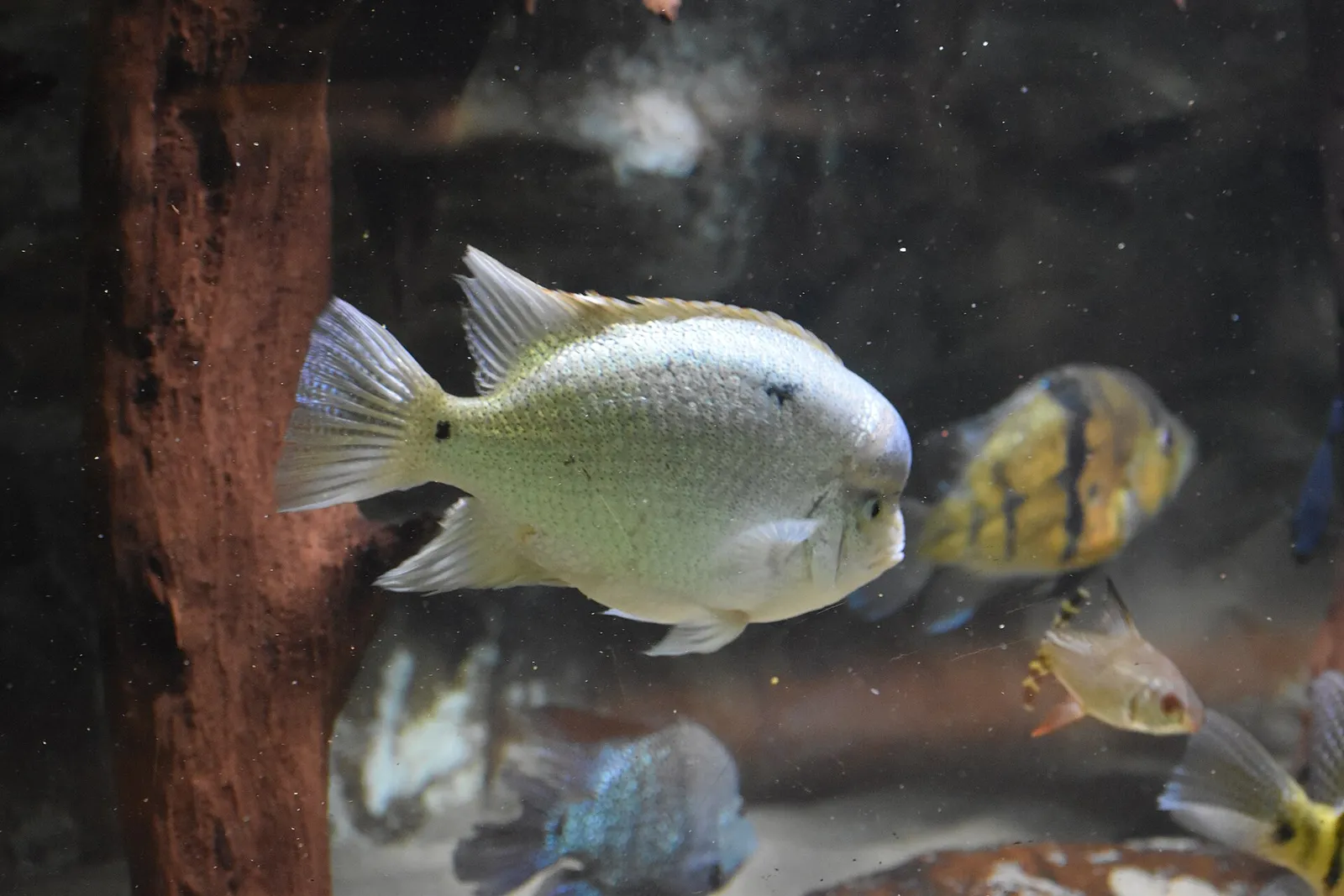
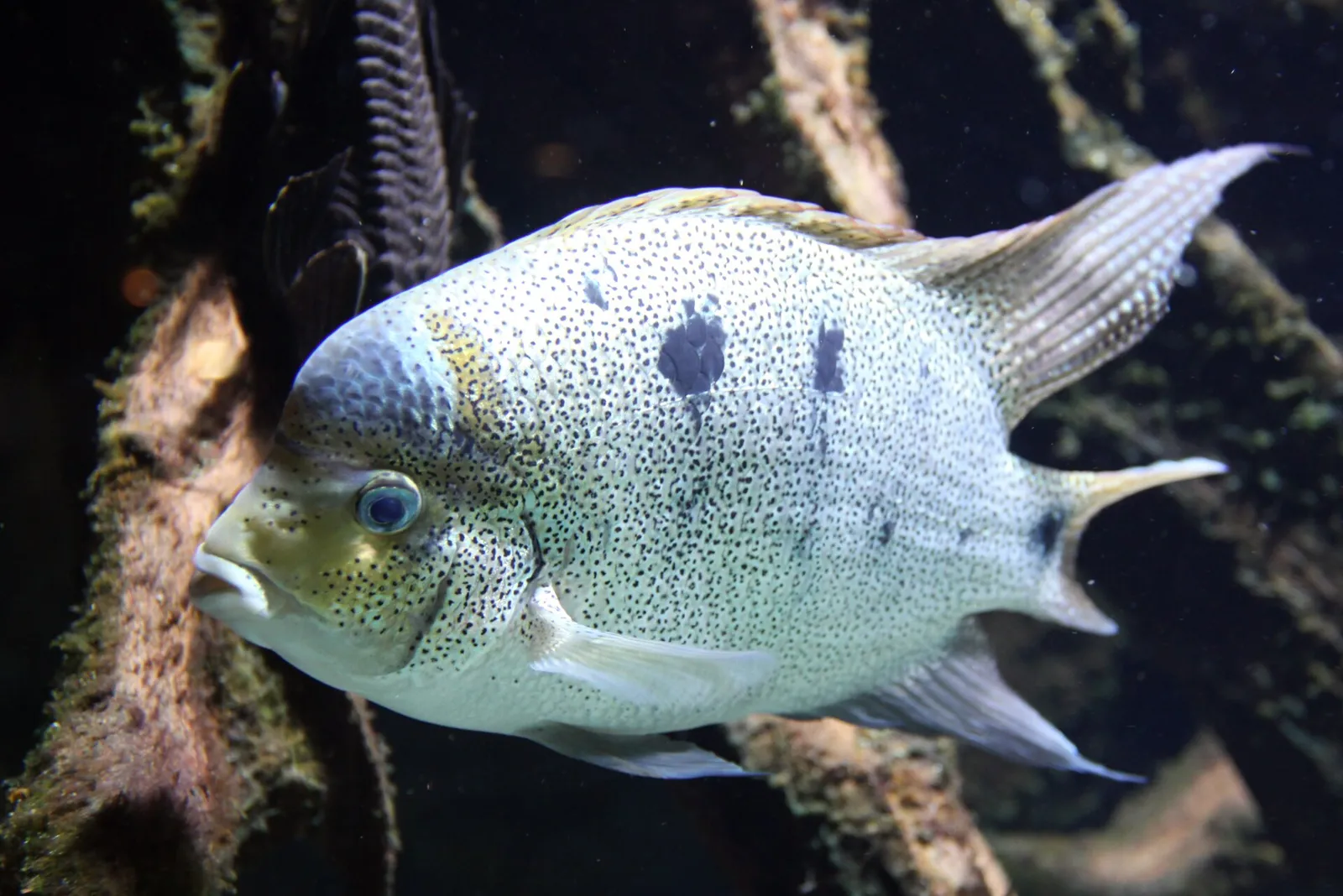
Maskaheros argenteus is a large, deep-bodied, laterally compressed cichlid reaching around 10.5–12 in total length (some captive males larger), with females staying somewhat smaller. The species is named for its colour: a silvery-white to pale pearl ground over the whole fish, finely peppered with small, dark, irregular spots across the body and fins. The diagnostic markings are the two broad, dark interorbital bars that cross the head between and above the eyes — the 'mask' — together with a dark blotch on the shoulder and another on the caudal peduncle. The head is large with a steep forehead, and the mouth bears the modest dentition of a fish that grazes and browses as much as it hunts. Sexual dimorphism is modest: mature males grow larger and develop a more pronounced nuchal hump and longer, more pointed dorsal- and anal-fin tips, while females are smaller, rounder-bodied, and may show the pale ground and spotting somewhat differently when in spawning dress. Both sexes can flush their pattern darker or paler with mood, the mask bars remaining the most constant feature.
Habitat
The species is native to the Atlantic slope of southern Mexico and Guatemala, in the great Grijalva-Usumacinta river system and adjacent drainages — recorded from the Usumacinta itself and tributaries such as the Río Tulijá, as well as neighbouring systems like the Río Tonalá. These are warm, lowland Neotropical rivers and their associated lagoons and backwaters, ranging from clear, faster rocky reaches to slower, vegetated, often turbid lowland stretches. Water in the basin is generally warm (mid-to-upper 20s °C) and hard, mineral-rich and alkaline, draining a limestone-influenced landscape; reported parameters for the species run to roughly pH 7.5-8 and high hardness. Like many large heroines it favours structured habitat — rock, submerged wood and root tangles — that provides cover, grazing surfaces and spawning sites. It shares these waters with a rich heroine cichlid fauna, including its relative Maskaheros regani in the upper Grijalva and a host of Vieja, Theraps, Thorichthys and Petenia species.
Feeding
Maskaheros argenteus is an omnivore leaning toward herbivory and detritivory, with a reported trophic level around 3.3 placing it in the middle of the food web. The modest dentition and large gut of the Maskaheros-Vieja group suit a diet built on algae and aufwuchs grazed from hard surfaces, plant material, and the small invertebrates, insect larvae and other animal matter taken incidentally or actively from the substrate and biofilm. In the wild it works rocky and woody surfaces and the bottom for this mixed fare. The group's flexible, vegetation-inclusive diet is part of why these fish grow large and do well across the variable conditions of the Usumacinta lowlands.
Mating
The white cichlid is a monogamous, biparental substrate spawner, and like its relatives it becomes territorial and assertive when breeding, though it is generally regarded as one of the more even-tempered large heroines outside of spawning. Pairs form through mutual display and become calmer and more settled with age. As a breeding pair the fish select and meticulously clean a hard surface, defend the surrounding territory, and intensify their colour and the contrast of the dark mask and spots. Courtship is the standard heroine sequence of lateral displays, fin-spreading, jaw contact and shared substrate-preparation that cements the pair bond before spawning.
Breeding
Maskaheros argenteus is an open substrate (rock) spawner with biparental care. The pair lays a large clutch of adhesive eggs — keepers report up to around a thousand from a big female — in rows on a cleaned stone or other firm surface, and both parents tend them: the eggs are fanned and cleaned, hatching in roughly three days at warm temperatures, and the wrigglers are moved to pits before becoming free-swimming about a week after spawning. Once mobile, the dense school of fry is guarded by both parents and readily takes newly-hatched brine shrimp and fine foods. The species has a reputation for being somewhat tricky to bring into spawning condition and to pair successfully — a compatible pair is the main hurdle — but once a bond forms it follows the reliable, attentive biparental pattern typical of the larger Central American cichlids.
In the aquarium
The white cichlid is a prized but uncommon aquarium fish, sought after for its clean silver-and-black colouring and its relatively manageable temperament for such a large cichlid. It needs serious space: a tank of at least 7 ft in length (on the order of 120 US gallons and up) is the realistic minimum for an adult or pair, furnished with a sandy bottom, large boulders and driftwood for cover, structure and spawning sites. Water should match its hard, warm, alkaline home — pH about 7.5-8, moderate-to-high hardness (around 12-16 dGH), temperature 75–86 °F. Powerful filtration and large regular water changes are needed for a big fish with a heavy, partly vegetable diet; feed quality pellets plus frozen and live foods (mysis, krill, shrimp) and vegetable matter such as spirulina and blanched greens to keep colour and gut health. Temperament is the species' selling point among large heroines: it is territorial and will defend a spawning site firmly, but it is comparatively peaceful and tends to mellow with age, so it can share a big tank with other sturdy Central Americans of similar size. It is a fish for the experienced large-cichlid keeper rather than a community aquarium, but a less belligerent choice than many of its neighbours.
Conservation
The IUCN Red List assesses Maskaheros argenteus as Least Concern (assessed 29 November 2018), reflecting its distribution across the large Grijalva-Usumacinta system and adjacent drainages and the absence of evidence for a significant decline. It carries no CITES listing. The wider pressures on its habitat are those affecting the whole Usumacinta-Grijalva basin: large hydroelectric dams on the Grijalva and proposed development on the Usumacinta, which fragment rivers and alter flow and sediment regimes; deforestation, agriculture and pollution in the lowlands; and the establishment of introduced fishes, especially African tilapias, across these waters. The species' size, adaptability and reasonably broad range buffer it for now, and its conservation status is secure, but the basin it depends on is under steadily mounting human pressure.