Taxonomy & naming
The species was described by the American ichthyologist Paul V. Loiselle in 1979 as Hemichromis stellifer, in his monographic revision of the genus Hemichromis (Annales du Musée royal de l'Afrique Centrale, Série Sciences Zoologiques No. 228). The holotype, MRAC 68036, is held at the Royal Museum for Central Africa in Tervuren, Belgium, with a series of paratypes split among the American Museum of Natural History and the Muséum national d'Histoire naturelle in Paris; the type locality is Malembo (Stanley) Pool — Malebo Pool, the broad lake-like reach of the Congo River between Kinshasa and Brazzaville — in the Democratic Republic of the Congo. Loiselle placed it among the smaller, three-spot 'jewel' members of Hemichromis, as distinct from the larger, five-spot, fasciatus-type predators that share the genus. Its standing was briefly questioned: Teugels and Thys van den Audenaerde (in Lévêque et al. 1992) treated stellifer as a synonym of the much-confused Hemichromis bimaculatus, but later authors (Daget & Teugels 1991; Stiassny et al. 2007) restored it as a valid species, and it has been treated as valid ever since. In 2022 Anton Lamboj and Stephan Koblmüller, working from a molecular phylogeny and morphology, split the jewel cichlids off into a resurrected genus Rubricatochromis (type species Hemichromis guttatus); under that arrangement the fish is Rubricatochromis stellifer (Loiselle, 1979). FishBase and the Catalog of Fishes now list it under Rubricatochromis, but the original combination Hemichromis stellifer remains in wide use in the literature and the hobby, and both names refer to the same species.
The species also has a tangled history in the aquarium trade. A wave of red jewel cichlids imported from the lower Zaïre in the mid-1980s, mostly from around Kinshasa — very close to Loiselle's own type locality for R. stellifer — arrived in the hobby mislabelled Hemichromis cerasogaster, apparently because that was already the 'next best' name in circulation for an easily recognisable red jewel. A comparison with type material later confirmed the imports were R. stellifer all along; true R. cerasogaster is a strict endemic of the distant, isolated Lake Mai-Ndombe and, tellingly, was so rarely seen alive that at the time no reliable account of its living colour existed — the fish being kept, photographed and written about under that name was almost always something else. Loiselle's original species concept has also drawn some skepticism on distributional grounds: he grouped populations from the lower Zaïre near Kinshasa and Brazzaville with others from the Kouyou and Likouala rivers of the Congo Republic, a disjunct range that struck at least one later reviewer as unusual — there is little faunal overlap between the Ogooué-basin drainages and the lower Zaïre — leaving open the possibility that more than one species is currently lumped under the name. Lamboj & Koblmüller's 2026 revision of the genus (Fishes 11(9): 531) then placed Rubricatochromis lifalili (Loiselle, 1979) — described in the same 1979 monograph, and for decades the standard hobby name for the blood-red jewel of the central Congo — in the synonymy of R. stellifer. Eschmeyer's Catalog of Fishes adopted the change in its update of 21 September 2026, and the atlas's separate lifalili page has been folded into this one.
Morphology
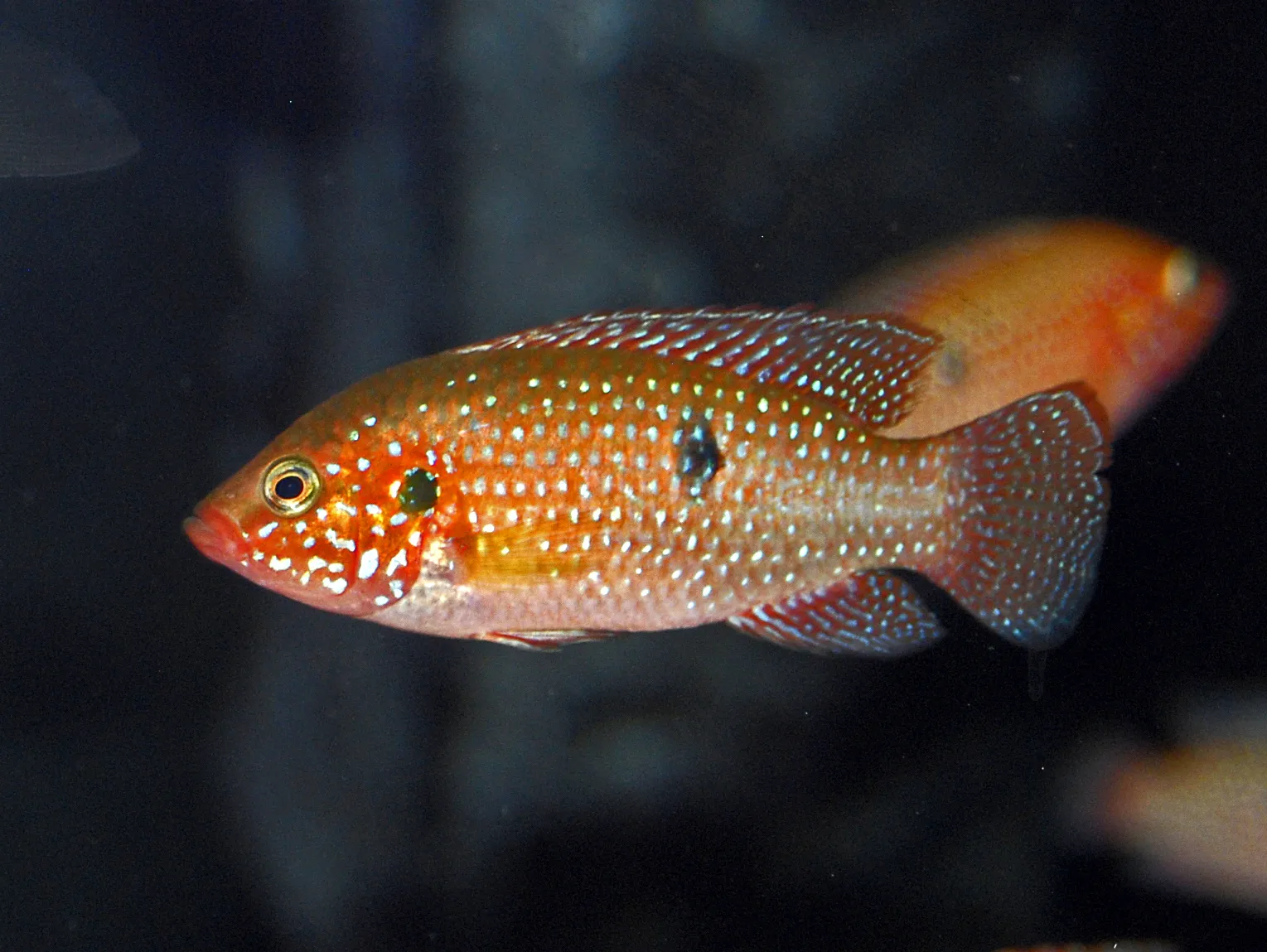
Rubricatochromis stellifer is a small cichlid, reaching about 4 inches in maximum total length; most aquarium and field specimens are smaller. The body is the moderately deep, oval form typical of the jewel cichlids rather than the elongate shape of the five-spot Hemichromis, with a slightly concave snout profile. Fin counts run to 13–15 dorsal spines and 10–12 dorsal soft rays, with three anal spines and 7–9 anal soft rays. Coloration in the genus is plastic and intensifies dramatically with mood: dominant or brooding fish flush a deep, glowing red over much of the body, the trait that gave the new genus name Rubricatochromis ('red-painted chromis'). The diagnostic markings, following Loiselle's revision and the FishBase diagnosis, set stellifer apart from its relatives. It always carries a single rounded, relatively large mid-lateral black spot, sometimes haloed front and back by a lighter zone but never fully ocellated; the flanks lack the multiple rows of bars or blotches seen in some congeners, though the dorsum may bear small black spots and seven to nine narrow dark bars that sometimes reach mid-body. Iridophores — the source of the 'star-bearing' epithet — show as blue-green spangles and irregular blue streaks, concentrated on the lower head and rarely spreading onto the body or unpaired fins; the streaking is similar to but narrower than the pattern of the related Rubricatochromis cerasogaster, from which stellifer is told apart by its retained mid-flank spot and concave snout. The trailing edge of the caudal fin is banded with alternating red and blue. The black spot on the caudal peduncle is usually absent or, if present, small.
Fish in full breeding dress show a further, consistent set of field marks: on the rear half of the body the iridophores concentrate along the posterior edges of the scales rather than spreading evenly; red coloration is concentrated on the lower half of the body; the scales forming the mid-lateral spot are usually edged in blue; and the faint vertical barring is most visible around that spot, sometimes intensifying just above it into one or more small dark blotches at the base of the dorsal fin. Two named colour forms are recognised from the lower Zaïre, distinguished only in males — the 'Rotkehl' ('red-throat'), with red extending onto the throat, and the 'Gelbkehl' ('yellow-throat'), which lacks it — while females of the two forms cannot be told apart. A similar-looking form collected near Bangui in the Central African Republic, reported as Hemichromis lifalili (a name now included in stellifer), is more delicate in build and shorter in the snout than true R. stellifer. Sexual dimorphism is otherwise modest, as in other jewel cichlids: ripe females are rounder-bodied, while breeding individuals of both sexes develop the intense red dress, and males tend to be somewhat larger with slightly longer unpaired fins.
Habitat
Rubricatochromis stellifer is a fish of the lower and central Congo basin and the adjacent Atlantic coastal drainages of west-central Africa. FishBase summarises its range as Equatorial Guinea south to Cabinda (the Angolan exclave), including the central regions of Gabon and the western Republic of the Congo, and along the Congo River itself from Malebo Pool downstream to the estuary; it also reaches upstream of Malebo Pool into the Likouala and Likouala-aux-Herbes of the middle Congo basin. The IUCN range statement is more conservative, listing Angola (Cabinda), the Democratic Republic of the Congo, and Gabon. As a jewel cichlid it occupies the shallow margins of rivers, streams, creeks, lakes, ponds, swamps and marshes, where it finds cover among submerged wood, roots, leaf litter and marginal or floating vegetation over substrates ranging from mud and silt to sand and gravel. Across the genus's range these waters are typically warm, soft and acidic — often the tea-brown blackwater of tropical forest — though jewel cichlids as a group tolerate a wide chemical envelope. FishBase gives a preferred temperature band of roughly 72–79 °F for stellifer; field measurements across the genus span pH from about 4 to 8.5 and temperatures from the high teens to the low thirties, with the species itself sitting in the soft, acidic part of that spectrum. These are shallow-water fish: there is no deep-water habitat for a small forest-margin cichlid, and it is best thought of as occupying roughly the upper 0–7 ft of the water column near cover.
Feeding
Like other jewel cichlids, Rubricatochromis stellifer is a small benthopelagic invertivore that forages over the bottom and among cover for live prey. FishBase places its trophic level near 3.4, consistent with a carnivorous diet. No detailed gut-content study of stellifer itself appears in the literature, but Congo fish then called Rubricatochromis lifalili — now included in stellifer — were examined by Matthes (1964), whose specimens had eaten sand, detritus, large quantities of aquatic insect larvae and terrestrial insects, with juveniles under about 1.5 in taking algae, copepods, water mites and small insect larvae. Diet in the genus is plastic and tracks what the local habitat offers: in hard, snail-rich waters some jewel cichlids develop crushing pharyngeal teeth and feed on molluscs, but in the soft, acidic forest streams that stellifer favours — where snails are scarce — small insects, their larvae and other invertebrates form the bulk of the diet. In its community it is a generalist micro-predator of the shallow margins, gleaning the leaf litter, roots and sediment surface.
Mating
Rubricatochromis stellifer is a monogamous, pair-bonding cichlid that forms a lasting bond between a single male and female. As in other jewel cichlids, courtship is mutual and conspicuous: both partners intensify their coloration, flushing red to varying degrees, and circle one another with flanks presented, swimming away in parallel and returning to repeat the display around a chosen surface. Pairs have been recorded forming year-round in nature in this genus, which suggests no fixed breeding season where conditions stay favourable. Once paired, jewel cichlids become markedly territorial, defending a comparatively large area for such small fish and driving off intruders with real determination — a trait that, scaled to a confined aquarium, makes them notably more aggressive than their size implies. The bond and the joint defense of the territory are the foundation of the biparental brood care that follows.
Breeding
Rubricatochromis stellifer is a biparental, pair-bonding substrate brooder: there is no mouthbrooding of eggs, and both parents share the work of guarding the clutch and young. No detailed account of spawning in the wild has been published for the species, but the genus is well documented in captivity and the pattern is consistent. The pair selects and meticulously cleans a spawning surface — a flat or sloped rock, a broad leaf, the wall of a cave or a flowerpot — and the female deposits several hundred small, oval, yellow-orange eggs (genus-typical clutches run roughly 200–300, up to about 400 for large females, fewer than many other substrate-spawning cichlids). The eggs hatch in about two to three days; the parents then move the wrigglers by mouth into one of several pre-dug pits, and after roughly five days the fry become free-swimming and are herded in a tight cloud by both adults. Jewel-cichlid fry carry a characteristic dark lateral stripe, broader toward the tail, that darkens as they grow. An intriguing facultative behaviour has been reported across several Rubricatochromis species: as a brood thins to the last couple of dozen fry, the female may repeatedly take the young into her mouth for spells of around half an hour — an incipient, part-time mouthbrooding that falls short of true oral incubation. Parental care is intense but comparatively brief, and well-fed pairs in good conditions will spawn repeatedly through the year.
In the aquarium
Rubricatochromis stellifer is a manageable but pugnacious little cichlid that suits an aquarist prepared for the territoriality jewel cichlids are known for. Under its own name it is less commonly traded than the staple red jewels — though the commonest of those, the fish sold as Rubricatochromis lifalili, is since 2026 this very species — and tends to arrive as wild or wild-line Congo imports, sometimes simply labelled 'jewel cichlid from the Congo.' Because the genus is so variable and the species so easily confused on coloration alone, accurate identification matters: the narrow blue head-streaking, retained mid-flank spot, concave snout and red-and-blue caudal banding are the features to look for.
Give a pair a tank of at least about 40 US gallons (40 US gal) — Konings' own figure for keeping this species trouble-free — with a footprint of around three feet; as with all territorial cichlids, floor area matters more than volume, and more space makes a settled pair far easier to manage. A fine sand substrate suits their digging, planted with robust species and broken up with driftwood, roots, rockwork and a cave or two (an upturned flowerpot works well) to provide spawning sites and sightline breaks. Subdued lighting and some leaf litter or tannin-stained water echo the soft, shaded forest margins they come from and show off the red breeding dress.
Water chemistry is forgiving in captivity. Although wild stellifer favours soft, acidic blackwater, jewel cichlids do not require those conditions to thrive: clean water with low dissolved waste and good oxygenation matters more than hitting a precise pH. Aim for a temperature around 75–81 °F and keep up frequent, generous water changes; this species comes from warm water and should not be kept cool. A neutral-to-slightly-acidic pH and soft-to-moderate hardness are ideal, but firm-water keeping is tolerated.
The central caveat is temperament. Outside breeding, stellifer is a relatively peaceful community-scale fish that will not bother tankmates too large to swallow, and sturdy dither fish — larger characins or other open-water swimmers that won't nip fins — actually help the cichlids feel secure and color up. But a bonded pair defending eggs or fry becomes intensely aggressive for its size and will harass or kill smaller or weaker tankmates, including conspecifics, that stray into the territory. Keep one pair per tank unless the aquarium is large enough to partition into defensible territories, avoid mixing with timid or slow fish, and be ready to separate a pair that turns on each other. Feeding presents no difficulty: they take prepared foods readily, and a varied diet built around live and frozen invertebrates — bloodworm, daphnia, brine shrimp — alongside a quality staple keeps them in best color and condition.
Conservation
The IUCN Red List assesses Rubricatochromis stellifer as Least Concern (assessed 16 February 2009 by T. Moelants; published 2010), with an unknown population trend and no known major threats. The assessment lists the native range as the Democratic Republic of the Congo, Gabon and the Angolan exclave of Cabinda. As a small, wide-ranging habitat generalist of the lower and central Congo basin and its coastal fringes, the species is far less exposed than the narrow-range endemics of the region — most famously those of the spectacular Lower Congo Rapids, a short, ferociously turbulent reach below Malebo Pool that harbors a disproportionate number of localized, threatened cichlids and other fishes. It carries no CITES listing and is not a fisheries target. The broader pressures on Congo-basin freshwaters — deforestation, sedimentation, expanding hydropower on the lower river, pollution near the major urban centers of Kinshasa and Brazzaville, and patchy survey coverage — form the backdrop against which its status should be read, but none is documented as a present danger to this particular jewel cichlid.