Taxonomy & naming
Telmatochromis bifrenatus was described by the American ichthyologist George S. Myers, who erected it from material H. C. Raven collected in Lake Tanganyika in 1920. Sources disagree on the exact year: FishBase, ITIS, and the USGS database render the authorship as 'Myers, 1936,' while the Cichlid Room Companion cites the original description as Myers (1938), 'Report on the fishes collected by H. C. Raven in Lake Tanganyika in 1920,' Proceedings of the United States National Museum 84(2998):1-15. The discrepancy is a publication-date question, not a question of identity, and the species name itself has never been seriously contested.
The genus name Telmatochromis fuses Greek telma ('swamp' or 'mud') with chromis, an old name for a perch-like fish. The epithet bifrenatus means 'two-bridled,' a reference to the dark longitudinal bands on its flanks. There is a small naming irony worth knowing, because it is the root of a chronic identification muddle in the hobby: counting the most dorsal stripe that sits at the junction of the back and the dorsal fin, the fish actually carries three bands, and the name refers to the two below it. Keepers who expect to count exactly two stripes routinely mislabel its look-alike congeners (Telmatochromis vittatus, Telmatochromis brichardi) as 'bifrenatus' and vice versa.
The species belongs to the family Cichlidae, subfamily Pseudocrenilabrinae, and the tribe Lamprologini, the substrate-spawning group that dominates Tanganyika's rocky and shell habitats. Within Telmatochromis it falls in the slender, torpedo-bodied lineage. A 2024 morphometric revision of the genus by Indermaur, Schedel and Ronco recovered three clusters: a 'Telmatochromis vittatus complex' of highly elongated, short-headed fishes (which includes bifrenatus), a deeper-bodied 'Telmatochromis temporalis complex,' and the intermediate riverine species; the same study described a new river endemic, Telmatochromis salzburgeri.
Morphology
If you imagine a cichlid stretched toward the silhouette of an eel or a marine blenny, you have Telmatochromis bifrenatus. The body is long and low, tapering to a comparatively large, blunt, rounded head that looks almost mismatched against the slender trunk. The base color is a muted tan to grey-brown, crossed by two prominent dark stripes (three if you count the band along the dorsal-fin base) that run from snout to tail. This is not a flashy fish; its appeal is in form and behavior rather than color.
Reported maximum size is modest and the figures are close. FishBase gives a maximum of about 3.5 in total length; the USGS lists 3.5-4 in; and aquarium accounts typically describe adults at roughly 3 in (3 in), with males running slightly larger and a touch more slender than females. Sexual dimorphism is subtle, and outside of breeding condition the sexes can be hard to separate by eye.
The practical task for a keeper is telling it apart from its elongate relatives. Per careful hobby identification work, Telmatochromis bifrenatus is actually the easiest of the slender Telmatochromis to recognize once you understand the band-counting trap above. The similar Telmatochromis vittatus shows a single nearly unbroken lateral stripe plus the dorsal-base band, while Telmatochromis brichardi's lateral stripe is broken into many small oblique bars and it has a more pointed snout and larger eye. Mislabeled stock is common, so buying from knowledgeable breeders matters.
Habitat
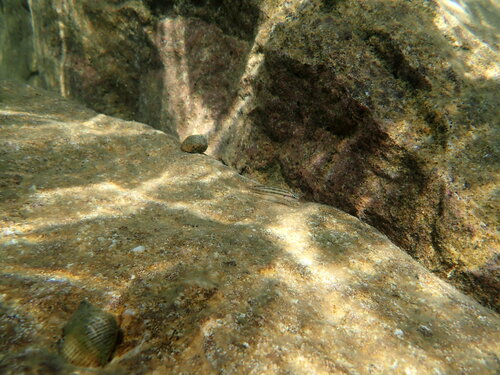
Telmatochromis bifrenatus is endemic to Lake Tanganyika, the ancient rift lake shared by Tanzania, the Democratic Republic of the Congo, Zambia, and Burundi. Like most lamprologines, it is a creature of the rocky littoral rather than open water. Field observations place it close to rocks or moving over the coarse sand between rock patches, typically at depths of about 16-33 ft, and sometimes as deep as 66 ft. It is usually seen alone in the clear, well-oxygenated shallows.
The water it inhabits is hard and strongly alkaline, the signature chemistry of Tanganyika: FishBase reports a pH range of roughly 8.5-9.5, a general hardness around 10-15 dH, and temperatures of about 24-26 C (75-79 F). This is a stable, high-mineral environment, and it is exactly what a captive setup must reproduce.
Within its narrow depth band the fish is a rock-crevice specialist. It tucks into cracks and small caves, and it readily occupies empty gastropod (snail) shells scattered through the rubble. It is worth being precise here: although bifrenatus uses shells, experienced Tanganyika keepers note it is not a true obligate shell-dweller in the way the Lamprologus shell specialists are, so much as a rock-dweller that will exploit a shell when one is available.
Feeding
In its rocky habitat Telmatochromis bifrenatus is a small generalist forager rather than a specialist. FishBase classifies it as omnivorous, feeding on microorganisms, and assigns it a low trophic level of about 2.0, consistent with a diet of small invertebrates, biofilm, and the tiny animals living in the algal turf and sediment of the rock zone. It picks and grazes at the substrate rather than hunting in open water.
That trophic flexibility, combined with its small size, makes it an unremarkable but stable member of the littoral community: prey for larger lamprologines and predatory fishes, and a consumer of the invertebrate fauna that the rock biofilm supports. FishBase models flag the species as having high resilience (a short population-doubling time) and low fishing vulnerability, both typical of a small, fast-maturing fish with broad feeding habits.
Its ecological story is best read against the genus as a whole, where related Telmatochromis have evolved striking habitat-linked body forms, including dwarfed shell-associated morphs. Telmatochromis bifrenatus itself sits in the elongate, crevice-using camp, its body plan an adaptation for slipping into and maneuvering within the tight spaces of the rocky reef.
Mating
The courtship is the species' most memorable trait, and accounts of it are consistent across independent keepers. The male performs an intense, eel-like 'dance,' driving himself forward and backward and up and down in rapid crescents, sometimes hurling his body toward the rocks at speed without injury. Hobbyists describe the female responding to the vibrations or shock waves this generates before retreating into the spawning shell. It is a genuinely unusual display, very different from the lateral flaring of most cichlids.
FishBase describes a temporary pair bond in which the male holds and defends a territory while the female tends the eggs and fry inside the spawning site. For a Tanganyikan, the fish is relatively peaceful, but it is not without an edge: intraspecific aggression flares in cramped quarters, where a dominant male can relentlessly harass a subordinate, which signals submission by going pale and contorting its body. One caution is well documented in the specialist literature: the slender Telmatochromis are closely related to Julidochromis and Chalinochromis, and at least one keeper recorded a Julidochromis x Telmatochromis hybrid produced in a small shared tank. Mixing these genera in tight breeding setups is a real hybridization risk.
Breeding
Telmatochromis bifrenatus is a substrate spawner that breeds in a concealed cave or shell, in the lamprologine fashion. Clutches are small for a cichlid, with up to about 80 eggs reported; the female typically lays them on the inner wall or roof of the cavity, and the young are guarded by the parents until they are free-swimming. Both parents participate in the defense of the spawn, with the female focused on the eggs and immediate surroundings inside the shelter while the male patrols the outer territory.
In the aquarium
By Tanganyikan standards this is an easy, rewarding fish, and FishBase even calls it 'an ideal beginner's fish.' It is small, hardy, undemanding about food, and far milder than most rift-lake cichlids, which is why it has a steady (if quiet) following. It is established in the aquarium trade in the United States and Europe.
Water should reproduce its native chemistry: hard, alkaline conditions around pH 8 or above, with the high mineral content of a Tanganyika setup and temperatures in the mid-70s F (around 24-26 C). The aquascape matters more than the box size; the tank wants stacked rock forming caves and crevices, a sand substrate, and a few empty snail shells, which the fish will use as spawning sites. Some hobby sources claim a single pair can be kept in a tank as small as 10 gallons; that is technically possible for a lone pair, but it is the floor, not a recommendation. For a small group, room to set up multiple territories, or any sort of Tanganyikan community, a longer tank (a 3- to 4-foot footprint) prevents the dominant-male bullying that crops up in cramped quarters.
Feeding is straightforward: a quality cichlid flake or small pellet base, supplemented with frozen or live foods such as brine shrimp, mosquito larvae, and small worms, conditions them well and is the practical key to spawning. Good tankmates are other peaceable Tanganyikans of similar disposition, such as Cyprichromis, while the standing advice from experienced keepers is to avoid housing the elongate Telmatochromis alongside closely related Julidochromis (and probably Chalinochromis) in confined breeding tanks, because of both aggression and the documented hybridization risk.
Conservation
Telmatochromis bifrenatus is listed as Least Concern on the IUCN Red List, in an assessment dated 31 January 2006. As a widespread, adaptable rock-dweller across much of Lake Tanganyika's littoral, it faces no species-specific threat: it is a low-value aquarium export collected in modest numbers, is largely captive-bred for the hobby, and is not a target of the commercial food fishery. On its own terms, the species is secure.
That status, however, sits inside a lake under real and growing strain, and an honest account has to hold both facts at once. Lake Tanganyika is warming, and the warming has a measurable ecological cost. O'Reilly and colleagues (2003, Nature) found that increased thermal stratification has reduced deep-water mixing and nutrient return to the surface, with sediment records implying primary productivity may have fallen by roughly 20 percent and fish yields by around 30 percent. Cohen et al. (2016, PNAS) reconstructed a further consequence from paleoecological records: reduced mixing has shrunk the oxygenated benthic habitat in their study areas by about 38 percent, squeezing exactly the kind of bottom-associated, shallow-living community that bifrenatus belongs to.
The more local threat to a rocky-littoral fish is sedimentation. Deforestation and shoreline development increase the load of fine sediment washing into the lake, and that silt smothers the rock surfaces and crevices these fish feed and breed in (a degradation documented for Tanganyika's littoral by Cohen and colleagues in the early 1990s). Layered on top is the intense pelagic fishery for clupeids (Stolothrissa and Limnothrissa) and their Lates predators that feeds millions across four nations; while it does not target bifrenatus, it is the clearest sign of how heavily this single water body is being asked to provide. Management is shared through the four-country Lake Tanganyika Authority. The takeaway is exact: Telmatochromis bifrenatus is not itself threatened, but the rocky shallows it depends on are exposed to warming-driven habitat loss and sedimentation, and the health of this fish is ultimately tied to the health of the lake.