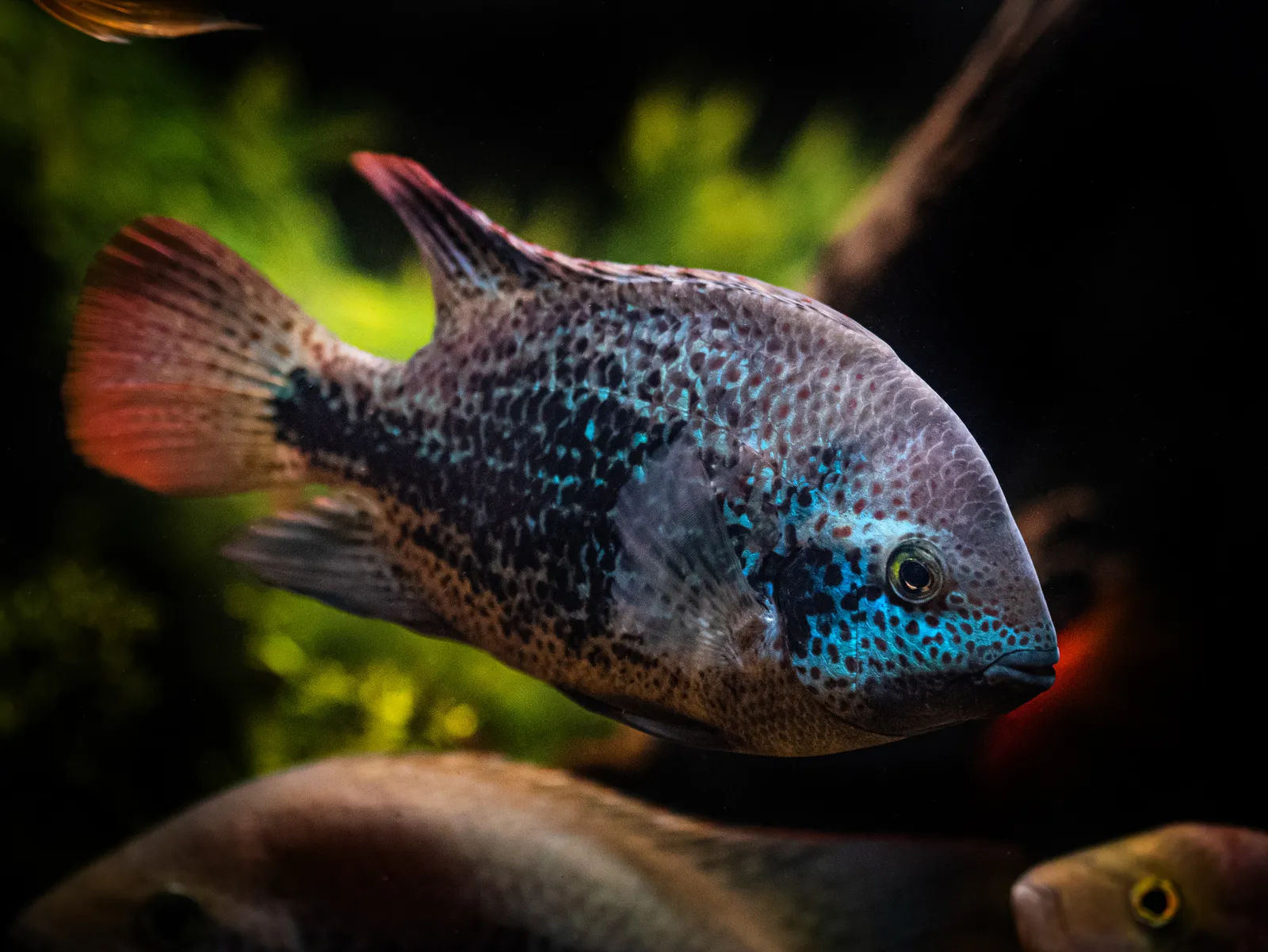
Taxonomy & naming
The Oaxaca cichlid was described by the American ichthyologist Seth Eugene Meek in 1905 as Cichlasoma zonatum, from Niltepec in Oaxaca, Mexico (holotype FMNH 3776). The epithet — 'banded' — refers to the dark vertical bars across the body. As with the rest of the Middle American 'Cichlasoma', it passed through that catch-all genus and later through Paraneetroplus before settling in Vieja, where the Catalog of Fishes lists it as valid (Vieja zonata). A point of recent interest is Vieja coatlicue, described by Del Moral-Flores and Hernández-Arellano in 2018 from the Atlantic-slope Coatzacoalcos basin: subsequent integrated molecular and morphological work has treated coatlicue as a junior synonym of Vieja zonata, folding the Atlantic-slope populations into this species. It sits in the Neotropical subfamily Cichlinae among the heroine cichlids, and the modern herichthyin revision (McMahan et al. 2015) and later checklists retain it in Vieja.
Morphology
Vieja zonata is a tall, stout, laterally compressed cichlid; FishBase gives a maximum of about 10 in, and large males develop the steep forehead and nuchal hump characteristic of the genus. Its defining feature is the set of dark vertical bars that cross the flanks — the 'zones' of its name — set against a ground colour that ranges from olive and silvery-grey to a pearly, faintly bluish or greenish sheen, sometimes with warmer tones on the head and breast in conditioned fish and a dark mark near the base of the tail. As in most Vieja the bars and colour sharpen with maturity and spawning condition, while subadults are plainer and more uniformly silvery. Sexual dimorphism follows the genus pattern: males grow larger and carry the heavier forehead and hump, ripe females are deeper-bodied; the sexes are difficult to separate reliably outside breeding condition.
Habitat
The Oaxaca cichlid is native to the Isthmus of Tehuantepec, the narrow neck of southern Mexico where the continent — and its watershed — pinches to its slimmest. The Catalog of Fishes records it as endemic to both the Pacific and Atlantic slopes of the Isthmus of Tehuantepec in Mexico (with an introduced population in Hong Kong), and the IUCN assessment maps it across the Mexican states of Oaxaca and Chiapas; with coatlicue subsumed, its Atlantic-slope range extends into the Coatzacoalcos basin. It is a fish of warm, slow, low-gradient water: the calm reaches of rivers, lagoons and lakes, over soft mud and sand among submerged wood. In-situ and aquarium-derived chemistry point to warm, near-neutral to alkaline, moderately hard conditions; FishBase gives a tropical temperature range of roughly 73–86 °F. Its occurrence on both slopes of the isthmus, like that of its Pacific relative Vieja guttulata, makes it a biogeographically interesting member of the genus.
Feeding
Vieja zonata is a large omnivore with the herbivorous and detritivorous bias characteristic of its genus. It works the soft bottom and submerged wood of slow lowland water for plant material, algae, detritus, fallen seeds and fruit and the small invertebrates living among them, using robust jaws suited to tearing and grazing vegetation rather than pursuing prey. In the riverine and lake community it functions as a large-bodied grazer and processor of plant detritus rather than a predator, taking animal food opportunistically as all big cichlids do. The vegetable-leaning diet is the practical key to keeping the species in good condition.
Mating
The species is a monogamous, biparental substrate spawner that becomes territorial as a pair forms. Outside breeding it is reasonably tolerant for so large a cichlid, but a settled pair claims and defends a territory around a chosen spawning surface, and — as throughout the genus — pairing can be combative, with a male liable to harass an unready female, so a well-matched pair in adequate space matters. Courtship follows the heroine pattern of lateral displays, jaw-locking 'wrestling', quivering and the joint cleaning and inspection of a flat hard surface, accompanied by the deepening of body colour and the female's increasing girth as she ripens.
Breeding
Vieja zonata is a biparental, open substrate spawner. The pair cleans a flat hard surface and the female lays her eggs on it in the open, after which both parents share guarding and fanning; after hatching the wrigglers are typically moved to pits excavated in the substrate and the free-swimming fry are led about and defended fiercely by both parents. Precise wild fecundity figures are not well documented for the species, but the genus typically produces several hundred fry per spawning, and large females can be expected toward the upper end of that range. In aquaria it spawns in the standard biparental manner once a compatible pair, a flat spawning site and a digging substrate are provided; as with the rest of Vieja, the practical challenge is managing the pair's spawning aggression rather than any difficulty in obtaining eggs.
In the aquarium
Vieja zonata is a handsome, robust large Central American cichlid kept by enthusiasts of the group but uncommon in the general trade. At an adult size around 10 in it needs a large tank: a footprint of roughly 150–180 × 19.5–23.5 in (about 75–120 US gallons) is a sensible minimum for a single fish or a settled pair, with more space advisable if other large fish share the aquarium. Water chemistry is undemanding within the species' natural envelope — a near-neutral to mildly alkaline pH (about 7.0–8.0), moderate hardness and a temperature of roughly 75–84 °F suit it well. As a big, messy feeder it needs generous filtration and substantial regular water changes, but not strong current; aim returns to break the surface for gas exchange.
Use a sand or fine substrate, since the fish digs, and furnish the tank with sturdy rockwork, roots and driftwood that provide cover and break up sightlines; décor must be stable, as an adult rearranges it. Rooted plants are largely futile with Vieja — they uproot and eat vegetation — so greenery is best treated as food or kept to tough, potted or floating species. Diet should respect the species' plant bias: spirulina and other green foods, blanched vegetables and quality vegetable-based pellets as the base, with frozen or live invertebrates as supplements rather than the staple; overfeeding rich protein is a common cause of digestive trouble and head-and-lateral-line erosion in big Vieja.
Temperament is robust but workable. Outside breeding the species is relatively even-tempered for its size and combines well with other large, sturdy Central American cichlids and big catfish or characins able to hold their own; nothing small enough to be eaten is safe. Aggression rises sharply at spawning, when a guarding pair can dominate even a large aquarium, so ample space, broken sightlines and the readiness to separate fish are the standard safeguards. The usual keeper mistakes are underestimating the adult size, overstocking and feeding too richly rather than any fussiness in the fish.
Conservation
The IUCN Red List assesses Vieja zonata as Data Deficient (assessed 24 September 2018 by M. Vega-Cendejas, published 2019), with the population trend recorded as unknown. The Data Deficient listing reflects genuine gaps in knowledge of the species' distribution, abundance and biology rather than a documented decline — a situation complicated by the taxonomic flux around its Atlantic-slope populations (the former Vieja coatlicue), now folded into this species. It is recorded across the Isthmus of Tehuantepec in Oaxaca and Chiapas, but the published information is too thin to support a threat-based category. It carries no CITES listing and is harmless to humans. The lowland rivers of the isthmus face the familiar pressures of deforestation, pollution, water extraction and introduced tilapia, so localized declines are plausible even though the species' overall status cannot yet be judged; clearer delimitation of its populations and better field survey are the obvious priorities.