Taxonomy & naming
George Albert Boulenger described Xenochromis hecqui in 1899, in the fifth installment of his survey of new Congo fishes in the Annales du Musee du Congo. The single type specimen (holotype MRAC 232) came from Albertville, the colonial town on Tanganyika's northwestern shore now known as Kalemie, in the Democratic Republic of the Congo. The genus name pairs the Greek xenos, "strange," with chromis, an old name for a perch-like fish, an apt label for a cichlid that did not fit neatly beside its relatives. The species honors Captain Celestin Hecq (1859-1910), a Belgian officer stationed in the Congo who collected the type.
Xenochromis remains monotypic: hecqui is its only species, and Eschmeyer's Catalog of Fishes lists no junior synonyms. Within the family Cichlidae (subfamily Pseudocrenilabrinae) it sits in the tribe Perissodini, the Tanganyikan scale-eaters, alongside the genera Perissodus, Plecodus and Haplotaxodon. Molecular work by Koblmuller and colleagues (2007) confirmed the tribe as a tight clade of nine species and showed that most of it diversified within deep water roughly 1.5-2 million years ago, only recently sending lineages up into the shallows. Xenochromis falls among the seven members the study treated as scale-eaters.
Morphology
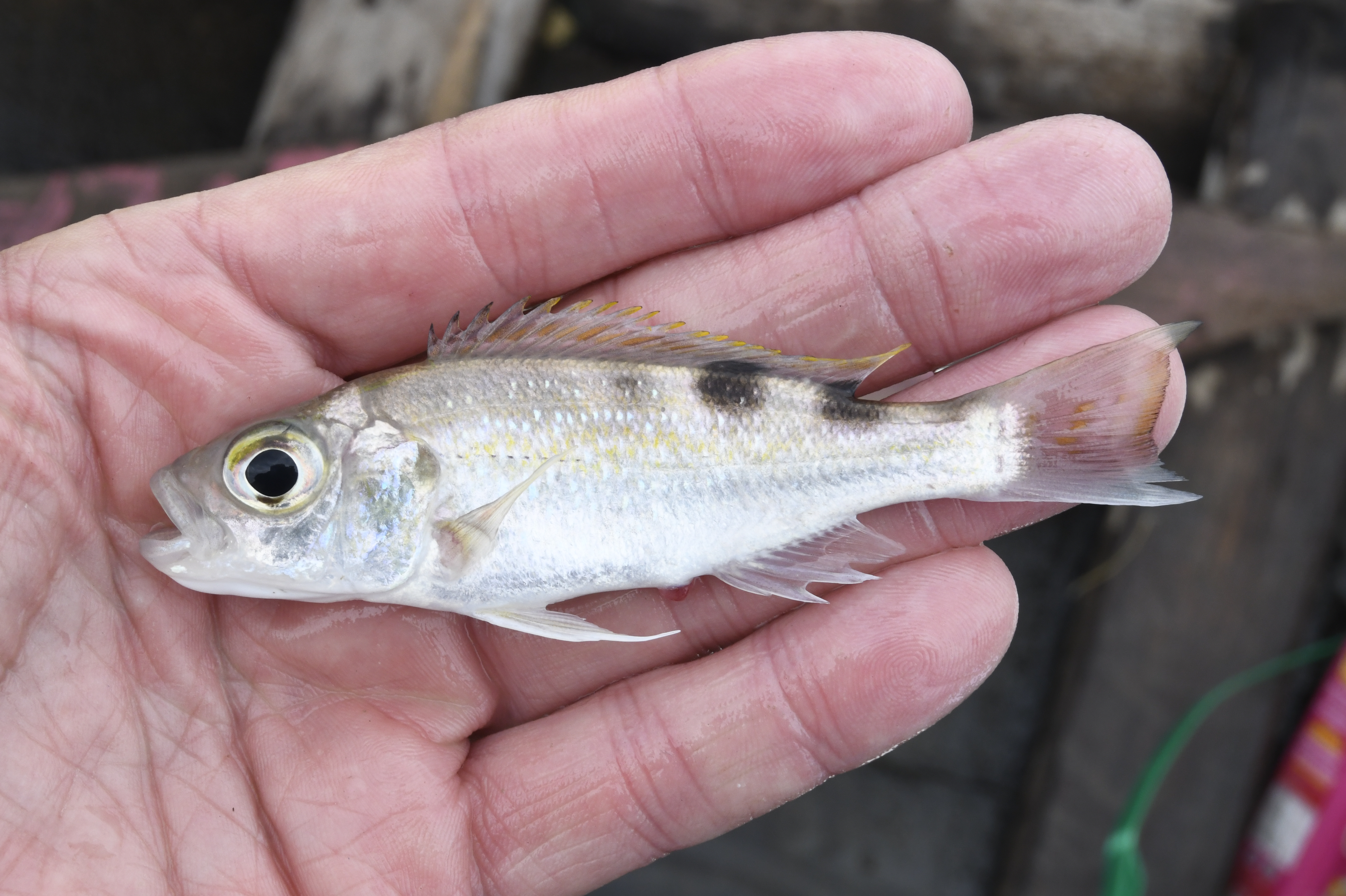
Xenochromis hecqui is among the larger Perissodini, reaching about 12 in (12 in) in total length, which puts it well above the palm-sized Perissodus microlepis more often pictured in the scale-eating literature. The body is the elongate, laterally compressed shape typical of the tribe, built for the quick lateral dart that a scale-raiding strike demands.
Reliable, photograph-backed descriptions of live coloration are scarce, a direct consequence of how rarely the fish is seen alive; the best images, such as those circulated by Ad Konings from fish collected at Kipili, show a plain silvery-grey deepwater animal rather than the bold barring of its shallow-water cousins. Sexual dimorphism has not been well documented. In practice the surest way to separate it from other Perissodini is the combination of its larger adult size, its mouth and tooth structure, and where it turns up: hauled from open mud bottoms far deeper than most of the tribe ventures.
Habitat
The species is endemic to Lake Tanganyika and is distributed lake-wide, recorded from all four riparian nations: Burundi, the Democratic Republic of the Congo, Tanzania and Zambia. It is not a rock-dweller. FishBase places it in the lake's deepwater benthic community, benthopelagic over a depth range of about 20-330 ft; the IUCN assessment gives an upper limit nearer 16 ft and the same lower bound, and notes specimens taken right at 330 ft. Poll's foundational 1956 survey already described it as a benthic fish of mud and silt bottoms.
That habitat preference matters for a lake whose biology is usually told through its rocky reefs. Tanganyika is meromictic and permanently stratified, with oxygen giving out somewhere around 328–656 ft depending on location; a fish working the mud at 328 ft lives near the deep edge of where vertebrate life is possible. The in-situ water is hard and alkaline, typically around pH 8.6-9.0 with high conductivity and surface temperatures in the high 70s Fahrenheit (mid-20s Celsius), cooling with depth.
Feeding
Here the sources genuinely diverge, and the honest answer is that this fish's diet is not fully settled. The phylogenetic and morphological literature is firm that Xenochromis hecqui is a lepidophage, a scale-eater: Koblmuller et al. (2007) and the broader Perissodini work count it among the seven scale-eating species in the tribe, and FishBase records it as a scale-eater thought to specialize on larger prey such as the deepwater predatory Bathybates. FishBase also assigns it a high trophic level of about 4.4, the value you would expect for a fish feeding on other fishes.
Against that, the IUCN assessment, drawing on Konings, describes the species more cautiously as benthic and zooplanktivorous, and both FishBase and Poll note copepods recovered from stomachs. These need not be a flat contradiction. Several scale-eaters supplement their grisly main course, and a deepwater Perissodini that scrapes scales from large benthic predators when it can, and falls back on copepods and zooplankton when it cannot, fits both observations. What is clear is the unusual ecological role: a mid-sized predator adapted to wrest a living from the scales and the plankton of the lake's dim, soft-bottomed depths.
Mating
Almost nothing has been observed directly. As both Konings and the IUCN flatly state, the reproductive behavior of this deepwater fish is essentially unknown, a recurring theme for cichlids that live below diving and easy-collecting depth. No spawning of Xenochromis hecqui appears to have been documented in the wild or in captivity, so any pair-forming or courtship behavior remains undescribed. Social structure in the deep, open, soft-bottomed habitat it favors is likewise unrecorded, and there is no published account of how, where, or in what season the species spawns.
What little can be said is inferred from its relatives. Many Perissodini are mouthbrooders, several of them biparental, and a deepwater scale-eater would be expected to follow the tribe's general reproductive template rather than the substrate-spawning habit of more distantly related Tanganyikan cichlids. Until a wild pair is observed or the species is bred in captivity, its mating system stays an inference drawn from the tribe rather than a recorded fact.
Breeding
The one concrete reproductive datum traces to Poll's 1956 material: a female was found carrying roughly 600 eggs, a fairly high count for a Tanganyikan cichlid. That fecundity offers a hint but not a verdict. A comparatively large egg complement would be consistent with a mouthbrooding strategy in which a parent shelters the clutch and fry, as is common across the Perissodini, but the figure alone cannot confirm the mode.
No brooding, fry-guarding, or clutch development has been documented for Xenochromis hecqui in the wild or in captivity, so its exact reproductive mode and its degree of parental care remain inferences rather than observed fact. Treated honestly, the species should be regarded as a presumed mouthbrooder of unknown brood-care detail, with the ~600-egg count the single anchoring observation.
In the aquarium
For practical purposes this is not an aquarium fish. The IUCN notes it is rarely found in the aquarium trade, and that matches what you see in the hobby: searches for "hecqui" overwhelmingly return the unrelated shell-dweller Lepidiolamprologus hecqui, not this scale-eater. Xenochromis hecqui is a deepwater species that is difficult and unrewarding to collect, ships poorly, and offers little of the color or accessible behavior that drives demand, so it has never established itself even among dedicated Tanganyika specialists.
If a wild specimen did surface, it would be a project for an expert, not a community tank. The obvious obstacle is diet: a lepidophage needs other fish to eat scales from, which is both ethically and practically awkward to sustain, and a 12 in (12 in) predator from soft, deep water would want a large, hard, alkaline-water system (pH well above 8, high mineral content, stable warmth) and tankmates it cannot easily harass. The realistic verdict is the honest one: admire this species in the literature and in the lake, and keep the readily bred Tanganyikans that the hobby already does well by.
Conservation
The IUCN Red List assesses Xenochromis hecqui as Least Concern, most recently on 28 February 2025 (assessor Y. Fermon), an upgrade from the Data Deficient status it carried in 2006. The reasoning is straightforward: the species is endemic to Lake Tanganyika but occurs throughout the lake, appears in fisheries catches, and faces no identified major, widespread threat, though the assessment flags that it could be threatened locally by over-fishing. Its rarity in the aquarium trade means collection pressure for the hobby is negligible.
Least Concern for the species, however, does not mean an untroubled lake. Tanganyika is under real, basin-wide strain. O'Reilly et al. (2003, Nature, DOI 10.1038/nature01833) linked sustained surface warming to stronger stratification, weaker deep mixing, and an estimated ~20% decline in primary productivity, with a comparable fall in fish yields. Cohen et al. (2016, PNAS, DOI 10.1073/pnas.1603237113) found from paleoecological records that warming has shrunk the oxygenated benthic habitat by on the order of 38%, squeezing exactly the deep, soft-bottom zone Xenochromis hecqui occupies. Add the heavily exploited pelagic clupeid-and-Lates fishery feeding four nations, and shoreline sedimentation degrading the lake's margins, and a deepwater benthic specialist sits in a vulnerable place even if it is not individually rare. Governance is coordinated across Burundi, the DRC, Tanzania and Zambia through the Lake Tanganyika Authority. The fair summary: the species itself is secure for now, but its habitat guild is among the most exposed to the climate-driven changes reshaping the lake from below.