Taxonomy & naming
Bathybates graueri was described by the Austrian ichthyologist Franz Steindachner in 1911, from material collected in Lake Tanganyika on the Tanzanian side, where the four surviving syntypes are housed in Vienna's Naturhistorisches Museum (NMW 32982-83). Catalog of Fishes and FishBase both treat the name as valid with no junior synonyms in current use, which makes this a refreshingly stable corner of cichlid nomenclature.
The genus name Bathybates is built from the Greek bathys, deep, and bates, one who walks or goes — "the deep-walker," a fitting label for a lineage that lives where sunlight runs thin. The species honors Rudolf Grauer (1870-1927), an Austrian explorer and zoologist whose collecting expeditions into the Congo basin and the Tanganyika region in 1909-1911 supplied many of the specimens Steindachner worked from.
Bathybates graueri sits in the subfamily Pseudocrenilabrinae and the tribe Bathybatini, a small, ancient radiation of large piscivores found nowhere but Tanganyika. The genus Bathybates today contains seven recognized species; molecular work by Koblmuller and colleagues dates the rapid diversification of the large-bodied members to roughly 2.3-2.7 million years ago. Within that group, Coulter long ago sorted the species into feeding morphotypes, and Bathybates graueri falls among the bottom-feeders rather than the streamlined open-water sprinters.
Morphology
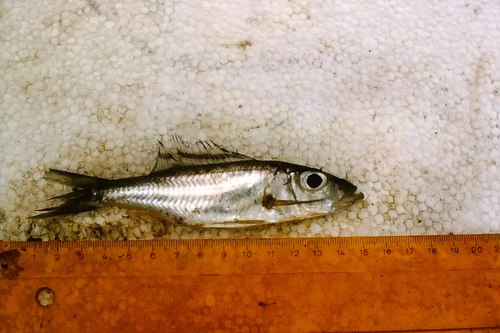
This is a substantial, deep-bodied cichlid. Authoritative sources put the maximum size at about 12 in total length; the specialist reference tanganyika.si gives roughly 12 in, and you will see larger figures of 14 in repeated in hobbyist posts that are best read as enthusiastic rounding rather than measured fact.
Compared with the elongate, torpedo-shaped pelagic Bathybates such as Bathybates fasciatus and Bathybates hornii, Bathybates graueri is noticeably more compact and robust — a build that suits a fish working close to the bottom rather than running down prey in open water. The pattern is the most reliable field mark: two dark blotches on the gill cover, followed along the body by a combination of vertical bars and horizontal stripes over a silvery ground, with the dark markings far stronger in mature males.
Sexual dimorphism is clear in adults. Males develop pronounced black markings and carry a large yellow egg-spot (ocellus) on the anal fin, the classic haplochromine-style spawning lure; females are plainer, with the dark pattern muted and the egg-spots reduced to faint or rudimentary marks.
Habitat
Bathybates graueri is a Tanganyika endemic with a lake-wide distribution, recorded around the basin's shores wherever suitable bottom exists. The lake spans Burundi, the Democratic Republic of the Congo, Tanzania, and Zambia, and this fish turns up in the records of all four nations' coastlines.
Where it sits in the water column is the species' defining trait, and it is also where the sources pull apart. FishBase labels Bathybates graueri as "pelagic," reflecting the open-water reputation of the genus as a whole. The detailed natural-history accounts, however — tanganyika.si and the phylogenetic literature alike — describe it as a benthic predator that lives over sand and mud from shallow water down to at least 525 ft, hunting near the bottom and only rarely venturing into the open pelagic; Konings (Cichlids Yearbook vol. 6) adds that adult specimens are sometimes caught in shallow water. The honest reading is that this is a wide-ranging demersal fish, not a true blue-water roamer like its clupeid-chasing relatives — though Konings also notes an interesting wrinkle from the handful of specimens he kept: in the aquarium the fish behaved more like an open-water species, rarely swimming close to the bottom, which suggests it may normally cruise at some distance above the substrate while hunting rather than hugging it directly.
Like the rest of Tanganyika's deepwater fauna, it occupies hard, alkaline water: the lake runs warm and stable at the surface, highly mineralized, with a pH around 8.6-9.2, and it is permanently stratified, so the habitable band for an oxygen-needing predator is capped from below by anoxic deep water.
Feeding
Every Bathybates is a piscivore, but the genus has partitioned the lake's prey, and that partitioning is the key to understanding Bathybates graueri. The pelagic specialists — Bathybates fasciatus, Bathybates leo, and the small Bathybates minor — chase Tanganyika's two endemic clupeids, the sardine-like Stolothrissa tanganicae and Limnothrissa miodon, through open water. Bathybates graueri belongs to the other camp.
Here the sources genuinely disagree, and it is worth saying so plainly. FishBase states the species "feeds mainly on clupeids." The more recent and more specific accounts — tanganyika.si and Koblmuller et al.'s trophic classification — instead place Bathybates graueri among the benthic-cichlid eaters, alongside Bathybates vittatus and Bathybates ferox, reporting that it preys chiefly on sand-dwelling cichlids, especially ectodine genera such as Xenotilapia, and takes clupeids only opportunistically. Konings (Cichlids Yearbook vol. 6) backs the cichlid-eating picture, citing Coulter (1991) for the observation that Bathybates graueri is normally found near the bottom preying on sand-dwelling cichlids such as Xenotilapia. The weight of the natural-history evidence favors the bottom-hunting cichlid-eater picture; the older "clupeid" line likely reflects the genus's general reputation more than this species' stomach contents.
Either way, it is a top-tier predator: FishBase estimates a trophic level of about 4.2, near the ceiling for a freshwater fish, marking Bathybates graueri as one of the apex consumers of the lake's demersal community. Reports that it forms schools point to a fish that aggregates over productive bottom rather than living as a solitary ambusher.
Mating
In terms of disposition, Bathybates graueri is reported as generally peaceful toward fishes of its own size; its menace is directed downward, at anything small enough to be eaten. It is a roaming, active predator rather than a territorial bruiser, which shapes everything about how it must be housed and, presumably, how it pairs.
The courtship of Bathybates graueri has not been observed, but the fish carries the full dimorphic toolkit of its lineage. Mature males blacken with display, intensifying the bold barring and stripes and flashing a large yellow egg-spot (ocellus) on the anal fin; females stay plainer, their pattern muted and their egg-spots faint or rudimentary. That signaling kit — display-blackened males with a conspicuous ocellus and drab, choosy females — is the classic haplochromine arrangement, consistent with a lek-style mating system in which males advertise and females select before the eggs are taken up for incubation.
Breeding
The breeding biology of Bathybates graueri is, frankly, undocumented — it has not been observed spawning either in the wild or in aquaria. What we can say rests on inference from its relatives. Like other Bathybates and the broader haplochromine lineage, it is almost certainly a maternal mouthbrooder: the female takes the fertilized eggs into her mouth, and the male's anal-fin egg-spot serves to draw her over freshly shed milt so the clutch is fertilized as she gathers it.
That the species shows the full dimorphic pattern — blackened, ocellus-bearing males and plain females — is consistent with this kind of female-incubated spawning, but the particulars remain blanks waiting to be filled. The actual clutch size, incubation period, and fry-release behavior have not been recorded for Bathybates graueri, and no captive spawning has been reported to fill the gap. Genus-typical mouthbrooder clutches for large Bathybates run on the order of a few dozen eggs, but that figure is inferred from relatives rather than measured in this species.
In the aquarium
This is not a fish most aquarists will ever keep, and that scarcity is the first honest point. Bathybates rarely enter the trade at all; hobbyists who track the importers report seeing them perhaps a couple of times a year, mostly Bathybates fasciatus and Bathybates ferox, at premium prices, and almost never as captive-bred fry. Bathybates graueri specifically is described as a very rare import, and the documented history of keeping it in captivity is thin enough to recount almost in full. Konings (Cichlids Yearbook vol. 6) records what was, at the time, the first live import of the species: three adults — two males and one female — brought into Germany, with cautious optimism that the species could be kept given adequate swimming room.
That optimism was not fully borne out by his own attempt. Konings kept a single specimen, on loan from a wholesaler, for three weeks, and was unable to switch it from live cichlid prey onto regular aquarium fare; the fish was fed his own shell-dwelling Neolamprologus brevis (culled stock with gill defects) until that supply ran low, at which point he returned the fish rather than continue depleting it. That account — a genuine predator that may refuse prepared foods and needs a steady supply of live fish — is worth weighing seriously against generic stocking advice, since it is closer to documented experience than any established care sheet.
If one does turn up, treat it as a large, open-swimming predator that may need live fish to feed at all. Specialist guidance calls for a long tank — on the order of 5 ft and at least 160 gal as a starting point — and experienced keepers of the genus argue that the chase-predator behavior really wants an 8-ft, 300-gallon footprint to be done well. Use a fine sand substrate to match the natural bottom; keep rockwork minimal and smooth, because these wide-eyed fish are prone to abrading or injuring their eyes on hard decor. A species-only setup is the safe default: it does not tolerate aggressive tankmates, and anything small enough to swallow is food.
Water should be hard and alkaline in the Tanganyikan range, well filtered and well oxygenated, with the pristine, high-oxygen conditions a big active predator demands. None of this is beginner territory — it is a specialist's fish, demanding on space, sourcing, and husbandry, with no established record of aquarium breeding to fall back on.
Conservation
On the IUCN Red List, Bathybates graueri is assessed as Least Concern, most recently published on 12 March 2025 (version 2025-2, assessor D. Mushagalusa). It is a naturally widespread, lake-wide endemic with no evidence of a species-specific decline, and while FishBase notes both commercial-fishery and aquarium-trade use, neither appears to threaten it: the aquarium offtake is tiny, and as a low-vulnerability, moderately resilient fish it is not a primary target of the artisanal fishery. So the species-level verdict is genuinely reassuring.
The lake it lives in is a different story, and the two should not be conflated. Lake Tanganyika has warmed steadily over roughly the past 150 years, and that warming has strengthened and shallowed the water column's stratification. O'Reilly and colleagues (2003, Nature, doi:10.1038/nature01833) showed this reduced mixing has cut primary productivity on the order of 20%, with knock-on losses to fish yields. Cohen and colleagues (2016, PNAS, doi:10.1073/pnas.1603237113) added the more pointed figure for a bottom-oriented fish like this one: in their study areas, warming has shrunk the oxygenated benthic habitat by about 38%, squeezing the very zone where Tanganyika's demersal endemics live. Layered on top are shoreline sedimentation from deforestation (Cohen et al. 1993) and a heavy four-nation pelagic fishery built on the clupeids Stolothrissa and Limnothrissa and the predatory Lates, the catch that feeds communities in Burundi, the DRC, Tanzania, and Zambia.
For Bathybates graueri the relevant pressure is that benthic oxygen squeeze. As a predator tied to the oxygenated sand and mud bottom and to the cichlid prey that share it, it depends on a habitat band that warming is narrowing from below. Cross-border governance now runs through the Lake Tanganyika Authority, established under the 2003 Convention to coordinate management among the four states. The accurate summary is the careful one: this species is not currently in trouble, but the deep, cool, oxygenated water it requires is, and its long-term fate is bound to the health of the lake rather than to any threat aimed at the fish itself.