Taxonomy & naming
Scleropages formosus was described by the German naturalists Salomon Müller and Hermann Schlegel in 1840 from Southeast Asia. It belongs to the genus Scleropages within the family Osteoglossidae, the true bonytongues, in the order Osteoglossiformes — a scattered, deep-time radiation found today on four continents (South America, Africa, Southeast Asia and Australasia) and counted among the oldest surviving lineages of bony fishes. The order takes its name from the glossohyal, a toothed bone on the floor of the mouth that bites against toothed plates on the roof, an ancient feeding mechanism shared across the group.
The genus name Scleropages comes from the Greek skleros, "hard", and pages, "knot" or "leaves", a reference to the fish's large, hard scales; the species epithet formosus is Latin for "beautiful" or "handsome". Several striking wild colour races have historically been described under their own names — S. macrocephalus (green forms), S. aureus (golden forms) and S. legendrei (red forms) — and are widely treated as colour morphs of a single variable species rather than distinct taxa, though the split remains debated among authors; the Catalog of Fishes (Eschmeyer, California Academy of Sciences) is the authority to consult on which names are currently valid.
Morphology
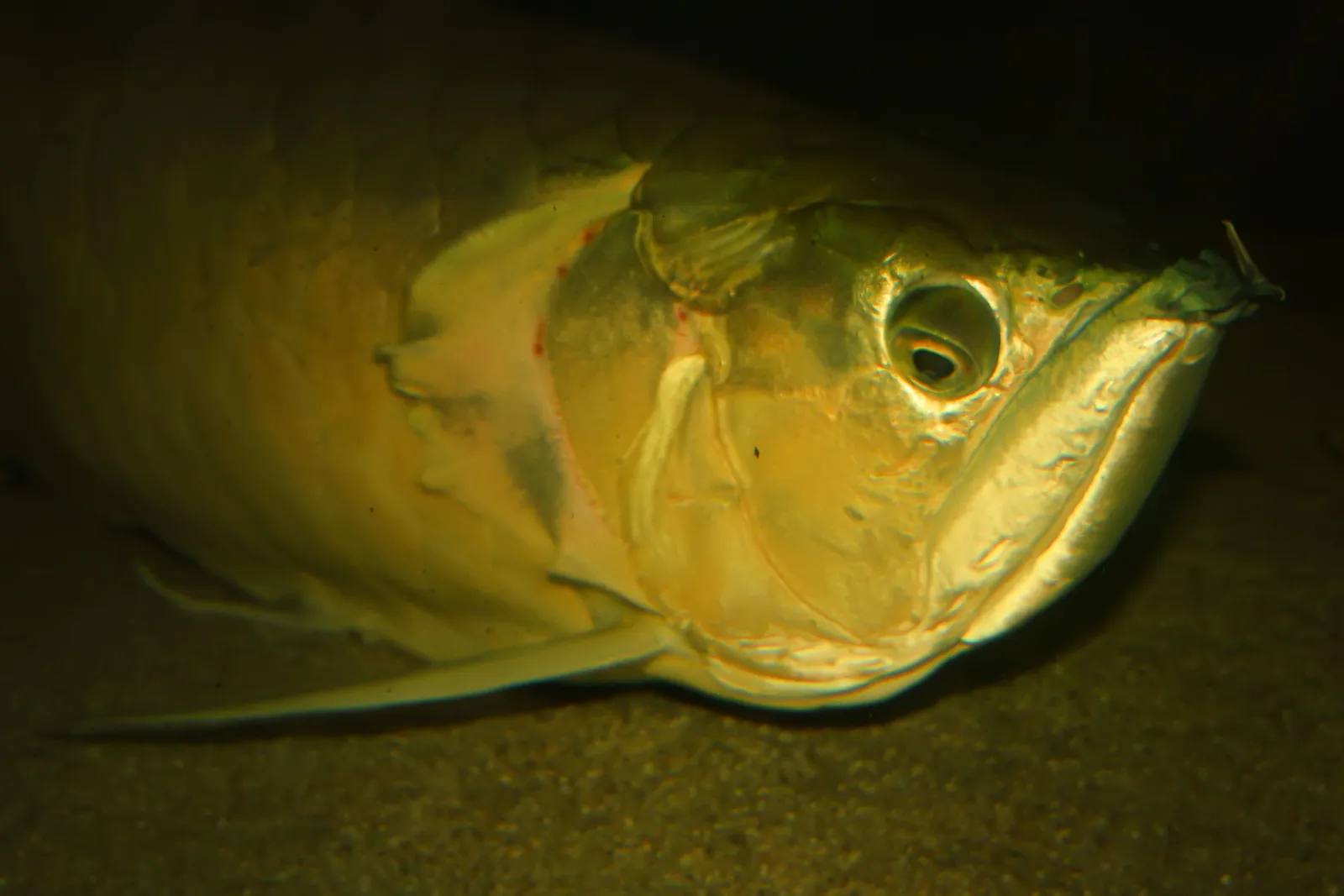
The Asian arowana has the classic true-arowana build: an elongated, laterally compressed, ribbon-like body carried on large, heavy, mirror-bright scales, an upturned "drawbridge" lower jaw built for striking prey at the surface, and a pair of long, sensory barbels on the chin. The dorsal and anal fins are set far back near the tail, giving the fish a long, trailing silhouette, and the large, forward-set eyes are well suited to spotting movement above the water.
Colouration tracks the colour form: wild and farmed fish range from pale silvery-green through gold to deep blood-red, with each scale often edged or highlighted in a way that produces the reflective, jewel-like sheen the trade prizes. FishBase reports a maximum length of about 35.5 in; growth is fast, and while farmed young sold into the hobby are usually much smaller, a mature adult is a genuinely large fish.
Habitat
Scleropages formosus is a Southeast Asian endemic of Sundaland and mainland Indochina, historically ranging from southern Myanmar through the Malay Peninsula, Sumatra and Borneo, and east through Thailand into the Mekong basin and the Cardamom Range. It lives in tannin-stained blackwater streams and forest-covered peat swamps — slow, structurally complex habitats shaded by rainforest canopy.
This is warm, soft, acidic water: FishBase and hobby sources both describe conditions around 75–86 °F and a pH in the roughly 6.0–7.0 range, far softer and more acidic than the hard, alkaline rift-lake water some other popular aquarium fish need. Its modern range is severely fragmented by deforestation, logging, damming and water pollution, and wild populations are now patchy compared with their historical extent.
Feeding
The Asian arowana is a carnivorous, surface-oriented predator throughout its life. Juveniles take insects and other small prey from the water's surface, while adults broaden their diet to fishes and small vertebrates; the species' famous leap — launching itself clear of the water to seize insects, and occasionally small lizards or other animals, from overhanging branches — is a genuine hunting behaviour, not just an aquarium curiosity, and it is the reason a secure lid is a non-negotiable part of keeping one.
In the aquarium it takes high-protein pellets readily and does well on a diet supplemented with live or frozen foods such as insects, shrimp and small fish. Adults are typically fed once daily and juveniles two to three times a day; growth is fast on a good diet, which is part of what makes the size trap easy to underestimate when a fish is bought small.
Mating
Courtship in Scleropages formosus is prolonged: a pair swims side by side for one to two weeks before spawning, a behaviour thought to help synchronise the partners ahead of a clutch of unusually large, yolky eggs. Fertilisation is external, and the clutch is small by fish standards but the eggs are large — reported at roughly 0.5–1 in in diameter, with a total of about 20–100 eggs per spawn.
After fertilisation the male, not the female, takes over: he picks up the eggs into his mouth, and it is this paternal role that defines the species' entire reproductive strategy. Sexual maturity is reached at around three to four years, and successful pairing depends on a well-matched, well-conditioned pair rather than any external sexing cue that is easy to read from the outside.
Breeding
Scleropages formosus is a paternal mouthbrooder: the male incubates the large eggs and, later, the free-swimming fry in his mouth. Incubation of the eggs themselves takes roughly a week, after which the hatched fry — still carrying a large external yolk sac — remain sheltered in the male's mouth for a further seven to eight weeks until the yolk is absorbed and the young are ready to feed and fend for themselves. It is an extended, resource-intensive form of parental care, and for that whole period the male neither feeds normally nor strays far from cover.
Breeding this species in home aquaria is difficult and rarely achieved; successful spawns are typically reported from large outdoor ponds rather than tanks, which is exactly the setting used by the commercial farms of Southeast Asia that supply the vast majority of the legal aquarium trade. Those farmed fish are bred, reared and documented under government-regulated programs, with the resulting young microchipped and sold with certificates as required under the species' CITES Appendix I listing.
In the aquarium
This is a large, long-lived, expensive fish that should only be taken on with its adult size and needs fully understood in advance. Hobby sources put minimum tank volume at roughly 250 gallons for an adult (juveniles can start smaller, around 60 gallons, but will quickly outgrow that), and a heavy, tight-fitting lid is mandatory — this is a strong, accurate jumper that will clear an open or poorly secured tank top going after prey or simply startling. Water should be kept soft and slightly acidic, roughly pH 6.0–7.0 at 75–86 °F, in a well-filtered, well-maintained system; growth is fast and the fish is a heavy waste producer for its size. Reported lifespan under good care is 10–15 years.
Asian arowanas are generally best kept singly or with robust, similarly large tankmates — they can be aggressive, especially toward their own kind, and will treat anything small enough to fit in that upturned mouth as food. As a factual matter of law and trade, Scleropages formosus has been listed on CITES Appendix I since 1975, the strictest tier of international protection; in range and importing countries it is farmed and traded only under permit, typically with individual microchip identification and accompanying certificates. This account states that status as a fact and does not offer guidance on acquiring, importing or trading the species.
Conservation
The IUCN Red List assesses Scleropages formosus as Endangered (last assessed in 2019). The assessment points to a history of rapid population decline driven primarily by the ornamental aquarium trade — demand for rare, high-value colour variants has been intense since the late 1970s — compounded by habitat loss from deforestation, logging, dam construction and water pollution that has fragmented the slow-moving freshwater habitats the species depends on.
The species has carried CITES Appendix I protection since 1975, and much of the modern legal trade now runs through permitted, microchipped, farm-bred stock rather than wild collection, which has taken some direct collection pressure off remaining wild populations. Even so, the wild population remains threatened and restricted to fragmented remnants of its former Sundaland and Indochinese range, and its long-term outlook is tied to the fate of the blackwater and peat-swamp habitats that are being lost across that range.