Taxonomy & naming
Scleropages jardinii was described in 1892 by the English naturalist and fisheries surveyor William Saville-Kent, working from specimens collected in northern Australia's monsoonal river systems. It belongs to the genus Scleropages within the family Osteoglossidae, the true bonytongues, in the order Osteoglossiformes — a scattered, deep-time radiation of freshwater fishes found today across four continents (South America, Africa, Southeast Asia and Australasia) and reckoned among the oldest living lineages of bony fishes. The order's name refers to the glossohyal, a toothed bone on the floor of the mouth that bites against toothed plates on the roof — the "bony tongue" shared across the group. The Catalog of Fishes (Eschmeyer, California Academy of Sciences) recognises Scleropages jardinii as a valid species.
The genus name Scleropages comes from the Greek skleros, "hard", and pages, an old root meaning roughly "knot" or "leaves", together read as a reference to the fish's large, hard scales. Besides jardinii the genus holds the closely related Australian species Scleropages leichardti, the Asian arowana Scleropages formosus, and a handful of other Southeast Asian and Australasian forms. The species epithet jardinii honours the Jardine family of Cape York in far-north Queensland, the same family for whom the Jardine River — within this species' range — is named. In the hobby and literature it carries several English names, among them gulf saratoga, northern saratoga, Australian bonytongue, Australian pearl arowana and northern-spotted barramundi, with "saratoga" the long-standing Australian vernacular for both native Scleropages species.
Morphology
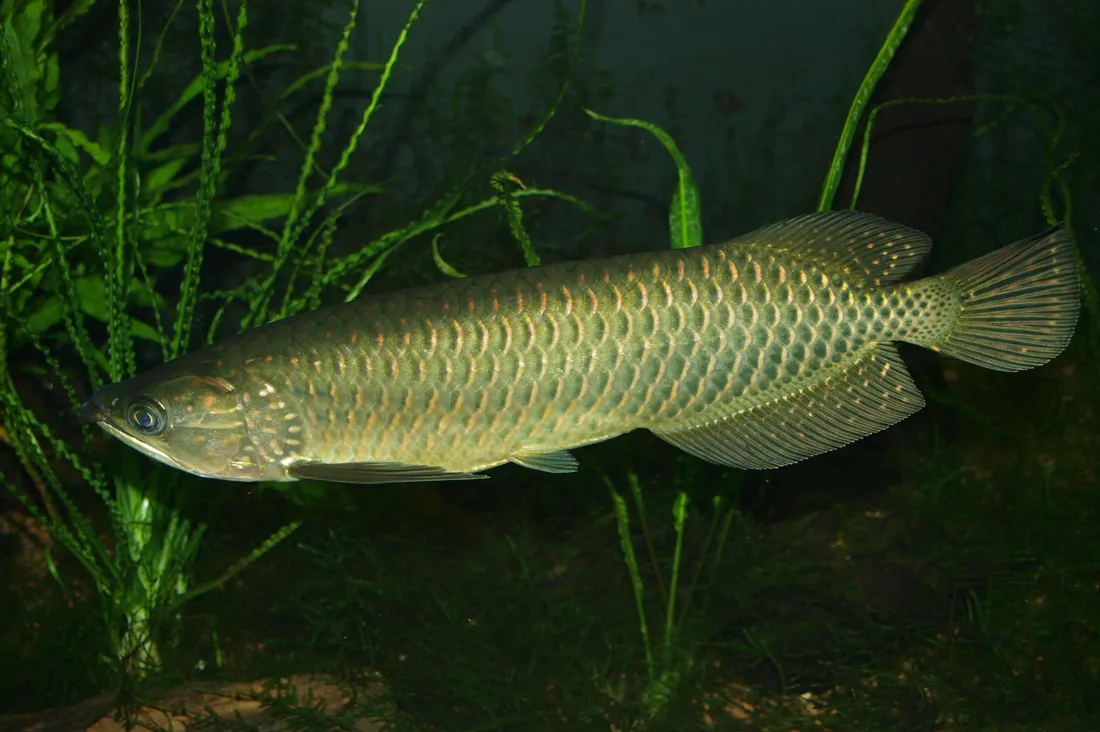
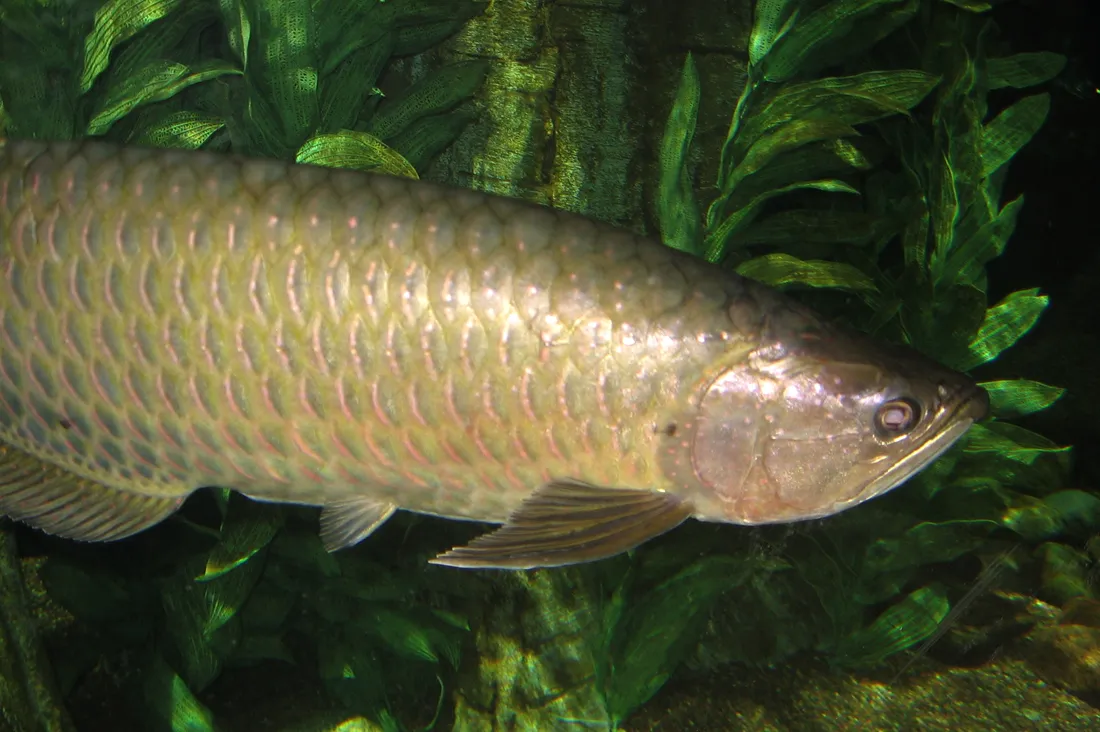
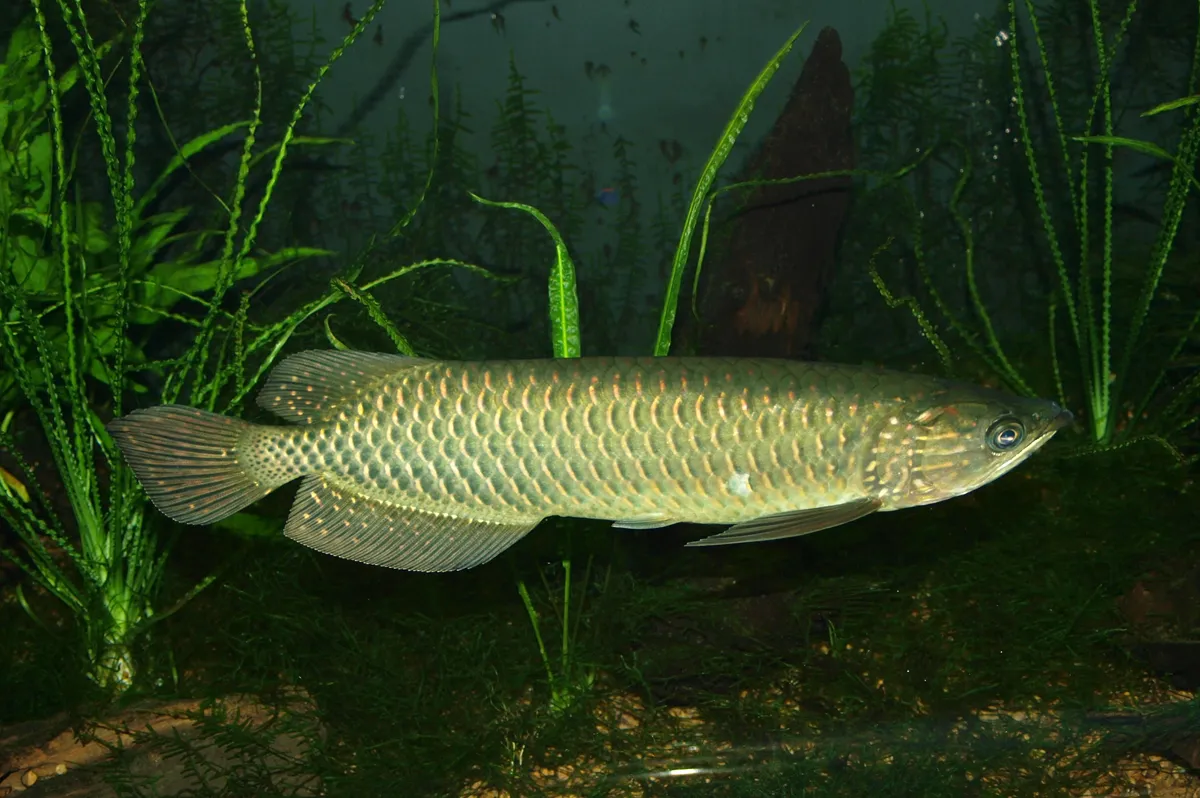
The gulf saratoga has the classic true-arowana silhouette: an elongated, laterally compressed, ribbon-like body carried on large scales, with a long-based dorsal fin and an even longer anal fin, both set far back toward a rounded tail, giving the fish a trailing, almost eel-like sweep from mid-body to tail. The head is bony and flattened on top, and the lower jaw is markedly upturned into a "drawbridge" mouth that opens nearly vertically — an adaptation for engulfing prey struck at the surface — with a pair of long, sensory barbels at the chin tip.
Body colour runs bronze to olive-gold, with each of the large lateral scales edged in a darker outline that builds into an overall spotted, reticulated pattern down the flanks — the basis of the "spotted barramundi" name — duller and less mirror-bright than the large, silvery scales of the Asian arowana. The gulf saratoga also carries a different scale count along the lateral line, roughly 32–35 scales against about 21–25 in Scleropages formosus. Maximum recorded length is around 39.5 in in the wild (FishBase reports 39.5 in standard length); aquarium fish commonly reach around 35.5 in, which is still a large, powerfully built predator by maturity.
Habitat
Scleropages jardinii is patchily distributed across the monsoonal river systems of northern Australia — the Gulf of Carpentaria drainage, west as far as the Adelaide River in the Northern Territory, and river systems across northern Queensland — and across central-southern New Guinea, reported from both the Indonesian and Papua New Guinean sides of the island.
Within these systems it favours still or slow-moving water: billabongs, swamps, backwater pools and the quieter reaches of streams and creeks, typically shaded by overhanging bank vegetation that both cools the water and supplies the terrestrial insects the fish ambushes from below. These are strongly seasonal, monsoon-driven waterways, flooding out across the wet season and contracting to isolated pools and billabongs through the dry — conditions that shape both the species' feeding opportunities and its breeding calendar.
Feeding
The gulf saratoga is a solitary, territorial predator that hunts mostly near the surface. Its signature hunting behaviour is a powerful vertical leap clear of the water to snatch insects, spiders and other prey directly from overhanging branches and foliage — a strategy shared with arowanas worldwide and the origin of the family's popular "water monkey" reputation among anglers and aquarists alike.
Beyond aerial prey it also takes surface-drifting invertebrates, small fish and other small vertebrates within reach of its upturned mouth. In the aquarium it is an enthusiastic, undemanding feeder that readily accepts meaty foods — prawn, fish, insects — and large sinking pellets, and it will strike at almost anything moving near the surface that fits inside that mouth.
Mating
Breeding in Scleropages jardinii is timed to the region's monsoon cycle: spawning takes place as surface water temperatures climb toward roughly 86 °F ahead of the wet season, when warming, rising floodwaters presumably improve conditions for the fry that follow. Adults reach sexual maturity at a substantial size, around 17.5 in, well before the species' maximum length.
After external fertilisation the gulf saratoga follows a mouthbrooding strategy — but with a twist within its own genus: it is the female, not the male, that gathers the fertilised eggs into her mouth. This reverses the pattern seen in the prized Asian arowana, Scleropages formosus, where males are the mouthbrooders, and makes jardinii one of the clearest examples of mouthbrooding sex roles flipping between closely related species in the same genus.
Breeding
Once the female has taken the clutch, she incubates the large, yolky eggs in her mouth for roughly one to two weeks until they hatch, and continues to shelter the free-swimming larvae inside her mouth for a further four to five weeks before releasing them to fend for themselves — an extended, high-investment form of parental care typical of the arowana lineage, here carried out by the opposite sex from its Asian relative.
Breeding in home aquaria is rare, a function of the species' adult size, the years needed to reach maturity and the difficulty of reliably sexing and pairing adults, rather than any lack of parental instinct. Most gulf saratogas in the aquarium trade are produced commercially, farmed in ponds in the Far East rather than bred by hobbyists — a supply chain that, unlike the CITES-restricted Asian arowana, faces no international trade controls.
In the aquarium
This is an honest size-trap species: aquarium specimens routinely reach around 35.5 in and wild fish have been measured to 39.5 in, so a gulf saratoga kept to maturity needs a genuinely large, long, low-profile tank — several metres of length, not a standard home aquarium — with filtration and swimming room to match. It is not a fish to buy small without a firm plan for the adult it will become.
Because arowanas are explosive jumpers that leap at surface prey, a heavy, tight-fitting, weighted lid across the entire tank is mandatory; an arowana that finds any gap will find it fast, and a jumped fish rarely survives long out of water. Seriously Fish rates the gulf saratoga as the most aggressive of the Scleropages species in aquarium conditions, so it is usually kept as a solitary specimen, or with large, robust, dissimilarly shaped tankmates rather than alongside other arowanas or similarly elongated fish.
Water should stay warm and stable, roughly 75–84 °F, at a near-neutral pH around 6.8–7.5 and moderate hardness, with strong but not turbulent surface flow to encourage its natural surface-oriented hunting behaviour. Feed a varied diet of meaty foods and quality pellets; given its predatory, upturned mouth, tankmates should always be chosen with an eye to what will comfortably fit inside it.
Conservation
The IUCN Red List assesses Scleropages jardinii as Least Concern, in an assessment dated 14 February 2019, and the species is not subject to CITES trade restrictions — a contrast with the Asian arowana, Scleropages formosus, which is CITES Appendix I listed.
Its range across the monsoonal rivers of northern Australia and southern New Guinea remains comparatively intact, and much of the aquarium trade supply comes from commercial pond-farming in the Far East rather than wild collection, which further eases pressure on natural populations. As with many northern Australian freshwater fishes, the longer-term outlook depends on continued protection of wetland and floodplain habitat from development, water extraction and invasive species.