Taxonomy & naming
Scleropages leichardti was described by the German-British ichthyologist Albert Günther in 1864, in a paper announcing "a new generic type of fishes discovered by the late Dr. Leichardt in Queensland." It belongs to the family Osteoglossidae within the order Osteoglossiformes — the bonytongues, an ancient teleost lineage found today only as scattered relicts on four continents (South America, Africa, Southeast Asia and Australasia). The Catalog of Fishes treats Scleropages leichardti as a valid species, one of two Australian members of the genus alongside the more northerly, more heavily spotted Scleropages jardinii.
The genus name Scleropages combines the Greek skleros, "hard", with a root referring to the thick, bony, mosaic-patterned scales that cover the body — "hard-scaled" or "bony-plated". The species epithet leichardti honours Ludwig Leichhardt, the Prussian-born explorer who vanished into the Australian interior in 1848; Günther's original spelling dropped the second "h" from Leichhardt's surname, and that variant spelling has stood as the valid epithet ever since.
Morphology
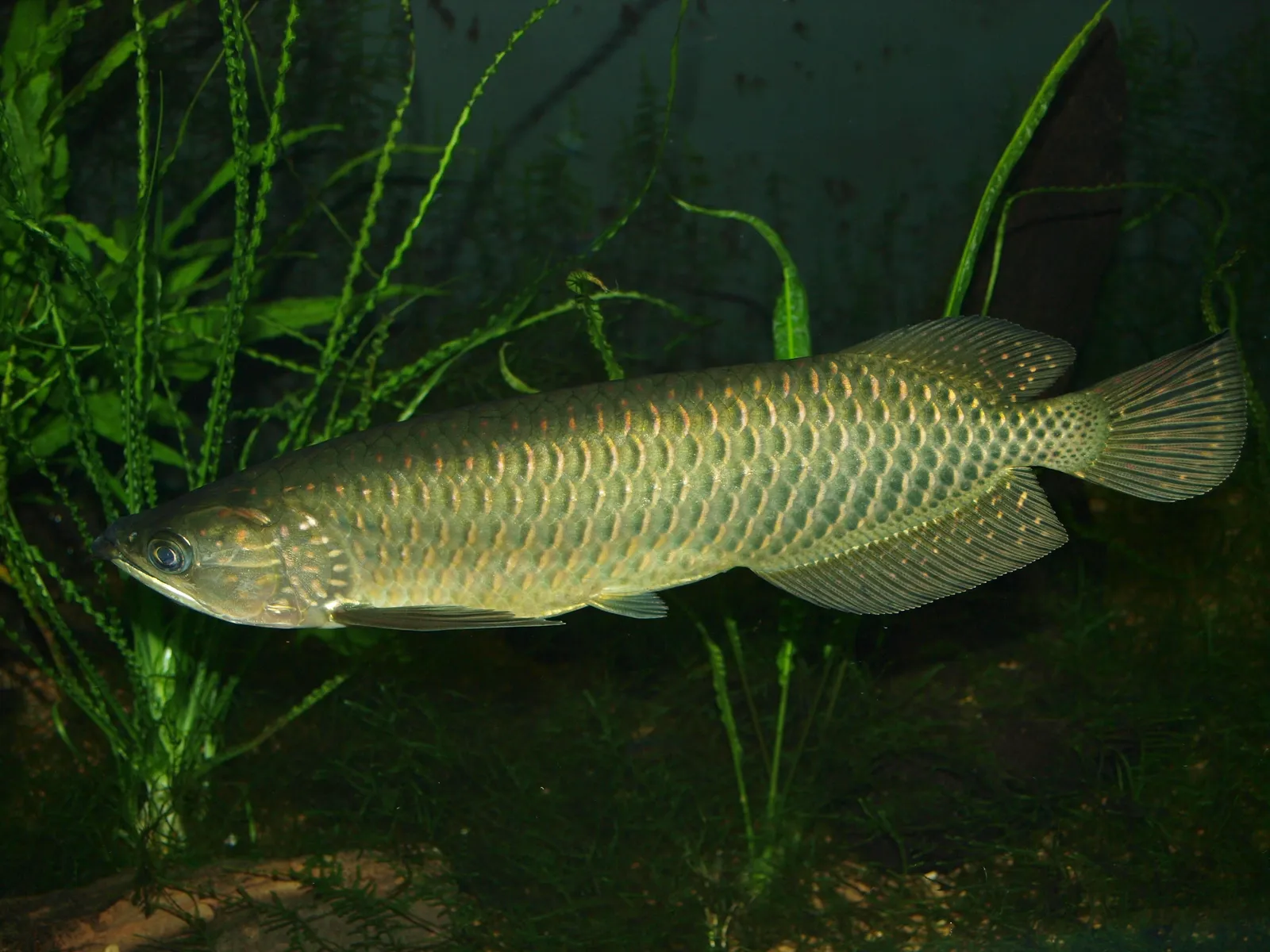
The southern saratoga has the unmistakable arowana silhouette: an elongated, laterally compressed, ribbon-like body with a nearly flat back, and long-based dorsal and anal fins set far back toward a rounded tail, giving the whole rear half of the fish a single sweeping fin margin. The mouth is large and strongly upturned — a "drawbridge" jaw built for striking prey at or above the surface — and carries a pair of long barbels on the lower jaw, used to detect surface disturbance. Large, thick, cycloid scales in an overlapping mosaic give the body a bronze-to-silver sheen.
FishBase and Seriously Fish both give a maximum size of around 36 in total length, making this a genuinely large aquarium fish rather than a novelty-sized one. The body is powerfully muscled for its shape, which the fish puts to dramatic use: saratoga are strong jumpers, capable of clearing the water's surface entirely to take prey from overhanging vegetation.
Habitat
Scleropages leichardti is endemic to the Fitzroy River system of central-eastern Queensland, Australia, including the Dawson River, a major tributary of the Fitzroy basin. It occupies slow-flowing streams, river reaches and billabongs (oxbow lakes) rather than fast, clear water, typically in warm, somewhat turbid conditions with cover from overhanging bank vegetation.
Queensland's subtropical climate imposes a strong wet-season/dry-season rhythm on this habitat, and the species' biology follows it: breeding is cued by a cooler period around 68–73 °F ahead of the wet season, after which the river system's flows and productivity increase. Outside that window the water the saratoga lives in is warm and food-rich, with plenty of insect life along the banks.
Feeding
The southern saratoga is a carnivorous ambush and surface predator. In the wild it takes aquatic and terrestrial insects, small fish, frogs and freshwater crayfish, and it is especially known for leaping to snatch insects, and occasionally small vertebrates, directly off overhanging branches and foliage — the same jumping ability that makes a secure lid essential in captivity.
In the aquarium it is an easy and enthusiastic feeder once established, taking whole fish, prawns and other crustaceans, insects, and formulated arowana pellets. As a surface-oriented sight-hunter it feeds most readily on food that moves or floats near the top of the water column.
Mating
Scleropages leichardti is a paternal mouthbrooder, the defining reproductive trait of the true arowanas. Spawning is timed to the cooler period before the wet season, and after courtship the pair releases and fertilises a small clutch of unusually large, yolk-rich eggs externally over open substrate rather than a prepared nest.
Immediately after fertilisation, the male gathers the eggs into his mouth. From that point he carries the entire clutch, foregoing normal feeding for an extended period while the eggs develop — a heavy parental investment built around very few, very large offspring rather than the thousands of tiny eggs many fish scatter and abandon.
Breeding
After incubating the eggs, the male continues to brood the hatchlings, which emerge still carrying a large external yolk sac, and shelters the free-swimming fry in his mouth for a further period of weeks as they grow, releasing them for short spells and recalling them at the first sign of danger. This extended paternal mouthbrooding is the standout breeding hook of the true arowanas, distinguishing them from almost every other aquarium fish family.
Captive breeding of the southern saratoga is reported to be difficult and infrequent in home aquaria; hobby sources describe occasional success in large outdoor ponds rather than reliable indoor spawns. Sexes are not reliably distinguished by external features, so building a compatible group and giving them space, stable water and a seasonal temperature dip is the practical route rather than deliberate pairing.
In the aquarium
This is a large, long-lived, advanced-level fish that demands real planning before purchase, not after. Adults approach 35.5 in, and care guides recommend a minimum footprint on the order of 180 × 60 × 23.5 in for a single fish — plan for something closer to that scale or larger, since a saratoga does not stay a manageable juvenile for long. A heavy, tight-fitting lid is non-negotiable: this is a committed jumper that will clear an open or poorly secured tank in pursuit of prey, or simply while startled.
Water should be kept warm (roughly 75–86 °F) at a mildly acidic-to-neutral pH (about 6.0–7.5) with moderate hardness; the species does well in slightly murky water furnished with floating or surface cover rather than a stark, brightly lit setup. Diet should be varied — whole fish, prawns, insects and good-quality arowana pellets — and tankmates need to be robust, similarly large, and not so small as to be mistaken for a meal. Reported lifespans of 10–15 years underline that this is a multi-decade commitment for the larger individuals kept long-term. Unlike the Asian arowana (Scleropages formosus), the southern saratoga is not CITES-listed.
Conservation
The IUCN Red List assesses Scleropages leichardti as Near Threatened. The species' entire natural range is restricted to a single river system — the Fitzroy, including the Dawson River tributary — in central-eastern Queensland, which by itself makes it more exposed to localised pressure than a widely distributed fish would be.
Relevant long-term concerns for a single-basin endemic like this include water extraction, damming and flow modification, riparian habitat loss along the banks it hunts from, and historical collection pressure for the aquarium trade. It is not CITES-listed, in contrast to the Asian arowana, and management sits with Australian and Queensland state regulation of a native, range-restricted freshwater fish.