Taxonomy & naming
Chaetostoma milesi was described by Henry Weed Fowler in 1941 in Notulae Naturae (Philadelphia), No. 73, pp. 2 (figures 1–5), from specimens collected at Honda, Colombia, in the upper Magdalena basin. The Catalog of Fishes (Eschmeyer, CAS) treats the name as valid: Chaetostoma milesi Fowler, 1941. The only listed synonym is the original misspelling Chaetostomus milesi (the generic name was later emended). Diagnostic characters in the species were noted in keys by Fernandez-Yepes (1945) and Ceas & Page (1996).
Chaetostoma is a diverse genus of roughly 50 valid species (and many undescribed forms; numerous L-numbers in the genus remain undescribed), placed within subfamily Hypostominae, tribe Ancistrini. It is the premier genus of what hobbyists call 'rubbernose' or 'bulldog' plecos — a group characterised by the broad, rounded, flexible snout, the absence of plates on the abdomen, and the presence of interopercular odontodes (bristle-spines) behind the gill-cover. The genus differs from Ancistrus in lacking the fleshy snout tentacles.
Fowler named the species in honour of Cecil W. Miles (1905–1973), who combined his role as Secretary of the Dorada Railway at Mariquita, Colombia, with an active interest in natural history and provided Fowler with a considerable collection of Colombian freshwater fishes in the 1940s.
Morphology
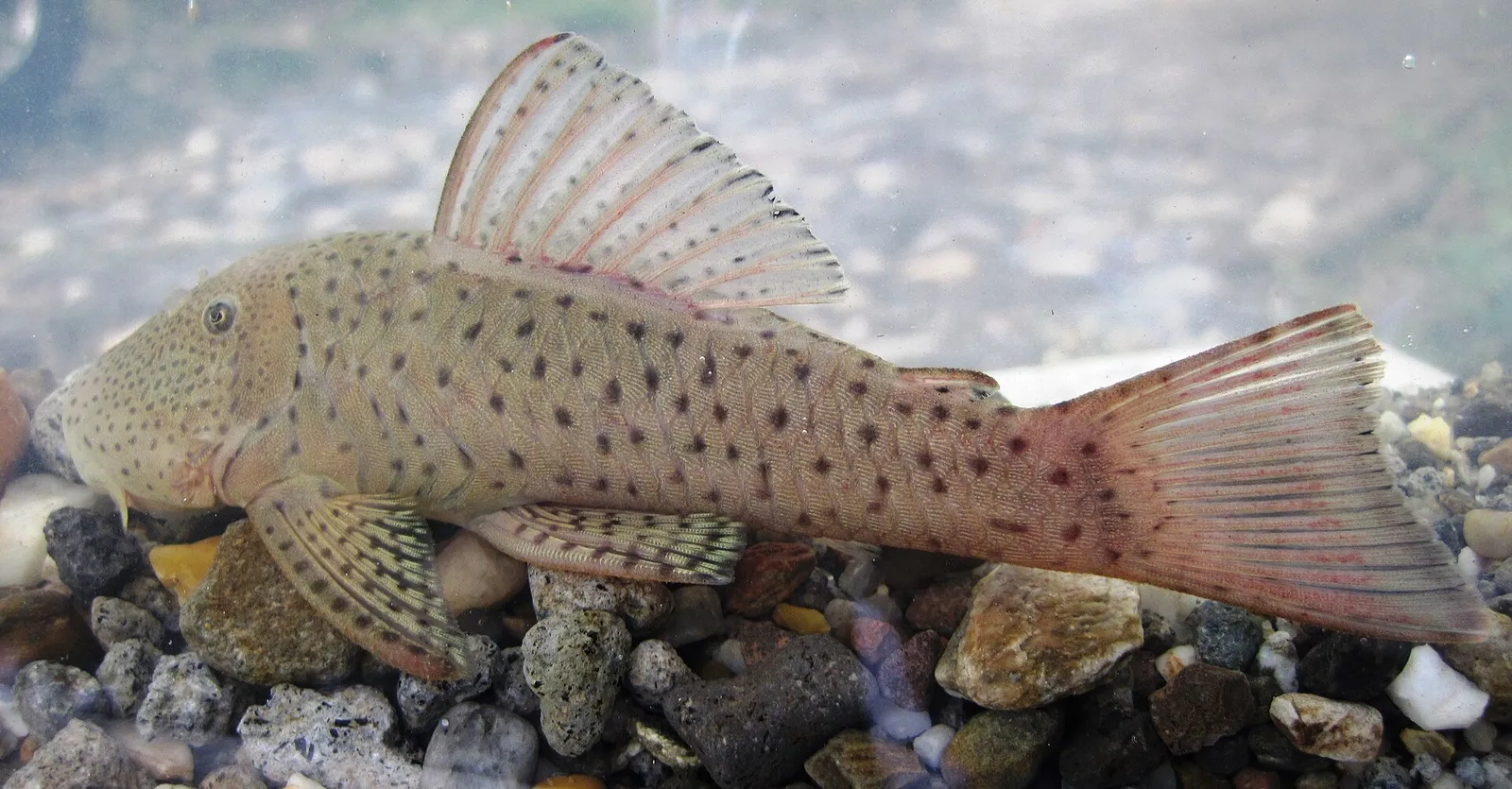
Chaetostoma milesi reaches up to approximately 5.5 in standard length (roughly 6.5–7 in total length), making it a medium-sized member of its genus. The body plan is typical Chaetostoma: strongly depressed, broad across the pectoral girdle, tapering to a moderately slender caudal peduncle. The snout is distinctively wide, rounded, and somewhat flexible — the 'rubbernose' of the common name — bearing the circular sucker mouth beneath.
Colouration is dark brown to grey-black, typically with a fine pattern of cream or pale spots or reticulations that may be faint or absent in large adults; coloration varies with locality and condition. Juveniles are often more distinctly marked than adults. The ventral surface is pale. Scutes cover the flanks and dorsum in the typical loricariid arrangement; the abdomen is naked (unplated), as in all Chaetostoma.
Sexual dimorphism is present and functionally significant. Males have a larger and broader head, slimmer ventral sides, and — most distinctively — disproportionately large pelvic fins relative to body length. The enlarged pelvic fins are thought to play a role in fertilisation: inverted over the egg mass in fast current, they may act as a physical barrier that prevents sperm dispersal. Females are broader-bodied when viewed from above and have relatively smaller pelvic fins.
Habitat
Chaetostoma milesi is endemic to the Magdalena basin of Colombia, with the type locality at Honda — a town on the Magdalena River where the lower and middle river transitions occur, approximately 4°12'N, 74°44'W. FishBase also lists the Apuré basin (Orinoco tributary in Venezuela) within the range, though the Magdalena is the primary and best-documented range.
The Magdalena is Colombia's most important river, draining the inter-Andean valley between the Eastern and Central Cordilleras. Chaetostoma species in the Magdalena occupy clear, fast-flowing sections — rocky rivers and streams with significant gradient, well-oxygenated water, and abundant hard substrate colonised by algae and biofilm. Water temperatures in the Andean foothills range seasonally from roughly 64 °F to 79 °F, with cooler conditions at higher elevations and during periods of high runoff.
Microhabitat is strongly associated with rapids and riffle zones, where the fish clings to large boulders and rock faces using its powerful sucker mouth and rasps the biofilm communities growing in the high-light, fast-water conditions. The flattened body and enlarged pectoral and pelvic fins are adaptations to maintaining position in current.
Feeding
Chaetostoma milesi is an algae and biofilm grazer, using its broad sucker mouth and fine multi-cusped teeth to rasp the periphytic communities growing on hard substrates in fast, well-lit water. In its native Magdalena rapids, the primary food is the thin film of microalgae (primarily chlorophytes and diatoms) and associated organic matter that coats every exposed boulder surface.
The diet is overwhelmingly plant-based. Gut analyses of Chaetostoma species from similar Andean habitats show predominantly algal material, fine detritus, and diatoms, with very small amounts of invertebrate material ingested incidentally. This strong herbivory is typical across the genus and distinguishes Chaetostoma from more omnivorous plecos like Hypostomus or Ancistrus.
In the aquarium, C. milesi performs well on a diet of natural algae growth in the tank (soft green film algae and brown diatoms), supplemented with high-quality algae wafers, spirulina-based foods, and blanched vegetables. Courgette (zucchini), spinach, and cucumber are accepted. Small amounts of protein-rich foods (sinking pellets, Daphnia) can be offered occasionally but should not dominate the diet. The species grazes most actively in areas of moderate to good current, and positioning food near a powerhead outlet often triggers feeding in shy individuals.
Mating
Courtship and pre-spawning behaviour in Chaetostoma milesi follows the pattern observed for the genus in fast-flowing stream environments. Males are territorial around potential spawning sites — typically the flat underside of large stones or smooth rock faces in areas of good current. A male holding a territory will actively repel other males with displays and, if necessary, physical contact.
Females seeking to spawn are attracted to the male's territory, and there may be competition among females during peak breeding season. The large pelvic fins of males appear to have a specific reproductive function: during fertilisation, the male positions himself inverted over the egg mass and curves his enlarged pelvic fins downward to enclose the clutch, forming a physical barrier against the current that would otherwise disperse the sperm before fertilisation occurs. This is one of the more intriguing spawning adaptations known in small loricariids.
In the aquarium, conditioning for spawning involves regular large (30–40%) water changes, ideally with slightly cooler water, increased current through powerhead adjustment, and generous feeding on algae and vegetables. Males that are in spawning condition will show intensified territorial behaviour around flat rocks and ceramic caves.
Breeding
Chaetostoma milesi is a substrate spawner that deposits adhesive eggs on the underside of flat objects in areas of good current. The male then guards the clutch, positioning himself over the eggs inverted or pressed against the spawning substrate. The oversized pelvic fins are extended to cover and protect the egg mass — an unusual brood-care mechanism that provides physical protection while still allowing oxygenated water to flow over the eggs.
Clutch sizes in Chaetostoma species are generally modest relative to large plecos — dozens to low hundreds of eggs per spawn. The eggs are adhesive and pale, typically hatching in 5–7 days at temperatures around 72–75 °F. The larvae are attached to the substrate initially by a small adhesive organ on the head; once this is resorbed and the yolk sac consumed (within 3–4 days), the fry begin active grazing behaviour on algae immediately.
Fry are robust once feeding begins. They require algae-covered surfaces; a tank with established biofilm is strongly preferable to a clean new setup. Commercial spirulina powder mixed with tank water makes a suitable first food supplement. Males should generally be removed or observed for aggression once the fry are free-swimming, though in a well-sized tank the male may continue to guard loosely.
In the aquarium
Chaetostoma milesi is an excellent aquarium fish for anyone who wants a pleco that genuinely cleans algae without outgrowing the tank or destroying the planting. At 5.5–6 in maximum SL it is large enough to be a visual presence but small enough for aquariums of 25 US gal and up; a pair can be maintained in 40–55 US gal with good filtration and circulation.
The single most important husbandry requirement is current. These fish come from Andean rapids and they want water movement. A powerhead or circulation pump that creates a strong flow across at least a portion of the tank floor is not optional — without it, the fish will be inactive, refuse food, and may decline. Smooth-surfaced rocks that accumulate algae in the flow are ideal décor. Fine to medium gravel or sand substrate is appropriate; sharp gravel is avoided.
Water parameters should reflect the Magdalena origin: temperature 64–75 °F (cooler than many tropical fish, which matters), pH 6.5–7.8, moderate hardness. This species tolerates cooler conditions better than most tropical plecos, which makes it a good choice for unheated tanks in temperate climates during summer, or for tanks kept at the lower end of tropical range.
Chaeostoma milesi is peaceful toward fish that do not compete for its grazing territories. It may squabble with other Chaetostoma or similar plecos if rock-territory is limited, but two individuals in a well-furnished tank usually work out their boundaries. Suitable tankmates include small danios, barbs, hillstream loaches, and other fish from similar fast-water Andean or Asian biotopes. Avoid soft-water blackwater species that need warm, still, acidic conditions.
Conservation
The IUCN Red List assessed Chaetostoma milesi as Least Concern in 2021. The assessment acknowledges the species' presence across the Magdalena basin and notes no major documented population declines attributable to the ornamental fishery or habitat loss at a level that would move the species above Least Concern.
However, the Magdalena is one of the most threatened river systems in South America. The basin drains a densely populated, heavily agricultural and industrialised region of Colombia; sedimentation, agrichemical runoff, and deforestation of Andean watersheds have dramatically altered water quality and riffle habitats in many tributaries. The upper Magdalena has also been subject to decades of hydroelectric development. For a rheophilic species adapted to clean, fast, oxygenated water over hard substrate, these pressures represent a genuine long-term threat to local populations even if the overall range remains broad.
Captive breeding is feasible and desirable. Tank-raised C. milesi are significantly hardier than wild-caught imports, which arrive from a stressful chain of collection and transport, and support for hobbyist breeding programmes reduces the collection pressure on wild populations in the Magdalena.