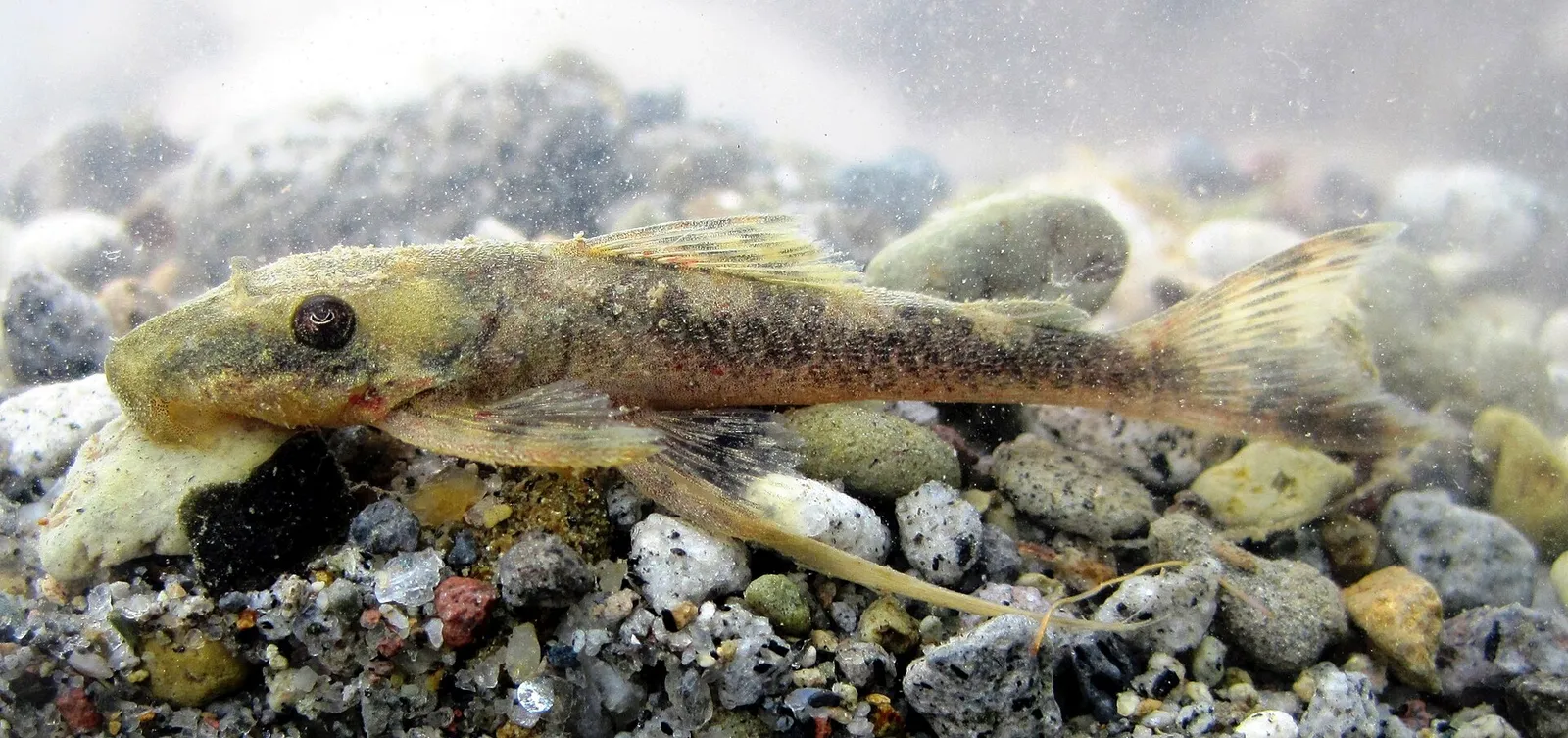
Taxonomy & naming
Carl H. Eigenmann described Lasiancistrus caucanus in 1912 in Indiana University Studies (No. 16 [sic No. 8]: 11), from holotype FMNH 56034 collected at Cartago, Colombia — a town in the upper Cauca Valley. Because Eigenmann described the species directly in Lasiancistrus, the authority is not enclosed in parentheses. The Catalog of Fishes (Eschmeyer, CAS; updated 10 Jun 2026) confirms valid status as Lasiancistrus caucanus Eigenmann 1912, with Loricariidae: Hypostominae, distribution in the upper Cauca River basin, Colombia.
A nomenclatural complexity surrounds L. caucanus: Eigenmann also described Hemiancistrus mayoloi in the same 1912 publication from the Río San Juan in the Isthmus drainage. Armbruster (2005: 555) served as first reviser, determining that L. caucanus and H. mayoloi are synonyms and selecting L. caucanus as the valid name because it was described in the correct genus. Additional synonyms include Ancistrus planiceps Meek & Hildebrand 1913, Lasiancistrus planiceps, and Lasiancistrus volcanensis Dahl 1942.
The genus Lasiancistrus was erected by Regan (1904) as a subgenus of Ancistrus to accommodate loricariids bearing the diagnostic whisker-like (lasios = hairy; ankistron = hook) evertible cheek odontodes. Armbruster's 2005 revision of the genus (Neotropical Ichthyology 3(4): 549–569) recognised only four valid species out of the ~16 names then assigned: L. schomburgkii, L. caucanus, L. guacharote, and L. heteracanthus.
Morphology
FishBase records a maximum size of 9.5 in SL for L. caucanus; Armbruster's (2005) revision reported most material in the 6–6.5 in range for adults, with large individuals reaching toward the upper end. The body is robust, depressed, and fully armoured in overlapping bony scutes. Ground coloration is brown to greyish-brown with variable mottling or spotting; preserved specimens often appear uniformly tan.
The most distinctive feature of Lasiancistrus is the cheek odontode array. Adult males develop dense whisker-like odontodes at the anterolateral corners of the snout and along the interopercular area — hair-fine, translucent rods that give the genus its name. Males also develop tentacle-like structures on the pectoral-fin spines during the breeding season, longer than the odontodes associated with them; this combination of whisker-like cheek odontodes and pectoral tentacles distinguishes adult male Lasiancistrus from superficially similar genera. The caudal fin is slightly emarginate to weakly forked with the lower lobe longer than the upper. Three rows of plates on the caudal peduncle and a modified bar-shaped opercle are additional Lasiancistrus synapomorphies (Armbruster 2005).
Sexual dimorphism is pronounced in nuptial males: the snout becomes almost square versus rounded in females and juveniles, and the pectoral tentacles elongate. Females and sub-adults lack the whisker-like odontodes at the snout corners. The species is facultatively capable of aerial respiration — Ref. 126274 on FishBase notes this capacity for the genus — allowing short excursions over wet rocks.
Habitat
Lasiancistrus caucanus has a trans-Andean distribution, known from the Magdalena, Atrato, San Juan, Tuyra, and Bayano river drainages of Colombia and Panamá. This range spans both sides of the Andes and extends into Central America via the Darién gap — a notably broad distribution for a single loricariid species and consistent with its recognition as a valid species encompassing what were formerly several named forms.
The Cauca River flows northward through the high inter-Andean valley between the Central and Western Cordilleras of Colombia, dropping from over 3,281 ft elevation to the lowland Magdalena floodplain. L. caucanus occupies both the higher montane reaches and piedmont sections. The Río San Juan and Atrato drain the Pacific slope and the Chocó biodiversity hotspot — among the wettest regions on Earth — where rivers are soft, acidic, and fast.
Microhabitat is rocky riffles and boulder cascades with good current. Water quality data for Colombian Andean rivers in the Cauca and Magdalena basins typically show temperatures of 64–75 °F at mid-elevation, rising toward 79 °F in lowland reaches; pH ranges from 6.0 in Chocó Pacific drainages to 7.5 in the more alkaline Cauca Valley. PlanetCatfish records for the genus suggest moderately well-oxygenated, clear to slightly turbid water. The species is listed alongside Chaetostoma sp. 'Colombia' as present in the Colombia Caribbean river drainages in addition to its core Cauca range.
Feeding
Lasiancistrus caucanus is an aufwuchs grazer and biofilm scraper. The dentition — bicusped teeth in modest series on both jaws — is adapted for rasping the periphyton community from rock surfaces: diatoms, green filamentous algae, and the bacteria and organic detritus that settle among them. This is a continuous, low-intensity feeding mode rather than discrete prey-capture events.
Field data from Colombian ichthyologists (Galvis, Mojica, Camargo) and the broader Neotropical fish literature indicate that rheophilic loricariids like Lasiancistrus feed almost exclusively on biofilm in fast water, supplemented by very fine plant detritus. The air-breathing capability noted in the genus (FishBase ref. 126274) may also assist in accessing supralittoral biofilm by allowing brief forays above the waterline on wet rock surfaces.
In aquaria, a diet of algae wafers, spirulina tablets, and blanched vegetables (courgette, cucumber, spinach) is appropriate, with occasional live or frozen daphnia and bloodworm for variety. The species is not a wood-eater and driftwood, while useful as décor and shelter, is not a dietary requirement in the way it is for Panaqolus or Ancistrus.
Mating
No published field observations of courtship in Lasiancistrus caucanus are available, and the species has no breeding reports on PlanetCatfish. Mating behaviour is inferred from the morphological sexual dimorphism documented by Armbruster (2005) and from the general biology of Hypostominae.
Male secondary sexual characters — the square snout, whisker-like anterolateral odontodes, and elongated pectoral tentacles — are most pronounced in nuptial males and are likely involved in territory advertisement and female assessment. The pectoral tentacles, unique to Lasiancistrus among closely related genera, may function in sensory signalling during close-approach courtship, their odontode arrays providing tactile stimuli. Males are presumed to establish territories around suitable nest sites in crevices beneath boulders.
Triggers for spawning in wild Lasiancistrus are not documented but are likely linked to seasonal hydrology: the Cauca valley has a bimodal rainfall pattern (two wet seasons per year), and rising water levels, cooler temperatures, and increased current during wet periods are classic cues for Andean loricariids. In captivity, simulating these conditions with water changes using slightly cooler water and increased flow may be necessary to induce breeding attempts.
Breeding
Captive breeding of Lasiancistrus caucanus has not been documented in the published literature or in PlanetCatfish's community breeding reports. Given the species' mid-sized dimensions, its wide distribution, and the occasional appearance of wild-caught specimens in Colombian fish markets (Corroncho is the common name used by fishers), it is likely that captive breeding would be achievable with appropriate conditions, but no confirmed account exists.
Based on the biology of Hypostominae broadly, L. caucanus is expected to be a cave or crevice spawner: eggs deposited adhesively on the ceiling or walls of a rocky cavity, with the male providing paternal guard. The clutch size for a 6.5–9 in SL loricariid would probably be in the range of several dozen to perhaps 100 eggs. Given the trans-Andean range and diverse river chemistries from which the species is known, it is likely tolerant of moderate variation in water parameters, which bodes well for eventual captive breeding.
Aquarists attempting to breed this species should focus on providing adequate cave sites (smooth-bottomed ceramic tubes or flat rock stacks), strong current, and a bimodal seasonal simulation — cooler, higher-flow 'wet season' periods alternating with warmer, lower-flow 'dry season' phases — to replicate the Colombian Andean hydrological cycle.
In the aquarium
Lasiancistrus caucanus occasionally appears in the ornamental trade under the common names Corroncho or Guachupé — Colombian Spanish folk names used broadly for several loricariid species — and is sometimes collected by hobbyists with an interest in South American plecos. It carries no L-number, which reflects its historical absence from the German aquarium coding system that assigned L-numbers primarily to Amazonian and Orinoco novelties during the 1980s and 1990s.
At up to 9 in SL this is a moderately large pleco, and a tank of at least 40–55 US gal with good filtration and strong flow is needed. The substrate should be rocky cobble with adequate flat-rock caves and crevices; the fish will spend most of its time pressed against rocks or resting in caves. Algae growth should be encouraged on rocks and décor, supplemented with algae wafers, spirulina, and blanched vegetables.
Water parameters reflecting the Cauca origin — temperature 68–77 °F, pH 6.5–7.5, moderate hardness — are appropriate, though the species' occurrence in the highly distinct chemistry of the Chocó Pacific drainages (soft, acidic) suggests a degree of adaptability. High dissolved oxygen is important. Clean water and regular partial water changes (25–30% weekly) are essential; ammonia and nitrite must be kept at zero.
The species is generally peaceful toward other tankmates and should be compatible with similarly sized, non-aggressive fish. Conspecific and congeneric males may be territorially intolerant in confined spaces, so single males or groups with one male and multiple females are preferable.
Conservation
The IUCN Red List assessed Lasiancistrus caucanus as Least Concern in 2019, reflecting a distribution spanning multiple major river systems across Colombia and Panamá, with no evidence of population-wide decline significant enough to trigger a threatened category. The species is known from the Magdalena, Cauca, Atrato, San Juan, and Darién systems — a broad footprint that buffers against local extirpation events.
Nonetheless, many of the rivers where L. caucanus occurs face substantial human pressure. The Cauca River, in particular, passes through one of Colombia's most densely populated and industrialised inter-Andean corridors. Agricultural runoff, sediment loading from deforestation, and urban wastewater discharge degrade stream quality and silt over the rocky substrates that loricariids depend on. Hydroelectric development on Andean rivers is also ongoing and fragments fish populations.
The common name Corroncho (used by Colombian fishers) suggests at least occasional incidental harvest, though the species is not targeted commercially. No formal monitoring programme for L. caucanus is known to exist. The Least Concern assessment should be revisited as Colombian freshwater biodiversity surveys improve, particularly for Pacific-slope Chocó populations, which may represent distinct evolutionary lineages given the pronounced climatic difference from the Atlantic-slope Cauca.