Taxonomy & naming
Rineloricaria eigenmanni was described by the French ichthyologist Jacques Pellegrin in 1908 in the Bulletin de la Société Zoologique de France (volume 33, number 6/7, page 125), as Loricaria eigenmanni, from material collected at Sarare, Venezuela — the Río Sarare being a tributary of the Orinoco basin in the Venezuelan Andes. The specific name honours the German-born American ichthyologist Carl Henry Eigenmann (1863–1927), one of the most productive students of South American freshwater fish; Pellegrin wrote that it was so named because 'we owe the knowledge of so many interesting forms of American fishes' to Eigenmann.
The species was subsequently transferred to Rineloricaria (Bleeker, 1862), the largest genus of the subfamily Loricariinae. In 2002, Isbrücker et al. erected the genus Hemiloricaria (Bleeker, 1862, resurrected) and transferred several species including R. eigenmanni to that genus, based on morphological and sexual dimorphism characters. However, Ferraris (2003) and subsequent authors recognised only Rineloricaria as valid and treated Hemiloricaria as a synonym. The Catalog of Fishes (Eschmeyer, CAS) lists the current valid name as Rineloricaria eigenmanni (Pellegrin, 1908), with Loricaria eigenmanni Pellegrin, 1908 as the basionym and Hemiloricaria eigenmanni (Pellegrin, 1908) as a synonym. The parenthetical authority reflects the transfer from the original genus of description.
Because Rineloricaria contains approximately 50–60 nominal species across a range from Costa Rica to Argentina — and many are nearly indistinguishable in the field — correct identification of trade specimens labelled as R. eigenmanni requires attention: specimens exported from Colombia are almost certainly R. eigenmanni, but material from other countries may belong to closely related taxa. Rineloricaria belongs to Loricariinae within family Loricariidae (order Siluriformes).
Morphology
Rineloricaria eigenmanni is a small to moderately sized loricariid. FishBase records a maximum standard length of 4 in; PlanetCatfish cites the same figure (4 in SL). In aquarium trade and field collections, most individuals are 3–3.5 in SL at maturity.
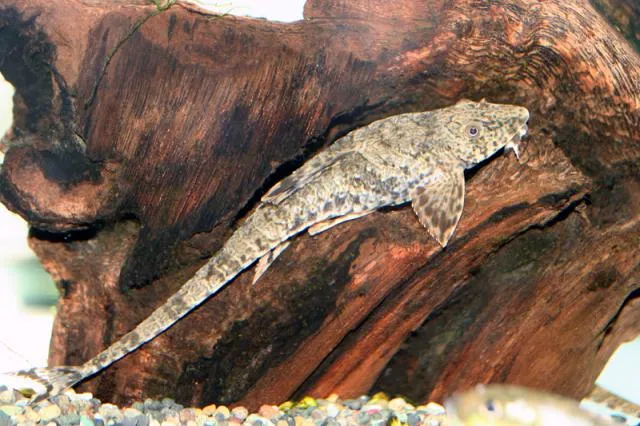
The body is strikingly elongated and strongly depressed — almost ribbon-like viewed from the side — tapering progressively from a broad, flat head to a thread-like caudal filament. The head is wide and flat, with a ventral sucker-disc mouth equipped with spatulate teeth for rasping biofilm from hard surfaces. The body is covered in longitudinal rows of bony scutes; the ventral surface is predominantly naked (unarmoured), as is typical for the Loricariinae.
Colouration is highly variable and substrate-responsive. The typical pattern consists of a pale to medium brown ground colour with darker brown saddle markings: a prominent saddle at the base of the dorsal fin, a second saddle at the rear of the dorsal fin, and three saddles along the caudal peduncle and base — the last set being critical to identification, as they are visible from below as well as above. This key diagnostic feature — dark markings visible on the underside of the caudal peduncle — helps distinguish R. eigenmanni from similar whiptails. When the fish rests on a light substrate the saddles can fade almost to invisibility; on dark sand they are crisp and obvious.
Sexual dimorphism is well-defined in mature adults. Males develop odontodes (fine bristle-like spines) on the sides of the head and along the first pectoral-fin spine — the 'beard' visible to the naked eye in conditioned males. Males also tend to be slightly broader-headed. Females are noticeably fuller through the mid-body when carrying eggs.
Habitat
Rineloricaria eigenmanni occurs across the Orinoco basin, primarily in the Venezuelan and Colombian llanos — the vast tropical savanna plains drained by the Orinoco and its tributaries. The type locality, Río Sarare, is an Andean-foothills river in Barinas state, Venezuela, flowing across the llanos toward the Apure. Export populations for the trade are largely collected around Villavicencio in Colombia, from rivers draining the Eastern Andes toward the Meta and Orinoco.
FishBase records its distribution as Venezuela; the IUCN assessment (LC, 2020) documents it from the Orinoco tributaries in the Andes and the Guiana Shield, covering both Colombia and Venezuela. PlanetCatfish confirms the distribution within the Orinoco basin. The species has also been recorded from the Colombian llanos rivers (Meta, Arauca systems).
Microhabitat is sandy or fine-gravel substrate, almost always in areas of accumulated leaf litter — the species is characteristic of the calm, leaf-litter-floored margins of llanos rivers and flooded savanna streams during the wet season. Shane Linder's PlanetCatfish article (October 2005 Catfish of the Month) describes field collections: 'They are typically captured in clear or whitewaters, but are very adaptable. Whatever type of water they are found in, however, they are always found over sandy areas, usually where there is an abundance of leaf litter for them to hide amongst.'
Water conditions in the llanos range from soft and near-neutral (clear-water streams) to slightly harder white-water Orinoco affluents; PlanetCatfish records pH 6.0–7.4 and temperatures of 75–84 °F. The species is a facultative air-breather, periodically surfacing to gulp atmospheric air — a useful adaptation in the warm, organically rich waters of leaf-litter habitats.
Feeding
Rineloricaria eigenmanni is a benthic aufwuchs and detritus feeder. In the wild, the fish feeds by continuously sifting through leaf litter and sand, rasping the biofilm coating of organic particles, submerged leaves, wood fragments, and sand grains. The diet encompasses algae, bacterial and fungal communities attached to substrate, fine detrital organic matter, and small invertebrates — a broadly omnivorous benthic grazing strategy typical of Loricariinae.
FishBase records the trophic level for R. eigenmanni at 2.6, consistent with a biofilm-and-detritus dietary base. The species is not a high-intensity algae-scraper in the manner of Pterygoplichthys or larger Hypostomus, but it grazes biofilm and fine algae actively and contributes to substrate cleaning.
In the aquarium, R. eigenmanni accepts a wide range of sinking foods: algae wafers, spirulina-based pellets, blanched courgette (zucchini), spinach, cucumber, lettuce, and pre-cooked peas. It will also take live or frozen invertebrates — bloodworm, Artemia, cyclops, daphnia — which are useful for nutritional variety and conditioning for breeding. Shane Linder's Catfish of the Month account notes that the species is 'very adaptable' in its feeding, and that standard community tank feeding approaches can be supplemented with specifically targeted vegetable foods. The fish forages actively at night; subdued lighting promotes more visible daytime activity.
Mating
Rineloricaria eigenmanni is a cave-spawner in which the male takes sole responsibility for brood care. In the aquarium, males defend and prepare a spawning site inside a tight-fitting tube or hollow cavity, then attract females inside to deposit a clutch of eggs.
The standard spawning cavity used by hobbyists is a section of PVC pipe approximately 8 in long and 1.5–2 in internal diameter — a size that allows the male to just fit inside. PlanetCatfish breeding reports describe this setup consistently, and the approach has proven reliable across multiple keepers. The specific material is unimportant; the key variables are the internal diameter (too wide and the male cannot properly guard the eggs; too narrow and the fish will not enter) and that the pipe is open at both ends to allow water circulation.
The male establishes a territory around the pipe, engaging in lateral displays and short chases against competing males. A dominant male is recognisable by a more developed odontode beard and more active territorial behaviour. He cleans the interior of the pipe before spawning. When a female is sufficiently conditioned, she enters the pipe, spawns, and then departs — leaving the male as sole guardian.
Spawning readiness is stimulated by regular large water changes with slightly cooler water — reflecting the seasonal cycle of the llanos, where Andean rainfall delivers cool, oxygenated water to the savanna streams in the wet season. Soft, near-neutral water chemistry further encourages spawning; PlanetCatfish notes that aquarists without naturally soft water may need to use RO or rainwater blends.
Breeding
Rineloricaria eigenmanni is among the most straightforwardly bred loricariids in the hobby, with nine breeding reports on PlanetCatfish and a well-established management protocol. Well-conditioned adults in appropriate conditions will spawn repeatedly with minimal special intervention beyond the provision of a suitable tube and clean, regularly changed water.
The female deposits eggs inside the pipe in a tight cluster; the male positions himself at the pipe entrance, alternately fanning the eggs with his pectoral fins and guarding against intrusion. He rarely leaves the clutch during incubation. Clutch sizes are modest — consistent with small Rineloricaria species — with hobbyist reports describing several dozen eggs per spawning event. Eggs are relatively large, pale in colour, and adhesive.
Incubation takes approximately 4–7 days at 79–82 °F; the fry hatch with large yolk sacs and emerge from the pipe 2–3 days later. The male continues to attend until the fry disperse. Shane Linder's Catfish of the Month article warns that 'the fry are very sensitive and raising them to a fair size is truly a test of the aquarist's skills.' Mortality in the first two weeks can be high if water quality lapses or if appropriate first foods are not available.
Fry accept microworms, baby brine shrimp nauplii, powdered spirulina, and finely crushed algae wafers. Small, frequent water changes are critical in the fry tank; organic accumulation rapidly elevates mortality. Fry grow at a moderate pace and reach sexual maturity at approximately 8–10 months. Multiple spawning cycles are typical from a conditioned pair over a breeding season.
In the aquarium
Rineloricaria eigenmanni is one of the most forgiving and adaptable loricariids available to aquarists, well-suited to community setups and beginners interested in loricariid breeding. A small group of two or three adults can be maintained in an aquarium as compact as 15–20 US gal, though 25–30 US gal is more appropriate for a pair intended for breeding, to provide stable water quality and room for territory and tube placement.
The aquarium should have a sand or fine-gravel substrate — the fish spend much of their time resting on and sifting through the bottom. Dried leaves (oak, beech, Indian almond) on the substrate replicate the natural leaf-litter microhabitat and encourage natural foraging behaviour. Several pieces of driftwood of appropriate shape and one or more PVC pipes or ceramic tubes complete the essentials. Lighting can be subdued; the species is more active in low light and will graze glass and décor surfaces during the day if undisturbed.
Water parameters are undemanding: temperature 75–82 °F, pH 6.0–7.5, soft to moderately hard water. The species tolerates moderate hardness and adapts to a wide range of tap water conditions without evident stress, making it more accessible than many specialist loricariids. Clean water matters; regular partial changes of 25–30% weekly are recommended, as organic accumulation is stressful for the species.
R. eigenmanni is peaceful toward virtually all tank inhabitants and presents no threat to fish of comparable or larger size, small shrimp (juvenile shrimp may be at minor risk), or plants. Compatible community fish include small to medium tetras, rasboras, Corydoras, and peaceful cichlids. The species is sometimes confused with Farlowella species at point of sale; R. eigenmanni is generally the more robust choice for general community keeping.
Conservation
Rineloricaria eigenmanni is assessed as Least Concern (LC) on the IUCN Red List (assessment published 2022, for the 2022-1 version; assessed 4 December 2020). The assessment by Usma, Rodríguez-Olarte, Taphorn et al. is based on the species' broad distribution across the Orinoco basin in Colombia and Venezuela and the absence of identified threats sufficient to qualify for a threatened category.
The Orinoco system and its llanos tributaries are under a range of anthropogenic pressures: agricultural conversion and sedimentation from Andean deforestation, oil extraction infrastructure in the Venezuelan llanos (including spill risk in the Apure and Meta drainages), urban growth around key export centres such as Villavicencio, Colombia, and periodic mass die-off events in llanos rivers during dry-season oxygen depletion. R. eigenmanni's leaf-litter and sandy-substrate microhabitat provides some resilience to moderate disturbance, and the species' demonstrated physiological adaptability — including facultative air-breathing — offers additional buffering against transient water quality stress.
The species is collected in large volumes for the aquarium trade, particularly from Colombia, but this collection pressure has not been identified as a conservation concern given the broad range and apparently high local abundance. Captive breeding in the hobby is feasible and documented, and a proportion of trade stock originates from farm-bred sources in Asia and Europe. The overall conservation outlook is reassuring, contingent on the maintenance of functional sandy, leaf-litter-rich benthic habitat in the major Orinoco tributaries.