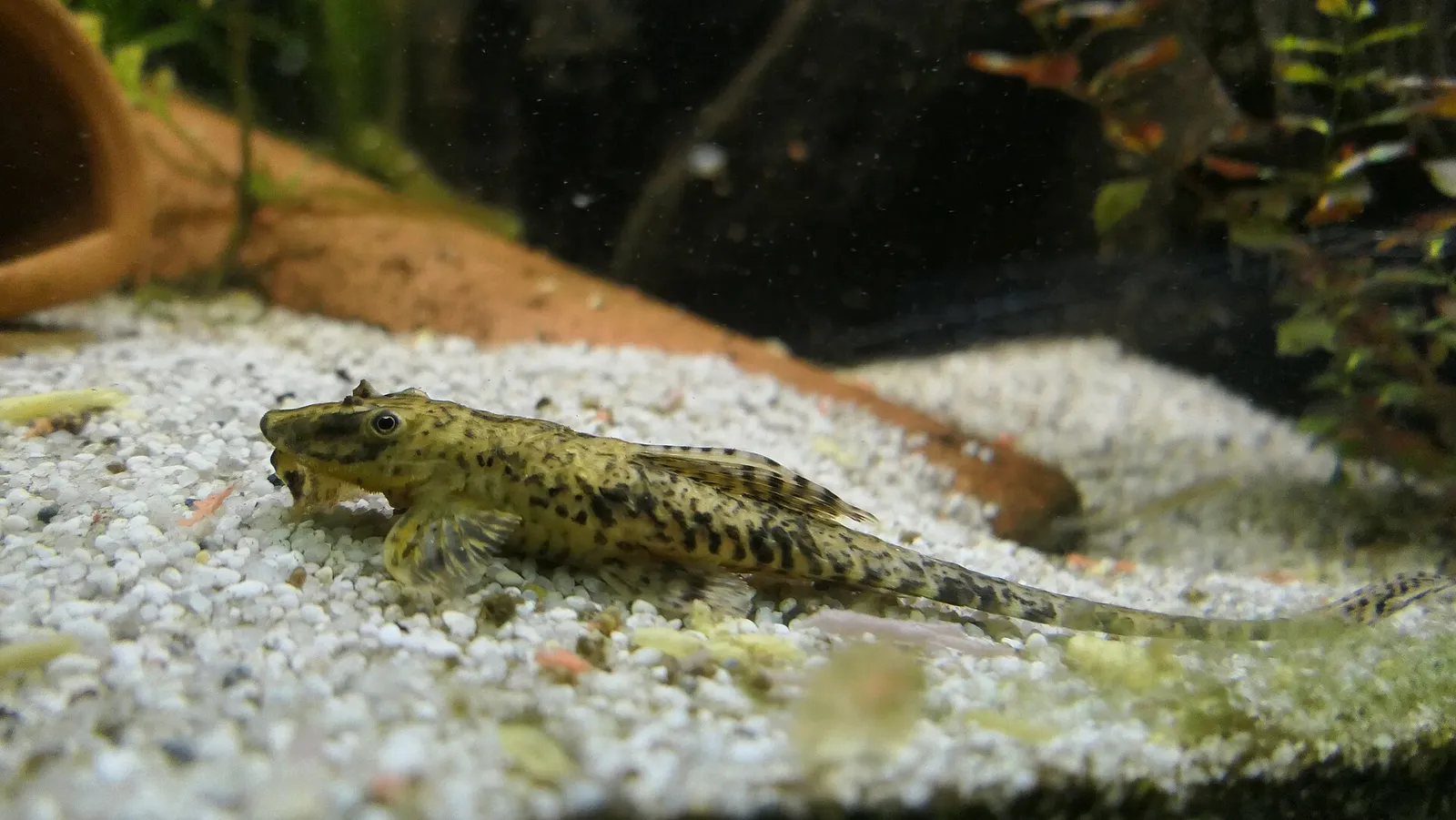
Taxonomy & naming
Rineloricaria lanceolata was originally described by the British Museum ichthyologist Albert Günther in 1868 in the Annals and Magazine of Natural History (Series 4, volume 1, number 6), under the name Loricaria lanceolata, from a single specimen (holotype BMNH 1867.6.13.79) collected at Xeberos (also rendered Jeberos), in the upper Amazon drainage of Peru.
The species has subsequently been placed in two additional genera. It was for a time classified under Hemiloricaria (Bleeker, 1862), a genus used for smaller whiptail catfishes, and appears under that name in older literature and databases. The current accepted placement in Rineloricaria (Bleeker, 1862) treats Hemiloricaria as a synonym of Rineloricaria; the two names refer to the same genus, and the Catalog of Fishes lists the current valid name as Rineloricaria lanceolata.
Because the species was originally placed in Loricaria rather than Rineloricaria, the authority is cited with parentheses: (Günther, 1868). The Catalog of Fishes (Eschmeyer, CAS) accepts Rineloricaria lanceolata (Günther, 1868) as the valid name, with Loricaria lanceolata Günther, 1868 as the basionym and Hemiloricaria lanceolata (Günther, 1868) and Loricaria hoehnei Miranda Ribeiro, 1912 as synonyms. The genus Rineloricaria belongs to subfamily Loricariinae, the same subfamily as Sturisomatichthys, within family Loricariidae (order Siluriformes). The name Rineloricaria hoehnei is treated as a synonym of this species in Eschmeyer's Catalog of Fishes.
Morphology
Rineloricaria lanceolata is a moderately small loricariid. FishBase records a maximum total length of 5 in; Seriously Fish gives a maximum standard length of 3.5 in; ScotCat cites 5 in TL. In practice most aquarium specimens reach 3–4 in SL, with males generally larger than females.
The body is extremely elongated and strongly depressed — almost ribbon-like in cross-section — tapering progressively to a fine, whip-like caudal peduncle and tail. The head is flat and broad, with a subterminal sucking mouth equipped with spatulate teeth and bordered by fleshy lips. The whole body is covered in bony scutes in longitudinal rows, though the arrangement is more loosely armoured than in the Hypostominae; the belly is mostly naked (unplated).
Colouration is highly variable: typically a base of brown, grey-brown, or tan with darker saddle markings, spotting, or reticulate patterning across the back and flanks. The belly is whitish to pale cream. Some populations show reddish-brown or olive tones. Colour can shift substantially depending on substrate colour and the fish's mood or stress level. ScotCat notes high colour variability within the species.
Sexual dimorphism is evident in mature adults. Males develop prominent odontodes (hair-like bristles) on the sides of the head and along the first pectoral-fin spine — a feature clearly visible and used for sexing. Males also typically have a broader head and may develop a slightly wider snout than females. Females are notably plumper through the mid-body when gravid. The ETYFish Project describes the genus name as derived from Greek *rine* (rasp) and the genus *Loricaria*, with the sharp bristles on the snout sides of males in mind.
Habitat
Rineloricaria lanceolata is one of the most widely distributed species in the genus. The type locality is Xeberos, in the upper Amazon of Peru, but the species' confirmed range is far broader: the Catalog of Fishes records it from the Amazon, Orinoco, Essequibo and Paraguay River basins, and the 2023 IUCN assessment adds the Tocantins-Araguaia and lower Paraná basins. Across that range it occurs in Argentina, Bolivia, Brazil, Colombia, Ecuador, Guyana, Paraguay, Peru and Venezuela — among the broadest distributions of any loricariid.
The species inhabits slow-flowing to moderately flowing waters, typically in clear or white-water habitats over sandy or muddy substrates, often among accumulations of leaf litter, submerged wood, and aquatic vegetation. Seriously Fish describes it as 'usually amongst leaf litter over sandy substrates, in both clear and whitewater habitats' — the phrase captures the species' preference for sheltered, substrate-rich microhabitats rather than the exposed rocky rapids preferred by Hypancistrus or Chaetostoma.
Water conditions in the upper Amazon at collection localities are typically warm (approximately 77–82 °F), soft to moderately hard, and ranging from slightly acidic to near-neutral (pH 6.0–7.5 or somewhat higher). The habitat is relatively benign and tolerant compared with the extreme blackwater conditions of the Rio Negro, which partly explains the species' reputation as a less demanding aquarium fish.
Rineloricaria species are facultative air-breathers, periodically rising to the surface to gulp atmospheric air; this adaptation is particularly useful in the warm, organically rich, occasionally hypoxic environments of leaf-litter habitats.
Feeding
Rineloricaria lanceolata is an omnivore with a dietary emphasis on aufwuchs, biofilm, and organic detritus — the typical feeding mode of the Loricariinae subfamily. In the wild, the fish graze continuously across substrate surfaces, consuming the algal, bacterial, and detrital biofilm coating sand grains, leaf litter, and submerged wood. Small aquatic crustaceans and invertebrates encountered during this grazing are also consumed.
Seriously Fish describes the natural diet as 'aufwuchs and small aquatic crustaceans,' and in captivity recommends 'sinking dried foods, vegetable matter (including blanched spinach, courgette, kale etc.) and live and frozen fare' such as bloodworm, daphnia, and cyclops. ScotCat notes acceptance of 'vegetable food such as cucumber and other various foods such as tablet, flake and frozen.'
The species is not a specialist algae-scraper in the manner of Pterygoplichthys or Hypostomus, and should not be relied upon as the sole algae-management strategy in an aquarium. However, it will actively graze biofilm from surfaces and is a useful secondary algae-control species in a planted tank. Regular supplemental feeding with sinking catfish wafers, blanched vegetables, and occasional frozen invertebrate foods is recommended regardless of apparent grazing activity.
Mating
Rineloricaria lanceolata is a cave-spawner in which the male takes exclusive responsibility for brood care. In the aquarium, males select a suitable hollow — most commonly a section of PVC pipe (2–3 in internal diameter is standard), a bamboo tube, or a slate cave — clean it thoroughly, and attempt to attract females into it for spawning.
Male–male competition over preferred spawning sites occurs; providing more caves than there are males reduces aggression. Courtship is direct: the male occupies and displays from the cave entrance, and a receptive female enters to deposit eggs. Spawning takes place entirely inside the cave, the eggs are fertilised immediately by the male, and the female departs — she plays no further role in brood care.
Conditions that promote spawning readiness in captivity include well-conditioned fish on a varied diet, established water quality with regular large changes, and occasionally a slight temperature drop mimicking cool-season rainfall. The species is noted as relatively easy to condition and spawn compared with many loricariids.
Breeding
Rineloricaria lanceolata is one of the more readily bred loricariid species in the hobby, recommended by Seriously Fish and ScotCat as achievable for intermediate aquarists. Well-conditioned fish in appropriate water conditions will spawn repeatedly with minimal intervention.
The female deposits a tight cluster of eggs inside the cave; clutch sizes are not well-documented in the primary literature but hobbyist sources describe modest batches typical for small loricariids. Eggs are large relative to the fish's size, pale-coloured, and adhesive. The male guards the clutch closely, fanning it with his pectoral fins to maintain oxygenation. Egg incubation lasts approximately 4–5 days at 79–82 °F; fry emerge with large yolk sacs and become free-swimming 2–3 days later.
The ScotCat account notes that the species is prone to egg-eating, and recommends removing eggs to a separate hatching container as a precaution. If eggs are to be hatched artificially, a gentle flow of well-oxygenated water across the eggs replicates the male's fanning behaviour. Alternatively, the male can be left in place if the aquarium is well-managed and he appears to be attending the eggs properly.
Fry are relatively easy to raise: they accept microworms, soft vegetable matter (powdered spinach, finely crushed spirulina wafers), and baby brine shrimp nauplii from first feeding. Seriously Fish emphasises that 'fry require a constant supply of food' including soft vegetable matter throughout early development. Fry grow steadily and are miniature adults in form from an early stage.
In the aquarium
Rineloricaria lanceolata is among the most accommodating loricariids for the community aquarium. Seriously Fish describes it as 'one of the most peaceful catfish around' — it is compatible with virtually any non-aggressive tankmate of appropriate size and poses no threat to small fish, shrimp (though very small shrimp juveniles may be at risk), or plants.
A minimum aquarium size for a pair is modest: Seriously Fish suggests 45 × 37.5 × 12 in (15 US gal), though a larger tank is necessary for a group and provides better stability. For breeding and keeping a small social group, 20–25 US gal is more appropriate. The aquarium should include a sand or fine-gravel substrate (the fish rest on and sift the substrate continuously), dried leaves or leaf-litter simulation, submerged driftwood or branches, and caves or PVC pipe sections of suitable diameter. Subdued lighting is preferred; dense planting or floating plants to diffuse light are appreciated.
Water parameters are undemanding: temperature 77–82 °F, pH 6.0–8.0, moderate hardness (5–20°H). Regular water changes maintain the water quality the species needs; it is sensitive to organic accumulation, and in a neglected aquarium will become inactive and reclusive.
R. lanceolata is sometimes marketed as a 'twig catfish' or 'whiptail' and may be confused with Farlowella species (the true twig catfishes), which share a similar elongated body plan but belong to a different Loricariinae lineage and have distinct care requirements. Buyers should confirm the identification before purchase. R. lanceolata is, in general, the more robust and adaptable option of the two and better suited to typical community aquarium conditions.
Conservation
Rineloricaria lanceolata is assessed as Least Concern (LC) on the IUCN Red List (assessed 3 December 2020; assessment published 2023). The assessment explicitly bases the listing on the species' very wide range — spanning the Amazon, Orinoco, Tocantins-Araguaia, Paraguay and lower Paraná basins across nine South American countries — together with the absence of identified threats putting the population at risk.
The vast Amazon and adjoining basins face significant and growing anthropogenic pressures: deforestation and agricultural conversion, illegal gold mining (which introduces mercury and sedimentation into otherwise clear streams), and expanding hydroelectric infrastructure. R. lanceolata's apparent preference for sandy-bottomed, leaf-litter habitats — which can include secondary and disturbed environments to some degree — may provide more resilience to moderate habitat disturbance than species with strict requirements for clean, fast-flowing rocky habitats.
The species is collected for the ornamental fish trade but is not a high-value or heavily targeted species; captive-bred specimens are widely available from European and Asian breeders. The combination of a very broad range, habitat flexibility, and the availability of captive-bred stock means the conservation outlook for R. lanceolata is currently reassuring.