

Taxonomy & naming
The French aquarist and cichlid worker Henri Allgayer described the yellow convict in 1994 as Archocentrus nanoluteus, from the Río Guarumo in the Chiriquí Grande district of Bocas del Toro Province, on the Atlantic slope of western Panama; the original locality is given at about 9°55′N, 82°13′W. The epithet joins the Greek nano- ('small, dwarf') to the Latin luteus ('yellow') — a small yellow fish. Its genus has moved more than once, as with the other dwarf convicts. The species has been carried as Archocentrus nanoluteus and Cryptoheros nanoluteus, and now sits in Amatitlania, following Schmitter-Soto's 2007 revision of Archocentrus (Zootaxa 1603), which raised Amatitlania, and the Říčan, Piálek, Dragová and Novák revision of Middle American cichlids (Vertebrate Zoology 66, 2016). Some authors still prefer Cryptoheros, and the borders among these small convict genera remain unsettled. Eschmeyer's Catalog of Fishes and FishBase both list it as valid: Amatitlania nanolutea (Allgayer, 1994).
Morphology
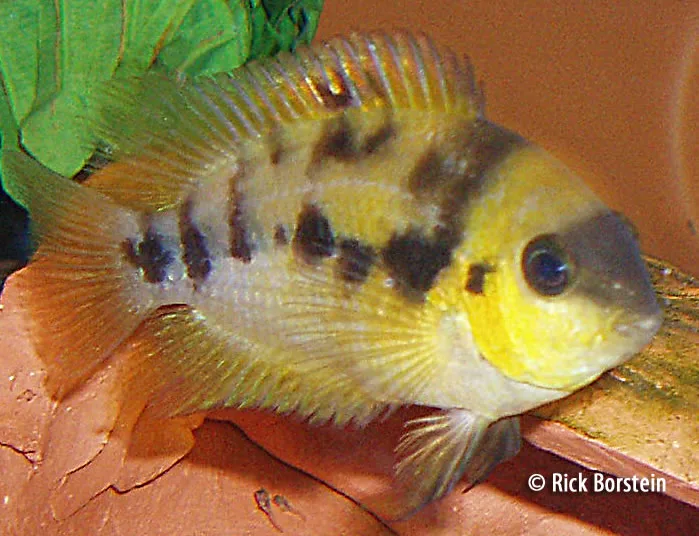
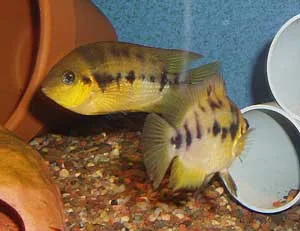
Amatitlania nanolutea is a genuinely small cichlid, reaching only about 2.5 in in standard length (FishBase) and ranking among the smaller members of the convict group. The body is the compact convict oval — grey to bluish above, washed with yellow on the lower flanks and belly. That yellow is strongest in ripe fish and is the source of the epithet. Faint dark vertical bars cross the flank and shift with mood, and the fins carry a soft blue or violet sheen with pale or yellowish margins in conditioned fish. Dimorphism follows the usual small-convict pattern: males grow somewhat larger, with longer, more pointed dorsal- and anal-fin tips, while females are smaller and rounder and often show the cleanest yellow when in breeding condition. Much of the documented biology rests on aquarium observation and the brief original description, so finer morphological detail is limited — and where the literature is silent, this article says so rather than embellishing.
Habitat
The species is known from the Atlantic (Caribbean) slope of western Panama, in the Río Guarumo basin and neighbouring drainages of Bocas del Toro; FishBase places it broadly on the Atlantic slope within the Guarumo system. These are warm, clear to slightly stained lowland rivers and creeks of moderate to slow current, running over sand, gravel and leaf litter with plenty of submerged wood and rock — cover, and ready-made spawning cavities, in one. FishBase treats it as a benthopelagic tropical freshwater fish. Precise temperature and pH ranges for the wild fish are not well published, but the lowland Caribbean-Panama setting points to warm, near-neutral to mildly acidic water typical of the region. Its range falls within the Atlantic-slope fauna of lower Central America — broadly the Chiriquí, or Caribbean-Panama, freshwater province.
Feeding
Amatitlania nanolutea is a small benthic omnivore, in the manner of its dwarf-convict relatives. It forages over and through the bottom for small invertebrates and insect larvae and grazes the algae, fine plant matter and detritus that coat stones, wood and the substrate. No published stomach-contents study exists for the wild fish, so the picture comes from the genus and from aquarium experience rather than from analysis — an adaptable gleaner, not a predator or a specialist. In the tank it takes prepared and live foods readily, as the omnivory of the group would suggest.
Mating
The yellow convict is a monogamous, biparental, pair-bonding cave-spawner, and — like the other dwarf convicts — it is fairly peaceable away from the nest. A male and female pair off and together choose and defend a cavity: a crevice among stones, a hollow under wood, or, in the aquarium, a cave or pipe. Courtship runs the standard cichlid sequence of lateral display, fin-spreading and shared cleaning of the spawning site, with the female's deepening yellow signalling readiness. Aggression sharpens around the chosen cave during breeding, but for so small a fish the territorial demands stay modest next to those of the larger Central American cichlids.
Breeding
Amatitlania nanolutea is a biparental cave-spawner that has been bred in the hobby. The adhesive eggs are laid on the inner wall or roof of the chosen cavity and tended chiefly by the female, who fans and mouths the clutch while the male holds the territory. Given the fish's very small size, broods are small — on the order of a few dozen to around a hundred eggs — and published fecundity is scant, so treat that figure as an order of magnitude, not a hard count. The eggs hatch within a few days at warm temperatures; the wrigglers are moved to pits, and once free-swimming the fry are led and guarded as a school by both parents. Care is extended and attentive, the hallmark of the convict group, and a settled pair will spawn repeatedly.
In the aquarium
The yellow convict is a niche but rewarding fish for keepers of small Central Americans, valued for its dwarf size and its full pair-bonding, cave-spawning behaviour in a tank far smaller than the bigger cichlids demand.
Tank: a pair can be kept and bred in as little as 15–25 US gal, larger in a community. Decor should mirror the home stream — a soft substrate of sand and fine gravel, rounded stones and bogwood arranged into caves and broken sight-lines, leaf litter, and one or more dedicated spawning caves such as an inverted flowerpot or short pipe. Hardy plants generally survive a pair's modest digging.
Water: track warm, near-neutral to mildly acidic Caribbean-Panama lowland streams — temperature around 75–82 °F and pH roughly 6.5–7.5, with moderate hardness, good filtration and regular water changes.
Feeding: easy. A small omnivore takes quality flake and small sinking pellets, with frozen and live invertebrates (daphnia, brine shrimp, small bloodworm) and a little vegetable matter to condition breeders.
Tankmates: keep it with calm, similarly small fish. This is a species that larger, pushier cichlids can bully, so a dedicated species tank or gentle dither fish suits it best. And as with all convicts, give a breeding pair its own room — even a dwarf will defend its fry.
Conservation
The IUCN Red List assesses Amatitlania nanolutea as Data Deficient (assessed 1 August 2019). That category reflects how little is firmly documented about the species' true range, population and trend — not a judgement that it is secure. This is a small, narrowly recorded fish from a handful of western-Panama drainages, exposed to the usual lower-Central-American pressures — deforestation and sedimentation, agricultural and plantation runoff, pollution, and introduced species — acting on its habitat with no clear measure of their effect. No firm population data are published, and that uncertainty is exactly what the listing records. The species carries no CITES listing. Because it is bred in the hobby, the aquarium population is secure even while the wild status stays unresolved.