Taxonomy & naming
Albert Günther described this fish as Heros nigrofasciatus in 1867 (in the 1866 Proceedings of the Zoological Society of London), from specimens that Salvin, Godman, and Captain J. M. Dow collected in Central America. The type locality is Lake Amatitlán, Guatemala — a name later borrowed for the whole genus. The species epithet is plain Latin: nigro- ("black") plus fasciatus ("banded"), for the deep vertical bars that generations of aquarists have read as a prison uniform, hence "convict."
Few aquarium fish have worn so many genus labels. Over more than a century and a half the species has been shuffled through Cichlasoma, Cryptoheros, and Archocentrus, and older hobby literature still lists it as Cichlasoma nigrofasciatum or Archocentrus nigrofasciatus. The current placement dates to 2007, when Juan Jacobo Schmitter-Soto revised Archocentrus (Zootaxa 1603) and erected the genus Amatitlania for the convict and its allies — the name meaning, roughly, "belonging to Amatitlán," the Nahuatl place-name glossed as "a place abundant in amate," a bark paper made from wild figs.
That revision also lit a taxonomic fuse that still smolders. Schmitter-Soto split several populations long lumped under nigrofasciata into new species, among them Amatitlania siquia (the Nicaraguan and Costa Rican populations) and Amatitlania coatepeque (endemic to Lake Coatepeque, El Salvador). Eschmeyer's Catalog of Fishes and FishBase follow the split, restricting true Amatitlania nigrofasciata to the Pacific and Atlantic slopes of Guatemala, El Salvador, and Honduras. Others disagree: McMahan et al. (2014) re-synonymized Amatitlania coatepeque, and Juan Miguel Artigas Azas (Cichlid News, 2021; Cichlid Room Companion) argues that Amatitlania siquia is not distinct either, which would return the convict to a single, wide-ranging species. Molecular work has not settled it — Bagley et al. found the genetic divergence among these forms may be too shallow to justify three species, a point both the U.S. Fish & Wildlife screening summary and the IUCN assessment flag. The honest summary: the name on the tank label is secure, but the boundaries within the genus are not.
Morphology
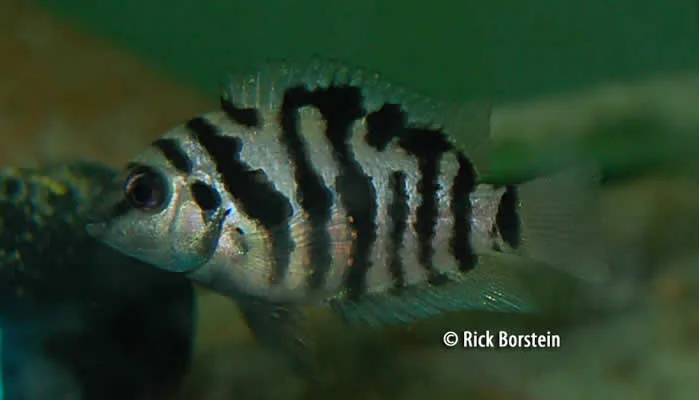
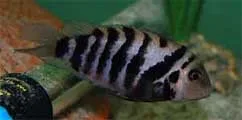
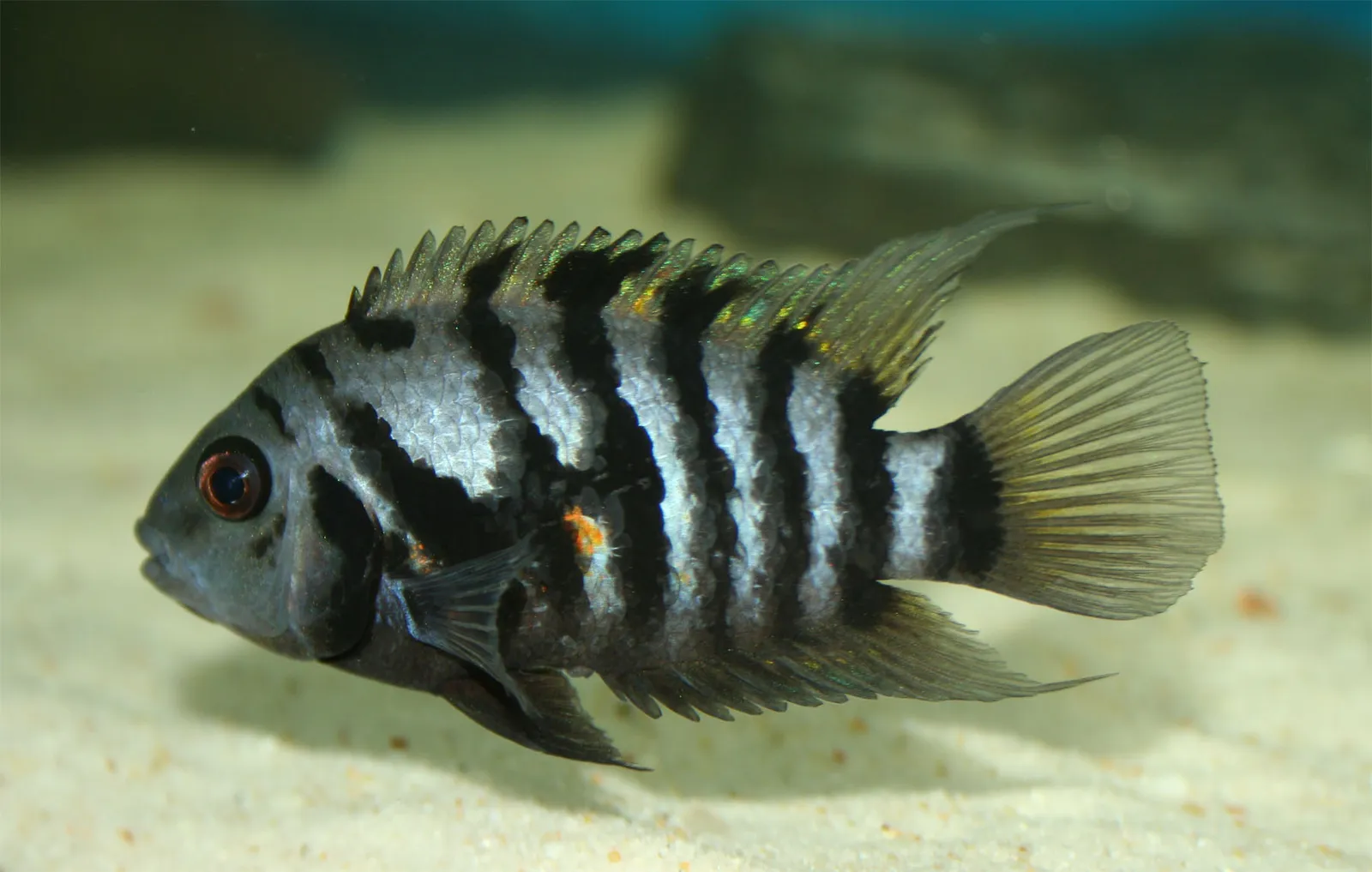
This is a stocky, oval, laterally compressed cichlid that stays small by cichlid standards. FishBase lists a maximum of about 4 in standard length (Kullander 2003), with most wild fish smaller; aquarium references stretch the range to roughly 3–6 in total length, the larger figures coming from well-fed tank males. The ground colour is pale blue-grey to tan, crossed by eight or nine dark vertical bars — Günther's namesake "black bands" — that run up onto the back and may extend onto the dorsal fin. The bars shift with mood and lighting, fading to faint blotches or flushing inky black, and one of the front bars is often Y-shaped; a dark spot marks the gill cover.
Sexing adults is straightforward, which is part of why the fish breeds so reliably in captivity. Males grow larger, develop longer, more pointed dorsal and anal fins with age, and sometimes a modest nuchal hump on the forehead. Females are smaller and, in a reversal of the usual pattern, the more colourful sex: a ripe female shows an orange-to-gold wash on the belly and lower flanks and usually a glittering dark blotch in the dorsal fin that males lack. Schmitter-Soto's diagnosis separates true nigrofasciata from its relatives on fine technical characters — two distal rows of interradial scales on the anal fin (versus one), a uniformly dark peritoneum, and details of the gill and jaw bones — but the later synonymizing of Amatitlania coatepeque undercut that very scale-row character, part of why the split stays contested. The hobby's fancy strains — pink (xanthic) convicts, marbled, white, and long-finned forms — are all artificial and do not occur in the wild.
Habitat
In the traditional, broad sense — the way the fish is still understood in the hobby and in much older literature — the convict ranges across Central America from Guatemala south to Panama, taking in the great Nicaraguan lakes (Lake Nicaragua / Cocibolca and Lake Managua / Xolotlán) and the rivers of Costa Rica. That is the fish most aquarists picture when they say "convict," and it is the basis for its famous Nicaraguan association. Under the post-2007 taxonomy, though, that broad range is carved up: FishBase and the Catalog of Fishes place true Amatitlania nigrofasciata only on the Pacific slope from the Río Sucio (El Salvador) to the Río Suchiate (Guatemala) and on the Atlantic slope from the Río Patuca (Honduras) to the Río Jutiapa (Guatemala). The Nicaraguan and Costa Rican populations — including those in Lakes Nicaragua and Managua — are, in that scheme, assigned to Amatitlania siquia, whose type locality is the Río Siquia near Rama, Nicaragua. Which name the Nicaraguan convict carries depends entirely on whose taxonomy you accept; the fish in those lakes is real and abundant either way.
The habitat itself is consistent across the whole complex, and it is not a deep-lake or open-water fish. Convicts are creatures of structured shallows — the rocky margins, gravelly runs, and slow pools of small creeks, larger rivers, and the littoral edges of lakes, from sea level up to around 2,297 ft. They are almost never found in open water, sheltering instead among rocks, roots, leaf litter, and debris, where the cracks and crevices double as feeding ground and spawning caves. The genus tolerates a wide thermal band — FishBase records roughly 68–97 °F in the wild — and hard, alkaline water (pH around 7–8, dH 9–20). That catholic tolerance is exactly why the fish travels so well: convicts have founded feral, breeding populations far outside their range, including warm springs and power-plant outflows in the western United States (Idaho, Nevada, Hawaii, California), and sites in Mexico, Australia, and Southeast Asia.
Feeding
The convict is a small, opportunistic omnivore, and its success rests on not being fussy. FishBase places it at a trophic level near 3.3 and records a diet of worms, crustaceans, aquatic insects and their larvae, small fish, and plant matter, taken by picking through the substrate and grazing the algal and detrital film (aufwuchs) on rocks. In its native streams it is a mid-level generalist rather than a specialist, as much at home rooting in gravel as rasping algae.
That flexibility makes it a heavyweight competitor where it has been introduced. Studies of feral Mexican populations document broad dietary overlap with native fishes and suggest the convict can displace them when food is short — Trujillo-Jiménez and others have implicated it in competition with sympatric native cichlids and minnows, and in Hawaiian streams native aquatic species are reported to be scarce where convicts have taken hold. A fish this adaptable, this prolific, and this aggressive over territory is a textbook invader: low fishing value, high ecological footprint. In its home range it occupies the productive shallows alongside other Central American cichlids, with larger predatory cichlids and birds taking the toll that its formidable parental care evolved to resist.
Mating
Mating is where the convict stops being an ordinary little fish and becomes a research subject. It is one of ichthyology's classic models of monogamous, biparental care: a male and female form a pair bond, claim and clear a territory around a cave or crevice, and settle into a rigid division of labour that scientists have probed for half a century. Pair formation is usually fast — in close quarters a male and female placed together often bond within days — but it is not guaranteed, and a mismatched, over-eager male can harass or kill a female he has been forced upon, which is why breeders prefer to raise a group of six juveniles and let a pair self-select.
Once a territory is established, the sexes calibrate their roles to the threat around them: the female stays close to the cave while the male patrols the perimeter and drives off intruders many times his size. Because both parents invest so heavily, the convict — or, under the newer taxonomy, its sibling Amatitlania siquia — became a model organism for testing ideas about parental investment, brood defence, mate desertion, and territoriality. Brian Wisenden's field work in Costa Rican streams is foundational here, showing how a pair reads predation risk and adjusts its defence accordingly, even continuing to guard a nest after the brood has been wiped out. Outside of breeding the convict is merely feisty and territorial year-round; in the run-up to spawning it turns genuinely dangerous to anything sharing its water, a stray finger included.
Breeding
The convict is a monogamous, biparental substrate spawner, and it is so willing that it will breed for a beginner who does almost nothing right. After a pair clears a site, the female lays a clutch — usually cited at roughly 100–300 eggs, with field counts often nearer 100–150 — on a cleaned hard surface inside a cave or crevice. Dark, single-entrance cavities (an overturned flowerpot serves perfectly in a tank) are preferred, because they hide the brood from visual predators and are easier for the female to defend. The eggs hatch in three to four days; the parents then fan the embryos and repeatedly shuttle the wrigglers between freshly dug pits in the substrate — "huddling" — until they go free-swimming, after which the school of fry trails both parents for weeks, the female shepherding while the male holds the perimeter.
Few aquarium fish are this prolific: a settled pair produces a new brood roughly every few weeks, and the fry are notoriously hard to rehome — many shops won't take them. (Dropping the temperature toward 75 °F is the usual trick keepers use to slow a pair down.) Water chemistry barely affects the outcome — broadly pH 6.5–8.0 and about 75–82 °F is ideal, and the fish will spawn well outside that — which, together with the certainty of the pair bond, is exactly why this species became the workhorse of biparental-care research. The same prolificacy and brutal nest defence that delight a first-time breeder are what make the convict a problem where it escapes: a single pair can found a feral population.
In the aquarium
The convict occupies a peculiar position in the hobby: it is at once one of the easiest fish anyone can keep and one of the most likely to wreck a community tank. Getting it right means respecting both sides of that character.
Tank: Seriously Fish recommends a minimum base footprint of 90 × 12 in (about 20 US gallons) for a single breeding pair, though a modest stretch to 100 × 15.5 in is more comfortable and holds water quality more easily. Two pairs, or convicts mixed with other robust cichlids, need something far bigger — 59–71 in becomes the working minimum once territory disputes are factored in. Use fine-to-medium gravel or sand; these determined diggers excavate around plant roots, so anchor plants in heavy pots or skip them for java fern and anubias tied to rock. Rock stacks, clay flower pots on their sides, slate caves, and bogwood all provide shelter, sight-breaks, and the enclosed single-entrance cavities a pair will want as a spawning site.
Water: this is one of the most forgiving of cichlids. The wild figures (pH 7–8, hardness about 9–20 dH, temperature 68–97 °F) translate to an aquarium sweet spot of pH 6.5–8.0 and 75–82 °F, with breeding at the edges of that range. Stability and cleanliness matter more than any single number: like other Central American cichlids they are prone to hole-in-the-head (HLLE) when water quality slips, a risk that climbs with a prolific pair fouling a modest tank. Weekly changes of 25–30 % — up to 50 % when conditioning a pair — are the simplest guard.
Feeding: no difficulty. A quality cichlid pellet as the staple, plus frozen or live bloodworm, brine shrimp, and Mysis shrimp, keeps them in fine condition; they will also graze algae and pick detritus.
Tankmates: honestly, the convict is a poor community fish, and shops mislead when they sell it as one. It is territorial even outside breeding and flat-out dangerous during it, to fish several times its size. A single pair in its own tank is trouble-free; a mixed tank invites injuries and deaths. The one workable exception is a large aquarium (71 in or more) of similarly robust Central American cichlids — firemouth, Jack Dempseys, salvini — with enough rock and visual barriers for each to hold a separate territory. Small or timid fish, and anything added at spawning time, will suffer.
Breeding: this is the standard first biparental cichlid to breed. A male and female usually pair within days; if compatibility is uncertain, raise six juveniles and let a pair self-select to avoid forced-pairing injuries. Once paired, remove other tankmates — the male will not tolerate them. Feed the fry brine shrimp nauplii at first, then micro-pellets and crushed flake. A settled pair spawns every few weeks if the fry are pulled promptly; nudging the temperature toward 75 °F slows production without breaking the pair bond.
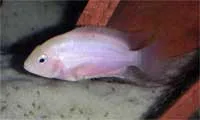
Colour forms: several artificial strains exist. Best known is the pink or white convict — the "Kongo" or leucistic form — a xanthic mutation that reduces or erases the grey ground and dark bars, leaving a peach-to-pale-pink fish, the ripe female a striking salmon-orange. Long-finned and marbled varieties also circulate. None occur in the wild.
Responsibility: because the convict breeds so readily and the fry are hard to rehome — many shops will not take them at any price — overproduction is a predictable problem; plan for it before pairing a fish. Never release surplus into local waterways: the convict is a documented invader across the southern United States, Hawaii, Australia, and parts of Asia, and some U.S. states already regulate possession. Humanely euthanising surplus fish is the responsible alternative to release.
Conservation
Under the name Amatitlania nigrofasciata, the IUCN Red List assessed the species as Data Deficient (Matamoros, Lyons & Angulo; assessed 5 June 2019, published 2020). That status reflects the muddled taxonomy more than the fish's abundance — it is common, and in places superabundant — because until the field agrees on what counts as Amatitlania nigrofasciata versus Amatitlania siquia or Amatitlania coatepeque, the very range and population being assessed are uncertain. The Nicaraguan–Costa Rican segregate Amatitlania siquia was likewise rated Data Deficient, its population trend listed as stable. By any reading, this is not a fish in danger.
The convict's real conservation story runs the other way: it is far more often a threat than a victim. As one of the world's most widely traded aquarium fish, it has escaped and established feral, breeding populations across the southern and western United States, Mexico, and parts of Asia and Australia, where its toughness, broad diet, and brutal nest defence let it out-compete native fishes — the U.S. Fish & Wildlife Service rates its overall invasion risk as High. Within its native Central American streams and the Nicaraguan great lakes, the wider pressures are the familiar ones — pollution and nutrient loading, agricultural runoff, and the spread of introduced tilapia that crowd native cichlid communities — but the convict, hardy and adaptable, is among the last natives those pressures would erase. The fair summary is unusual for a species article: the concern here is less for the convict than from it.