Taxonomy & naming
Juan Jacobo Schmitter-Soto described Amatitlania siquia in 2007 in his revision of the genus Archocentrus (Zootaxa 1603) — the same monograph that erected the genus Amatitlania for the convict cichlid and its allies and split several long-lumped populations into new species. The holotype (UMMZ 245585) is a fish from a forest stream flowing into the Río Siquia, about seven miles above Rama on the Atlantic slope of Nicaragua, with paratypes spread across museums in Michigan, Philadelphia, London, Chicago, and Geneva and drawn from both Nicaragua and Costa Rica. Schmitter-Soto separated siquia from its congeners on a suite of fine characters: a relatively deep body, a simple gut folded ventrorostrally with the anal and medial loops not touching, a peritoneum pigmented only toward the front, and — most usefully in the hand — a caudal blotch that sits about two-thirds on the tail base (peduncle) and one-third on the fin itself, rather than wholly on the fin.
The split redrew the convict's geography. Populations from Nicaragua and Costa Rica that had for a century been called Cichlasoma nigrofasciatum, then Archocentrus nigrofasciatus — including the fish of Lakes Nicaragua and Managua — became Amatitlania siquia, while true Amatitlania nigrofasciata was restricted northward to Guatemala, El Salvador, and Honduras. Eschmeyer's Catalog of Fishes and FishBase both follow this arrangement and list siquia as valid.
Not everyone is convinced. Bagley and colleagues (2016), in a phylogeography and species-delimitation study of the whole convict complex, found the genetic divergence between siquia and nigrofasciata too shallow to clearly support two species — a result that, as several authors note, effectively makes siquia a junior synonym of nigrofasciata, though the paper stopped short of declaring it so. Juan Miguel Artigas Azas (2021), writing in Cichlid News and on the Cichlid Room Companion, took the next step and treated Amatitlania siquia as a synonym of Amatitlania nigrofasciata outright. The Catalog of Fishes records the disagreement directly, listing both the 'valid' usages and Artigas Azas's synonymy. The honest summary is the one the IUCN assessors reached: under its current concept siquia is a real, mappable population, but whether it deserves a species name of its own is genuinely unsettled, and further molecular work may either split it further or fold it back into the convict.
Morphology
This is a small, deep-bodied, laterally compressed cichlid — a convict in every visible respect. Schmitter-Soto's largest examined specimen measured 3 in (about 3 in) standard length, the figure FishBase carries as the maximum; the IUCN assessment cites a slightly larger maximum of about 4.5 in SL from regional workers, so most fish in hand fall in the roughly 3–4.5 in range, with aquarium males running to the upper end. Body depth is high — on the order of half the standard length. The fin counts are diagnostic of the complex: 17–18 dorsal spines and 8–10 soft rays, 9–10 anal spines and 7–8 soft rays, and 26–27 vertebrae. In larger fish the gill rakers on the first arch are often bifid or at least distally expanded, and the trailing filamentous dorsal rays can reach back over the caudal fin.
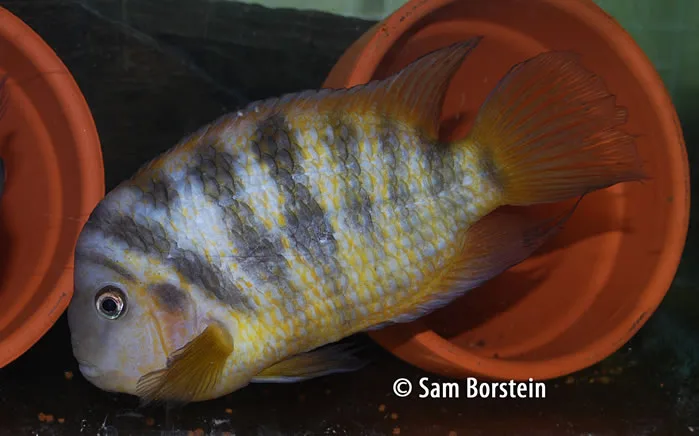
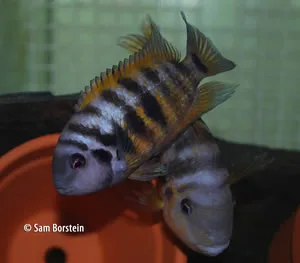
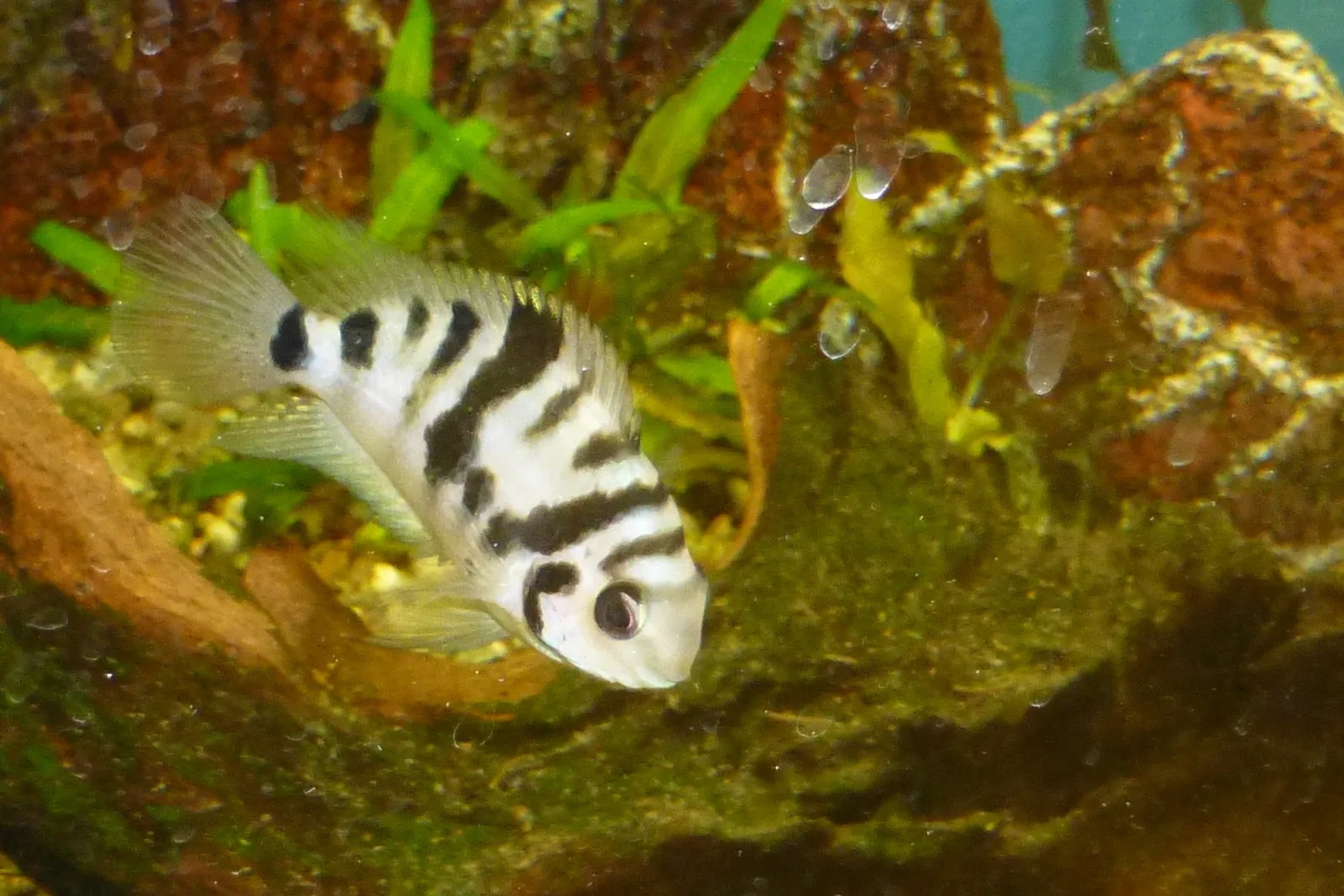
The colour is the classic convict scheme: a pale grey to olive-tan ground crossed by dark vertical bars that, in this species, tend to break up and fade toward the belly more than in its relatives, with one of the front bars characteristically I-shaped. A dark spot marks the upper part of the pectoral-fin base, the base of the pectoral itself is conspicuously white, and the caudal blotch straddles the peduncle and tail. Sexual dimorphism is marked, and it is part of what made the convict such a convenient laboratory animal. Males grow larger and longer-finned; females are smaller but, paradoxically, the showier sex when breeding. Wild females studied in Costa Rica develop a striking high-contrast black-and-white barring while guarding young, plus a separate gravid 'black phase' in which the body darkens to set off gold flecks on the swollen belly (possible egg mimics), yellow pigment in the dorsal-fin webbing, and blue in the throat — an advertising, aposematic livery rather than camouflage.
Habitat
Amatitlania siquia occupies the southern arc of the convict's old range. The Catalog of Fishes gives its distribution as Central America on both coasts of Costa Rica and from Nicaragua north to Honduras; the IUCN assessment maps it more precisely from eastern Honduras (the Coco and Patuca drainages on the Atlantic slope) through Nicaragua — including the great lakes Nicaragua/Cocibolca and Managua/Xolotlán and crater lakes such as Laguna de Xiloá — to central Costa Rica, where it spans Atlantic drainages (Frío, San Juan, San Carlos, Sarapiquí, Tortuguero, Parismina, Matina) and Pacific ones (Nicoya, Tempisque, Bebedero, Barranca, Tárcoles). The estimated extent of occurrence is about 53,153 mi², and the species ranges from sea level to roughly 1,772–2,329 ft elevation.
This is a fish of structured, flowing shallows rather than open water. It lives in everything from small creeks to the margins of large, fast rivers, plus the shallows of lakes and the warm pools of springs and their outflows, always favouring rocky and sandy bottoms strewn with tree branches, roots, leaf litter, and debris — the cracks and crevices that serve at once as cover, feeding ground, and spawning caves. The genus tolerates a broad thermal band, with field reports of about 68–97 °F in occupied pools, and the water chemistry is typically near-neutral to alkaline; in-situ measurements at Costa Rican convict habitats span roughly pH 6.6–7.8. Tellingly, Amatitlania siquia persists even in heavily disturbed water, including urban streams in metropolitan San José — the mark of a resilient habitat generalist.
Feeding
The convict is a small, opportunistic omnivore, and siquia is no exception. FishBase places it low on the food web at an estimated trophic level near 2.3, and the wild diet is reported as worms, crustaceans, aquatic insects and their larvae, small fishes, and plant matter, taken by picking and grazing over the substrate. In foraging-mechanics studies it ranks among the cichlids that do some sediment sifting, but it is a generalist rather than a specialist sand-sifter. In the low-order forest streams of Guanacaste, Costa Rica, free-swimming young forage across the stream bottom by day, working the substrate film and interstitial fauna under the close guard of their parents — a reminder that for this fish, feeding and brood defence happen in the same few square metres of streambed. That catholic diet is exactly the trait that lets convicts thrive across such varied waters and, where the broader complex has been introduced elsewhere, compete hard with native fishes.
Mating
Few wild cichlids have had their mating system mapped as thoroughly as this one, thanks to some thirty years of fieldwork by Brian Wisenden and collaborators on populations in the Río Cabuyo system of Lomas Barbudal, Costa Rica, and in Laguna de Xiloá, Nicaragua — work carried out on fish now classified as Amatitlania siquia. Convicts form monogamous pair bonds and practise size-assortative mating: larger males monopolize spawning lairs and pair with larger, more fecund females, and within every pair the male is the bigger fish. The bond is social rather than genetic — DNA work has revealed mixed maternity, mixed paternity, and a 'sneaker' male tactic in the Xiloá lake population.
Courtship is bound up with the spawning cavity. A male often already holds a lair from a previous brood, and gravid 'black-phase' females actively court such paired males and fight other females for access to them. Once formed, a pair holds two territories at once: a fixed one around the spawning lair and a mobile one that travels with the free-swimming brood. The division of labour reads like a textbook of behavioural ecology — the female stays with the eggs and young while the male makes regular sorties, roughly once every ten minutes, back to the lair to drive off conspecifics looking to take it over. A male can spawn up to four times in a single five-month dry season, usually reusing the same lair with successive females, whereas most females spawn only once.
Breeding
Amatitlania siquia is a biparental substrate spawner with prolonged, cooperative care of free-swimming young — the trait that made the convict a model organism. The female glues a clutch of roughly 100–150 eggs to the cleaned ceiling of a dark cavity (a rock crevice, a hollow under a branch, or in aquaria an inverted flowerpot), where the male fertilizes them; dark, concealed nest sites are strongly preferred because they hide the brood from visual predators. The female does most of the direct tending and fanning while the male patrols outside. After a few days the eggs hatch into yolk-bearing 'wrigglers' that heap on the lair floor, and the parents shuttle them between freshly dug pits until, days later, the young absorb their yolk and become free-swimming.
In Costa Rican streams the fry emerge from the lair at about 0.5 in standard length and stay under parental protection until roughly 0.5 in SL — a span of four to six weeks depending on growth rate. The guarded brood forms a low disc on the streambed by day and retreats into the lair each night to escape nocturnal predators such as the catfish Rhamdia. Parents calibrate their defence to the threat: they all but ignore harmless poeciliids, nudge schooling characins aside, and reserve their fiercest, longest-range attacks for the predators that actually eat fry, especially juveniles of the piscivore Parachromis dovii. Even so, predation takes a heavy toll — only a minority of broods survive to independence, and successful broods converge on an average of about 27 surviving young regardless of how many eggs were laid. The same studies documented intraspecific brood adoption: parents accept smaller, unrelated young into the brood, a benefit because the smaller adoptees are eaten preferentially and so dilute the predation risk to the parents' own offspring. Wisenden's celebrated 'empty nest' experiment even showed pairs continuing to defend a territory after their entire brood had been lost. Where conditions allow, a population may spawn one or two times a year, and up to six under favourable conditions.
In the aquarium
Sold into the hobby for decades under the name 'convict cichlid' — usually alongside or instead of Amatitlania nigrofasciata — Amatitlania siquia is treated as interchangeable with it in practice, and all husbandry guidance written for the convict applies without qualification. It is one of the hardiest, most adaptable, and most easily bred cichlids available: a genuine beginner species for anyone who can accommodate its temperament.
Tank: a bonded pair fits a footprint of about 90 × 12 in (roughly 20 US gal), though a pair in breeding condition will claim every centimetre and menace anything that approaches. For multiple pairs, added cichlids, or a calmer setup between spawnings, give 47 in or more. Furnish with a generous layer of sand or fine gravel (the fish dig constantly), flat rocks, stacked limestone or slate, roots, and bogwood arranged into distinct crevices and shadowed corners. An inverted clay flowerpot, a ceramic cave, or a smooth flat stone propped against the back glass all make acceptable spawning sites — the fish will pick and clean one themselves. Plants can be included but expect them to be uprooted once a pair excavates; robust, fast-rooting or floating species fare better than carefully anchored specimens.
Water: a temperature of 75–82 °F, a pH on the neutral to mildly alkaline side (7.0–7.8 is ideal, though the fish tolerates 6.6–8.0), and moderately hard water suit both aquarium and natural conditions. Tap water in most cities falls squarely in this range, part of why the convict complex became so ubiquitous. Large partial water changes — up to 50 % weekly — maintain quality and often trigger a new spawning cycle.
Diet: completely undemanding. Quality cichlid pellets or flake as a staple, supplemented with frozen or live invertebrates (bloodworm, brine shrimp, daphnia), is more than enough, and the fish also graze algae and detritus off substrate and glass.
Tankmates: the central challenge is not keeping this fish alive but keeping the peace. A breeding pair is among the most aggressive small cichlids in the freshwater hobby — it will charge, nip, and pin fish considerably larger than itself, relentlessly, for weeks. In any tank short of 59 in, keep them as a species pair on their own or with a few robust dither fish large enough to shrug off a charge (larger barbs or fast characins can work in a spacious tank). In a very large aquarium — 71 in or more — they can coexist with other robust Central American cichlids if enough structure breaks sight lines. The male also turns on the female between spawnings, so give her bolt-holes and watch for sustained bullying.
Breeding: almost no intervention needed. A male and female in a prepared tank usually pair and spawn within days to weeks; alternatively, grow on six to eight juveniles, let a pair form naturally, and remove the surplus. The female selects and cleans a cave ceiling, lays 100–200 adhesive eggs, and the male fertilizes them; both then guard with conspicuous intensity. Eggs hatch in three to four days, wrigglers are moved to substrate pits, and free-swimming fry appear a further four to seven days later. Start the young on newly hatched brine shrimp nauplii, graduating to finely crushed flake and micro-pellet; parental care continues for several weeks. A pair will spawn again within weeks of the fry becoming independent, so overpopulation is a real concern — dealers rarely take convict fry, which are among the most oversupplied fish in the trade.
Difficulty is fairly rated easy to beginner: the species is resilient and disease-resistant and demands no special water, live foods, or elevated temperatures. Its virtues as a first cichlid are its near-guaranteed breeding and its highly readable, sustained biparental care — the very behaviours that made wild populations worth three decades of study.
Conservation
The IUCN Red List assesses Amatitlania siquia as Data Deficient (Lyons, Matamoros & Angulo; assessed 7 November 2019, published 2020). The category reflects taxonomy more than scarcity: under its current concept the species is widely distributed across the Atlantic slope of Honduras, Nicaragua, and Costa Rica plus the Pacific slope of Costa Rica, with a population suspected to exceed 10,000 individuals, a stable trend, and no evidence of range-wide decline — but because the validity of the species itself is uncertain, the assessors judged the data insufficient for a threat-based category. It carries no CITES listing. The fish is taken in subsistence and artisanal fisheries and is common in the ornamental trade, though the wild-harvest volume is unknown and its fishing vulnerability is rated low.
The pressures on its habitat are the familiar ones for lowland Central American streams: deforestation, sewage discharge, and agricultural runoff — particularly the herbicides, pesticides, and nutrient loads from the expanding pineapple and banana plantations of Costa Rica's northern Caribbean lowlands — all of which degrade water quality. A more singular concern is the proposed Nicaragua Canal, which Härer and colleagues warned could damage habitat and erode genetic diversity across the species' Nicaraguan core. Against all of this, Amatitlania siquia is conspicuously tough, persisting in highly disturbed and even urban streams — which is exactly why none of these pressures is documented as a present threat to its overall numbers. As with its convict relatives, the story here is less about a fish in danger than about an adaptable survivor whose taxonomy outpaces our certainty about it.