Taxonomy & naming
The redhump eartheater has one of the most tangled nomenclatural histories of any popular cichlid, and untangling it took the better part of a century. The fish was first reported by Franz Steindachner in 1880, who examined material from the Río Cauca in Colombia and identified it — wrongly — as Geophagus brasiliensis, the well-known Brazilian eartheater. Carl H. Eigenmann recognized that the Cauca fish was distinct, and the name Geophagus steindachneri (honoring Steindachner) first appeared, without description, in his 1909 zoogeographic survey. It was given an indication the following year, in Eigenmann's 1910 catalogue of South American freshwater fishes, where it was tied to Steindachner's earlier description; Eigenmann figured and discussed it more fully in his 1922 monograph. Independently, Charles Tate Regan described the same fish as Geophagus hondae in 1912 from Honda, Colombia, and W.L. Brind later coined Geophagus magdalenae (1943) for an aquarium-bred population that had, after years of captive husbandry, drifted subtly enough in body form from wild fish that Brind took it for a distinct species. The hobby reintroduced the fish in the 1970s, when Paul V. Loiselle (1974) cut through the confusion and concluded the "red hump Geophagus" was Eigenmann's steindachneri; Jean-Pierre Gosse's 1976 revision then briefly demoted the name to a synonym of Geophagus hondae, treating Eigenmann's earlier usages as nomina nuda. The matter was settled by Gosse & Kullander (1981), who showed that the 1910 citation was a valid indication and that Geophagus steindachneri Eigenmann & Hildebrand, 1910 is the available, priority name, with Geophagus hondae and Geophagus magdalenae as junior synonyms. The Catalog of Fishes follows this, listing the species as valid with the type locality Río Cauca near Cáceres, Colombia, and the holotype in the Naturhistorisches Museum Wien (NMW 23289-90); FishBase and ETYFish cite the authorship as 1922, reflecting the later detailed description. Within the geophagine eartheaters, steindachneri anchors a small radiation of trans-Andean mouthbrooders — the "redhump" or steindachneri group, also containing Geophagus crassilabris and Geophagus pellegrini — that Kullander's work has treated as distinct from the surinamensis-type Geophagus and from the brasiliensis complex (now usually placed in Geophagus sensu lato or Gymnogeophagus).
Morphology
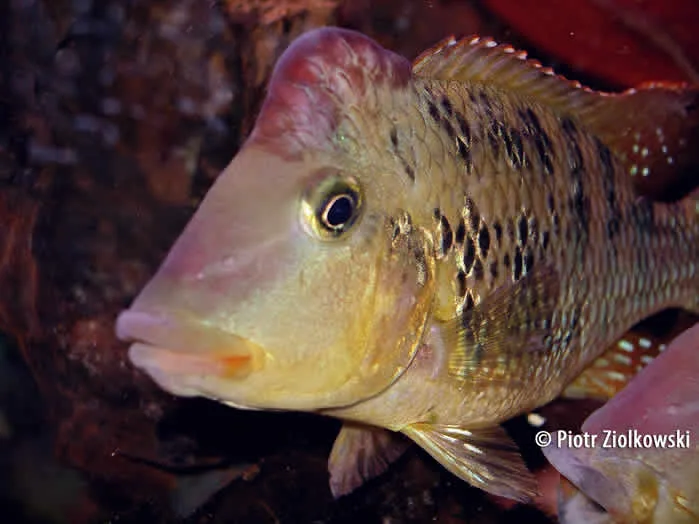
Geophagus steindachneri is a moderately deep-bodied, fusiform eartheater with the steep forehead and underslung, protrusible mouth typical of the substrate-sifting geophagines. FishBase records a maximum of 8 in total length, but wild fish are considerably smaller: Lee Newman's long-term observations put adult males at about 5.5 in standard length and females at only about 4 in, and the survey of 158 specimens by Taphorn & Lilyestrom (1979) found the largest at 5.5 in TL — far short of the anomalous 8 in holotype, a size discrepancy Gosse & Kullander flagged as worth further study. Body color is a warm tan to olive-bronze, frequently washed with iridescent green or gold and marked by a single dark midlateral blotch on each flank; faint vertical bars and a dark cheek bar may show, especially in stressed or displaying fish. The diagnostic feature, and the source of the common name, is the swollen nuchal hump that mature males develop above and behind the eyes — a fatty, often brilliantly red or orange-red boss that is absent in females and small in immature males. Newman notes that males are not only larger but markedly more colorful than the comparatively plain females. The species is separated from the superficially similar acaras (Aequidens) by two geophagine traits: a lobe on the first gill arch used in sifting, and, in males, that head protuberance.
Habitat
Unlike the great majority of Geophagus, this is not an Amazonian fish. Its verified range lies in the trans-Andean drainages of northern South America: the Magdalena, Cauca and Sinú river systems of Colombia, and the Limón River and other tributaries of the Lake Maracaibo basin straddling the Colombia–Venezuela border. An old report from the Río Tumbes of Peru — sometimes cited as evidence of an Amazonian or Pacific-slope occurrence — was shown by Gosse & Kullander (1981) to rest on a misread record and a poor, unidentifiable photograph, and there is no confirmed population in the Amazon basin. The redhump lives in the slower stretches, pools and margins of these warm lowland rivers and their tributaries, working sandy and fine-sediment bottoms. The water it inhabits is, on average, harder and closer to neutral than the soft blackwater of the Amazon eartheaters, and there is a geological reason for that: the Magdalena valley is a comparatively young rift-like depression, hemmed in by the northern Andean cordilleras, and its geologically recent origin leaves the drainage's water more mineral-rich than the ancient, leached Amazon basin — hardness in the Magdalena system can run up to about 10° dGH with pH sitting in the neutral zone. FishBase gives a preferred pH of about 6.5–7.0 and a hardness range of roughly 5–15 dH, with temperatures around 75–79 °F, and the species is well known for tolerating a wider chemical envelope than its Amazonian relatives. Published depth data are lacking for this shallow riverine fish; it is best regarded as an inhabitant of the upper few metres of the water column over open bottom rather than a deep-water species.
Feeding
The redhump eartheater feeds exactly as its genus name promises — it is a sand-sifter. The fish takes mouthfuls of sand and fine sediment, sorts edible items from grit in the buccal and pharyngeal cavities, and expels the cleaned substrate through the gill covers and mouth, the lobe on the first gill arch helping winnow the load. Its prey is the small benthic invertebrate fauna of the river bottom — insect larvae, microcrustaceans, worms — together with detritus and organic matter sieved from the sediment, placing it low on the food web; FishBase estimates a trophic level near 2.0, consistent with a benthic invertivore-detritivore rather than a predator. This constant excavating is more than a feeding style: it conditions the way the fish must be housed, since a redhump steadily liberates settled waste from the substrate back into the water column, a point experienced keepers stress when designing filtration. In the wild community it functions as one of the bottom-processing foragers of its lowland rivers, turning over and aerating the sandy substrate as it feeds.
Mating
Reproductively, Geophagus steindachneri abandons the monogamous, biparental model of the surinamensis-group eartheaters for a polygamous one. A dominant male establishes and defends a loosely-held spawning territory and courts a succession of ripe females — effectively maintaining a harem — while the females, outside of brooding, are comparatively peaceful and unterritorial. This asymmetry makes males pointedly aggressive toward conspecifics and other fishes, and a male presented with an unreceptive female will chase and harry her hard enough to cause injury or death; Newman's practical advice is to keep several females so the male's attentions are diluted, and to introduce a male only once a female shows readiness. Courtship is brief and conspicuous. The male performs lateral and opercular displays and species-specific head vibrations, holding his snout close to the substrate with the upper jaw pursed over the lower, and darkens dramatically — Newman describes a sooty black flush over the branchiostegal rays and the leading edges of the ventral and anal fins, set against the red hump. There is no nest-building and no fixed site; the spawning surface may be anything from open sand to the base of a standpipe, and the location follows the female. Courtship typically runs two to four hours before spawning proper begins.
Breeding
Geophagus steindachneri is an immediate, ovophilous, maternal mouthbrooder — among the New World cichlids a strategy almost unique to this eartheater lineage. The female lays only one or a few eggs on each pass, then immediately backs up and takes them into her mouth before the next pass; once she holds a clutch, the male positions himself perpendicular in front of her, quivers, and releases milt directly at her mouth, so that fertilization happens intrabuccally. (Wayne Leibel famously described the female "gargling" the eggs as she collects and turns them.) Clutches are small by cichlid standards, reflecting the limits of a brooding mouth: Newman recorded only 12–15 eggs from young females, rising to 45–60 in large, well-conditioned individuals. The whole spawning lasts about an hour, after which the male should be removed to spare the now-incubating female his continued courtship. The female alone broods, taking no food, for about twelve days at 82 °F; she can be moved without losing the brood after the first couple of days, and offering food can help trigger release of the free-swimming fry. On release the fry take newly-hatched brine shrimp or crushed flake at once, and the female continues to offer buccal shelter for up to about three weeks, gradually excluding the larger fry as they outgrow her mouth. They begin sifting sand at around three weeks and show sex-linked color differences by roughly fourteen weeks. Because the female does all the parental work, the species is one of the easier eartheaters to spawn in captivity once a compatible male and ripe females are paired.
Field observations of Geophagus pellegrini — steindachneri's closest relative in the same trans-Andean, ovophilous-mouthbrooding lineage, found across the Andes on Colombia's Pacific slope rather than in the Magdalena–Cauca system — describe essentially the same courtship and fertilization sequence: a displaying male "vacuum-cleans" a chosen stone or root with his mouth before the pair circles it, the female depositing one to three eggs at a time and taking each directly into her mouth as the male fertilizes them. In that population, buccal incubation ran about fourteen days before fry of roughly 0.5 in were released, already able to take newly-hatched Artemia and Cyclops — a duration close to, if slightly longer than, the roughly twelve days recorded for G. steindachneri itself, consistent with the two species sharing a single derived brooding strategy (Konings, Cichlids Yearbook Vol. 3).
In the aquarium
The redhump has been a fixture of the hobby since the 1970s, and it is among the more forgiving large eartheaters — but it is not a community fish to be added thoughtlessly. A single male with two or three females needs a tank on the order of 47 in / 80 US gal or larger; the extra females are not optional ornament but a working necessity, diluting the male's relentless courtship so that no one female is harassed to death. The single most important parameter is substrate: fine sand, deep enough for the fish to sift and sort as it would in the wild. Gravel frustrates the feeding behavior and coarse grit can abrade the gills. Décor can be sparse — driftwood, a few smooth rocks, subdued light — and rooted plants are largely incompatible with a fish that rearranges the bottom for a living.
Filtration deserves real thought. As Newman emphasizes, geophagines suffer in tanks with poorly managed nitrogen because their constant sifting liberates trapped waste back into the water; the answer is over-filtration with an easily cleaned mechanical stage, a protected biological stage, and generous, regular partial water changes. The redhump is otherwise undemanding on water chemistry — much more so than the Amazonian eartheaters. It does best around 75–84 °F in water from slightly acidic to slightly alkaline (about pH 6.5–7.5) and soft to moderately hard (roughly 5–15 dH); the published TFH guidance of slightly acidic-to-neutral, moderately hard water at about 79 °F is a reliable target. Feeding is easy: it takes essentially all standard aquarium foods and relishes frozen bloodworms and chopped earthworms, with a good sinking pellet or flake as a staple.
Tankmate selection turns on the male's temperament rather than the species' overall disposition. A breeding male can bully even robust cichlids — Newman recorded one harassing adult Geophagus surinamensis and Satanoperca daemon in a 180-gallon tank — yet redhumps are themselves cowed by pushier cichlasomines, so the goal is a careful behavioral balance. Brooding females are best isolated to harvest fry and to spare them aggression from tankmates and rival females. Many serious keepers run a two-tank system, conditioning females within sight of the male and moving the male across only when a female is visibly ready; it sidesteps the species' one genuine husbandry hazard, which is a male with nowhere for an unreceptive female to escape.
Conservation
The IUCN Red List assesses Geophagus steindachneri as Least Concern (assessed 15 January 2021 by A. Perez, published 2023), citing its wide distribution across the Magdalena, Cauca, Sinú and Maracaibo drainages of Colombia and Venezuela. The species carries no CITES listing and is not considered threatened with extinction. It is harvested for the ornamental aquarium trade and taken in local fisheries, but neither is flagged at a population level by the assessment, and the fish is bred in captivity in large numbers, reducing pressure on wild stocks. The broader context is the condition of its home rivers: the Magdalena–Cauca system is one of the most heavily dammed, deforested and pollution-burdened river basins in South America, and while none of these pressures is documented as a present danger to this adaptable, wide-ranging cichlid, they are the backdrop against which its long-term status should be read.