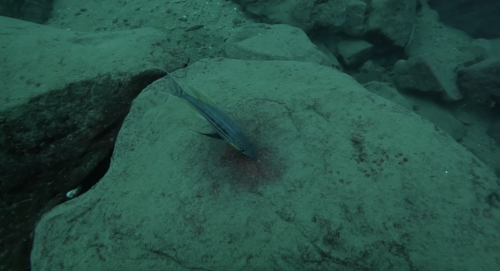
Taxonomy & naming
Benthochromis horii was formally described by Tetsumi Takahashi in 2008 (Journal of Fish Biology 72: 603–613), with the holotype taken off Mtondwe Island, Zambia, at about 197 ft depth. The species name honors Michio Hori, the Kyoto University fish ecologist who first recognized these animals as an undescribed species; the genus name combines the Greek benthos ("depth of the sea") with chromis, an old name for a perch-like fish—fitting for a lineage that lives well below the reach of snorkelers.
The genus Benthochromis sits in its own tribe, the Benthochromini, within the African cichlid subfamily Pseudocrenilabrinae. It is a small group: Benthochromis tricoti (Poll, 1948), Benthochromis melanoides, and Benthochromis horii. The practical upshot of Takahashi's work matters to hobbyists more than the Latin. For decades, almost every "Benthochromis tricoti" traded in the aquarium world was in fact this species. As keepers on cichlid forums now note matter-of-factly, true tricoti are essentially absent from the trade—the featherfins people buy are Benthochromis horii. The three congeners are most easily told apart by the male stripe count: three light stripes in horii, two in tricoti, and none in melanoides, alongside differences in head proportions, mouth angle, and fin shape.
Morphology
This is a laterally compressed, fusiform cichlid with a notably small eye set on a long snout—a useful field mark separating it from its relatives. Meristics from the type series run to 17–19 dorsal spines and 11–13 soft rays, 3 anal spines and 9–11 soft rays, and 36–38 vertebrae. The sexes could hardly look more different. Mature males are bluish to violet, crossed by three prominent horizontal light-blue stripes (a faint fourth sometimes shows), and carry markedly elongated pelvic and caudal fins that stream behind them as they hover. Females are silvery to grey and lack the stripes entirely, which is why plain-colored juveniles and females are easy to overlook.
Reported size depends on which yardstick you use. The original type series tops out near 6 in standard length, the figure FishBase carries. Keepers and field observers, measuring total length on fully grown wild males, routinely cite larger animals—commonly around 10 in total length, with maximum size varying between geographic populations. Both can be true at once: standard length excludes the tail, and the longest fish are big dominant males rather than the average specimen. Treat the high-teens-to-10 in range as the honest answer for a grown male, and expect females to stay smaller.
Habitat
Benthochromis horii is a lacustrine endemic—it lives only in Lake Tanganyika and nowhere else on Earth. The type locality is Zambian water in the far south, but the species is thought to be more or less lake-wide, with populations recorded across the Zambian, Tanzanian, Congolese, and Burundian shores and several recognized geographic variants (sold under location names such as 'Kipili' or 'Kasanga').
It is fundamentally a deep-water fish. FishBase places it as benthopelagic at roughly 197–413 ft, and field accounts describe the bulk of the population in very deep, dimly lit water over muddy bottoms, often near the edges of rocky and intermediate habitat. The exception is breeding: a fraction of the population ascends to shallower water, around 66–164 ft, to spawn at the margins of rocky zones where sand-dusted rocks occur. This depth preference has a practical consequence collectors know well—wild fish cannot be brought straight to the surface. They have to be decompressed over a span of days, with staged stops, or they die of the swim-bladder equivalent of the bends. Lake Tanganyika's deep water is also old, stable, and chemically distinctive: hard and alkaline, with a pH in the high 8s and temperatures that change little through the year.
Feeding
Benthochromis horii is a carnivorous planktivore. In the lake it feeds chiefly on zooplankton—copepods especially—picked from open water rather than scraped off rock, which suits its small, upturned mouth and the long, drifting body plan it shares with other open-water Tanganyikan cichlids. FishBase estimates a trophic level around 3.5, consistent with a small-prey predator rather than a piscivore.
In community terms it occupies the dimly lit deep-water plankton-feeding guild, a niche the rift lakes have filled repeatedly with unrelated lineages. Living deep is not without cost: the same dark, predator-rich zone is patrolled by specialized deep-water hunters such as Bathybates, and the unusually cautious reproductive style of Benthochromis horii is widely interpreted as a response to that pressure. Its own low fishing-vulnerability score and "medium" resilience rating reflect a fish that is locally abundant but slow to throw off large numbers of young.
Mating
Courtship in Benthochromis horii is built around dispersed, deep-water display arenas. Breeding males defend large, well-spaced territories—on the order of several meters apart in the wild—and each prepares a spawning site, either the top of a large rock or, in some populations, a low sand mound built up like a small volcano, on which the gloriously striped, filament-finned male hovers and displays to passing females. Toward conspecifics the temperament is lopsided: males are generally calm around other species but intensely intolerant of rival males, so in nature and in tanks a single dominant male monopolizes the area, the spacing between courting males giving the deep slope the feel of a loose lek. A fraction of the population ascends from the deep into shallower water—roughly 66–164 ft—to spawn at the margins of the rocky zone, where sand-dusted rocks provide the display platforms.
The spawning act itself skips the tight circular dance typical of mouthbrooders. The female deposits eggs one at a time and immediately backs up to take each into her mouth, so fertilization and pickup are folded into a single deliberate, repeated motion rather than the rapid mat-spawning seen in many of the lake's other cichlids.
Breeding
Like most Tanganyikan cichlids, Benthochromis horii is a maternal mouthbrooder, but its version of the strategy is unusual. What sets the species apart is the arithmetic. Clutches are tiny—often just three to five eggs, rarely more than a dozen—and the female then incubates for an exceptionally long time, frequently around two months and in some cases beyond 100 days, continuing to feed while she holds. Fry are released large, on the order of 1–1.5 in. The trade-off is classic: very few young, each given an enormous head start, an apparent hedge against the heavy predation of deep water.
That cautious arithmetic carries straight into the aquarium. Wild-import females are reported to hold poorly and spit clutches early, the broods are minuscule to begin with, and raising the few fry that do appear is a separate challenge; successful captive breeding remains uncommon and is a genuine accomplishment rather than a routine result.
In the aquarium
This is a beautiful fish and an honestly difficult one—not a beginner's project and not cheap to do right. Keepers with decades behind them are blunt about the footprint: a six-foot tank is the practical minimum and an eight-foot tank is closer to ideal, with one male and a group of females, because male-on-male aggression is severe even in large volumes. Plan for roughly 130 gal and up, with length and height to let the fish hover. Tankmates should be calm, non-pushy sand- and open-water species—Xenotilapia, Enantiopus, gentle Cyprichromis or Paracyprichromis—and decidedly not boisterous or fin-nipping fish. More than one forum keeper has watched busy cyps harass Benthochromis to death, so err toward placid company.
Water should mirror the lake: hard, alkaline (pH around 8.5–9), and stable, in the mid-70s °F (about 75–79 °F). These fish favor dim lighting and fine sand, and they take time to settle. Feeding is straightforward—small frozen and live foods such as cyclops, daphnia, mysis, and artemia echo the natural plankton diet. The hard part is reproduction. Wild-import females are reported to hold poorly and spit clutches early, the broods are minuscule to begin with, and raising the few fry that do appear is a separate challenge; successful captive breeding remains uncommon and is a genuine accomplishment rather than a routine result.
Conservation
The IUCN Red List assessed Benthochromis horii as Least Concern (assessment dated 26 February 2025), with the population trend listed as unknown. The species is naturally abundant in deep water that the lake's commercial fisheries do not target; the only direct take is incidental, a few breeding males caught by hook-and-line fishers in shallower water, which is not considered a meaningful threat. (Older hobby references that predate the assessment described it as "not evaluated," so the current Least Concern listing is the figure to trust.) For a single-lake endemic, that is reassuring—but "Least Concern" describes the species, not the lake it depends on.
Lake Tanganyika is under real strain. Long-term work by O'Reilly and colleagues (Nature, 2003; doi:10.1038/nature01833) linked regional warming to weaker mixing of the water column, a roughly 20% decline in primary productivity, and an estimated drop of around 30% in fish yields—because a more strongly stratified lake brings fewer nutrients up from the depths to feed the plankton at the base of the food web. Cohen and coworkers (PNAS, 2016; doi:10.1073/pnas.1603237113) reconstructed an associated loss of roughly 38% of the lake's oxygenated benthic habitat as warming pushes the oxygen boundary shallower, and earlier work (Cohen et al., 1993) documented sedimentation smothering the rocky littoral near deforested shorelines. The same warming, oxygen, and plankton-productivity changes that pressure the lake's clupeid and Lates fishery feeding four nations bear most directly on a deep-living planktivore like Benthochromis horii: it depends on zooplankton production from the open water and on the oxygenated deep zone it inhabits, exactly the things a warmer, more stratified Tanganyika erodes. Governance is shared across Burundi, the Democratic Republic of the Congo, Tanzania, and Zambia through the Lake Tanganyika Authority. The honest summary is narrow but worth stating plainly: this species is not currently threatened, yet it is wholly tied to a basin whose deep-water productivity is trending the wrong way.