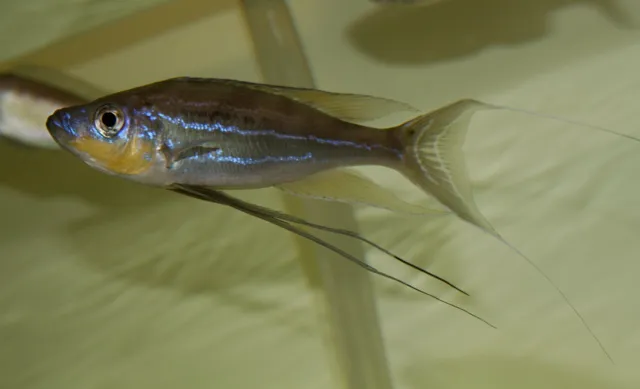
Taxonomy & naming
Belgian ichthyologist Max Poll described this fish in 1948 as Haplotaxodon tricoti, working from specimens collected during the Belgian Hydrobiological Mission to Lake Tanganyika in 1946–1947. The species epithet honors a Monsieur Tricot, director of the Great Lakes Railroad Company at Albertville, who supported that expedition. Poll himself later recognized that the population he had lumped as tricoti actually comprised two distinct fish: in 1984 he split it into Haplotaxodon tricoti and a new species, Haplotaxodon melanoides, and two years later, in 1986, he moved both into a new genus he erected for them, Benthochromis — the name fusing the Greek benthos ('the deep') with chromis (an old word for a perch-like fish), a fitting label for cichlids of the lake's lower layers. It anchors its own small tribe, the Benthochromini, within the African cichlid subfamily Pseudocrenilabrinae. To the fishers of the lake it is the "Tambatamba" or "Kamdomo."
The genus has a tangled history even beyond Poll's original split. For a long stretch the names Perissodus burgeoni (David, 1936) and Perissodus gracilis (Myers, 1936) were folded into tricoti's synonymy. Then Tetsumi Takahashi, in a 2008 paper in the Journal of Fish Biology, described a third species, Benthochromis horii, separating it from tricoti on the basis of relative eye and snout proportions. Andersen (2013) went further, arguing that Poll's long-recognized melanoides, Takahashi's newly described horii, and true tricoti are all valid, distinct species coexisting in the lake — three featherfin Benthochromis rather than one. Ad Konings, who had earlier agreed with Patrick Tawil that tricoti and horii were one fish, reversed himself after personally examining a single true tricoti pulled from a net alongside forty Benthochromis horii: it was larger, deeper-bodied, and carried only two pale longitudinal lines where horii shows three — and where melanoides, in turn, is distinguished by a scatter of black blotches on the head rather than clean flanks. That distinction matters for hobbyists, as explained below.
Morphology
Benthochromis tricoti is a laterally compressed, fusiform cichlid built for hovering rather than dashing. Mature males trail long, filamentous extensions on the dorsal and anal fins — the "featherfin" look the genus shares with Cyathopharynx — and develop blue-grey longitudinal lines along the flanks set against a yellow-tinged throat, while females remain plain and largely silver. The diagnostic features Takahashi used to separate it from its congeners are subtle: the eye is as long as or longer than the snout (101–129% of snout length), there are usually 28–29 total dorsal-fin rays, and the body carries two pearl-grey lines rather than the three shown by B. horii; unlike its other close relative, B. melanoides, which carries a scatter of black blotches on the head, tricoti's head is clean. Fin counts run to 16–18 dorsal spines, 11–12 dorsal soft rays, three anal spines, and 9–11 anal soft rays.
Size is where the sources genuinely disagree. FishBase lists a maximum of 6.5 in (6.5 in) total length, and the IUCN assessment repeats that 6.5 in figure for the species as a whole — yet the same assessment also describes territorial males of 8–10 in (8–10 in), hobby accounts routinely cite males of around 8 in (8 in), and Poll's own diagnosis distinguishing tricoti from its close relative B. melanoides gives tricoti a maximum of about 8 in, with melanoides running some 1 in smaller. The most honest reading is that males reach roughly 8 in (8 in) and clearly outgrow the considerably smaller females, with FishBase's lower published maximum probably reflecting a smaller measured sample. Either way, this is a large, slow-moving cichlid that needs room — and despite its size, it is not a piscivore.
Habitat
The species is endemic to Lake Tanganyika and, despite its scarcity in collections, is distributed around the lake — recorded from the Burundian, Congolese, Tanzanian, and Zambian waters that the lake's four nations share — though field accounts describe it as mainly found in the southern part of the lake. It is a deep-water fish: the IUCN gives a depth band of roughly 80–660 ft (82–656 ft), Konings reports it down to at least 656 ft, and observers note the largest aggregations at around 330–490 ft (328–492 ft); only at a handful of known locations does it come up into water shallower than 131 ft, which is a large part of why it is reckoned one of the most difficult fish in the lake to catch. It favors large rocky slopes and "rich" substrates but ranges out over open water as a benthopelagic, semipelagic schooler.
That depth is not a trivial detail. Fish brought up from these depths cannot simply be hauled to the surface: their closed, air-filled swim bladder expands drastically as pressure drops, and a too-rapid ascent can burst it and force internal organs out through the anus and throat, killing the fish outright. Collectors decompress them in careful stages instead — one documented account for a fish caught at just 115 ft took five full days to bring safely to the surface, with fish able to change depth far more quickly on their own initiative than when forced to do so against their will. Divers who do descend to the fish's territory (around 131 ft and beyond) scatter the schools outright; territorial males return to their patch after a while, but females vanish into small schools that keep well clear of anything resembling danger, and the handful that have been collected were mostly caught by accident, tangled in nets rather than deliberately targeted. In situ the water is warm and alkaline — FishBase notes an environmental range of about 73–77 °F, consistent with Tanganyika's hard, buffered, pH ~8–9 water. As a creature of the lake's twilight zone, Benthochromis tricoti lives much of its life in conditions of low light and, increasingly, near the edge of the lake's oxygenated layer.
Feeding
Benthochromis tricoti is a planktivore. In the wild it feeds on zooplankton and small crustaceans and invertebrates picked from the water column, a diet that places it at a trophic level of about 3.5 — a mid-water carnivore rather than an apex predator. Its slender body, large eye, and protrusible mouth all fit a fish that hunts small, dispersed prey in dim, deep water, hovering and picking rather than chasing.
Ecologically it occupies the semipelagic plankton-feeding guild over deep rocky habitat, a niche it shares loosely with the lake's Cyprichromis and featherfin Cyathopharynx but at greater depth. Schooling — reported flocks of 30 to 100 fish — is the usual strategy for a planktivore in open water, providing both foraging efficiency and safety in numbers from the lake's deep-water predators such as Bathybates and Hemibates. Within the Tanganyika food web it is a link converting plankton production into prey for larger piscivores.
Mating
Socially, Benthochromis tricoti lives in schools, with dominant males establishing and defending spawning territories to court females; outside of breeding, smaller groups and harems are reported. Males display over a chosen site — a large, roughly 35-cm flat rock set atop a rock pile more than 12 in high, in one documented aquarium account, rather than a pit dug into the substrate — courting passing females from these dispersed display posts in a manner akin to a deep-water lek. In a tank holding two mature males, the two divided the territory by time of day rather than space: one male controlled it while the aquarium lights were off (until early afternoon) and the other took over once the lights came on, a striking light-oriented territoriality not typical of most cichlids. Courtship intensified over weeks before culminating in observed spawning: a female followed the dominant male onto his chosen rock, deposited eggs, and then turned to pick each one up into her mouth while the male waited nearby to fertilise them — the standard mouthbrooder sequence, but rarely documented for this species. Courtship is part of why the fish's true colors stay hidden in the wild: Konings has speculated that, like other deep-water Tanganyikan breeders such as Bathybates and Trematocara, it courts in conditions where color is reduced to black and white — which would explain why the one wild tricoti he examined showed only stark markings rather than the bright nuptial dress of its shallower relatives. Much of this courtship happens at depths too great for divers to easily observe.
Breeding
Benthochromis tricoti is a maternal mouthbrooder. A female who spawns takes the eggs into her mouth to incubate them, carrying and protecting the developing young herself with no paternal involvement. Clutches are strikingly small — one aquarist's documented record stands at just 12 eggs — and the eggs themselves are notably small too, reportedly less than half the size of those laid by the similarly sized Tropheus, a striking mismatch between adult body size and egg investment.
Much of its reproduction happens out of sight, and even in captivity the process remains poorly understood. Takahashi and Konings both note that the species may spawn at depths too great for brooding females to turn up in shallow net catches. Aquarists who have achieved spawnings report that the fry, once released, seem to struggle to digest Artemia nauplii, leaving real uncertainty about what they actually eat in the days after their yolk sac is exhausted — one of several open questions, along with why captive spawning attempts proceed so differently from one pairing to the next, and why live free-swimming young are so rarely produced even though spawning itself is comparatively frequent. In at least one documented case, the only female who reliably carried a clutch through to completion died before her breeding could be studied further, cutting off what had been the most promising line of investigation. The small clutch size and deep, low-light spawning are consistent with a fish adapted to a stable, resource-thin environment. In aquaria, spawnings do occur — often a day or two after a water change — but females frequently spit their tiny clutches early, and fry that are produced are slow and difficult to raise, as detailed in the aquarium section.
In the aquarium
Start with the identity problem: as keepers themselves point out, true Benthochromis tricoti is almost never in the trade. The featherfin "tricoti" sold and bred in the hobby is overwhelmingly Benthochromis horii, the shallower-water species that actually shows up in collectors' nets. Anyone genuinely keeping wild tricoti has an uncommon fish on their hands.
Whatever the label, this is a large, deep-water schooler. One of the earliest published aquarium accounts described it as an "ideal aquarium resident" — neither aggressive nor predatory, and one that regains its full colour within a relatively short acclimatisation period, unlike slower-colouring featherfins such as Cyathopharynx and Cunningtonia. That account judged it did not need an enormous tank, though the modern hobby consensus, built from more extensive keeping experience, treats it as a large-aquarium specialist: keepers converge on a 6-foot tank as the bare minimum and an 8-foot (roughly 180–220 US gallon, ~185–210 US gal) tank as more appropriate, housing a group of six or more so the natural schooling behavior emerges. In one documented 650-litre setup, five tricoti (two males, three females) shared the tank without incident alongside ten Cyathopharynx furcifer and a pair of Altolamprologus calvus — useful evidence for compatible tankmates, though that keeper also cautioned against mixing individuals of different geographic origin, having noticed his own two males differed subtly in build and stripe width in a way that suggested separate wild populations. They want calm, dim conditions and gentle tankmates otherwise: experienced aquarists report that boisterous companions — even spawning Cyprichromis — will harass and stress them, and several describe losing fish that way. Water should mirror the lake: hard, alkaline, and warm. One successfully breeding tank ran pH 8.5, 12° GH, 9° KH, and roughly 400 µS conductivity, with zero nitrite and nitrate held under 20 mg/L — figures consistent with the roughly pH ~8.5–9, 75–79 °F generally recommended. Feed small foods that suit a planktivore: adult brine shrimp (Artemia salina) and quality flake or pellet food formed the diet in that same successful setup, and frozen mysis and krill are good additions.
Breeding is the real challenge. Spawnings do occur in aquaria, often a day or two after a water change, but keepers repeatedly report females spitting tiny clutches early and fry that fail to grow past 1 in, so raising young to size is harder than triggering a spawn. The combination of a big footprint, a need for tranquility and subdued light, slow growth, and stubborn fry makes Benthochromis tricoti — and its hobby stand-in Benthochromis horii — a project for a dedicated, patient keeper rather than a community centerpiece.
Conservation
On its own account, Benthochromis tricoti is in reasonable shape. The IUCN Red List assessed it as Least Concern in March 2025 (assessment by D. Mushagalusa, published 2025), citing a wide distribution throughout Lake Tanganyika, occurrence in many habitats, and no major lake-wide threats; it carried the same Least Concern rating in 2006. The species does face localized pressure: it is caught by artisanal gillnet and seine fishers — in quantity in July–August after the lake mixes and brings deep-water fish within reach — and is often salted for inland trade in DR Congo, while a trickle enters the international ornamental market. Habitat disturbance and siltation are noted as localized threats. None of these currently rises to a population-level concern for a fish this widespread.
The larger story is the lake itself. Lake Tanganyika is warming, and that warming strengthens the thermal stratification that normally lets deep, nutrient-rich water mix back to the surface. O'Reilly and colleagues (2003, Nature, DOI 10.1038/nature01833) found that reduced mixing has cut primary productivity by roughly 20%, implying on the order of a 30% decline in potential fish yields — a serious matter for a lake that supplies much of the animal protein for the four countries around it through its clupeid (Stolothrissa and Limnothrissa) and Lates pelagic fishery. Cohen and colleagues (2016, PNAS, DOI 10.1073/pnas.1603237113) showed that the same warming has shrunk the oxygenated benthic habitat in their study areas by about 38%, squeezing the deep, oxygen-dependent zone toward shallower water; sedimentation from shoreline deforestation further degrades the rocky littoral (Cohen et al. 1993). Governance of these shared pressures falls to the four-nation Lake Tanganyika Authority. For Benthochromis tricoti, a deep-water, rocky-slope planktivore, this matters directly: a fish that lives near the lower edge of the oxygenated layer is precisely the kind of species a contracting oxygen zone and falling deep-water productivity would pinch first. So the honest summary is this — the species is Least Concern today, but it lives in a lake under measurable strain, and its deep, oxygen-limited niche makes it one to watch rather than one to dismiss.