Taxonomy & naming
The species was described by the Belgian ichthyologist Dirk Thys van den Audenaerde in 1969, as Tilapia louka, in the Revue de Zoologie et de Botanique Africaines (v. 79). The holotype (MRAC 164492) and a paratype series spread across museums in Tervuren, Paris and Hamburg came from a river near Bo, in southern Sierra Leone. The epithet is an unusual eponym: louka honours Louka Thys van den Audenaerde, the describer's wife — a personal dedication rather than a descriptive name.
The species followed the same taxonomic path as its relatives: described in the old, oversized genus Tilapia, then moved when Dunz and Schliewen's molecular phylogeny (2013, Molecular Phylogenetics and Evolution 68) split that catch-all and resurrected Coptodon Gervais, 1853 for the substrate-spawning West and Central African tilapias. Tilapia louka became Coptodon louka, the combination used by Eschmeyer's Catalog of Fishes and FishBase, and confirmed in regional faunal work such as Kidé et al. (2016) on the fishes of the West African coastal basins.
Morphology
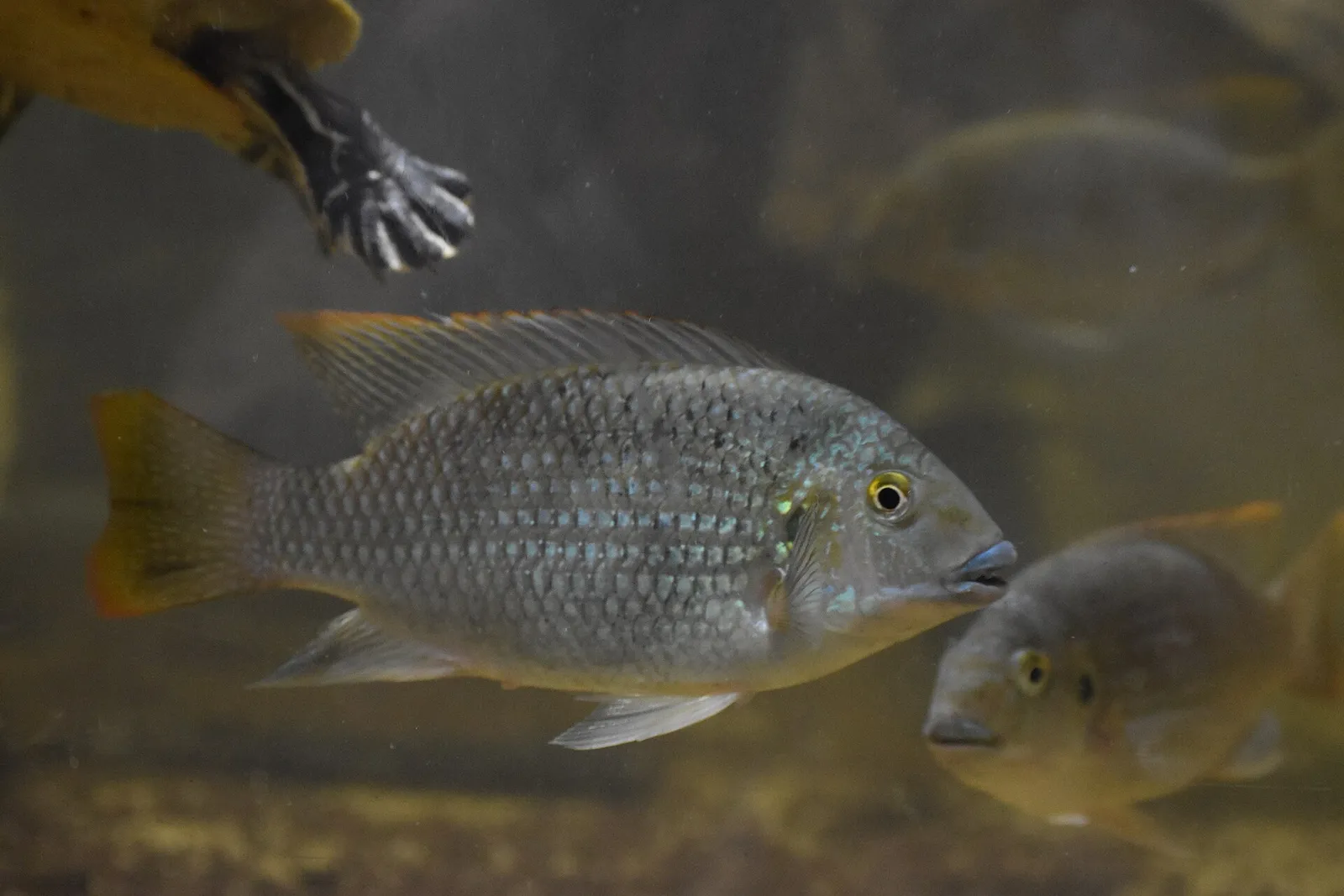
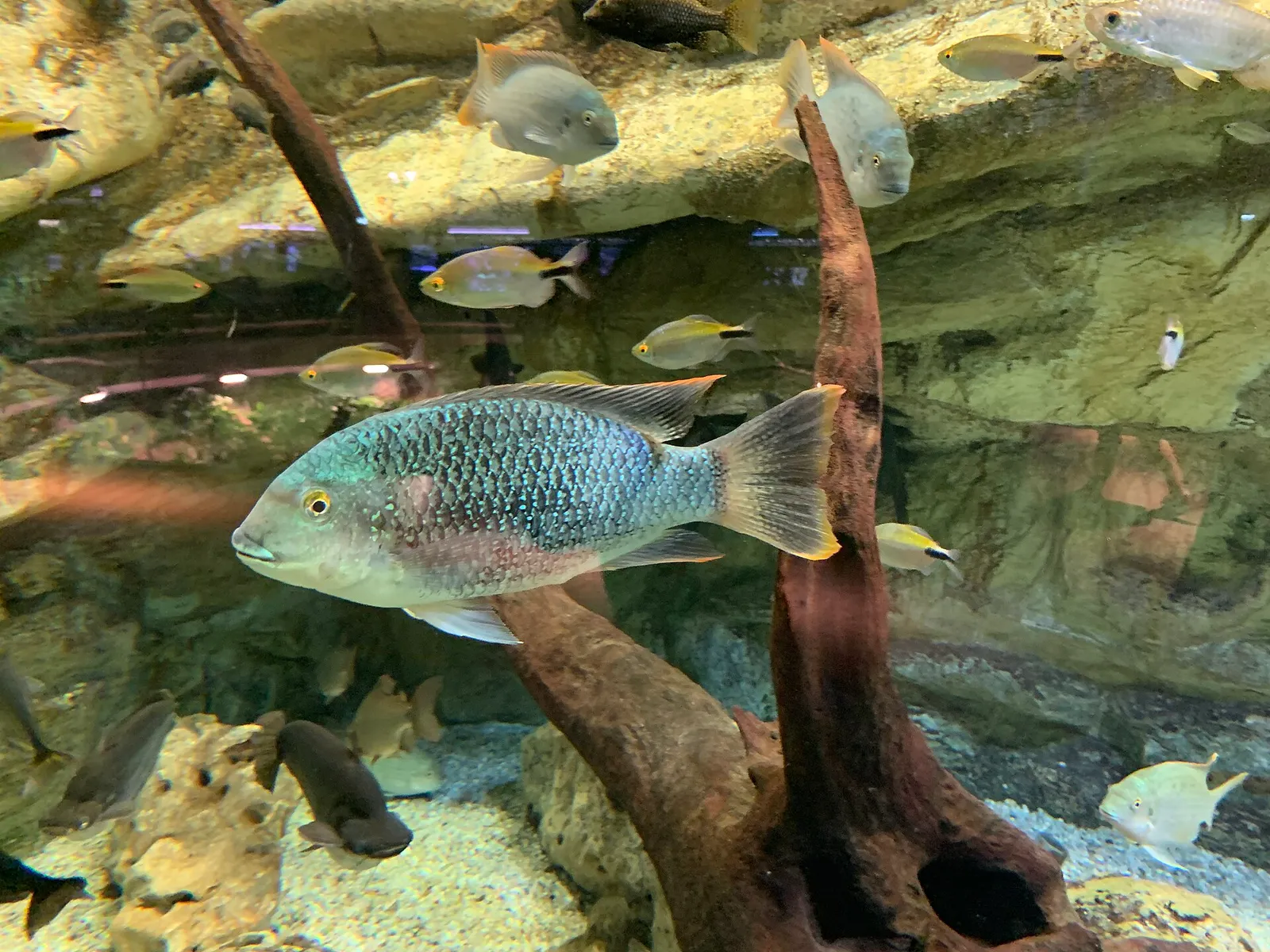
Coptodon louka is a medium-sized tilapia, reaching about 10 in in total length (FishBase). Its body shape is described as fusiform and 'normal' for the genus — a moderately deep, laterally compressed cichlid with a single continuous dorsal fin. The meristics give 13–16 dorsal spines and 12–14 soft dorsal rays, three anal spines and 8–10 anal soft rays. As in all Coptodon, the lower pharyngeal bone is about as long as broad with the anterior lamella shorter than the toothed area, and the median pharyngeal teeth are not broadened.
Two features make louka relatively easy to recognise among West African tilapias. First, the soft dorsal fin and the upper tip of the caudal fin are bordered with orange-red, a warm marginal flush that is a useful field mark. Second, the dark lateral 'tilapia spot' — the blotch on the rear body that many tilapias lose as they grow — remains clearly marked even in adults, and the dorsal and caudal fins are not, or only feebly, blotched (which helps separate it from congeners whose fins are densely speckled). FishBase carries photographs of both sexes; as in other substrate-spawning tilapias the sexes are broadly similar in pattern, separated mainly by size and breeding condition rather than by a fixed colour difference.
Habitat
Unusually for the genus, louka is a fish of brackish as well as fresh water. FishBase lists it as freshwater and brackish, benthopelagic, and notes that it 'seems to prefer brackish regions and coastal lagoons' and 'probably has a high tolerance for elevated salinity levels.' Its range runs along the Upper Guinean coast from the Corubal River in Guinea-Bissau south to the Lofa River in Liberia, taking in the Great Scarcies, Kogon, Konkouré and Corubal drainages, between roughly 6° and 14° N; recorded temperatures sit around 79–86 °F. This is a fish of the lower river reaches, estuaries and lagoons where fresh water meets the sea, rather than of the headwaters and rapids that its Konkouré congeners Coptodon rheophilus and Coptodon konkourensis occupy.
That salinity tolerance and coastal-lagoon habit set it apart ecologically from most Coptodon, which are strictly freshwater. It places louka among the relatively few tilapias of this lineage able to exploit the productive but physiologically demanding estuarine zone, and gives it a broader, more linear coastal range than the single-river endemics of the same region.
Feeding
Coptodon louka is herbivorous, and on the available data emphatically so: FishBase records its trophic level as 2.0 — the floor of the scale, derived from actual food-item data rather than estimated — marking it as a near-pure plant- and detritus-eater. That fits the genus, in which herbivory and detritivory dominate, and fits a fish of vegetated lower rivers, estuaries and lagoons, where submerged and marginal plants, algal growth on hard surfaces, and organic detritus are abundant. In such habitats a grazing tilapia works over macrophytes, the algal film on stones and woody debris, and the soft, detritus-rich sediments of slow coastal water. The species has not been the subject of a detailed gut-content study in the published, accessible literature, but the herbivorous characterisation is well grounded in its recorded trophic level and the consistent diet of the genus.
Mating
Coptodon louka is a pair-bonding substrate spawner, following the biparental, monogamous-pairing model that defines the genus and separates it from the mouthbrooding food-tilapias. FishBase summarises its reproduction as pair-bonding, open-substrate spawning with both parents guarding the brood. In practice this means a male and female form a bonded pair, jointly select and clean a spawning site, and establish and defend a territory around it through the breeding cycle. The fine detail of courtship, the choice and preparation of nest sites in estuarine versus purely freshwater settings, and any seasonal or salinity-linked timing of spawning have not been described for this species, so the account here rests on the consistent biology of the genus rather than on dedicated field observation of louka itself.
Breeding
Reproduction is biparental open-substrate spawning: adhesive eggs are laid on a cleaned hard surface or in a cleared depression and tended by both parents, which fan the clutch and guard the wrigglers and free-swimming fry. This is the standard Coptodon pattern, and FishBase applies it to louka — 'pair-bonding, open substrate spawner, with both parents guarding the brood.' Quantitative breeding figures — clutch size, egg dimensions, fry development, the timing of the spawning season, and whether spawning is tied to particular salinity or flow conditions in its estuarine habitat — have not been published, and there are no aquarium breeding reports to fill the gap. The reliable statement is the qualitative one: louka is a biparental substrate-spawner with extended joint parental care, not a mouthbrooder.
In the aquarium
Coptodon louka has essentially no presence in the aquarium hobby. It is not a trade species, has no aquarium-strain history, and is best understood as a wild West African river-and-estuary fish rather than a hobby cichlid; the lack of keeper accounts means anything said about husbandry is inference from its biology, not tested practice.
The one genuinely distinctive husbandry implication is its brackish habit. Of the Coptodon, louka is among the better candidates for a brackish or salinity-variable setup, given that it naturally favours coastal lagoons and tolerates elevated salinity — a keeper attempting it would sensibly mirror that, rather than forcing strictly fresh water. Beyond salinity, the general requirements would track the genus and the fish's size: a large tank for a 10 in cichlid, a sand substrate, warm water in the high 20s Celsius, strong filtration, and a vegetable-forward diet to suit a near-obligate herbivore (trophic level 2.0). As a substrate spawner it would turn territorial and earth-moving around breeding. All of this, though, is extrapolation: the practical reality is that louka is a wild species with no real aquarium track record.
Conservation
Coptodon louka is assessed by the IUCN Red List as Least Concern, assessed on 23 November 2019. That comparatively comfortable status reflects its relatively broad, linear coastal range — spanning the Corubal in Guinea-Bissau to the Lofa in Liberia, and including several major drainages along the way — together with its tolerance of brackish and lagoon habitats, which gives it more ecological room than the single-river freshwater endemics of the same region. A wider distribution and a flexible, salinity-tolerant habit buffer the species against the localised threats that have pushed narrower-range relatives such as Coptodon walteri and Coptodon coffea into the threatened categories. None of this makes it immune to the broad pressures on West African coastal freshwaters — pollution, habitat alteration and fishing all operate across its range — but at present those are not judged to threaten the species at the population level. It carries no CITES listing and is of limited fishery interest.