Taxonomy & naming
The blue-eyed cichlid was described by the German-born British ichthyologist Albert Günther in 1862, in the fourth volume of his Catalogue of the Fishes in the British Museum, as Heros spilurus. The type series came from "Lake Isabel" — Lake Izabal, the large lowland lake of eastern Guatemala that drains to the Caribbean through the Río Dulce. Günther figured no holotype; a lectotype (BMNH 1864.1.26.52) was later fixed from his syntypes by Juan Jacobo Schmitter-Soto in his 2007 revision, with at least two paralectotypes also held at the Natural History Museum, London. The species has been a nomenclatural traveler. For over a century it was shuffled through the catch-all genus Cichlasoma (as Cichlasoma spilurum), then placed in Archocentrus when that genus was resurrected in the 1990s for the convict-cichlid group. Robert Allgayer erected the genus Cryptoheros in 2001 and moved the species into it, and Schmitter-Soto's comprehensive 2007 reassessment of the former Archocentrus assemblage — which split the convicts into Amatitlania and named several new genera — retained spilurus in Cryptoheros and treated it as the type species of that genus. Subsequent molecular and morphological work (Říčan and colleagues 2016) has continued to recognize Cryptoheros as a small, mostly Caribbean-slope clade of dwarf to medium cichlids, though some authors still debate where its boundaries should be drawn. The species sits firmly in the convict-cichlid radiation of the subfamily Cichlinae, tribe Heroini. The epithet spilurus is treated by the Catalog of Fishes as an indeclinable noun meaning "with a spotted tail."
Morphology
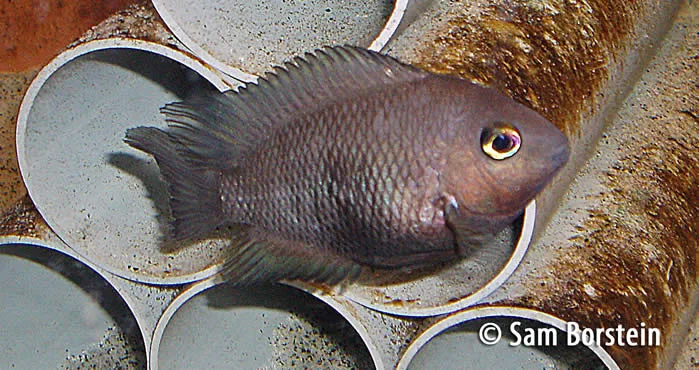
Cryptoheros spilurus is a compact, deep-bodied cichlid with the rounded profile and powerful jaws typical of its convict-cichlid relatives. It is modest in size: FishBase gives a maximum of about 4.5 in total length for males and around 3 in for females, and field and aquarium reports broadly agree that males approach roughly 6 in only exceptionally while females stay smaller still. The ground color is a warm grey-tan to olive, overlaid by a series of darker vertical bars down the flanks that the fish can intensify or fade with mood; brooding and territorial fish darken markedly. The single most useful diagnostic mark, and the source of the scientific name, is a discrete dark blotch at the base of the caudal fin — the "spotted tail" of spilurus — which is consistent within the species and distinguishes it from several look-alike congeners. The common name draws on a different feature: in good condition the iris glows a bright turquoise to jade green, giving the fish its "blue-eyed" and "jade-eyed" trade names. Sexual dimorphism is clear in mature fish. Males grow larger and heavier-headed, develop a more steeply rounded nuchal profile, and extend the trailing rays of the dorsal and anal fins into pointed filaments; ripe females are smaller, fuller-bodied, and frequently show a brighter belly or a contrasting flush in the dorsal and flanks when in spawning dress.
Habitat
The species is a fish of the Atlantic (Caribbean) slope of northern Central America. The Catalog of Fishes summarizes its range as the rivers flowing into Lake Izabal and, more broadly, the Atlantic slope from Belize to Nicaragua, spanning Belize, Guatemala, Honduras, and Nicaragua; a population has also been introduced and established in the Hawaiian Islands. Within this range it occupies the shallows and bank zones of streams, rivers, and lakes, typically over bottoms of sand, mud, and rock, and it favors the slower-moving, lower stretches of river valleys rather than swift headwaters. These are warm, lowland tropical waters: FishBase brackets the species' temperature envelope at roughly 72–90 °F. Like most lowland Caribbean-slope cichlids of this region, it lives in neutral to moderately alkaline water (about pH 7.0-8.0) of moderate hardness, reflecting the limestone-influenced karst geology of the Yucatán-Petén-Izabal lowlands. Recorded habitat is shallow — bank margins and the photic shallows of lakes and slow river reaches — rather than deep open water. It is a generalist of structurally varied littoral habitat, using rocks, submerged wood, and leaf litter for cover and for the caves and crevices it needs to breed.
Feeding
Cryptoheros spilurus is an opportunistic benthic omnivore. FishBase places it at a low trophic level (estimated near 2.0 on food-item data), consistent with a diet built largely around small invertebrates, aufwuchs, algae, detritus, and organic material gleaned from the substrate and from rock and wood surfaces in its shallow-water habitat. In the manner of its convict-group relatives it works the bottom and hard surfaces, picking and grazing rather than pursuing open-water prey, and it readily takes whatever small animal and plant matter the littoral zone offers. In captivity this translates into an undemanding feeder that accepts virtually any prepared or live food; keepers note that it comes into breeding condition quickly on protein-rich items such as bloodworm. Within its community it functions as a small, ground-level generalist forager.
Mating
Reproduction in Cryptoheros spilurus follows the convict-cichlid template of a strongly bonded biparental pair holding and defending a fixed territory. The genus name itself — from the Greek for "hidden" — alludes to the cave-oriented breeding of these fishes. Pairs form readily, and once a bond is established it tends to be durable, but the road there is the species' main behavioral hurdle: conspecific aggression is high, and individuals can be rough on one another before and during pairing. Hobbyist accounts repeatedly describe the timing mismatch in which a male is ready to spawn well before the female, with the female taking considerable time to ripen and the pair displaying with everted genital papillae ("tubes down") for days before eggs are laid. Both sexes become markedly territorial as spawning approaches, darkening in color and excluding other fish from the chosen cave or crevice. Established pairs cooperate closely, with the female focused on the eggs and brood and the male patrolling and defending the wider territory.
Breeding
The blue-eyed cichlid is a biparental cave (substrate) spawner. In the wild and in aquaria it deposits adhesive eggs on a sheltered hard surface — the wall or ceiling of a cave, a crevice, an overhang, or, where caves are scarce, a cleaned depression in firm substrate — rather than scattering them in the open. FishBase reports a fecundity on the order of 300-400 eggs per spawning, while aquarium breeders typically raise broods of roughly 100-500 fry; the female tends and fans the clutch while the male guards the perimeter. The species' early development was documented in detail for the first time by Lardizabal and colleagues (2025), working with Honduran stock: eggs laid on rocky substrate measured about 0.5 in in diameter and hatched asynchronously at 52-54 hours after fertilization, yielding larvae near 0.5 in total length with a large yolk sac, finfold, and as-yet undeveloped eyes. Over the following two weeks the larvae developed pigmentation and functional eyes within the first day or so post-hatch, formed the mouth, dentition, and taste buds by about six days, regressed their larval cement (attachment) glands by around seven days, and completed fin formation and metamorphosis by sixteen days post-hatch at roughly 0.5 in total length. Through this period the free-swimming young are shepherded as a school by both parents, which lead them through the territory and herd them back to cover when threatened — the attentive, cooperative brood care for which the convict-cichlid group is well known.
In the aquarium
Cryptoheros spilurus has a long history in the hobby and is widely regarded as an easy, rewarding fish for a keeper prepared for a feisty cichlid — it is more often traded through cichlid clubs and specialist breeders than seen on general shop shelves. A single pair can be housed in a tank of roughly 35.5–47 in (about 55-75 US gallons); larger is better wherever conspecifics or other cichlids share the space, because intraspecific aggression is the species' defining husbandry challenge. The most common way keepers lose fish is by confining two ill-matched individuals together with no room to retreat: pairing is best done by growing on a small group in a generous tank and letting a bond form, with a divider or escape routes available if a mismatch turns violent.
Water chemistry is undemanding within the range the species occupies in the wild. A temperature of about 75–86 °F suits it, with neutral to slightly alkaline water (pH roughly 7.0-8.0) of moderate hardness — conditions that mirror the limestone-influenced lowland rivers and lakes of its native Atlantic slope and that most tap water in hard-water regions provides without adjustment. It is hardy and tolerant of ordinary aquarium conditions provided maintenance is sound; routine water changes and reliable filtration are sufficient. Décor should provide what the fish wants for both security and breeding: a sand or fine-gravel bottom, rockwork, driftwood, and at least one or two enclosed caves (a flowerpot, slate cave, or rock crevice) per pair. Robust or potted plants help break up sightlines and reduce aggression, though a determined pair will dig.
Feeding is straightforward — the fish accepts flake, pellet, and frozen and live foods readily, and a varied diet with periodic bloodworm or similar brings it into spawning condition quickly. For tankmates, choose fish that are neither small enough to be eaten nor delicate enough to be bullied: similarly robust Central American cichlids in a large tank, or sturdy dither fish, work better than timid community species. The long fin filaments of mature males are a target for nippers, so avoid fin-nipping companions. Breeding is generally easy once a true pair is settled, and the parents are diligent; fry are readily raised on baby brine shrimp and finely crushed food. The honest caveat for newcomers is temperament, not difficulty: this is a small fish with a large attitude, and planning the tank around its territoriality is the key to success.
Conservation
The IUCN Red List assesses Cryptoheros spilurus as Data Deficient (DD), in an assessment by C.C. Lardizabal dated 17 January 2020 (published 2020). The Data Deficient rating reflects genuine uncertainty rather than a verdict of safety: although the species is reported across a fairly wide Atlantic-slope range and is locally common, the assessment notes that taxonomic questions and a shortage of population and threat data make a confident category assignment impossible. Part of that uncertainty is nomenclatural — material once lumped under spilurus has in places been split off to other Cryptoheros species, so the precise limits of this species' range and the status of its populations remain incompletely resolved. It carries no CITES listing and is of no commercial fisheries interest; harvest is essentially limited to the ornamental aquarium trade, in which it is bred in sufficient numbers that wild collection is not a primary supply. As a hardy, adaptable habitat generalist of lowland rivers and lakes it is less exposed than many narrow-range Mesoamerican endemics, but the freshwaters of its range face the region's broad pressures — deforestation, agricultural runoff, pollution, and introduced species — and the DD listing is best read as a call for the basic distributional and population work that would allow a firmer assessment.