Taxonomy & naming
The blue flash was described by Albert Günther in 1862 as Heros aureus, from a specimen taken at Lake Izabal ("Yzabal") in Guatemala; the holotype is held at the Natural History Museum, London (BMNH 1864.1.26.51). Through most of the twentieth century it was placed in the omnibus genus Cichlasoma and traded as Cichlasoma aureum, before the resurrection of Thorichthys for the firemouth group returned it to the modern combination Thorichthys aureus (Burgess 2000; Kullander in Reis et al. 2003). Günther's original 1862 description called T. affinis "very closely allied" to aureus, and the two do share an overall gold-based colour scheme. Later work within the genus, however, complicates a simple pairing of the two: Ad Konings splits the genus's roughly eight species into two natural subgroups by jaw shape — an isognathous group with equally long jaws, which includes T. aureus (its best-known member) alongside T. callolepis, T. helleri, T. maculipinnis and T. socolofi, and a prognathous group with a protruding lower jaw, comprising the firemouth T. meeki, T. affinis and T. pasionis. On that reading, T. aureus sits in a different subgroup from both T. meeki and T. affinis, even though Günther's original comparison to affinis (likely made on overall colour rather than jaw structure) still stands as a historical judgment worth noting. Aureus is, in any case, one of the larger-headed, higher-bodied members of the genus. It was among the cichlids Belize and Honduras collecting expeditions of the early 1970s (Klee, Norris, Specht and Loiselle) first introduced to the aquarium hobby, alongside Nandopsis salvini, Amphilophus robertsoni and several other now-familiar Central American cichlids. The specific epithet is simply the Latin aureus, "golden," a reference to the species' yellowish-olive ground colour.
Morphology
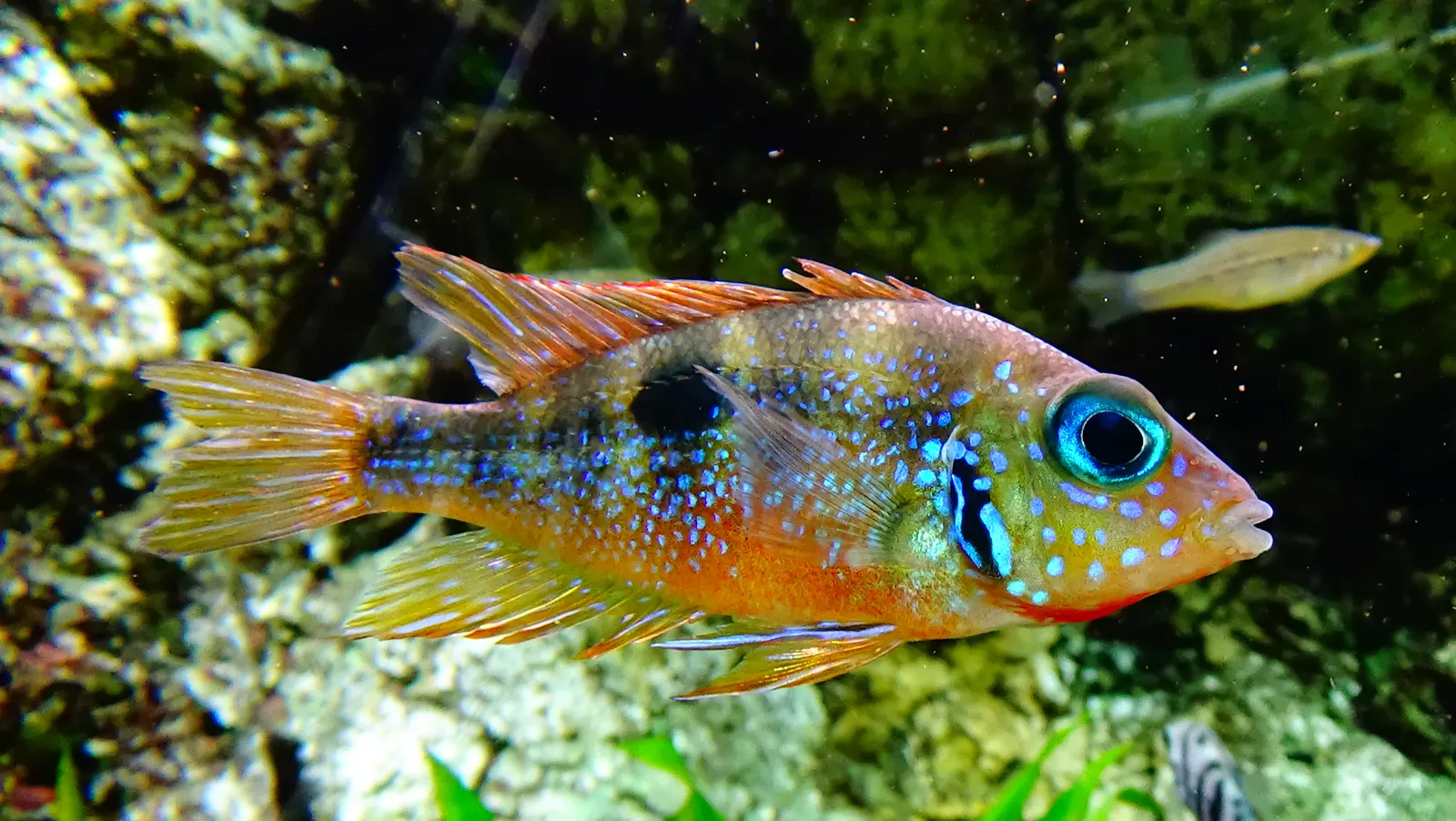
Thorichthys aureus is a deep-bodied, moderately large firemouth, reaching about 6 in standard length according to FishBase. The body is a warm yellow-gold to grey-olive, and it is the fish's iridescence that makes it striking: rows of brilliant blue-green to electric-blue spots and streaks cover the flanks, cheeks and gill covers, and the unpaired fins are washed and edged in turquoise. As in other Thorichthys the lower head and throat carry a reddish flush, and the gill cover bears a dark, light-ringed ocellus used in frontal threat display. A series of dark midline blotches and a dark spot on the caudal-fin base complete the pattern. Males grow larger, with more produced dorsal- and anal-fin filaments and the most intense colour; females are smaller and somewhat plainer. The species is sometimes confused with the firemouth in the trade, but is generally more golden-bodied and more heavily spangled with blue.
Habitat
The blue flash is restricted to Atlantic-slope drainages of eastern Guatemala, southern Belize and western Honduras. Documented populations include the Grande and Hondo rivers of Belize, Lake Izabal and its surrounding rivers in Guatemala and Honduras, Lake Lachuá in the upper Usumacinta basin of central Guatemala, and the Motagua River of western Honduras; scattered, partly disputed records exist for the Yucatán Peninsula and Quintana Roo. FishBase describes it as a fish of warm lakes and lagoons that also occupies the lower and middle reaches of rivers, with only sparse populations in the upper riverine sections. In Lake Izabal — where it is one of the most abundant cichlids — it has been reported from dense stands of the aquatic plant Hydrilla verticillata. Field collections document the species alongside the Río Amarillo near Copán, Honduras, together with Chuco microphthalmus and Nandopsis motaguensis, and at Marimonte on Lake Izabal, where a single evening's netting turned up eight other cichlasomine cichlids sharing the same shoreline — a site with recorded water at pH 7.8–8.2 and about 80 °F. Recorded temperatures more broadly run about 75–82 °F, and FishBase notes a preference for hard, alkaline water (pH from about 7.5 upward, hardness roughly 2–15 °dH), consistent with the limestone catchments it inhabits.
Feeding
Thorichthys aureus is a benthopelagic omnivore. Field study in Lake Izabal found it preying on a variety of aquatic insects, zooplankton and algae, and to some extent on aquatic gastropods (snails). Like its congeners it works the bottom by taking in and sifting soft substrate, but it also feeds in the water column and among submerged vegetation, giving it a moderate trophic position (FishBase estimates a trophic level near 3.3). This mixed invertebrate-and-algae diet, drawn from sediment, plant beds and open water alike, lets it exploit the productive shallows of lakes such as Izabal where it reaches high densities.
Mating
Like other firemouths, the blue flash is a monogamous pair-spawner whose social life is organised around the frontal threat display shared by the genus: a flared, red-throated, eyespot-presenting confrontation that serves both to repel rivals and to court mates. Field observations from Lake Izabal indicate that spawning is seasonal, taking place in spring. Detailed in-situ courtship behaviour is not well documented, but in aquaria the species behaves like its relatives — a pair forms after a period of mutual display, selects and cleans a spawning surface, and jointly defends a territory around it, the male's golden, blue-flecked flanks and reddish throat advertising condition during courtship.
Breeding
Breeding follows the firemouth pattern: Thorichthys aureus is a biparental, open-substrate spawner that lays its eggs on a cleaned hard surface such as a flat rock or piece of wood, with both parents guarding the clutch and, after hatching, moving the larvae to pits and escorting the free-swimming fry. Specific wild clutch counts for aureus are not well recorded, but congeners in the genus typically lay on the order of a few hundred eggs per spawning, and aquarium spawnings produce broods of comparable size that the pair tends together. Parental care is biparental and extended through the wriggler and early free-swimming stages, as in Thorichthys meeki. The spring timing of spawning observed in Lake Izabal coincides with seasonally rising temperatures and productivity.
In the aquarium
The blue flash is an established, if less common, aquarium fish, kept much like the firemouth. Hobby accounts often describe it as pushier and more territorial than Thorichthys meeki, though Konings' own comparative behaviour scoring in Enjoying Cichlids actually rates the two as equally assertive — both score the maximum for territoriality and aggression in his tables — so "feistier than the firemouth" is best read as a matter of degree and individual temperament rather than a settled species-level difference. A pair is best given at least about 55 US gal, with a footprint of around 47 in; larger is better if it is to share space with other robust fish or to breed. (Konings' own stocking suggestions run more modest — a pair in as little as 25 US gal — but that reflects a minimum in a mixed community-style setup rather than an ideal, and a more generous 55 US gal remains the safer practical target, especially for a serious breeding attempt.) Provide a soft sand substrate for natural sifting, generous rockwork and wood to create caves and broken sightlines, and open foreground for swimming.
Water conditions should reflect the hard, alkaline lakes and rivers of its range: temperature about 75–82 °F, pH roughly 7.2–8.2, and medium-hard to hard water. As with all Thorichthys, stable, clean water from good filtration and regular partial changes matters more than precise values, and the genus is prone to head-and-lateral-line problems in stale, over-stocked tanks. Feeding is straightforward — a varied diet of quality sinking pellets, frozen and live invertebrate foods (bloodworm, brine shrimp, small crustaceans), and some algae- or vegetable-based food to reflect its omnivorous wild diet.
For tankmates, choose sturdy, similarly sized fish that can hold their own without being aggressive — larger characins, robust barbs, other medium Central Americans of even temperament, and peaceful catfish. The blue flash can be kept in a community of suitable fish, but a breeding pair will defend its corner vigorously and may need extra space or relocated companions. It is more confident and more colourful than the firemouth and rewards a slightly larger, well-aquascaped tank with a fine display of its blue spangling.
Conservation
The IUCN Red List assesses Thorichthys aureus as Data Deficient (assessed 10 August 2018, published 2019, by Lyons & Daniels). Although it is locally very abundant — among the commonest cichlids in Lake Izabal — the assessors judged that too little is known about its population trend, total size and the precise limits of its distribution to assign a threat category with confidence. Potential pressures flagged in the assessment are commercial mining operations and hydropower development that could degrade habitat, and the spread of the invasive aquatic plant Hydrilla verticillata in Lake Izabal, whose effect on local cichlid abundance is unknown. The species occurs in at least one protected area within its range. It is widely traded in the aquarium hobby, but the impact of that trade on wild populations has not been studied. The assessment's overriding message is a call for basic survey and population data rather than evidence of decline.