Taxonomy & naming
The true parrot cichlid was described by the Austrian ichthyologist Johann Jakob Heckel in 1840 as Heros psittacus, in his treatment of the new river fishes that the Austrian naturalist Johann Natterer had collected during his long Brazilian expedition. The type locality is the Rio Negro north of Maribitanos, at the foot of the Cocui Mountains in southern Venezuela, and the surviving syntypes are held in the Naturhistorisches Museum Wien (NMW 17641-42). The genus Hoplarchus was erected later, by Johann Jakob Kaup in 1860, originally for his own nominal species Hoplarchus pentacanthus — now recognised as a junior synonym — so the modern binomial pairs Kaup's genus with Heckel's species epithet. A second synonym, Centrarchus cychla Jardine, 1843, from the Rio Negro, was sunk by Kullander in 2003. The species wandered through a long list of combinations over the following century, shuffled in turn into Acara, Astronotus, and Cichlosoma; for much of the twentieth-century hobby it was traded as Cichlasoma psittacum. When Sven O. Kullander's 1983 revision restricted Cichlasoma to a small core of species around Cichlasoma bimaculatum, the valid name reverted to Hoplarchus psittacus (Heckel, 1840). Kullander at first suspected a close relationship to the chocolate cichlid Hypselecara temporalis, but in his 1986 monograph on Peruvian cichlids concluded the resemblance was merely superficial. The genus is monotypic and sits in the subfamily Cichlinae; the Cichlid Room Companion places it in the tribe Therapsini.
Morphology
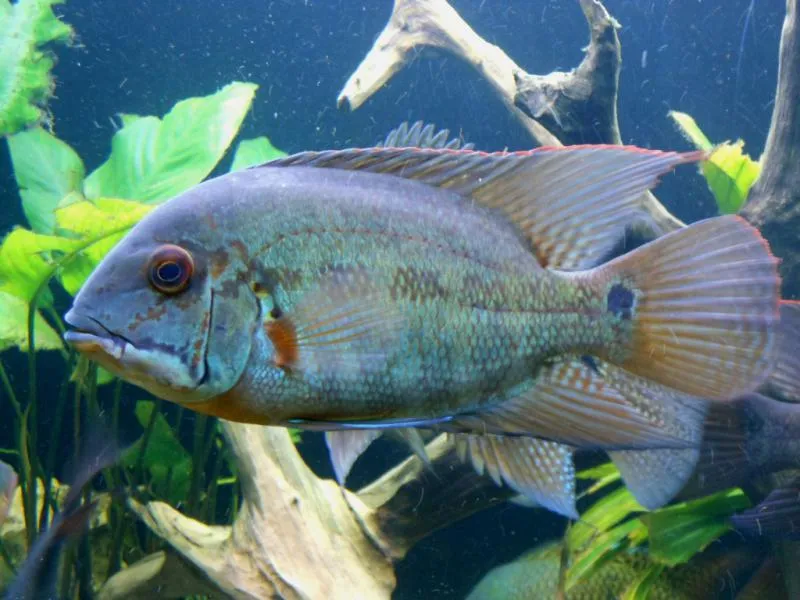
Hoplarchus psittacus is a large, deep-bodied, strongly laterally compressed cichlid with an oval profile, a steeply rounded forehead, and a blunt, terminal mouth set into a head that vaguely suggests a parrot's beak. FishBase gives a maximum of 12.5 in total length and a published weight of 730 g, with older sources citing wild specimens to 14 in TL; well-fed aquarium adults are widely reported to exceed 15.5 in, and 12 in fish are described as the rule rather than the exception among serious keepers. Most adults settle around 10–13 in. The defining feature is colour: the head and flanks range from blue through emerald to a deep olive green, overlaid with a row of dark spots running the length of the body, scattered dark-green blotches, and faint grey bars. The most coveted populations — wild fish from the Atabapo River between Venezuela and Colombia, and certain Brazilian localities — add a vivid red throat, underbelly, and iris, though that red often fades in captivity. The fish is a quick-change artist: an excited or stressed individual darkens dramatically in seconds. Sexual dimorphism is subtle. This is essentially an isomorphic species — males and females look much alike — but males grow somewhat larger, develop a more pronounced nuchal (forehead) hump, and tend to carry longer, more pointed dorsal and anal fins. Juveniles wear a distinctly different barred, mottled pattern that transforms only gradually into the adult livery, a transition that has surprised more than one keeper expecting an unremarkable brown youngster to stay that way.
Habitat
The species is a blackwater specialist of the upper Amazon and upper Orinoco. Its range spans southern Venezuela, eastern Colombia, and northern Brazil: the Rio Negro and its affluents, the upper Orinoco system (including the famously dark Atabapo), and a set of Brazilian rivers — the Preto da Eva, Urubu, and Jamari — within the Amazonas drainage. These are the classic tea-coloured waters of the Guiana Shield: soft, mineral-poor, and stained brown by tannins leached from decaying leaf litter and flooded forest. FishBase records a narrow chemical envelope of pH 5.5–6.0 and hardness of roughly 5–10 dH, with temperatures of 81–86 °F; the Cichlid Room Companion likewise characterises the habitat as moderately acidic (pH 5.5–6) with very low dissolved minerals and water around 81–86 °F. Within these rivers the fish favours quiet, structurally complex margins — flooded forest (igapó), swamps, and lakes — where it lives among submerged tree roots, fallen branches, and drifts of leaf litter rather than in open current. It is a benthopelagic fish that ranges through the middle of the water column rather than hugging the bottom, but it stays close to the cover of sunken wood. The blackwater habitat is strongly seasonal, swinging between high-water flood and low-water draw-down, and the fish's diet shifts with it.
Feeding
In the wild Hoplarchus psittacus is an opportunistic omnivore that tracks the flood pulse. During high water, when the forest is inundated and invertebrate life is abundant, it feeds mainly on aquatic insects and crustaceans such as shrimp; as the waters fall and prey concentrates, it takes a larger proportion of small fishes. Fruit and seeds washed into the flooded forest are also reported in the diet, a common pattern among igapó cichlids. FishBase places it at a trophic level near 3.7, consistent with a generalist that leans carnivorous in the dry season. It is not a substrate-sifting eartheater; it forages through the structured leaf-litter and submerged-wood zone, picking prey from surfaces and the water column. In captivity that flexibility makes it easy to feed — it accepts pellets, sticks, flakes, frozen krill and Gammarus, and earthworms readily — but the same robust appetite, paired with a habit of becoming a picky, high-protein-fixated adult, is exactly what makes the species prone to digestive trouble if the diet is not varied with plant matter.
Mating
Parrot cichlids are slow to mature, typically not breeding until around three years of age, and the standard route to a compatible pair is to raise a group of young together and let a bond form naturally rather than forcing two adults into proximity. Outside of spawning the species is comparatively peaceful toward its own kind — it can be kept in groups in a large enough tank — but a settling pair becomes territorial, and intraspecific aggression is the central management problem of the species. As a pair forms, courtship intensifies the colours, both fish darkening markedly, and includes a characteristic mutual jaw-locking display in which male and female seize each other's mouths, a test of strength common to large substrate-spawning Neotropical cichlids. The pair then selects and meticulously cleans a spawning surface — a flat stone, a branch, or a cleared patch of substrate — and, being powerful diggers, will rearrange the tank's décor and excavate the substrate to their own design in the days beforehand. In confined quarters these pre-spawning tensions readily escalate into injuries, particularly to the eyes, which is why every serious account stresses a very large tank and abundant broken sightlines.
Breeding
Hoplarchus psittacus is a biparental substrate spawner, and it is not often bred — the species has a long-standing reputation as difficult even for experienced keepers. Spawning is triggered by recreating the blackwater rainy season: very soft, acidic water (commonly RO water re-mineralised lightly and tinted with peat, leaf litter, or rainwater) and a temperature raised into the 82–86 °F range, on a rich conditioning diet. The female lays her eggs in plaques on the cleaned surface, a few at a time, while the male follows to fertilise them; the whole act lasts perhaps half an hour. For so large a fish the clutch is notably small — typically on the order of 100–200 yellowish, relatively large eggs, with experienced pairs reported up to about 300. Hatching rates are often low and a proportion of eggs fungus over (these are usually eaten by the parents). Larvae hatch in roughly 60–70 hours depending on temperature and are moved by the parents to pre-dug pits in the substrate; the free-swimming fry begin foraging a few days later once the yolk is absorbed. Both parents guard and fan the brood vigorously, but the pair are notoriously prone to eating eggs or fry under stress — a clumsy water change is a classic trigger — so survival is erratic, with one documented case yielding only about 40 surviving fry from 300 eggs. Where the bond breaks down, artificial rearing of stripped eggs is the fallback. Fry that do survive grow well on microworms, grindal worms, baby brine shrimp, and finely powdered foods.
In the aquarium
This is unequivocally an advanced aquarist's fish, and the single hardest requirement is space. Given its adult size and powerful intraspecific aggression, the minimum acceptable footprint for adults starts at roughly 71 in long by 30 in wide by 23.5 in tall (about 72 × 30 × 24 inches); a pair can be housed from around 80 US gal but is far better in 125 US gal or more, and a group needs a tank of three metres or beyond. Growing juveniles can begin in smaller tanks and be moved up as they size, but undersizing the adult tank is the commonest cause of injuries and losses, because aggression scales directly with confinement.
Water should mirror the soft, warm, tannin-stained rivers the species comes from. Aim for a temperature of 81–86 °F (the warm end is preferred), a pH around 5.5–6.5, and low hardness; the fish is adaptable enough to live in harder, near-neutral water (pH up to about 7) and even breed has been coaxed from such conditions, but soft acidic water is strongly preferred and is effectively mandatory for reliable spawning. Driftwood, oak or other leaf litter, and peat all help acidify and tint the water, and subdued lighting over a tannin-browned tank shows the fish at its best. Filtration must be heavy — a fish this large is a prolific waste producer — but flow should be gentle, in keeping with its slow-water origins; over-filter, then diffuse the return. Generous, regular water changes (commonly 20–50 % weekly) are essential, as the species is notably prone to hole-in-the-head disease (head-and-lateral-line erosion) when dissolved waste is allowed to accumulate.
Furnish the tank for refuge and sightline-breaking: stacked dark stone, chunks of driftwood and finer branches, and only the toughest plants. Keepers report success anchoring Anubias and Java fern to décor and using floating plants or trailing aerial roots of Monstera and Philodendron, since rooted plants are liable to be excavated. A sand or fine-gravel substrate suits the fish's digging. A submersible heater is best protected behind a guard — a determined adult can crack glass.
Diet is straightforward but should be deliberately varied: quality pellets, sticks, and flakes as a base, supplemented with earthworms (purged of soil), krill, Gammarus, and frozen foods, plus spirulina and other plant matter to guard against the bloat that a relentless high-protein diet can bring on. Many keepers avoid feeder fish, both to limit aggression and to avoid importing parasites.
For tankmates, think large and even-tempered: Uaru, severums, large eartheaters, and bigger acaras are the usual companions. Anything small enough to swallow will be eaten, so the community must be built from sizeable, robust fish; dither species in a big tank help diffuse aggression. The real flashpoint is conspecific — a hard-bonded pair, or rival adults in a tank that is too small, is where injuries and deaths occur. Wild-caught imports also commonly arrive carrying internal parasites and benefit from quarantine. None of this is insurmountable, but it is a fish that rewards diligence and punishes shortcuts.
Conservation
The IUCN Red List assesses Hoplarchus psittacus as Least Concern, assessed on 19 November 2020 by R.G. Frederico, with the population trend listed as unknown; it occurs in Brazil, Colombia, and Venezuela and carries no CITES listing. The species is widely distributed across the Rio Negro and upper Orinoco blackwater systems and is taken at a local level both as a subsistence food fish — it appears in regional fish markets — and for the ornamental aquarium trade, where wild Atabapo and Brazilian fish are prized for their colour. Neither pressure is flagged in the assessment as a population-level threat. As with the whole Amazon–Orinoco region, the broader backdrop is one of accelerating freshwater pressure from deforestation, mining (and its mercury contamination), and altered flood regimes, but none of these is documented as a present danger specific to this cichlid, and its wide range across remote blackwater rivers leaves it far less exposed than the basin's many narrow-range endemics.