Taxonomy & naming
Lugubria lugubris was described by the Austrian ichthyologist Johann Jakob Heckel in 1840 (page 422 of his foundational cichlid monograph) from material taken in the Rio Negro of Brazil — the upper Negro near Manaus is usually cited as the type locality. It was one of a cluster of pike cichlids Heckel named in that same work, alongside Crenicichla johanna, Crenicichla lenticulata, Crenicichla macrophthalma and others, and it has stood as a valid species ever since; the name Cychla rutilans is treated as a junior synonym. Within the genus it gives its name to the 'lugubris group,' an informal assemblage of large, robust Amazonian and Guianan pikes long recognized by aquarists and taxonomists alike — Ploeg's 1991 revision places close relatives such as Crenicichla marmorata, Crenicichla strigata and Crenicichla jegui here, while Kullander (1991) proposed separating these blunt-snouted, robust pikes from a set of more pointed-snouted large Crenicichla (including C. percna, C. multispinosa and C. tigrina), a division that does not hold cleanly in every case. Crenicichla cametana, despite superficial resemblance, is actually placed by Ploeg with the unrelated reticulata (Batrachops) group rather than with lugubris. A further, more serious identification problem shadows this species' hobby profile: Kullander and Nijssen's 1989 revision of the Guianan pikes restricts confirmed Lugubria lugubris to the Corantijn river system on the Suriname–Guyana border, the Essequibo of Guyana, the Rio Branco, and the lower Rio Negro near Manaus — a Guiana Shield and lower-Amazon distribution that stops well short of the Orinoco. The vivid orange-and-red 'lugubris' widely traded out of the upper Orinoco and its Venezuelan and Colombian tributaries, and used in some feeding-ecology literature from the Venezuelan llanos, sits outside that confirmed range, and whether it represents true L. lugubris or one or more closely related, still-unresolved members of the lugubris complex is an open question the literature has not settled. We flag the conflict rather than resolve it here: FishBase and the Catalog of Fishes continue to list an Amazon-and-Orinoco distribution, but the primary Guianan revision is narrower, and the Orinoco-population material discussed below should be read with that caveat. The genus Crenicichla — by far the most species-rich of all cichlid genera, with roughly ninety described species — was overdue for revision, and in 2023 Varella, Kullander, Menezes, Oliveira and López-Fernández published an integrative phylogenetic study (Zoological Journal of the Linnean Society) that split it. Their classification confines Crenicichla in the strict sense to the type species and two subgenera, and erects several new genera for the outlying groups: the dwarf pikes become Wallaciia, the spangled saxatilis-group pikes become Saxatilia, and the big lugubris-group pikes — sixteen species — are placed in a new genus Lugubria, named for and typified by this fish, making it Lugubria lugubris (Heckel, 1840). The revision is sound and increasingly cited in the literature, but the trade and most hobbyists have not adopted the new names, so Crenicichla remains the practical, recognizable name in the hobby. We note the change honestly and keep Crenicichla here for continuity.
Morphology
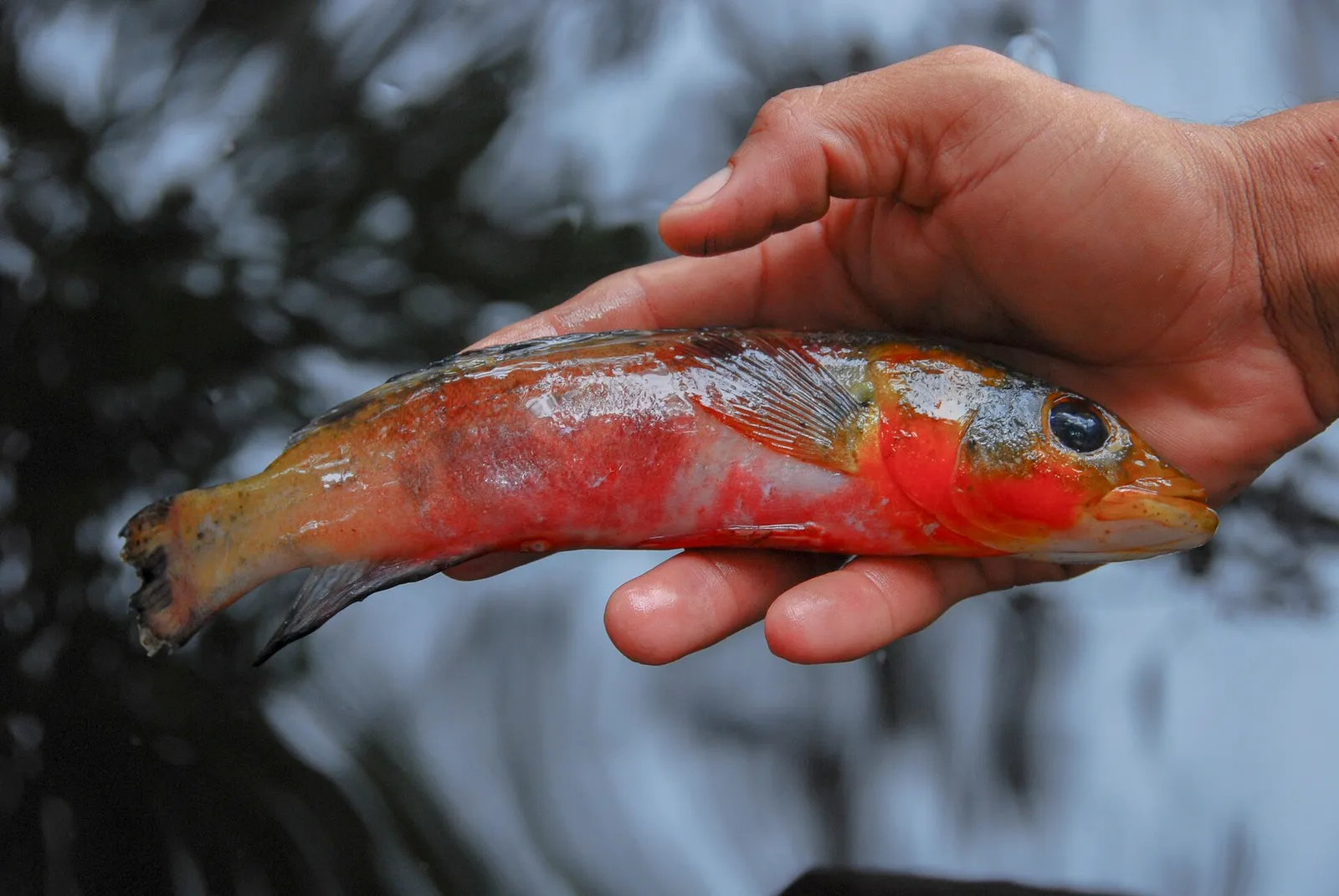
This is a large pike cichlid. FishBase gives a maximum of about 13 inches total length, and field and aquarium observers routinely record adults of 12 in or more; some older hobby sources cite a more conservative ~8 in standard length, the difference largely a matter of how the fish is measured and which population is meant. The body is the genus archetype: long, cylindrical, only modestly compressed, with a flat-topped head, large terminal mouth and a long-based dorsal fin running most of the length of the back — the silhouette of a freshwater barracuda built for the short, explosive lunge. Base coloration in preserved specimens is a uniform sombre olive-brown (the trait that earned the fish its name). In life, genuine Guiana Shield and lower-Amazon populations are comparatively subdued day-to-day — a plain light grey body with some red pigment confined to the ventral fins — but during the breeding season, typically winter, both sexes transform: the lower head flushes yellow and orange, the ventral fins turn bright red, and dark violet zones appear along the flank, so a spawning pair can look like an entirely different fish from their non-breeding selves. Heckel's original 1840 description makes no mention of a light band in the dorsal fin, a mark regularly seen in females of other species in this group, which may simply reflect the sex or condition of his type material rather than a fixed species character. The permanently vivid orange-to-blood-red fish sold in the trade as 'red pike' or 'orange pike lugubris' come overwhelmingly from the upper Orinoco and its Venezuelan and Colombian tributaries — outside the confirmed range of true L. lugubris (see Taxonomy) — and their relationship to Heckel's species is unresolved, so that colouring should not be taken as characteristic of the species as described. A dark humeral blotch sits behind the pectoral fin, and a series of darker bars or saddles may cross the back. Sexual dimorphism is subtle and unreliable as a field character — Ploeg, examining the Guianan material, found no consistent colour difference between the sexes in preserved fish — but in good condition females developing toward spawning take on a swollen, often cherry-red belly, while males tend to grow larger and heavier-headed, the usual pike pattern.
Habitat
Lugubria lugubris ranges across the Guiana Shield and lower Amazon, though how far its range truly extends is unsettled (see Taxonomy). Eschmeyer's Catalog of Fishes gives its distribution as the Amazon and Orinoco River basins; FishBase details the Branco, Negro and Uatumã rivers in Brazil, the Essequibo and Branco in Guyana, and the Corantijn in Suriname, while upper-Orinoco populations are widely reported from Venezuela and the Colombian llanos. Kullander and Nijssen's 1989 revision, by contrast, restricts confirmed material to the Corantijn, Essequibo, Rio Branco and lower Rio Negro, omitting the Orinoco basin entirely — so the Venezuelan and Colombian records are best treated as provisional pending a fuller review of the lugubris complex. (Some compilations also list Bolivia, which lies outside even the broader Amazon–Orinoco–Guiana range and warrants even more caution.) It is a fish of structured water: in the río Cinaruco, a floodplain river of the Venezuelan llanos, Montaña & Winemiller studied a population identified there as Lugubria lugubris and found it consistently associated with habitats containing rocks or sunken woody debris, in both the main channel and connected lagoons, rather than the open leaf-litter shallows favoured by the dwarf pikes it shares those waters with — useful data for the lugubris complex generally, though subject to the same species-identity caveat as the rest of the Orinoco material. Across its confirmed Guiana Shield and lower-Amazon range it occupies blackwater and clearwater streams and rivers — soft, warm, acidic to near-neutral water over rock, sand and submerged timber, often near rapids and rocky shoals. FishBase's preferred envelope is warm and soft: temperatures around 81–84 °F and pH from about 5.5 upward, consistent with the blackwater and shield-stream habitats it favours. No precise depth range is published for the species; like other riverine pikes it is essentially a fish of the shallow shoreline and rocky-margin band rather than open deep water.
Feeding
Lugubria lugubris is a piscivorous ambush predator, and FishBase places it high on the food web with a trophic level near 3.8. Its hunting style is the classic pike-cichlid template: it lies motionless against rock or wood, relying on cryptic coloration, then accelerates in a short rush to engulf prey with its large, protrusible mouth. The most detailed dietary data come from Montaña & Winemiller's stomach-content study of the río Cinaruco population identified there as Lugubria lugubris — a Venezuelan Orinoco-basin population whose identity as the true, Guiana Shield species is not fully settled (see Taxonomy) — which documented a clear ontogenetic shift. Juveniles under about 4 in standard length fed mostly on aquatic insects, shrimps and even fish scales, taking the small invertebrate prey available among rocks and litter. Larger fish — above roughly 4 in SL — switched decisively to fish, preying on small characids, cichlids and other shoaling species; prey families recovered spanned the Characidae, Cichlidae, Anostomidae and armoured catfishes. In its community this makes the adult a significant mid-level predator of rocky and woody habitats, partitioning resources by habitat and size from smaller, more insectivorous congeners. The shift in diet with growth — from invertebrates to fish — is typical of the larger pike cichlids and explains why imported adults arrive with an entrenched preference for live and meaty foods.
Mating
Like all pike cichlids, Lugubria lugubris is a substrate spawner that forms a monogamous pair bond, and the path to a stable pair is the central drama of breeding these fish. Intraspecific aggression is intense, and an ill-matched introduction can end with one fish killing the other; experienced pike keepers describe pairing as something close to chance. As recounted in the American Cichlid Association's pike-cichlid bulletin (Buntbarsche Bulletin 153), a recurring theme is 'love at first sight' — compatible pikes tend to accept one another almost immediately when both fish are in excellent health and ripe condition, and one keeper's two 'blind-dated' Lugubria lugubris bonded on introduction and remained devoted months later. Where fish are less obliging, breeders condition the pair separately on the opposite sides of a divider, watch for mutual display, and often introduce a 'target' fish to absorb aggression and cement the bond. As a female ripens she develops the pronounced cherry-red belly characteristic of the genus and begins to court with a head-down shaking dance, swollen belly swung first to one side and then the other — behaviour the bulletin likens to the courtship of the West African kribs. A large water change frequently helps bring a conditioned pair into spawning readiness.
Breeding
Lugubria lugubris is a biparental cave-and-substrate spawner, not a mouthbrooder — the rule for the genus. The pair selects and cleans a sheltered site, typically a cave, crevice, overhang or the underside of wood or rock, and the female attaches a clutch of adhesive eggs to the ceiling or wall while the male guards the surrounding territory. Specific published clutch figures for this species are scarce; congeneric large pikes of comparable size typically lay on the order of several hundred eggs (genus-typical, undocumented for this species). The female tends and fans the eggs; both parents defend the brood vigorously once the fry are free-swimming, shepherding them and herding them back into cover at any disturbance. A striking detail comes from upper-Orinoco field observation of the bright-red 'Atabapo' form, reported under the qualified name Crenicichla cf. lugubris (AMAZONAS Magazine, Jul/Aug 2021) — the 'cf.' flagging the same open identity question noted under Taxonomy: adults of this Orinoco population practise an unusually long period of brood care, extending over several months — far beyond the few-week guarding period of many smaller cichlids. In aquaria this is regarded as a challenging fish to spawn, the limiting step being not the spawning itself but the formation and survival of a compatible pair; once a true pair is established in a large tank with ample cover, conditioned on live and frozen foods and triggered with generous water changes, breeding follows the standard pike pattern.
In the aquarium
Lugubria lugubris is a specialist's fish — a large, powerful, aggressive predator kept by hobbyists who deliberately set up oversized cichlid or 'monster' tanks, and emphatically not a community fish or a beginner's project. Because adults reach 12 in or more and demand long swimming lanes plus territory, the realistic minimum is a tank in the order of 71 in (about six feet) of length and several hundred litres; for a pair, more is better, as floor space and broken sightlines are the main tools for managing aggression. Décor should provide heavy structure — large rounded stones, caves, rock piles and big pieces of driftwood — both to mirror the rocky, wood-strewn shoals the species inhabits and to give subdominant fish and potential mates somewhere to escape. A sand or smooth fine-gravel substrate suits its digging and the riverine biotope.
Water should be warm and on the soft, acidic-to-neutral side: roughly 79–86 °F, pH about 5.0–7.0, low to moderate hardness, in keeping with the blackwater and shield-stream origins of the fish. These are big, messy carnivores that produce a heavy bioload, so strong filtration, good oxygenation and large regular water changes are essential; pikes are also sensitive to deteriorating water and accumulated waste. Diet is straightforward for a confirmed piscivore: a varied menu of meaty frozen and live foods — earthworms, prawn, mussel, smelt and similar — with many specimens eventually accepting good-quality sinking carnivore pellets. Feeding live 'feeder fish' is best avoided for disease and nutrition reasons.
Tankmates are the hard part. Outside of spawning Lugubria lugubris can be kept with other large, robust fish that are neither small enough to eat nor weak enough to be bullied — big characins, large catfishes, and similarly sized cichlids in a tank large enough to dilute aggression — but anything bite-sized will be hunted, and slow or timid tankmates are stressed relentlessly. The most dangerous relationship is with its own kind: pairing two adults is genuinely risky and is normally attempted only with a divider, a target fish, careful observation and a contingency plan, because a mismatched pair can turn lethal. Kept as a single specimen or as a properly formed pair in a big, well-structured tank, it is a hardy, long-lived and characterful predator with real personality; the common mistakes are simply an undersized tank, fragile tankmates, and forcing incompatible fish together.
Conservation
The IUCN Red List assesses Lugubria lugubris as Least Concern (assessed in 2020 by R.G. Frederico, published 2023), reflecting its broad distribution across the Amazon and Orinoco basins and the Guianas and the absence of any documented range-wide threat; its population trend is listed as unknown. The species carries no CITES listing. It is collected for the ornamental aquarium trade — the large red and orange forms are sought-after and command premium prices — but there is no evidence this harvest threatens wild populations at the basin scale, and as a widespread, habitat-flexible predator it is far less exposed than the many narrow-range endemic pikes of single rapids or tributaries. The broader backdrop is the accelerating pressure on Amazonian and Orinoco freshwaters from dam construction, deforestation, gold-mining and mercury contamination, and altered flood-pulse regimes; none of these is identified as a present danger to this particular fish, but they form the context against which its long-term status should be read. That Least Concern reasoning leans on the same broad Amazon-Orinoco range questioned under Taxonomy; nothing currently in the literature signals elevated risk, but if the lugubris complex is eventually split, the true Guiana Shield / lower-Amazon species' exposure would need reassessing on its narrower footprint.