Taxonomy & naming
The Nicaragua cichlid was described by the British Museum ichthyologist Albert Günther in 1864 as Heros nicaraguensis, on material from Lake Nicaragua, which stands as the type locality. The genus name Hypsophrys, however, predates the species: Louis Agassiz erected it in 1859, so the valid binomial Hypsophrys nicaraguensis (Günther, 1864) pairs the older genus with Günther's species epithet, the parentheses recording that the species was first placed in a different genus. Few cichlids have been shuffled between as many genera in the interim — over the years the fish has been carried under Heros, Cichlasoma, Copora, Theraps and Herotilapia before stability settled on Hypsophrys. López (1974) published a well-illustrated species monograph, and Bussing (1998) reviewed it with a key and diagnosis for the freshwater fishes of Costa Rica. Hypsophrys is monotypic for this species, but it does not stand alone: molecular and morphological work by Chakrabarty & Sparks (2007) and the comprehensive Central-American phylogeny of Říčan and colleagues (2016) recover Hypsophrys and the small, incisor-toothed Neetroplus nematopus as sister genera, nested among Amatitlania and Cryptoheros within the heroine cichlids. Říčan et al. weighed lumping the whole cluster under the oldest available name — Hypsophrys — but kept Hypsophrys and Neetroplus as separate monotypic genera precisely because each is so strikingly specialized: the two differ in skull and tooth shape, diet, breeding colour and, uniquely in Hypsophrys, in the non-adhesive eggs.
Morphology
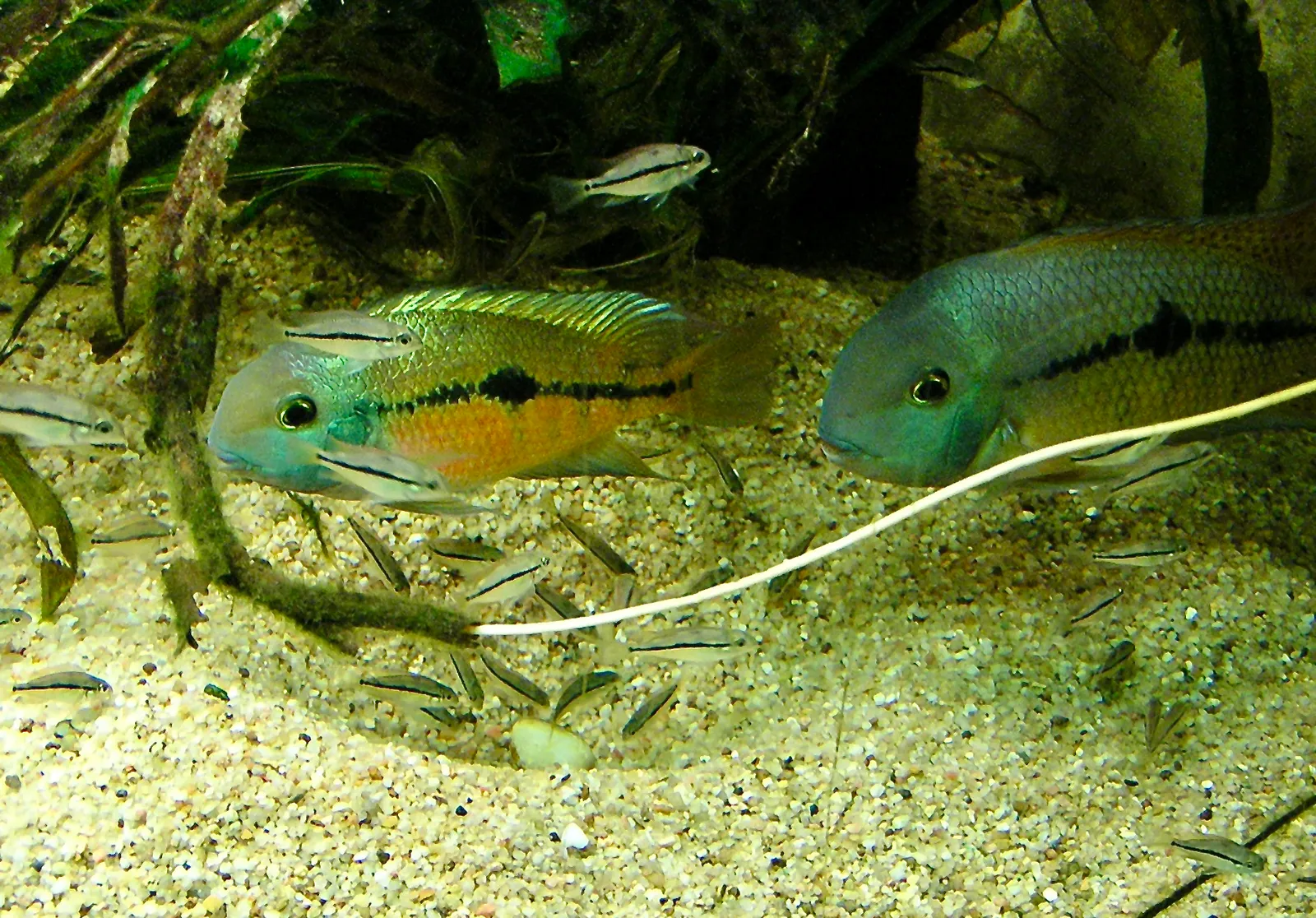
This is a moderately large, fusiform and laterally compressed cichlid. Length reports vary with how they are measured and with sex: FishBase lists 6.5 in standard length for males and unsexed fish and about 8 in total length for females, while a maximum of roughly 10 in TL has been cited; a sample of 556 wild fish from Lake Nicaragua topped out near 8 in TL, with half the catch between 10 and 6 in. Two features fix the identification at a glance: a dark longitudinal line runs the length of the flank, broken by a single large black blotch at midbody, and the head profile is extraordinarily curved and rounded, dropping to a small, slightly downturned, sub-terminal mouth. Adults are the reason the fish is kept — males show an iridescent greenish-blue head over a gold to copper body, scales finely edged in dark pigment to give a reticulated net pattern, and many dark spots on the fins with a red margin to the dorsal. The sexes diverge as they mature: females are smaller but often the more intensely coloured, retaining the full black lateral stripe, while in males the stripe contracts toward the single mid-flank spot. Both sexes develop a nuchal hump as a pair forms, rounding the forehead further, and males carry a pointed genital papilla. Juveniles are drab — silvery and yellowish with the dark bar and blotch — and the full colour does not arrive until the fish are roughly one and a half to two years old.
Habitat
Hypsophrys nicaraguensis is endemic to the Atlantic (San Juan) slope of southern Central America, ranging from Lakes Nicaragua, Managua and the crater lake Xiloá through the entire Río San Juan and its tributaries to the river's mouth, and south into the Matina drainage on the Atlantic slope of Costa Rica; a scattered record from the Río Coco hints at a thin presence farther north. It occupies both lakes and the slow-to-moderate reaches of rivers at elevations between about 5 and 656 ft. In the great turbid, phytoplankton-rich lakes of Nicaragua and Managua it is one of the most abundant open-water cichlids, and tellingly it concentrates in deeper water: in Lake Nicaragua roughly 80 percent of the population sits between 9 and 46 ft, apparently keeping clear of the shallow-loving Amphilophus citrinellus. Clear, deep Lake Xiloá by contrast offers 10–13 ft visibility. Bottoms range from mud and silt to sand, gravel, clay and rock, often with waterlogged wood; aquatic plants are sparse in its habitats. The water it lives in is decidedly alkaline — carbonate-alkaline rather than GH-hard — in the big lakes — pH measured at 8.35 to 8.5, conductivity of 200–400 µS/cm (and an extreme 5,580 µS/cm reported in Xiloá) — and warm, with Lake Nicaragua's surface running 75–86 °F through the year (the deep bottom near 61 °F) and Xiloá around 82 °F. Across river sites, Stawikowski & Werner recorded a wide envelope: pH 6.8 to 9, hardness only 2–5 °GH, and temperatures from 73–97 °F.
Feeding
The Nicaragua cichlid is best described as an omnivore that shifts diet with age and leans herbivorous-detritivorous as an adult. Juveniles take aquatic insects; adults graze bottom detritus, seeds and leaves, also ingesting sand and feeding on snails and other molluscs. Bussing's examination of 82 stomachs found one of the longest intestines among Costa Rican rainforest cichlids — a gut-to-body ratio of about 2.6, the hallmark of a plant- and detritus-processing fish — yet the contents were mixed: on average 48 percent aquatic animals (mostly dipteran larvae), 21 percent plant matter, 20 percent detritus, 9 percent silt and a trace of terrestrial prey. McKaye characterized the lake population outright as an herbivore working sandy areas. The small, downturned mouth is a grazing and sifting tool rather than a predator's, and the species sits low on the food web, with FishBase estimating a trophic level near 2.7. In short, it is a generalist bottom-grazer that the community treats as forage and competitor rather than threat.
Mating
Outside of breeding, Hypsophrys nicaraguensis is a gregarious, schooling fish of open sandy ground and, by Central-American standards, not especially aggressive. Reproduction reorganizes the population into a colony of female-centred nests. Males mature at about 4 in and females smaller, under about 2.5 in. In a clearwater tributary of the Río San Juan, Artigas Azas watched a breeding colony packed onto a clay bank in roughly a metre of water, with females each guarding a neatly drilled hole — a narrow rounded entrance about 3 in across and 8 in deep — and some nests as little as 4 in apart, while males patrolled the periphery and would court more than one female. Because the fish has a tiny, downturned mouth, Ron Coleman's underwater observations show it excavates by driving its large rounded head into the soft clay with twisting, drill-like movements rather than by digging with the jaws. Where rock is available, as in Lake Xiloá, pairs instead claim natural crevices, but they are pushovers in the competition for them: McKaye repeatedly saw the smaller, fiercer Neetroplus nematopus, along with convicts, evict Hypsophrys nicaraguensis pairs and push them into deeper water to spawn.
Breeding
Hypsophrys nicaraguensis is a biparental substrate spawner, but with a twist found in no other egg-laying cichlid: its eggs are non-adhesive. The medium-sized oval eggs, about 2.1 by 0.5 in, are laid loose at the bottom of the excavated chamber or pit, where — being light and buoyant — they roll about and are repeatedly gathered up by the female, the sealed tunnel keeping them from washing away. A spawn typically numbers about 200 to 400 eggs. The female tends the clutch deep in the cave while the male holds the surrounding territory; once the fry are free-swimming both parents escort and defend the school, retrieving the young the moment danger nears. At about 81 °F eggs hatch in roughly 84 hours and the wrigglers become free-swimming some 216 hours later; development slows markedly at 79 °F. In the dense lake colonies the species shows an unusual cooperative defence known as crèching, documented in Lake Xiloá and in an introduced Hawaiian population: groups of three or four females pool their broods and collectively repel intruders without fighting one another. Stranger still, McKaye found males of this species enlisted as helpers guarding the fry of the large predator Parachromis dovii — initially threatened, then tolerated, the moga vigorously attacked fry-predators (chiefly Neetroplus), and broods with such helpers fared best, a behaviour interpreted as a delayed-return benefit to the helper.
In the aquarium
The Nicaragua cichlid has been a hobby fish since William Bussing first imported it from Costa Rica in 1963, with Stratton & Loiselle publishing an early US keeping-and-breeding account in 1970; it reached Europe in the late 1970s. It is a good aquarium subject and, by the standards of large Central-American cichlids, comparatively peaceful — but it is still a 20-plus-cm territorial fish, so an adult male or a pair wants a tank of at least about 75 US gallons (80 US gal), and keeping it alongside other cichlids realistically calls for a six-foot footprint. A group can be housed together or with other mild-mannered cichlids; pairing it with genuinely aggressive species is a mistake, as the moga is easily bullied off territory.
Décor should reproduce its sandy, rocky home: a sand or fine-gravel substrate (the fish dig enthusiastically, especially when spawning), rocks and bogwood arranged into caves and broken sightlines, and few if any plants, since most will be eaten or uprooted — tough, attachable species such as Anubias and Java fern are the safe choices. Water should be kept mildly alkaline and warm to match the wild range: roughly 73–82 °F and pH 7.0–8.0, with hardness around 8–20 °H a common keeping target; the species does poorly in soft, acidic water. Coming from clean, well-oxygenated waters, it rewards heavy, frequent water changes and strong aeration. Feeding is undemanding — it accepts dried, frozen and live foods readily — but a thoughtful diet mirrors the wild ontogenetic shift: more animal protein (mysis, krill, bloodworm) for growing fish, then a greener, vegetable-leaning diet (blanched spinach, spirulina foods) for adults, both for colour and to suit that long herbivore's gut.
Breeding is straightforward once a pair forms, which is the hard part: the fish are aggressive toward each other, so the standard approach is to raise a group of six or more and let a pair settle out, then remove the rest, often using a shoal of robust dither fish such as silver dollars to diffuse tension. Provide a cave or a large flowerpot; the female will choose or excavate a spawning site and tend the brood, the male guarding the perimeter. Because the eggs are non-adhesive they roll loose and the female keeps collecting them. In captivity the pair are not always reliable at rearing fry — many keepers siphon off a portion to grow separately on baby brine shrimp — but a portion should be left, as stripping the whole brood can turn the pair on each other. The fry grow quickly, approaching 1 in a month after becoming free-swimming. The most common keeper errors are housing it too acidic and soft, pairing it with bullies that deny it a territory, and the longstanding temptation to cross it with convict cichlids — a hybridization best avoided.
Conservation
The IUCN Red List assesses Hypsophrys nicaraguensis as Least Concern (assessed 17 June 2019, published 2020, by T.J. Lyons and A. Angulo), with a population trend reported as stable. The species is widespread across the San Juan basin and the Nicaraguan great lakes, abundant in open water, and adaptable across a broad span of habitats, substrates and water chemistry — all of which buffer it against localized pressures. It carries no CITES listing and is of no commercial fishery interest, though it is traded as an aquarium fish. None of this exempts its watershed from the wider stresses on Central-American freshwaters: the Nicaraguan lakes and the Río San Juan face nutrient loading and eutrophication, shoreline alteration, invasive species and proposed large-scale infrastructure, and an established introduced population in Hawai'i is a reminder of the fish's own potential as a non-native colonizer elsewhere. For now, however, this is a secure and common species at the bottom of no one's conservation worry list.