Taxonomy & naming
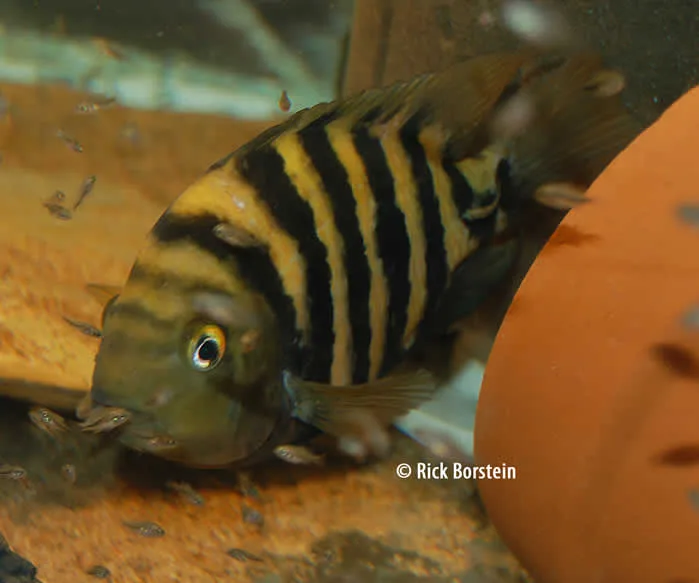
Amphilophus amarillo was formally described in 2002 by Jay R. Stauffer Jr. and Kenneth R. McKaye, in a monograph that introduced three Lake Xiloá cichlids at once — Amphilophus amarillo alongside Amphilophus xiloaensis and Amphilophus sagittae. The type locality is Lake Xiloá itself. The epithet is unusual: not Latin or Greek but Spanish, amarillo simply meaning "yellow," a nod to the buttery cheeks and flanks of breeding adults.
The fish belongs to the Amphilophus citrinellus species complex — the "Midas cichlid" radiation of Nicaragua's great lakes and crater lakes. These gold-and-grey fishes were long lumped as a single, wildly variable species; Stauffer and McKaye's work helped make the case that Xiloá holds several reproductively isolated forms that mate assortatively. Later crater-lake studies by Kathryn Elmer, Axel Meyer and colleagues set the Xiloá assemblage within a wider pattern of repeated, parallel Midas radiations across Nicaragua's young volcanic lakes, and showed those radiations arose by non-parallel genetic routes in different craters. Catalog of Fishes, FishBase, GBIF and the IUCN all treat Amphilophus amarillo as valid, authored by Stauffer & McKaye, 2002 — useful confirmation, given how tangled Midas-complex names get in the older literature.
Morphology
This is a large, robust Midas cichlid. The 6 in standard length in FishBase comes from the preserved type series; in the aquarium the fish grows well past that, with experienced keepers reporting males to around 14 in and females a little smaller — a snail-crushing heavyweight that needs the same six-foot tank as the rest of the Midas group. The body is deep and laterally compressed, the high-bodied, benthic shape typical of shoreline Midas cichlids rather than the torpedo-shaped open-water forms sharing the lake.
Colour is where the name earns itself: breeding adults show a yellow wash across the lower head, cheeks and flanks. Unusually for a cichlid, males and females are coloured much alike, so sexing by eye is unreliable; what dimorphism there is comes down mainly to size, with males running a little larger. The most telling feature is internal rather than a surface mark — like the other shoreline Midas species, Amphilophus amarillo carries robust, molariform (flattened, crushing) pharyngeal teeth in the throat, the toolkit of a snail-eater. Distinguishing it from its lakemate Amphilophus xiloaensis is genuinely hard; the two are so alike in colour and shape that even researchers lean on genetics and breeding-pair behaviour rather than any single field mark.
Habitat
Amphilophus amarillo is endemic to a single body of water: Lake Xiloá (Laguna Xiloá), a small volcanic crater lake on the Chiltepe Peninsula about 12 mi north of Managua, and one of the water bodies covered in this atlas. The IUCN puts both its extent of occurrence and its area of occupancy at no more than about 4 sq mi. Although Xiloá sits beside the much larger Lake Managua (Lake Xolotlán) and the species is sometimes reported under that lake's name, Xiloá is a separate crater basin; its Midas cichlids are thought to descend from Managua colonists that arrived when a higher historical lake level briefly connected the two.
Within Xiloá this is a shallow-water, near-shore fish. FishBase records it across roughly 10–33 ft, and the IUCN notes it usually keeps close to shore among weedy aquatic vegetation rather than over the deeper rocky reefs — a partitioning by depth and substrate that helps hold the lake's Midas species reproductively apart. The water is warm and alkaline: a survey of Nicaraguan crater lakes recorded Xiloá (spelled "Jiloá" in the older literature) at about pH 8.0 at the surface, a surface temperature near 81–82 °F, conductivity around 5,580 µS/cm and high carbonate alkalinity. The shallow vegetated margins this fish prefers are exactly the zones most exposed to whatever happens along the shoreline.
Feeding
Amphilophus amarillo is best read as a benthic, shoreline snail-eater. Trophic work on Xiloá's Midas cichlids (Vivas & McKaye 2001) separated the high-bodied, near-shore forms from the elongate, open-water Amphilophus sagittae, which is limnetic and takes a more pelagic diet. The molariform pharyngeal jaws are the shoreline tool: hard mollusc shells are crushed in the throat rather than the mouth. FishBase places the species at a trophic level around 3.3, in line with a generalist invertebrate feeder that leans on snails but is unlikely to refuse worms, insect larvae or other small benthic prey.
This carving-up of the food supply is the ecological heart of the Xiloá story. From one founding Midas population the lake produced fishes tuned to different niches — shoreline benthic feeders against an open-water form — a case of incipient sympatric speciation, where new species arise within a single area with no geographic barrier to split them. Amphilophus amarillo sits near the conservative, benthic end of that radiation.
Mating
Like Midas cichlids generally, Amphilophus amarillo is monogamous: it forms a bonded pair, defends a territory, and tolerates almost nothing inside it once breeding begins. That reproductive behaviour is also the engine of the species' identity. In Xiloá the several Midas species breed largely in different micro-habitats and mate assortatively, pairing with their own kind rather than across species. For a fish this hard to tell apart by eye, that consistent mate choice does much of the work a geographic barrier would do elsewhere, and it is a large part of what keeps Amphilophus amarillo a distinct lineage rather than blending back into the Midas swarm.
As across the complex, pairing brings a sharp rise in aggression: bonded fish turn territorial and will drive off intruders many times their size, so courtship and the holding of a spawning site are inseparable. The handful of aquarists who have kept genuine Xiloá amarillo report the same pattern — a pair that dominates its surroundings rather than coexisting peacefully — though identity claims on hobby fish deserve caution given how alike the complex's members look, and the species essentially never moves through the ordinary trade.
Breeding
Amphilophus amarillo is a biparental substrate spawner. Pairs lay adhesive eggs on a firm, cleaned surface — a rock face or the wall of a cave or crevice — after which both parents guard the clutch, fan the eggs and then shepherd the free-swimming fry, the deposit-on-hard-substrate, both-parents-on-guard pattern documented across the Midas complex. Clutch counts, egg numbers and fry-development timings specific to Amphilophus amarillo have not been published in the original description or the later crater-lake literature, so the species-level figures stay thin. The genus-typical template is the one well established for close relatives such as Amphilophus citrinellus, which deposits on the order of 300 to 1,000 adhesive eggs per spawning and guards eggs and fry together for several weeks (FishBase) — the best guide for amarillo until a species-specific count is documented.
What the Xiloá research does pin down is the timing and placement of breeding rather than the brood-care arithmetic. The lake's Midas species spawn in partly separate micro-habitats and seasons, and it is that separation — not any difference in the basic care behaviour — that keeps the forms apart. In aquaria the sensible expectation, by analogy with the complex, is a pair that spawns on a hard surface in warm, hard, alkaline water echoing its crater-lake origin and guards the young intensively; read that as context, not as a verified care record for a fish that belongs, realistically, in its lake and in research collections.
In the aquarium
The honest starting point is sourcing. Amphilophus amarillo essentially never moves through the commercial chain; genuine fish surface only among specialist Central American cichlid breeders, usually with documented lineage, and a verified pair is the exception. The name "amarillo" is applied loosely to any yellow-washed Midas cichlid, and since even researchers struggle to separate the Xiloá species, treat any identity claim with skepticism.
Water: match the crater lake — warm, hard and alkaline, roughly 81–82 °F at pH about 8.0–8.2, with conductivity near 5,580 µS/cm (Barlow, Baylis & Roberts 1976/ICHTHY). Tap water trending neutral-to-alkaline and moderately hard suits these fish; the soft, acidic conditions right for Amazonian cichlids are emphatically wrong. Weekly changes of about 50 % keep pace with a big cichlid's load, and filtration should be oversized for the volume.
Tank: a six-foot (about 71 in) tank is the working minimum for a bonded pair, more floor area better. FishBase's 6 in SL is the wild type figure; aquarium males can approach 14 in TL on generous feeding (Borstein), so space is not optional. Seriously Fish's guidance for the close relative Amphilophus citrinellus calls for at least a 150 × 17.5 in footprint for one fish, and more for a pair. Use sand or fine gravel (the fish will dig), with large stable rocks and heavy ceramic or clay pieces as spawning sites and sight breaks; live plants won't survive the digging and alkalinity, and even artificial ones get moved.
Tankmates: aggression is the defining challenge. Males are hard on each other and on females outside a stable bond, so the safest route to a pair is to grow on a group of juveniles and remove the surplus once a pair declares itself. In genuinely large systems — well over 130 US gal — other big, robust Central American cichlids (comparable Vieja, Parachromis or other Amphilophus) are the only realistic companions, and even then some individuals tolerate none. Smaller or community fish should not be attempted.
Common mistakes: underestimating the space and the aggression. Spawning sharpens both — the pair attacks anything near the nest, including your hand, and the male may turn on the female once the fry are mobile, so keep a divider handy. Feeding is easy: quality cichlid sticks, earthworms, prawn, mussel and some vegetable matter all work (Borstein); skip high-protein mammalian meats. The difficulty is intermediate-to-advanced — not because the fish is delicate, but because the space and aggression are unforgiving and finding a verified specimen is the hardest part of all.
Conservation
The IUCN Red List assesses Amphilophus amarillo as Vulnerable (VU, criterion D2), assessed on 17 June 2019 and published in 2020 by Lyons and Contreras MacBeath. The category is driven by geography rather than any observed decline: the species is known from a single location with an area of occupancy of about 4 sq mi, and the population trend is judged stable. There is no trade or fishery pressure — the fish is not utilized — and Lake Xiloá lies within the Chiltepe Peninsula Nature Reserve, which affords some indirect protection. The flagged danger is future, not present: the establishment of non-native tilapia (Oreochromis spp.), or land-use change around the crater, could imperil a fish with nowhere else to go. As of the assessment, tilapia had not become established in Xiloá (McCrary et al. 2007), and the lake faced no major current threats.
That picture is strikingly different from the lake next door. Lake Managua (Xolotlán) — the larger basin from which Xiloá's cichlids descend — is one of Central America's more degraded lakes: shallow and naturally alkaline, it has absorbed decades of untreated sewage from greater Managua, agricultural runoff and industrial discharge, with documented heavy-metal contamination and nutrient loading. It would be easy to let Managua's troubles bleed onto its small neighbour, but the evidence doesn't support it: Amphilophus amarillo's own lake stays comparatively healthy, and the species is listed Vulnerable because its entire world is one small crater — a fish that is fine today but would have no refuge if that single lake's luck changed.