


Taxonomy & naming
Albert Günther described the Midas cichlid as Heros citrinellus in 1864, in the Proceedings of the Zoological Society of London, working from material collected in Lake Nicaragua. The epithet is Latin for "lemon-coloured," a nod to the near-uniform yellow some adults show. The genus name Amphilophus, coined by Agassiz in 1859, joins the Greek amphi ("on both sides") and lophos ("crest"); Agassiz never spelled out the allusion, and the usual reading ties it to the hyperdeveloped lips of Amphilophus froebelii — a synonym of Amphilophus labiatus — rather than to the forehead hump.
The fish has carried several names, passing through Cichlosoma and Cichlasoma citrinellum before workers settled it in Amphilophus, where it remains. Two well-known nominal species fold in as synonyms: Gill's Heros basilaris (1877) and Meek's Cichlasoma granadense (1907). Today Amphilophus citrinellus anchors what biologists call the "Midas cichlid species complex," a cluster of closely related, recently diverged Amphilophus from Nicaragua's lakes.
Central American cichlids with this specialised substrate-picking habit — echoing the true earth-eaters of the genera Satanoperca and Geophagus in South America — are grouped together in Amphilophus: besides A. citrinellus the assemblage includes A. alfari, A. lyonsi, A. macracanthus, A. rostratus and A. robertsoni. The diagnostic package for the genus is a pointed head with a long snout, a straight upper (dorsal) profile, long pectoral fins, and five to nine bars along the flank. Within that assemblage the fish split by feeding technique: A. longimanus, A. rostratus and A. robertsoni are true substrate sifters, taking a mouthful of bottom material and straining it for edible matter much as a Geophagus does, while the citrinellus-complex species — A. citrinellus among them — instead pick food items directly off the substrate rather than sifting for them (see Feeding).
Morphology
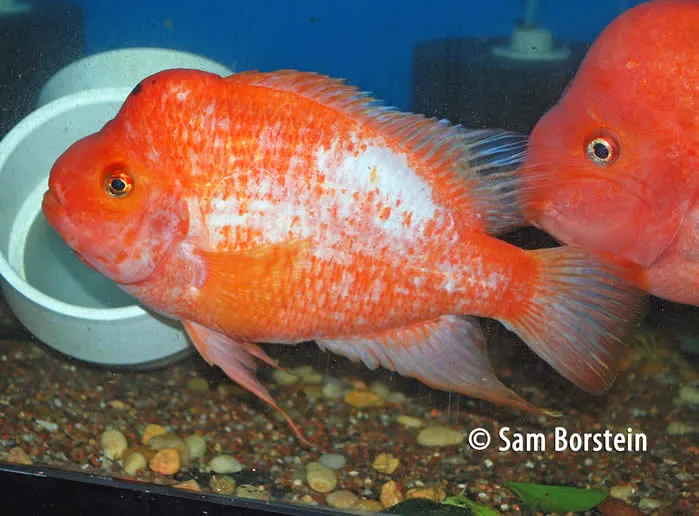
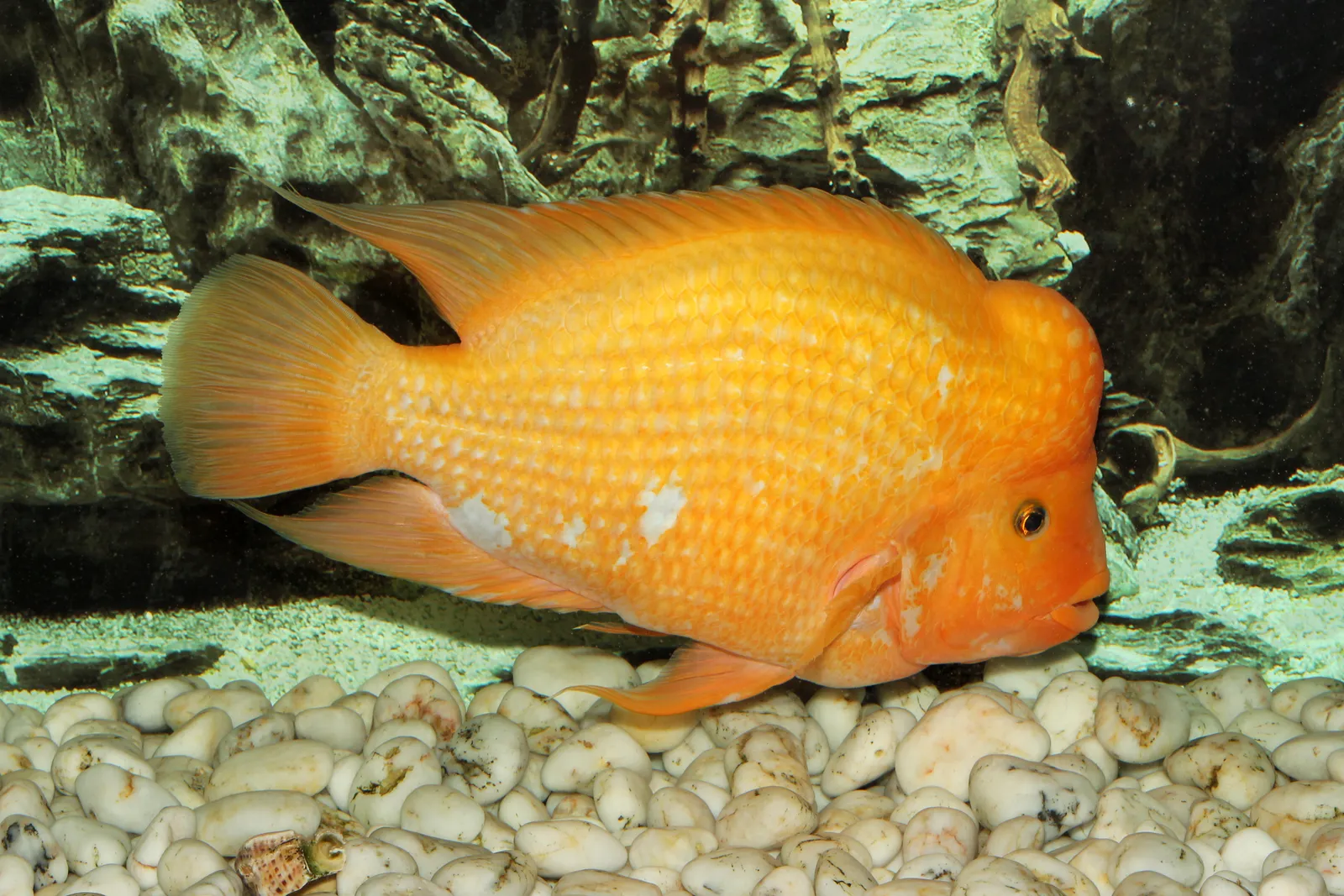
This is a deep, laterally compressed, heavy-headed cichlid built like a small bulldozer. Most wild fish wear cryptic camouflage — grey, brown or black broken by darker bars — that matches the rocky bottom. The gold is the exception: roughly one fish in ten is xanthomorphic, losing its dark melanin and turning yellow, orange or red, sometimes only partway through life and, in a few fish, over just a few weeks. Hobby strains have pushed that orange, gold and red as far as it will go, so most shop fish are colour-selected rather than wild-typical, and white, piebald and barred forms exist as well.
Maximum size is genuinely disputed. Ichthyological references cap it near 9.5–10 in standard length — FishBase carries 9.5 in SL, after Kullander, 2003, the figure the IUCN also cites — while aquarists routinely report fish of 12-16 in (12–15.5 in) total length on rich food; the honest read is that wild fish stay smaller than the tank monsters the hobby produces. Mature males are the larger, longer-finned sex and grow a pronounced nuchal hump on the forehead. In the wild that hump swells during the breeding season, but tank-raised males, feeding continuously on rich food, often carry a permanent, exaggerated version. The Midas is most often confused with the red devil, Amphilophus labiatus; the reliable separators are the Midas's heavier build and bigger hump, not the lip size the "red devil" name implies.
Habitat
Amphilophus citrinellus is native to the Atlantic (Caribbean) slope of Nicaragua and Costa Rica, centred on the San Juan River drainage. That range takes in the two Nicaraguan great lakes — Lake Nicaragua (Cocibolca) and Lake Managua (Xolotlán) — the volcanic crater lakes Masaya and Apoyo, and, southward into Costa Rica, the rivers down to about the Matina drainage. It is fundamentally a lake fish: common in standing water, uncommon to rare in rivers, where it keeps to the slow, tranquil lower reaches. Those small, young, isolated crater lakes are the engine of the Midas complex's radiation, colonised and re-diversified again and again by founding citrinellus stock.
Within a lake it favours structure, hugging rocky walls and banks, crevices, and box-cut canals whose vertical faces double as foraging ground and spawning sites. Field transects place it in the shallow littoral, densest near 16 ft and thinning to about 66 ft. The water is mildly alkaline, as these basins tend to be, and the thermal band is wide — FishBase gives roughly 23-33 degrees C (73-91 degrees F). That toughness cuts both ways: aquarium and fish-farm releases have established breeding populations in the United States, and the species is recorded as a non-native in Singapore, Indonesia, the Philippines and Australia.
Feeding
FishBase rates the Midas an omnivore at a trophic level near 3.2, taking aufwuchs — the film of algae and small invertebrates on rock — along with snails, insect larvae, worms, other bottom life and small fish. Unlike its true earth-eating relatives in the genus — A. longimanus, A. rostratus and A. robertsoni, which sift mouthfuls of substrate the way a South American Geophagus does — the Midas is a picker: it selects food items directly off the bottom rather than filtering them out of a mouthful of sediment, and invertebrates make up a substantial share of what it takes. What makes its feeding scientifically interesting is the machinery behind it. The species is trophically polymorphic: an individual grows one of two forms of the lower pharyngeal jaw, the second set of "throat" teeth cichlids use to process food. Papilliform morphs carry fine, pointed teeth suited to soft prey; molariform morphs grow blunt, heavy crushers.
Meyer's work on Nicaraguan populations in the late 1980s and 1990 showed the payoff: molariform fish crack snail shells the papilliform fish cannot, while papilliform fish handle soft, evasive prey more efficiently. Crucially, none of this is fixed at birth. Every Midas starts papilliform, and the jaw can shift toward the molariform condition with diet — a case of adaptive developmental plasticity, shown in common-garden experiments (e.g. Gunter et al., 2011). That switchable jaw, paired with a generalist appetite, helps explain how one lineage kept colonising new crater lakes and diversifying.
Mating
The Midas forms monogamous pairs that bond and defend a shared territory around cover — a vertical rock face, a crevice, a log — which becomes the focus of both courtship and spawning. Socially it is intensely territorial and can be severely aggressive toward its own kind and toward tankmates, above all as a pair forms and prepares to spawn. Keepers' reports run a wide spectrum: some describe a "gentle giant" with personality to spare, others a fish that kills indiscriminately. That spread is real — temperament varies by individual, sex and space, and the gentler stories almost always come from fish given plenty of room.
That behaviour drives the standard advice: grow out a group of six or so juveniles together and let a pair sort itself out, rather than forcing two adults together, where a mismatched male will often kill the female. The aggression that makes the fish difficult is the same trait that makes it a formidable parent — its territoriality is the leading edge of a long, determined brood defence. In the wild, pairing and spawning concentrate in the rainy season.
Breeding
The Midas is a biparental substrate spawner. A settled pair spawns by preference on the ceiling of a cave or another hard surface — a vertical rock face or a log — where the female lays a clutch usually put at 300-1,000 eggs, fertilised and then guarded by both parents. The eggs hatch in a few days, and the pair shepherd the yolk-bearing wrigglers from pit to pit until they go free-swimming, defending them fiercely the whole time.
The most charming detail is documented rather than anecdotal: Midas fry feed partly by grazing mucus from their parents' skin — "parent-contacting," worked out by Noakes & Barlow (1973). The species has been a behavioural-research workhorse for exactly this kind of rich parental care. In aquaria it breeds readily once a compatible pair has settled, given a cave or flat hard surface and stable, warm water; the hard part is rarely getting a spawn and far more often managing the aggression a spawning pair turns on everything else in the tank.
In the aquarium
One of the most rewarding and most demanding large cichlids in the hobby — intelligent, long-lived and impossible to ignore, but big, strong, destructive and quick to punish any compromise in space, filtration or tankmates.
Tank: space is non-negotiable. Seriously Fish recommends at least 5 ft of floor length for a single fish and more for a pair, with 6-8 ft the practical standard and larger always better; undersized housing drives the pacing, explosive aggression and fin damage behind the species' worst reputation. Bed heavy rockwork on the tank base before the substrate goes in, because the fish digs and bulldozes relentlessly and will topple anything unsecured. Use only smooth, inert stones — sharp edges can cut a big Midas as it works the rock — and forget planted aquascapes, though floating plants can add cover in a tall tank.
Water: pH 7.0-8.0, moderately hard (10-20 dGH), 23-28 degrees C (73-82 degrees F), nudged to the top of that range to help condition a pair. Chemistry is forgiving; cleanliness is not. A big, gluttonous omnivore makes a heavy waste load, so run strong filtration — at least 8-10 times the tank volume per hour — and change 30-50 % of the water weekly.
Tankmates: aggression is the defining challenge. Two males usually fight until one is dead or crippled, and even a pair can turn lethal if the male harasses an unreceptive female — so grow out six or more juveniles, let a pair form, then rehouse it, and introduce any strange adult only across a divider. Toward other species the Midas is broadly hostile, treating most fish as rivals or food; large, robust tankmates can work in very spacious systems, but a single-species tank for a pair, or a lone fish, is the safest and most humane setup, and the fish does not suffer for the lack of company. Amphilophus species generally combine reasonably well with each other, but not as a blanket rule: Amphilophus citrinellus should not be housed with the true red devil, Amphilophus labiatus, and A. robertsoni should likewise be kept apart from A. rostratus — established incompatible pairings within the genus, presumably driven by hybridisation risk and sharpened territorial conflict between close relatives.
What you're buying: the trade is muddled. The true red devil, Amphilophus labiatus, is a separate species from Lakes Managua and Nicaragua with deeply hypertrophied, rubbery lips, yet most fish sold as "red devil" are Midas cichlids, citrinellus-type hybrids or selected strains, since pure Amphilophus labiatus is genuinely uncommon. Both the man-made flowerhorn — mass-produced in Southeast Asia since the late 1990s — and the blood parrot trace partly to Amphilophus citrinellus, but neither bears any real relation to a wild Nicaraguan fish. If a documented wild line matters to you, buy from a breeder who keeps one.
Feeding: a quality large-pellet staple plus earthworms, prawns, mussels and vegetable matter such as blanched spinach or courgette. Avoid mammalian meats like beefheart — the fat load harms the liver over time — and feed once or twice a day without overfeeding a fish that eats voraciously whether it needs to or not.
Conservation
The IUCN Red List assesses Amphilophus citrinellus as Least Concern (Lyons & Angulo, assessed 7 November 2019, published 2020). It is widespread across the Nicaraguan lakes and rivers, breeds readily, is bred in large numbers for the trade, and has even become an established invasive abroad — so the species itself is in no danger, and there is no meaningful wild-collection pressure on it. That security, though, sits inside a strained basin, and the two facts should not be confused.
Lake Cocibolca and Lake Xolotlán are under real and documented pressure: nutrient loading and pollution, agricultural runoff, the spread of introduced African tilapia that can aggressively displace native species, and long-running proposals for an interoceanic canal cut through the lake. The worry concentrates on the endemic radiation Amphilophus citrinellus seeded — narrow-range crater-lake descendants with nowhere to go. Lake Apoyo is the showcase: Barluenga, Meyer and colleagues (Nature, 2006) presented it as a convincing case of sympatric speciation, the arrow cichlid Amphilophus zaliosus diverging in place from a Midas-like ancestor. That arrow cichlid is now Red-Listed as Critically Endangered, and several other crater-lake Amphilophus remain unassessed. The fair summary: the Midas cichlid is secure, but the lakes and the young species it helped spawn are not.