Taxonomy & naming
The zebra acara was described in 1993 by the Swedish ichthyologist Sven O. Kullander and the Colombian ichthyologist Saúl Prada-Pedreros as Nannacara adoketa, in Ichthyological Exploration of Freshwaters (4(4):357–366). The description rested on just two specimens collected in 1990: the holotype (MZUSP 44685, in the São Paulo museum) and a single paratype (NRM 27058, Stockholm), taken from the Igarapé do Cumaru, a small forest tributary of the Paraná Atauí in the middle Rio Negro drainage of Amazonas State, Brazil. The species had actually reached aquarists first — a colour photograph of an export bycatch fish was published in a Japanese magazine in 1989 and a German one in 1990 — and Uwe Römer's group collected and bred living fish in 1992, so the formal description and the hobby's discovery ran almost in parallel. In 2006 Römer and Hahn split adoketa (together with the Guyanese Eigenmann's bimaculata) out of Nannacara into a new genus, Ivanacara, named for Tsar Ivan the Terrible in allusion to what they regarded as the fish's aggressive, unpredictable temperament; they diagnosed the two inland species on morphometrics, breeding behaviour and distribution. That move was published in a book rather than a peer-reviewed paper, and acceptance has been split ever since: Eschmeyer's Catalog of Fishes lists the current valid name as Ivanacara adoketa, while FishBase retains Nannacara and flags the Ivanacara placement as needing scientific confirmation. Most of the hobby now uses 'Ivanacara,' but the fish is still very widely sold and written about under its original combination, Nannacara adoketa. The genus sits in the American cichlid subfamily Cichlinae, tribe Cichlasomatini.
Morphology
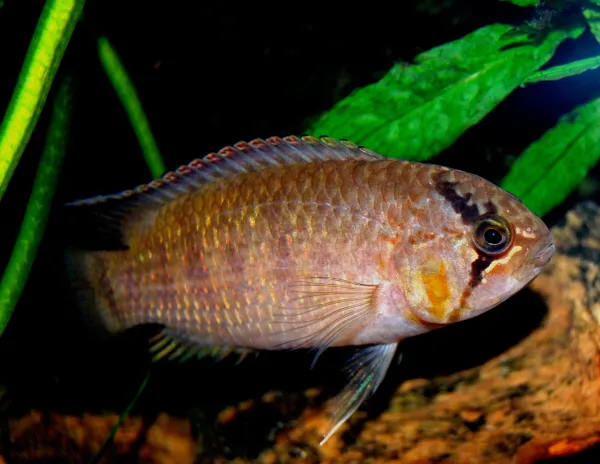
Ivanacara adoketa is a comparatively chunky, deep-bodied dwarf cichlid with a notably rounded, short head — a 'beefy' look that sets it apart at a glance from the slimmer Apistogramma it is often sold beside. It is also among the larger of the South American dwarfs. The original description and FishBase give a maximum of about 2 in standard length (males), and FishBase notes a maximum of roughly 4 in total length; experienced keepers report well-fed aquarium males exceeding 4 in and occasionally approaching 4.5 in TL, with females staying considerably smaller — generally up to about two-thirds of male size. The defining feature is the colour pattern, which is extraordinarily mood-dependent and can change completely within minutes. In a neutral mood the fish is a quiet beige, light grey or blue-green, scattered with silvery and metallic-green spots and lines across the flanks and head; a dark lateral spot is sometimes visible. The longitudinal stripes typical of true Nannacara are absent. Instead, with excitement or in breeding condition, about seven dark transverse bars rise across the body — intensely black, especially in reproductively active females, which take on extreme, high-contrast 'zebra' coloration that may spread to the lips and underside of the head. The face carries additional dark markings on the forehead, snout and below the eye. Geographic colour forms exist: lower-Rio-Negro fish tend toward pure green-blue, while fish exported via Colombia show strong orange-brown on the caudal peduncle, head and the bases of the dorsal and anal fins. Sexual dimorphism is real but subtle outside of breeding: adult males are larger and often less contrastingly marked, while elongated dorsal, anal and thread-like ventral-fin tips occur in both sexes and are not reliable for sexing.
Habitat
The species is endemic to the middle and upper Rio Negro drainage in Amazonas State, Brazil, with documented localities lying between the mouth of the Rio Uaupés and the municipality of Santa Isabel do Rio Negro; Kullander (2003) treated it as endemic there. (A more recent, unverified report — photographs of an apparent zebra acara from the Rio Inírida near Puerto Inírida in Colombia's western Orinoco basin — would, if confirmed, extend the range some 497 mi to the northwest, but this remains anecdotal and is not reflected in the formal range.) These are quintessential blackwater fish. At the type locality the Igarapé do Cumaru was a tiny forest stream, at most about 11 in deep, with a surface temperature near 75 °F and very low dissolved oxygen (around 1.8 mg/L). Römer's ecological notes describe a clearwater-to-blackwater forest brook 2–10 ft wide and under about 8 in deep, its bottom buried in a thick layer of fallen leaves and twigs, with temperatures of 75–81 °F, electrical conductivity below 50 µS/cm, and a pH oscillating between just 4.5 and 5.0. Hobbyist field accounts from the region report dry-season pH dropping as low as 3 in places. In short, this is a fish of the leaf-litter layer of small, shaded, extremely mineral-poor and strongly acidic rainforest waters. During the wet season these streams flood into the surrounding forest floor, opening up new feeding territory; FishBase records the species 'collected from a small stream in inundable forest.'
Feeding
In the wild the zebra acara is a micro-invertivore of the leaf-litter zone. It picks small prey from the interstices of submerged leaves and branches — aquatic crustaceans such as Cyclops and water fleas, insect larvae, and other small invertebrates and zooplankton — rather than sifting open sand. FishBase places it at a trophic level of about 3.1, consistent with a small predator of bottom-dwelling invertebrates rather than a herbivore or detritivore. Its association with deep leaf litter is so close that keepers use a mature, leaf-strewn substrate not only as cover but as a self-renewing food source: micro-crustaceans and worms colonise the litter and supply a trickle of live food between feedings, which is often what coaxes shy wild-caught fish into eating. In the stream community it is one of many small fishes — alongside Apistogramma and characins — working the litter bed for the invertebrate fauna that the decaying leaves support, with that food supply expanding dramatically when the seasonal flood lets the fish onto the inundated forest floor.
Mating
Zebra acaras form monogamous pairs, and pair compatibility is the hinge on which everything turns. Reported temperament varies sharply between observers: Römer's wild-caught fish were aggressive and intolerant enough that he advised against keeping them in simple pairs, and the genus name Ivanacara was coined precisely for that reputation; Wolfgang Staeck, by contrast, after decades keeping the species, described stable, close pair bonds with little or no aggression once fish had settled, and even a male peacefully holding two females that periodically swapped breeding roles. The likeliest reconciliation is that mismatched, force-paired adults turn on each other, while compatible pairs — best obtained by raising a group of juveniles and letting bonds form naturally — settle into a tight partnership. Courtship is mutual and conspicuous: both sexes flush into variable, intensified coloration and perform head-jerking and tail-slapping displays, and together they clean and prepare the spawning site the female has chosen. Males are territorial toward rival males, and during spawning either sex may turn on the other, which is why even a breeding setup needs a generous footprint and broken sightlines so a harassed fish can retreat. Where the bond holds, the pair defends a shared territory and the female leads.
Breeding
Ivanacara adoketa is a biparental substrate/cave spawner with strongly female-biased brood care — the classic Nannacara pattern in which the female assumes a bold, dark dress and runs the nursery while the male patrols the perimeter. The female selects the site, typically a solid, sheltered horizontal surface or a cave-like cavity protected from above (in nature, a leaf or root; in tanks, the underside of décor, a flat stone, a flowerpot, a seed pod or a length of PVC). The eggs are amber-coloured; FishBase, after the original description, gives roughly 200–300 deposited on roots, guarded and fanned by both parents. Once the clutch is laid the female does most of the close tending of eggs and larvae while the male defends the breeding territory against intruders. Depending on temperature (about 75–81 °F), up to roughly 100 larvae hatch after three to five days, and the fry are free-swimming about a week later, by which point they are large enough to take newly hatched brine shrimp. Successful spawning is genuinely difficult and not consistently achieved: very soft, very acidic water (negligible carbonate hardness, low conductivity, pH well below 6) appears essential for the eggs to develop, and even experienced breeders report frequent pseudo-spawnings, cleaned sites with no eggs laid, and clutches that fail when the water is not soft enough. Diet, water chemistry and tank layout all seem to interact as triggers, and no single decisive cue has been pinned down.
In the aquarium
The zebra acara is a rewarding but demanding fish, well suited to a dedicated soft-water or biotope tank and poorly suited to a general community. Because it runs larger than most dwarf cichlids and the sexes can turn on each other, give it more room than its size suggests: a footprint of about 90 × 35–40 US gallons is a sensible minimum for a single pair, and larger is better — especially if any tankmates are present — so that a harassed fish always has somewhere to hide. Staeck kept fish successfully in smaller 60-cm tanks, but with careful pairing; the safe default is space plus plenty of visual breaks.
Water chemistry is the crux. These are blackwater fish from water of almost no hardness and pH around (or below) 5. For maintenance, captive-bred stock tolerates a fairly wide band — even hard, alkaline tap water in Staeck's experience — and FishBase lists pH 4.5–6.0, dH 5–10 and 72–82 °F; but for colour, health and any hope of breeding, aim low: start from RO or clean rainwater with negligible carbonate hardness, then let botanicals (leaf litter, alder cones, catappa leaves) and peat acidify it to a pH of 6.5 or, better, below 5.5, with low conductivity. Temperature in the mid-to-upper 70s °F (about 75–82 °F) suits them. Filtration should be gentle — a matten/sponge filter on a slow airlift mirrors the still, dark forest brooks far better than strong flow.
Furnish the tank as a leaf-litter biotope: a fine, inert sand substrate, aquarium-safe wood, and a generous bed of leaves and seed pods. Use only inert hardscape — calcareous rock or 'Seiryu'-type stone will slowly drive hardness and pH back up and undo the whole setup. Crucially, offer several spawning options (caves, coconut shells, flat stones, PVC, large seed pods) and let the female choose; she will often ignore proffered flowerpots and spawn on the most unexpected surface.
Feeding is straightforward once fish settle. Wild-caught individuals may sulk at first and are best tempted with live and frozen micro-foods — Cyclops, Daphnia, bloodworm, mosquito larvae, small worms — over a mature litter bed that breeds its own live food; captive-bred fish usually take prepared foods readily. Avoid overfeeding rich, protein-heavy foods, a common mistake with leaf-litter dwarfs.
For company, keep it loose and water-matched. Small characins of the same blackwater — cardinal tetras, pencilfish — make good, fry-safe dither fish that stay out of the cichlids' way. Avoid bottom-grubbing catfishes (the former Corydoras), which blunder into the acaras' territory and get harassed, and avoid other cichlids or boisterous species, since zebra acaras are simultaneously territorial and easily intimidated. The single biggest husbandry pitfalls are pairing incompatible adults (raise a group and let pairs form) and failing to make the water soft and acidic enough for the eggs to develop.
Conservation
Ivanacara adoketa has not been assessed for the IUCN Red List — it carries no global conservation status under either Nannacara adoketa or the name Ivanacara adoketa (FishBase, Red List version 2025-2: Not Evaluated), and it is not listed by CITES. No formal population data exist. The species has a small, somewhat patchy and hard-to-access natural range in the middle and upper Rio Negro, and it has only ever been exported sporadically for the aquarium trade, so collection pressure appears modest; a regularly bred captive population (including an attractive Colombian-import form) keeps it secure in the hobby without continuous reliance on wild fish. The broader context is the Rio Negro blackwater system itself, whose extreme, mineral-poor, acidic forest streams are vulnerable to deforestation, gold-mining and watershed disturbance; none of these is documented as a specific threat to this particular cichlid, but as a narrow-range blackwater specialist it would be exposed to any large-scale degradation of its leaf-litter habitat. A modern Red List assessment would be needed to judge its status with any confidence.