Taxonomy & naming
Salvin's cichlid was described by Albert Günther in 1862 as Heros salvini, named for the British naturalist Osbert Salvin, who collected extensively in Central America. For most of the twentieth century it swam through the aquarium and scientific literature as Cichlasoma salvini, parked in the enormous catch-all genus Cichlasoma. In 2007 Schmitter-Soto, revising the firemouth-and-allies group, erected the monotypic genus Trichromis for it — the name ('three colours') alluding to the fish's striking yellow, black and blue livery — and Trichromis salvini is now the accepted name, though the synonym Cichlasoma salvini remains widespread in the hobby. The genus belongs to the Middle American heroine cichlids (tribe Heroini); molecular work (Říčan et al. 2016) supports its recognition as a distinct lineage among the smaller Mesoamerican heroines. It is the only species in Trichromis.
Morphology
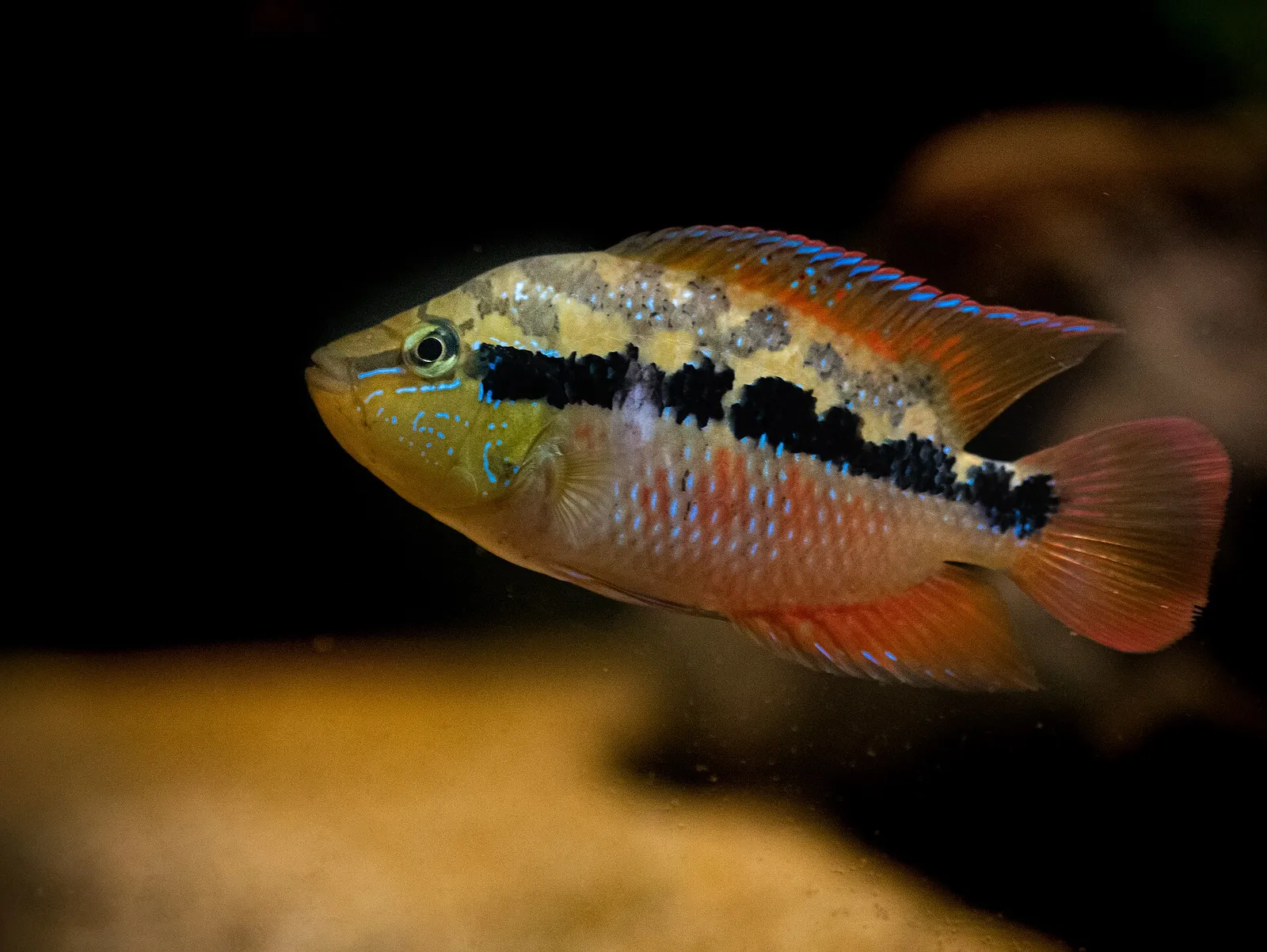
Trichromis salvini is a moderately elongate, medium-sized cichlid reaching about 8.5 in SL, with males somewhat larger than females; most aquarium fish mature around 5–7 in. It is among the most colourful Central American cichlids: the flank is a brilliant yellow to gold, crossed by two dark longitudinal stripes — an upper line running from the snout through the eye along the back, and a lower midlateral line of fused blotches — with a dark spot at the caudal-base and another mid-flank. Turquoise to blue spangling dusts the lower body, cheeks and unpaired fins, and the fins are often edged red. Colour intensifies dramatically with condition and breeding. Sexual dimorphism is unusually pronounced and reversed from the usual cichlid pattern in one respect: the female, when in breeding condition, becomes the more vividly coloured sex, developing an intense black-and-gold belly and a bright red or orange throat and lower flank, while the male, though larger and with more produced, pointed dorsal and anal fins, is somewhat plainer. This makes sexing relatively straightforward in mature fish.
Habitat
Salvin's cichlid inhabits the Atlantic slope of northern Central America, from southern Mexico (the Coatzacoalcos, Papaloapan, Grijalva–Usumacinta and Yucatán drainages) through Guatemala into Belize. It favours warm rivers and streams of the lowlands and lower highlands, particularly the moderately to fast-flowing middle and lower reaches, but also occurs in lagoons, lakes and quieter backwaters, over varied substrates among rock, wood and vegetation. The water across its range runs warm and typically hard and alkaline, in keeping with the limestone geology of much of the region; FishBase cites a broad temperature tolerance of roughly 72–90 °F and pH about 7.0–8.0. Its preference for flowing, well-oxygenated water distinguishes it somewhat from the more swamp-tolerant Jack Dempsey, but it is adaptable across a range of lowland habitats.
Feeding
Trichromis salvini is a carnivore, FishBase placing it at a trophic level near 3.7 — somewhat higher than most of its relatives, reflecting a notable inclination toward fish prey. In the wild it feeds on macro-invertebrates (aquatic insect larvae, crustaceans, worms) and on small fishes, hunting among rock, wood and vegetation in the flowing reaches it favours. The relatively pointed head and well-armed jaws suit a fish that takes mobile invertebrate and small-vertebrate prey by picking and short ambush. In the river communities it occupies it is a small-to-medium predator on the invertebrate and small-fish fauna; in captivity this manifests as an eager, assertive feeder.
Mating
Salvin's cichlid is a monogamous, biparental species that forms a strong pair bond and defends a joint breeding territory. Pairing is preceded by the usual cichlid courtship of lateral display, fin-flaring, jaw-locking and cooperative substrate cleaning; as spawning approaches, the female in particular flushes into her vivid black-gold-and-red breeding dress, and the pair becomes sharply territorial. The species is notably pugnacious for its size — a settled pair drives off intruders vigorously, and incompatible pairs can fight destructively, so pair formation is best managed in a spacious, structured tank where a subordinate fish can retreat. Pairs select and clean a hard surface in advance of spawning.
Breeding
Trichromis salvini is a biparental open substrate spawner and a reliable aquarium breeder. The female lays a clutch of typically 150–500 adhesive eggs (some sources cite up to 500–600) on a cleaned flat stone, piece of wood, or sheltered surface, and the pair shares care: the female tends and fans the eggs while the male guards the perimeter. Eggs hatch in about 2–3 days at roughly 79 °F; the parents move the wrigglers to pits in the substrate, and the fry become free-swimming after a further 4–6 days. Both parents then guard the dense school of fry vigorously, leading them through cover and accepting their grazing on small foods; first foods are infusoria, microworms and newly hatched brine shrimp. Parental care is extended and the pair re-spawns readily. The vivid breeding colours of the female and the attentive, combative brood defence make this one of the more rewarding small cichlids to breed.
In the aquarium
Salvin's cichlid has been a hobby favourite for decades, prized for its electric colour and bold personality, but it is genuinely feisty and is not a peaceful community fish. A single fish or a pair needs a tank of at least about 55–75 US gallons, with more space easing the management of its aggression; floor space matters. The species is hardy and adaptable in water chemistry, thriving at 72–82 °F (it tolerates a wide range) and pH from about 7.0 to 8.0 in moderately hard, neutral-to-alkaline water that suits its limestone-river origins. Good filtration, some water movement, and regular water changes keep it in colour and health.
The tank should be furnished with a sand or fine-gravel bottom, rock and driftwood structure forming caves and broken sight-lines, and a flat stone or two as spawning sites; the fish is a moderate digger and will uproot delicate plants, so use hardy, anchored species or a hardscape-led layout. Tankmate choice is the crux: despite its modest size, Trichromis salvini is territorial and pugnacious and will harass fish that are too small, too slow, or that crowd its space. Suitable companions are other robust Central American cichlids of similar size and temperament (firemouths, smaller Vieja, robust Thorichthys), or fast dither fish kept in the upper water; it should not be mixed with small, timid or long-finned fish. Many keepers find it best kept as a single specimen or a bonded pair in its own tank, removing or carefully managing tankmates at breeding time when aggression spikes sharply. Feeding is easy — quality cichlid pellets and flake as a staple, supplemented with frozen and live meaty foods (bloodworm, brine shrimp, prawn, earthworm); the bright colours respond to a varied, carotenoid-rich diet. The common mistakes are undersizing the tank, mixing it with unsuitable small tankmates, and underestimating breeding aggression.
Conservation
The IUCN Red List assesses Trichromis salvini as Least Concern (assessed 2018), reflecting a wide distribution across the Atlantic-slope rivers of southern Mexico and northern Central America, abundant and adaptable populations, and occurrence across many drainages. It is harvested for the ornamental trade and locally for food, but neither is regarded as a population-level threat to so widespread and hardy a fish. The broader pressures on its lowland and lower-highland river habitats — deforestation and agricultural runoff, water extraction and damming, pollution, and the spread of introduced fishes — are the familiar watch-points for the Mesoamerican freshwater fauna but do not presently threaten this successful species. It carries no CITES listing, and it has itself become established outside its native range in places through aquarium releases.