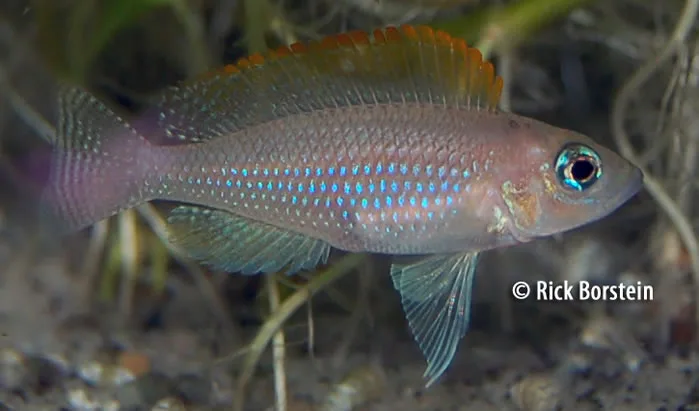
Taxonomy & naming
The species was described by the Belgian ichthyologist Max Poll in 1978 as Lamprologus caudopunctatus, from material collected at Cape Kabeyeye, east of Kasaba on the southern Zambian shore of Lake Tanganyika; that holotype sits in the collections of the Royal Museum for Central Africa in Tervuren. Maréchal and Poll later transferred it to the genus Neolamprologus in the 1991 CLOFFA checklist, and Eschmeyer's Catalog of Fishes lists Neolamprologus caudopunctatus (Poll, 1978) as the current valid name.
The genus assignment is not entirely settled. Ad Konings, whose field guides are widely used by hobbyists, keeps the fish in an informal 'Lamprologus' rather than Neolamprologus, reflecting the long-recognized fact that the Tanganyikan lamprologine cichlids do not sort neatly into the genera erected for them. For everyday purposes the binomial in the literature and the trade is Neolamprologus caudopunctatus. The species epithet is transparent: from the Latin cauda (tail) and punctatus (spotted), for the pale spots scattered across the caudal fin. Hobbyists usually just call it the "caudopunct" or, less precisely, the "red-fin" or "pearl-tail" lamprologus. It belongs to the lamprologine tribe, the substrate-spawning lineage that dominates the rocky and sandy littoral of Tanganyika and includes the familiar shell-dwellers and the brichardi group.
The species' status as distinct from its close relative Neolamprologus leloupi took a field trip to settle. In the first volume of the Cichlids Yearbook, Konings had followed Pierre Brichard's survey of the Zaïrean (Congolese) coast in treating caudopunctatus as a synonym of the similarly built, yellow-dorsalled leloupi. A September 1991 dive with Martin Geerts near the village of Kapampa, on the southern Congolese shore, overturned that: the two were found living side by side in the same intermediate habitat, confirming them as separate, co-occurring species rather than one. Konings mapped a boundary either side of that contact zone — leloupi ranging north from Kapampa to Cape Tembwe, caudopunctatus found south of it and along the entire Zambian shoreline — and noted that Kapampa was, in his experience at the time, the only locality where caudopunctatus showed a bright yellow dorsal fin like leloupi's, speculating that the shared colour there might be exactly what keeps the two from hybridizing where they meet. Whether that bright yellow dorsal is a Kapampa-specific trait or simply his most vivid example of a marking recorded more broadly for the species by later hobby sources isn't resolved by this account, so it is flagged here rather than folded into a blanket claim about the species' colour.
Morphology
This is a small, torpedo-shaped fish. FishBase gives a maximum of about 2.6 in total length, and the Cichlid Room Companion describes wild fish at roughly 2–2.4 in; aquarist accounts put males near 3 in (about 3 in) and females a touch smaller at around 2.5 in (2.5 in), so something in the 2–3 in (2–3 in) range covers the realistic span.
The body is cream to pale pinkish-grey, overlaid with rows of tiny iridescent pearl spots that are most concentrated on the tail and catch the light when the fish turns. The dorsal fin carries a warm yellow-to-orange margin, brightest in mature males, and the pelvic fins flash white at the tips; a thin blue ring around the eye finishes the look. Sexual dimorphism is genuinely subtle, which is the single most common frustration for keepers trying to pick a pair: males run slightly larger with marginally longer pelvic fins and a more saturated dorsal, while females are a little rounder, but a row of similarly sized juveniles can be nearly impossible to sex by eye. The fish also has a striking "fright" or display pattern in which it drops its pastel base color and throws on bold brown vertical bars, seen when a fish is stressed, defending a territory, or facing off head-down with a rival. It resembles the similarly small Neolamprologus leloupi, from which it is separated by its narrower body and brighter, more contrasting coloration.
Habitat
Neolamprologus caudopunctatus is endemic to Lake Tanganyika and confined to the southern half of the lake; it has not been recorded from the northern basin. Sources disagree on how to draw the range. FishBase describes it as endemic to the Zambian shore, while the 2025 IUCN assessment lists it from the Zambian, Tanzanian, and Democratic Republic of Congo coasts of the southern lake. Several recognized geographic color forms are traded under place names such as "Kapampa" (a Congolese locality), which is consistent with the broader, three-country reading; the conservative summary is that it is a southern-lake fish well documented on the Zambian side and present along adjacent DRC and Tanzanian shores.
It lives in the shallow-to-mid littoral over a characteristic intermediate biotope: sand and fine sediment strewn with rocks and rubble, rather than pure rock reef or open sand. Depth figures vary with the source. The Cichlid Room Companion cites 3–82 ft, the IUCN assessment 16–131 ft, and aquarist field notes describe shoals from roughly 7–49 ft (about 6 to 50+ ft), while Konings' own diving records the species down to about 82 ft — consistent with the shallower end of that spread; collectively the fish occupies the well-lit upper littoral down into deeper rubble. Konings' surveys also sharpen the range boundary within the southern lake: he places Neolamprologus leloupi north of the Congolese village of Kapampa up to Cape Tembwe, and caudopunctatus south of Kapampa across the entire Zambian shoreline, with the two overlapping only at Kapampa itself. The water it lives in is hard and alkaline, as everywhere in Tanganyika: pH on the order of 7.5–8.8, high carbonate hardness, and surface temperatures generally in the mid-70s to mid-80s F (about 75–84 °F), with the fish's own preferred band nearer 73–77 F (73–77 °F).
Feeding
Functionally this is a zooplanktivore of the near-bottom water column. During the day, loose shoals hover a meter or more above the substrate and pick small crustaceans and other zooplankton from open water, dropping back toward cover when threatened. FishBase assigns it a trophic level of about 3.4, the value expected of a small invertebrate feeder rather than a strict herbivore or a piscivore. In aquaria it takes this further and accepts most small foods readily, which matches the wild picture of an opportunistic micro-predator rather than a specialist.
Its ecological role is that of one more entry in Tanganyika's dense guild of small lamprologines partitioning the sand-and-rubble margin. Where dedicated shell-dwellers like Neolamprologus multifasciatus and Lamprologus species tie themselves to empty Neothauma snail shells, Neolamprologus caudopunctatus works the open water just above the bottom and excavates its own nest sites under rocks, so the two strategies coexist without competing head-on for the same refuge. As a small, abundant, mid-littoral fish it is both a consumer of zooplankton and, in turn, prey for the larger predatory cichlids and other fishes that hunt the rocky margin.
Mating
Neolamprologus caudopunctatus is moderately social rather than solitary. In the lake, pairs hold small territories within a larger aggregation, so many pairs nest in close proximity to form breeding colonies. One well-documented wrinkle is that the colony includes a protective, warning group of sexually inactive individuals around the breeding fish, an arrangement reminiscent of the cooperative "helper" systems described in related lamprologines. The brown-barred fright pattern features heavily in male-to-male boundary disputes, and males defend territory perimeters with head-down posturing and color-flaring against rivals while the pair bond itself remains comparatively stable within a functioning colony.
Breeding
Neolamprologus caudopunctatus is a substrate-spawning cave brooder, not a mouthbrooder. Because its sandy-rubble biotope often lacks the empty Neothauma shells that the true shell-dwellers depend on, wild fish typically excavate a pit and spawn on the ceiling or wall of a cavity dug under a rock. In captivity the fish freely substitutes a shell, a broken flowerpot, or a length of pipe for the natural rock cave, and spawns readily once a pair forms. Eggs are laid inside the chosen cavity and guarded by both parents, with the female usually the closer attendant; reported clutches range from just a handful to a hundred or more, and the small fry become free-swimming within roughly a week.
Aquarist accounts emphasize two consistent points: the fry are notably tiny and slim compared with other Tanganyikan shell-dweller young, so they need fine first foods and are easily lost to filters or tankmates, and the female can turn sharply aggressive while guarding, banishing the male to the territory's edge even though both will still share the nest cavity when disturbed.
In the aquarium
Among dwarf Tanganyikans this is one of the easier fish to keep and breed, which accounts for its steady presence in the hobby. A single pair can be spawned in something as small as a 9–10 gallon tank, but a colony does better with more floor space; a 29- to 40-gallon footprint is a sensible target for a small group, since these fish prize bottom area over water volume. Provide a sand substrate they can dig in, plenty of rock to break sightlines and create caves, and a scattering of shells or flowerpots as spawning sites. The water should be hard and alkaline, broadly pH 7.8–8.8 with high carbonate hardness and a temperature around 75–79 F (75–79 °F); keepers in soft-water areas commonly buffer with crushed coral or aragonite, though the long-term boost from substrate alone is modest and steady mineral dosing during water changes is more reliable.
They are best described as feisty for their size rather than dangerous: peaceful enough for a Tanganyikan community of comparable dwarfs, but territorial around the nest, where they will harass shell-dwellers such as multifasciatus or even larger, bolder tankmates. Realistic compatibility means giving each pair enough room and cover that disputes stay ritualized. The mistakes that recur on the forums are predictable: trying to sex look-alike juveniles by eye (better to grow out a group and let a pair form), losing the very small fry to filter intakes (a sponge pre-filter solves it), and assuming "shell-dweller" means it wants only shells when in fact it is happiest with a rock cave to excavate under. Feeding is easy; small frozen and quality dry foods are taken eagerly, with live or frozen Cyclops and similar relished, especially as conditioning before spawning.
Conservation
The IUCN Red List assesses Neolamprologus caudopunctatus as Least Concern, most recently in February 2025 (assessor L. Haambiya, published 2025). The rationale is straightforward: it is widespread through the southern sector of Lake Tanganyika, considered very abundant, and faces no known major lake-wide threat. The assessment flags localized habitat sedimentation from soil erosion and agricultural runoff as the one identified pressure, notes the fish is only locally consumed where caught rather than commercially fished, and records an unknown population trend. There is no targeted collection concern for the species, and aquarium stock is widely captive-bred. In short, the species itself is secure even though the lake it lives in is not unstressed.
That lake-level context matters for a shallow, sediment-dwelling littoral fish like this one. Lake Tanganyika is warming, and the warming has biological teeth: O'Reilly and colleagues (2003, Nature, doi:10.1038/nature01833) showed that a more stable, less-mixed water column has cut deep-water nutrient upwelling, with sediment-core evidence suggesting primary productivity has fallen by roughly 20% over the twentieth century, implying on the order of a 30% drop in fish yields from a pelagic clupeid-and-Lates fishery that supplies a quarter to two-fifths of the animal protein for the four surrounding nations. Cohen and colleagues (2016, PNAS, doi:10.1073/pnas.1603237113) added paleoecological evidence that reduced mixing has shrunk the oxygenated benthic habitat by about 38% in their study areas, squeezing the very coastal zone where most of Tanganyika's endemic cichlids live. Layered on top of warming is the direct sedimentation the IUCN cites: deforestation and shoreline development load fine sediment onto the rocky and sandy littoral, degrading exactly the sand-and-rubble margin this fish nests in. Governance of these basin-scale problems is shared across Burundi, the DRC, Tanzania, and Zambia under the Lake Tanganyika Authority. None of this currently threatens Neolamprologus caudopunctatus with extinction, and it would be an overstatement to imply otherwise; but a small, locally distributed littoral endemic is precisely the kind of fish whose long-term fortunes are tied to whether the lake's nearshore habitat and productivity hold up.