Taxonomy & naming
Jacques Pellegrin described this fish as Lamprologus stappersi in 1927 (Revue de Zoologie et de Botanique Africaines 15(1): 53), from a holotype (MRAC 13885) taken at the Sambala River near Mpala on the Congolese shore. Heinz H. Büscher then described Lamprologus meleagris in 1991, in the German aquarium journal Die Aquarien- und Terrarien-Zeitschrift (DATZ 44(6)), alongside a second new shell-dweller, Lamprologus speciosus; his holotype (ZSM 27968) came from near the village of Bwassa, about 40 mi south of Moba. Büscher not only described the fish but also introduced it to the aquarium hobby himself. The epithet meleagris is the Latin word for guineafowl, a nod to the dense scattering of pale, pearly spots across a dark body.
The complication is that Büscher's fish already had a name. Ad Konings, in his Tanganyika cichlid works of 2015 and 2019, treated meleagris as conspecific with 'Lamprologus' stappersi — a species from the same stretch of muddy, river-mouth coastline that Büscher himself later re-recorded near Kalemie. Eschmeyer's Catalog of Fishes follows that synonymy: its current status for meleagris is "Synonym of Neolamprologus stappersi (Pellegrin 1927)", and stappersi, as the older name, is the valid one. This page follows the Catalog. FishBase still carries Lamprologus meleagris as a valid name, and the trade overwhelmingly sells the fish as meleagris (a few dealers already list it as Lamprologus stappersi), so all three names remain in use.
The genus is unsettled too. The shell-dwelling lamprologines of Tanganyika have been shuffled among Lamprologus, Neolamprologus, and 'Lamprologus' (quotation marks flagging the uncertainty) for decades; the Catalog currently places stappersi in Neolamprologus, while Konings writes it as 'Lamprologus'. A 2025 proposal by Konings to move stappersi into Altolamprologus has been met with open skepticism by experienced aquarists, who note it rests on non-peer-reviewed, explicitly "temporary" assignments awaiting genetic confirmation.
Morphology
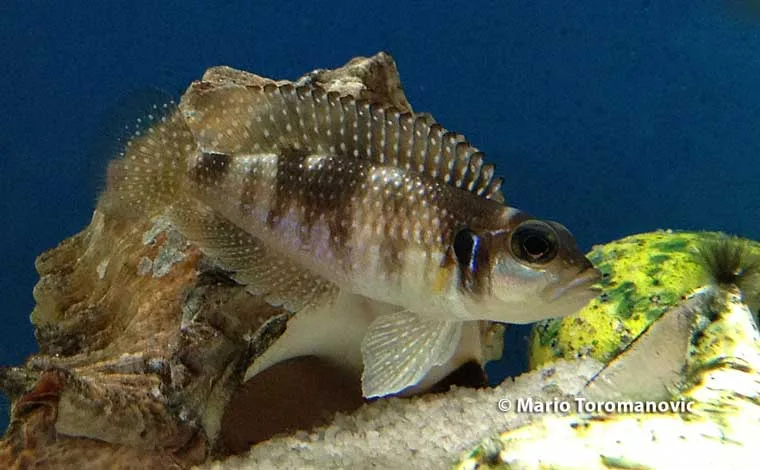
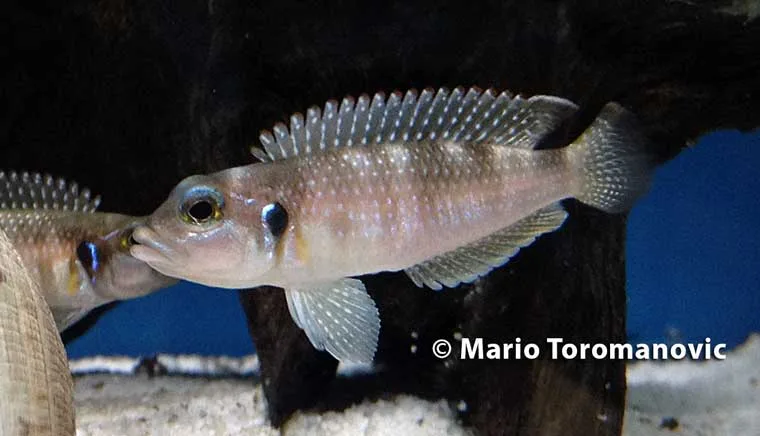
This is a compact cichlid. Wild-collected adults measure little more than 2 in (2 in) standard length; aquarium-raised males often add roughly another centimetre, and FishBase separately cites a maximum of about 2.75 in (3 in) total length. Adult females are noticeably smaller, full-grown at around 1.6 in (1.5 in) SL. The body is the elongate, shell-dweller shape — built to reverse into a snail shell tail-first — in muted grey to brownish, marked with darker brown or reddish-brown blotching along the flanks. Over that ground runs the scattering of small, iridescent pearly spots that names the fish; in good light the belly can show a purplish wash and there is often a touch of blue near the mouth and gill cover.
The sexes differ modestly. Males grow larger and, as keepers and Seriously Fish both note, carry a longer, less steeply sloped facial profile; females are smaller and more subdued in color. The fry are worth a mention because they don't look like the adults at all: newly free-swimming young are striped, only developing the speckled adult pattern as they grow. Visually the fish sits close to its relative Neolamprologus ocellatus — close enough that it was once thought to be a color morph of it, and close enough that it still moves through shops as "pearly ocellatus."
Habitat
Neolamprologus stappersi is endemic to Lake Tanganyika, and within that vast rift lake it has a tight distribution along the Democratic Republic of the Congo (western) shore. Pellegrin's stappersi holotype came from the Sambala River near Mpala, and Büscher's meleagris types from near the village of Bwassa, roughly 40 mi south of Moba; recorded occurrences run the Congolese coast between about Moliro/Moba in the south and Kalemie in the north. FishBase, working from a narrow set of records, notes it as known chiefly from the Bwassa area — a sign of how localized the verified collections are.
It is a fish of the soft littoral, not the rocky reef. It lives over open sand in the shallow coastal zone wherever the bottom is littered with empty snail shells — the spent shells of Neothauma and similar gastropods that accumulate in beds and give Tanganyika's shell-dwellers their entire way of life. Several accounts place it specifically near river mouths on muddy or sandy bottoms, part of why the stappersi/meleagris synonymy looks so convincing: both forms turn up in the same low-energy, river-influenced habitat. The surrounding lake water is hard and strongly alkaline, typically pH 7.5–9.0 with high carbonate hardness, and warm — around 75–82°F (75–82 °F).
Feeding
In the wild this is a benthic micro-predator. FishBase characterizes it as a "greedy eater" feeding mainly on insect larvae, and assigns it a trophic level of about 3.6 — squarely carnivorous rather than algae-grazing. Büscher singles out mosquito larvae specifically as the mainstay of the wild diet, abundant and reliable enough that mosquito larvae alone make a suitable captive diet even without other foods; Cyclops and brine shrimp are also readily taken if offered. Foraging happens close to the substrate, the fish picking small invertebrates from the sand and from among the shell debris it lives in, then retreating to the safety of a shell.
Its ecological role is that of the classic Tanganyikan shell-bed specialist: a small predator that converts the empty shells of dead snails into both shelter and nursery. The shell beds these fish depend on are themselves a product of the lake's biology — generations of gastropods living and dying over sandy flats — so the species is woven into a habitat that exists only because of the lake's particular limnology. Because it is small, abundant where it occurs, and reproduces quickly, FishBase rates its resilience as high and its intrinsic fishing vulnerability as low; it is prey and forager, not a fishery target.
Mating
Neolamprologus stappersi is a substrate-spawning shell brooder with a polygamous, harem-style mating system — closer in temperament to the pugnacious Neolamprologus ocellatus than to the colony-forming, pair-bonding Neolamprologus multifasciatus. A dominant male holds a territory containing several shells and the females that occupy them. Females initiate spawning by cleaning and then partly burying a chosen shell, leaving only a narrow opening, and displaying at its mouth to attract the male.
Breeding
Fertilization is a neat piece of plumbing dictated by size. The female deposits her eggs deep inside the shell; the male, often too large to follow her in, releases sperm at the entrance as she backs out, the current she generates drawing it inward — though where the shell is large enough he may enter directly. The female then guards the shell closely for roughly ten to twelve days while the male patrols the wider territory. Free-swimming fry appear around the shell mouth after about a week to ten days and dart back inside at any disturbance; both parents tend them. Even so, fry losses can be substantial in a community setting: Büscher documented other shell-dwellers such as Julidochromis, and non-breeding N. stappersi themselves, preying on the fry, and whether the brooding parents ever join in this cannibalism was never established — nor was it ruled out. Fry that do survive take newly hatched brine shrimp readily and grow quickly, though tank size, population density, and water and food quality all shape how well a batch comes through. In keeping, aggression scales with crowding: keepers consistently report that giving each fish a choice of several shells, with open sand and a few rocks to break up sightlines, dramatically reduces the squabbling. Reports of casualties are common enough that the species earns a reputation as "feisty," but its bite, as one supplier put it, can largely be laughed off.
In the aquarium
For its size this is a manageable but not beginner-proof fish. A single pair can be housed in something as small as 18 x 12 x 12 in (about 10 US gal), but a colony needs more floor space, and footprint matters far more than volume — these are bottom-dwellers that contest territory across the sand, not up the water column. The essentials are a deep bed of fine sand (they dig enthusiastically) and more empty snail shells than there are fish; escargot shells from a delicatessen work well as substitutes for wild Neothauma.
Water should match the lake: hard and alkaline, pH roughly 7.5–9.0, temperature 73–81°F (73–81 °F), kept clean with regular water changes. Diet should lean on live and frozen foods — brine shrimp, small frozen invertebrates — as the fish sometimes refuse dry foods. For tankmates, exploit the vertical separation: pair them with rock-dwellers such as Julidochromis or the brichardi group, or open-water Cyprichromis, and adults generally ignore one another — though that truce doesn't extend to fry. Büscher recorded Julidochromis, along with non-breeding N. stappersi, preying on free-swimming young even in a community tank arranged this way, so keepers hoping to raise a brood in numbers should expect losses unless the shell is isolated or the fry are moved to a separate rearing tank. The mistakes keepers make most are too few shells, too little sand, and skewed sex ratios; because subordinate males get harried, the standard advice is to start with a young group, aim for more females than males, and be ready to remove surplus males. Handled that way, a stappersi colony is one of the more rewarding small-tank Tanganyikan projects.
Conservation
Neolamprologus stappersi (under either stappersi or its junior synonym meleagris) has not been formally evaluated by the IUCN Red List — its status is Not Evaluated, as is its CITES listing — so there is no species-specific threat category to report. It is not a fishery species, it is bred readily in captivity, and the aquarium-trade fish are largely tank-raised rather than wild-collected, which limits direct collection pressure. Its narrow, localized distribution along the Congolese shore is the main reason for caution: a species known from a short stretch of coastline is inherently more exposed to local habitat change than a lake-wide one.
That localized fish lives inside a lake under measurable strain. O'Reilly et al. (2003, Nature, doi:10.1038/nature01833) showed that climate warming has reduced vertical mixing in Lake Tanganyika, cutting primary productivity by an estimated ~20% and, by their reckoning, lowering potential fish yields by up to ~30%. Cohen et al. (2016, PNAS, doi:10.1073/pnas.1603237113) found that warming has shrunk the oxygenated benthic habitat available to lake animals by roughly 38% over the past century. On the shoreline itself, sedimentation from deforestation and land use degrades the littoral (Cohen et al. 1993), and the lake's commercial pelagic fishery — the clupeids Stolothrissa and Limnothrissa together with the Lates predators — feeds the four bordering nations whose shared management runs through the Lake Tanganyika Authority.
For a shallow, sand-and-shell species like this one, the relevant pressures are the local ones: sedimentation that smothers the sandy flats and buries the snail-shell beds it breeds in, and any decline in the gastropod populations that produce those shells. The basin-scale, warming-driven productivity losses bear more directly on open-water and deepwater fishes than on a littoral micro-predator. The honest summary is narrow but real: the species itself carries no Red List flag, yet it depends on a specific shoreline habitat within a lake whose ecology is demonstrably changing.