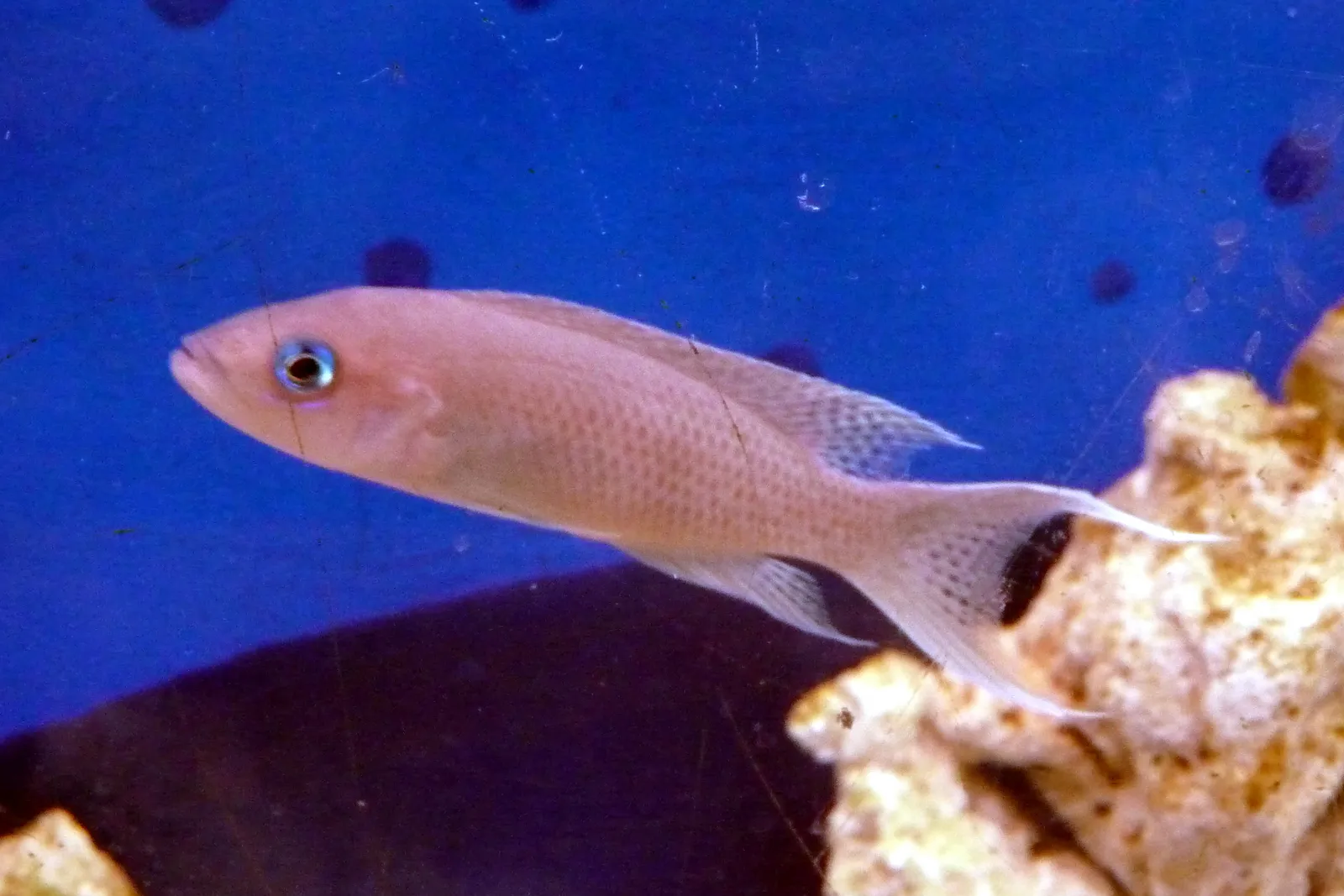
Taxonomy & naming
Pierre Brichard described this fish in 1989 as Lamprologus gracilis in his sprawling popular volume on the fishes of Lake Tanganyika, designating a holotype (MRAC 84-23-P-15) and eight paratypes collected at Cape Kapampa on the lake's Congolese shore. Maréchal and Poll moved it to the genus Neolamprologus in their 1991 CLOFFA checklist, and Eschmeyer's Catalog of Fishes lists it today as a valid species, Neolamprologus gracilis (Brichard 1989). The species epithet is simply the Latin for "slender," an apt label for a fish whose body is noticeably more attenuated than most of its kin; the genus name is assembled from the Greek neos (new) prefixed to Lamprologus, itself built from lampros (bright) and logos (word, discourse).
Neolamprologus gracilis sits inside the Neolamprologus brichardi species complex, the cluster of "fairy" or "princess" cichlids of the Lamprologini tribe. Within that complex it is closely tied to Neolamprologus palmeri: Konings, examining a population traded as 'White Tail' or 'Palmeri' from Kibwesa on the Tanzanian shore (fide Dieckhoff), concluded it is 'without doubt' a geographical race of gracilis rather than a distinct species, and treats palmeri as a regional variant on that basis. Both lack the dark blotch behind the eye on the gill cover that marks brichardi-type fish, instead wearing a thin bluish-white crescent under each eye. As with much of the lake's lamprologine flock, the boundaries here are soft and partly geographic, and the literature reflects that ongoing debate rather than a settled answer.
Morphology
This is a small cichlid. FishBase gives a maximum of about 3.5 in (3.5 in) total length, and keepers consistently note that gracilis stays smaller than the brichardi and pulcher "fairy" cichlids it resembles. Much of that length is fin rather than body: the dorsal and anal fins draw out to points, and the caudal fin extends into a graceful lyretail whose trailers, in well-grown fish, can run roughly as long as the standard body itself.
The overall impression is pale and silvery rather than gaudy, lit by white edging along the unpaired fins and a striking light-blue eye split by a fine white line. The narrow bluish-white mark beneath the eye, and the absence of the dark opercular spot found on brichardi, are the field marks that separate gracilis (and its near-twin palmeri) from the rest of the complex. The body itself is measurably slender: Konings gives a body depth of about 25 to 28% of standard length in gracilis, distinctly shallower than the 30 to 35% recorded in the deeper-bodied Neolamprologus crassus — a numerical match for the 'slender' meaning of its species name. Sexual dimorphism is subtle; males tend to grow a little larger and carry longer fin extensions, but pairs are easier to recognize by behavior at a spawning site than by color alone. Hobbyist and museum images circulate under several location names, including 'Kapampa', 'Kanoni', and 'Tembe', reflecting modest geographic variation across its range.
Habitat
Neolamprologus gracilis is endemic to Lake Tanganyika, the great rift-valley lake shared by Tanzania, the Democratic Republic of the Congo, Zambia, and Burundi. The Catalog of Fishes ties it to the Congo (DRC) shore, with the type series from Cape Kapampa, where Konings recorded it living sympatrically with N. brichardi and a local geographical race of N. crassus (described as N. marunguensis); further south at Zongwe, also on the Congolese shore, he found it alongside N. savoryi and N. splendens. Konings additionally records a geographical race of the species — traded as 'White Tail' or 'Palmeri' — from Kibwesa on the Tanzanian shore, and notes that gracilis, along with N. brichardi and N. pulcher, is one of only a handful of brichardi-complex species with a discontinuous distribution spanning both the western and eastern coasts of the lake rather than being confined to one side. Aquarium-trade collections carry it under several further locality names along the central and southwestern coasts.
Like the rest of the brichardi complex, gracilis is a fish of the rocky littoral. Members of the complex occupy essentially every rocky habitat in the lake, typically from about 15 to 75 ft (roughly 16–75 ft) down, hugging the broken stone, ledges, and crevices that give shelter from open-water predators. In situ, this is hard, alkaline, well-oxygenated water: FishBase summarizes the species' tolerances as pH 7.5 to 9.0, hardness around 10 to 25 dH, and temperatures of 24 to 28 degrees C (75 to 82 degrees F), figures that match the lake's famously stable, mineral-rich chemistry.
Feeding
Gracilis is a micropredator of the rock zone, taking small invertebrates and zooplankton rather than rasping algae or crushing snails. FishBase places it around trophic level 3.5, consistent with the rest of the fairy-cichlid complex, which feeds heavily on plankton drifting past the rocks together with small benthic invertebrates picked from the substrate. Observers of captive fish describe exactly this flexibility: the cichlids dart out to snatch food suspended in the water column with quick mid-water jabs, and when nothing is drifting past, they turn to picking at the sand and the surfaces of the rocks.
In the lake's economy the fairy cichlids are abundant small links in the rocky-shore food web, both consumers of the plankton the lake produces and prey for the larger lamprologines, catfishes, and other predators that share the reef. Their dense, multi-generation colonies are part of what lets them hold rocky ground against that predation pressure.
Mating
Socially, gracilis is territorial but, by the standards of the family, restrained. Within a tank a colony often splits into a dominant trio or pair holding the prime rockwork and "exiles" pushed to the margins, with a fairly stable demilitarized buffer between them; trespassers are met with flared fins and gills and quick, decisive chases, but lethal aggression is the exception rather than the rule. Multiple keepers independently rate it as less aggressive than Neolamprologus brichardi or Neolamprologus pulcher, which is part of its appeal.
Pair bonds form within the colony hierarchy. The dominant pair or trio secures the best crevices and defends a territory against rivals, while subdominant fish — often their own grown offspring — occupy adjacent ground in an arrangement that looks hierarchical rather than strictly monogamous. Courtship itself is understated: lateral displays, fin-spreading, and close shadowing of the female near the chosen spawning crevice signal readiness, and spawning follows when territory conditions are stable.
Breeding
Neolamprologus gracilis is a substrate spawner that breeds in caves and crevices, and it follows the cooperative, colonial pattern that makes the brichardi complex so distinctive. Eggs are laid in cracks among the rocks; the pair guards the site, and older juveniles from previous spawns stay on as helpers, defending the territory and shielding their younger siblings while the adults concentrate on guarding ground and producing the next brood. Keepers describe quarter-inch fry darting out to challenge intruders many times their size, with the parents sometimes nowhere in sight, an unusually developed example of the "helper at the nest" system documented across this group.
In the aquarium
For an experienced Tanganyika keeper, gracilis is a rewarding and forgiving subject; the main obstacle is finding it, since it is genuinely scarce in the trade and tends to pass between breeders rather than sit on shop shelves. Because it stays small and is comparatively peaceful, it does not demand the footprint many rift cichlids do: keepers have spawned colonies in tanks as modest as a 20-gallon long aquascaped with piles of rock, caves, or shells over sand, though a longer tank gives a colony room to establish the territory split it naturally forms. Match the lake's water: hard, alkaline (pH around 8 to 9), and warm, 75 to 82 degrees F (24 to 28 degrees C).
A few honest cautions. These are accomplished jumpers, more so than many tankmates, so a tight-fitting lid is not optional. In a community, fry survival is the real test: gracilis is secretive and breeds in hidden crevices, and small or nocturnal tankmates, from loaches to other lamprologines, will quietly thin the fry until a keeper wonders why a constantly spawning colony never grows. And while it is mild for a cichlid, it is still a cichlid, defending its cave with conviction; pairing it with delicate or similarly elongate fish that compete for the same rock is asking for trouble. Suitable companions are other small, sand- or shell-oriented Tanganyikans that keep to their own zone.
Conservation
The IUCN Red List assesses Neolamprologus gracilis as Least Concern, in an evaluation dated 28 February 2025 (reflected in FishBase's 2025-2 version); the species carries no CITES listing and is not heavily targeted by the food fishery. Its main direct human contact is the ornamental trade, and even there it is a niche, low-volume fish rather than a collection target under real pressure. On the species' own ledger, in other words, there is little cause for alarm.
That status sits inside a lake under genuine strain, however, and gracilis is a rocky-shore specialist exposed to those basin-wide changes. O'Reilly and colleagues (2003, Nature, doi:10.1038/nature01833) showed that warming has strengthened the lake's stratification and shoaled its mixing zone, with sediment records implying primary productivity has fallen by roughly 20 percent and fish yields by about 30 percent. Cohen and colleagues (2016, PNAS, doi:10.1073/pnas.1603237113) found that warming-driven loss of oxygenated bottom water has erased on the order of 38 percent of the lake's habitable benthic habitat over recent decades. Closer to this fish, shoreline deforestation and sedimentation degrade exactly the clean rocky substrate the brichardi complex depends on (Cohen et al. 1993), smothering crevices and the invertebrate and plankton supply it feeds on. The lake's huge pelagic fishery for the clupeids Stolothrissa and Limnothrissa and the predatory Lates feeds four nations and is managed across borders through the Lake Tanganyika Authority, but that effort is aimed at the open-water fishery, not the rocky littoral. So the honest summary is the careful one: gracilis itself is currently secure, yet it lives on habitat whose long-term trajectory, warming, deoxygenation, and sediment, is the same one straining the lake as a whole.