Taxonomy & naming
The lemon cichlid was described by the Belgian ichthyologist Max Poll in 1956, working from material collected during the 1946–1947 Belgian hydrobiological survey of Lake Tanganyika. Poll placed it in the catch-all genus Lamprologus; it was later transferred to Neolamprologus, the large genus that now holds most of the lake's rock-dwelling lamprologine cichlids. The species name honors Narcisse Leleup, the entomologist who collected widely in the Belgian Congo for the Tervuren museum.
A darker form from the same northwestern Zaïrean coast near Bemba was named as a subspecies, Lamprologus leleupi melas, by Matthes in 1959; underwater observation later showed the same dusky morph living alongside ordinary yellow leleupi on the eastern shore near Magambo as well. Examining fresh specimens of the dark morph, Poll found in his 1986 revision of the Tanganyika cichlids that its yellow pigment is not simply reduced but is being obscured by an overlying layer of black pigment — the ordinary yellow fish, in other words, is the same animal minus that black overlay. Poll used that 1986 revision to sink melas as a synonym of Neolamprologus leleupi leleupi.
The knottier taxonomic question is the relationship with Neolamprologus longior. Wolfgang Staeck described it in 1980, from the eastern (Tanzanian) shore, as a slimmer, more elongate subspecies, Lamprologus leleupi longior; it was Poll's 1986 revision that raised it to full species status. Here the authorities genuinely disagree, and it is worth being honest about it. The Catalog of Fishes currently lists longior as a valid, separate species, matching Poll's 1986 call. Ad Konings, the field worker who has done the most diving on these populations, instead treats longior as a valid subspecies within leleupi. Either way the practical point for aquarists is the same: body shape is the key — Neolamprologus longior is the more streamlined fish, Neolamprologus leleupi is shorter and deeper-bodied, sometimes developing a slight cranial hump with age — and a great many fish sold as 'leleupi' over the decades have actually been longior or leleupi-longior crosses, a legacy of periods when longior was exported under the leleupi name.
In the hobby it is universally the 'lemon cichlid' or 'lemon yellow cichlid,' and older labels still call it Lamprologus leleupi. It belongs to the Lamprologini, the tribe of substrate-spawning cichlids that, unlike the mouthbrooders of Lakes Malawi and Victoria, lay and guard their eggs on a surface — a defining trait of Tanganyika's endemic species flock.
Morphology
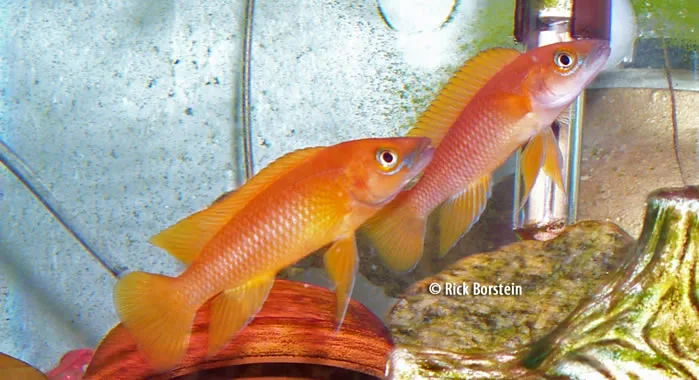
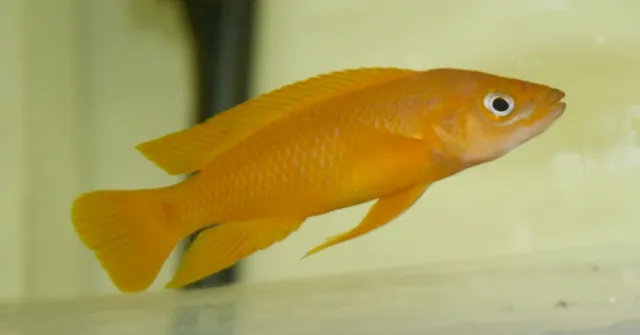
This is a modestly sized cichlid with an outsized reputation for color. Maximum length runs to roughly 4.3 inches (4.5 in) total length in the wild — Konings' own tabulation of the leleupi group gives 4.5 in as the ceiling — with aquarium fish occasionally pushing 4.5 inches (4.5 in). Males run larger than females; hobbyist breeders consistently report males reaching roughly 4 inches while females top out nearer 2.5–3 inches, and that size gap is in practice the only reliable way to sex them. The body is elongate and torpedo-shaped, built for slipping into rock crevices, and the mouth is surprisingly large for the fish, lined with small but distinct conical teeth suited to grabbing invertebrate prey.
The famous color is genuinely variable. The classic form is a clean, uniform lemon yellow, but the species is polychromatic: wild and aquarium populations range through orange, grayish-tan, and very dark, near-black variants, and several geographic forms are recognized by location name (for example 'Bilila/Kavala Island' and 'Cape Caramba'). This kind of within-population color polymorphism shows up in a handful of other Tanganyika lamprologines and appears to be a trait more common among rare, deep-living rock cichlids; Poll's examination of dark leleupi found the black morph is not simply lacking yellow pigment but carries it normally, masked under an overlying layer of black. A 'blue-lip' form and orange strains circulate in the trade. The eye is dark, often ringed in blue, and many fish carry a dusky lip — show breeders prize a bright, even yellow with the least black on the mouth. Color is not fixed: keepers note it brightens over pale substrate and with carotenoid-rich food and dulls to a muddy tone over dark gravel, recovering over a month or two when the fish is moved. Sexual dichromatism is otherwise weak, so a confidently sexed pair usually comes down to watching behavior and size rather than markings.
Habitat
Neolamprologus leleupi is a Lake Tanganyika endemic — it occurs nowhere else on Earth. Within the lake it is a fish of the rocky littoral, living among boulders, rubble and the cavities between them, and it is closely tied to that rock cover for both feeding and shelter. Depth records run from roughly 16 ft down to about 131 ft, though most observations and most collecting fall in the shallower part of that band, on rocky slopes where light still reaches.
The exact geography is reported a little differently from source to source, which is worth flagging rather than smoothing over. FishBase summarizes the range as the southern half of the lake; the 2025 IUCN assessment emphasizes rocky zones along the Congolese (western) coast; and field-guide compilations following Konings describe it along the Congo coast from north of Moba up to the far north near Uvira. Konings' own photographic record complicates a clean west/east split further: he has documented nominal leleupi as far as Bulu Point on the Tanzanian shore and near M'toto on the Zaïrean coast, with the dark melas-type morph specifically recorded near Bemba and Magambo on the northwestern coast. The honest synthesis is that it is primarily a western-shore, rocky-coast specialist distributed over a substantial stretch of the lake, with occasional records further east, and with the longior form (however one ranks it) representing the main eastern, Tanzanian counterpart. Its habitat is described as rocky but sediment-rich — a detail that matters for conservation. Like all Tanganyikan cichlids it lives in hard, alkaline water: pH roughly 7.5–9, high carbonate hardness, and warm, stable temperatures around 75–80°F (75–81 °F). These are some of the most chemically stable freshwater conditions on the planet, and the fish is adapted to them rather than tolerant of swings.
Feeding
The lemon cichlid is a carnivore and a crevice hunter. In the wild it works the 'biocover' — the film of algae, detritus and the small animals living in it that coats Tanganyika's rocks — and the deep recesses of the substrate, picking out invertebrates: crustaceans such as copepods, aquatic insect larvae, and other zoobenthos, along with items like fish eggs when it finds them. FishBase places it at a trophic level of about 3.6, squarely among the secondary consumers, and the IUCN account notes it will also take small fish. Functionally it is a sit-and-search predator of the rocky reef rather than a grazer or a plankton-picker, and its body plan — slim, with a large mouth and a habit of hovering at cave mouths — fits that role.
In the broader community, leleupi is one of dozens of small lamprologine predators partitioning the same rocky habitat with congeners and with shell-dwellers, julies (Julidochromis) and the Altolamprologus 'compressed' cichlids. That packing of many similar species into the same reef, each exploiting a slightly different micro-niche, is the hallmark of Tanganyika's adaptive radiation, and the lemon cichlid is a textbook littoral piece of it.
Mating
Socially, the lemon cichlid is two fish at once: relatively tolerant of unrelated species but ferociously intolerant of its own kind. Keepers describe it as otherwise even-tempered yet capable of relentlessly harrying conspecifics, and that intraspecific aggression is the single most consistent theme across forum reports — males drive subordinate leleupi behind heaters and into rockwork, leaving torn fins and missing scales. It is a slow-moving, deliberate fish, which makes the bullying easy to underestimate until a weaker individual is being pinned.
Pair bonds are weak and often temporary — a single male will spawn with several females given the chance, and the pair commonly dissolves within a few weeks of the fry going free-swimming. In aquaria a large water change after a couple of weeks of stability is a commonly cited spawning trigger.
Breeding
Reproduction is substrate spawning in a cave, in the lamprologine manner, and there is broad agreement on how it goes. A female claims and prepares a cave, lures the male in, and lays a clutch — typically 50 to 100 eggs, sometimes more — on the cave wall, which the male then fertilizes. One frequently repeated, useful detail from breeders: the eggs are nearly pure white, so much so that newcomers have mistaken healthy clutches for fungused or infertile ones and discarded them; they hatch in about four days. The female stays in the cave tending eggs and wrigglers while the male patrols the territory outside. Parental care is otherwise good while it lasts, and multiple broods can sometimes coexist, though keepers warn that parents may turn on older fry once a new spawn is imminent. There is no fixed breeding season.
In the aquarium
The lemon cichlid first reached aquarists in 1958 (Riehl & Baensch, 1985), and its early years in the hobby were rough: because nearly everything shipped out of the Belgian Congo at that time came from soft, acidic jungle waters, dealers assumed leleupi needed the same and kept the pricey new imports in pure rainwater — which killed them within days, and the softer and more acid the water, the sooner they died. It remained a rare, difficult fish through the 1960s and was not bred in real numbers until the early 1970s; from that point it became, and remains, a widely available, inexpensive Tanganyikan, now almost entirely tank-raised. It is a good intermediate Tanganyikan: not a beginner's first fish, but very keepable for anyone who can hold hard, alkaline, stable water — the very lesson those early rainwater-tank losses taught the hobby the hard way. A single pair can be housed in a tank on the order of 30 gallons / 25 US gal or more, heavily aquascaped with piled rock and caves; a group needs considerably more room and a plan for the aggression, since crowding several leleupi together without enough broken sight-lines ends badly.
The honest care notes are these. First, intraspecific aggression is the limiting factor — the classic approach is to buy six or so juveniles, grow them out, let a pair form, and rehome the surplus, because adults often will not tolerate extra conspecifics. Second, choose tankmates that can hold their own without being targets: experienced keepers pair leleupi with open-water Cyprichromis or Paracyprichromis, with Altolamprologus, or with robust julies, and warn specifically that small shell-dwellers like Neolamprologus ocellatus are at risk once leleupi start breeding. Third, ignore the persistent care-sheet myth that Tanganyikans resent water changes: they dislike rapid swings in temperature and chemistry, not clean water, and seasoned breeders run large, regular changes with replacement water matched in temperature and parameters. Diet is easy — they take quality flake and pellet readily (the big mouth swallows surprisingly large pellets), with frozen or live foods such as brine shrimp, mysis and bloodworms to condition and to deepen color. For the brightest yellow, keepers raise and hold the fish over pale substrate and feed color-enhancing foods; over dark gravel even a good fish looks dull. Lifespans of several years, up to around eight, are reported in good conditions.
Conservation
Neolamprologus leleupi was assessed by the IUCN as Least Concern in February 2025 (the same category it held in 2006). It is widespread within its rocky-coast range, no major lake-wide threat to it has been identified, and the bulk of its supply is captive-bred rather than wild-collected. The assessors do flag two species-specific pressures and decline to overstate them: heavy collection for the ornamental trade is causing localized depletion near densely populated stretches of shoreline — it is a prized aquarium fish — and sedimentation and water pollution could affect it where they are intense. The population trend is listed as unknown, and the assessment explicitly notes the status could change with better monitoring. In short: the species itself is not currently in trouble, but it is not being watched closely either.
That individual reassurance sits inside a lake under real strain, and a rocky-shore fish like the lemon cichlid is exposed to exactly the pressures Tanganyika faces. Two lines of evidence frame the basin-scale picture. O'Reilly and colleagues (Nature, 2003) showed that a century of climate warming has increased the stability of the lake's water column and weakened the wind-driven mixing that lifts deep nutrients to the surface; their sediment-core isotope record implied primary productivity may have fallen by roughly 20%, with a correspondingly large hit to fish yields — and they argued this regional climate signal can outweigh local overfishing in driving the decline of the pelagic 'sardine' fishery that feeds millions around the lake. Cohen and colleagues (PNAS, 2016) extended the case to the bottom: warming-driven reductions in mixing have depressed algal production and shrunk the oxygenated benthic habitat in their study areas by about 38%, with declines in commercially important fishes and endemic molluscs tracking the warming. For a littoral cichlid the more immediate threat is physical: shoreline deforestation and agriculture wash sediment onto the very rocky habitat leleupi depends on, smothering the crevices and biocover it feeds and breeds in — and its own habitat is already described as 'sediment-rich.' Layered on top is the governance challenge of a lake shared by four countries (DR Congo, Tanzania, Zambia and Burundi), which complicates coordinated fisheries and catchment management. None of this currently endangers the lemon cichlid as a species; but the long-term health of the rocky littoral it lives in is tied to how the basin as a whole is managed.